


How Russell can make history again in F1 2023
George Russell's first season at Mercedes was a resounding success amid the context of the team’s struggles. But things could get spicy against Lewis Hamilton in 2023 if Brackley's latest car is good enough to place either driver on the F1 throne

George Russell joined an exclusive club last year when he became just the 12th driver to start a world championship Formula 1 race for Mercedes. Come the end of the season, he’d collected an even rarer accolade, by becoming only the third man in 16 years to beat Lewis Hamilton over the course of a campaign with the same machinery.
Jenson Button and Nico Rosberg are the other members. Both are world champions, and to emulate them remains Russell’s ultimate aim. With his Sao Paulo Grand Prix victory late last year, he’s taken a big step towards achieving that ambition. He now knows that he can win at the top level – and under severe pressure, given the late safety car restart that gave Hamilton the chance to mount an attack that never came, because his team-mate was in control up front.
The 2022 season was obviously not what Mercedes, or its drivers, had hoped it would be. The ill-conceived W13 came to be most closely associated with the porpoising problem that plagued each team to some extent. At the start of the year, Mercedes was clearly at the more extreme end, and knew its title ambitions were badly off course.
PLUS: How a "baked in" F1 flaw consigned Mercedes to a year of recovery
It was therefore a campaign where its drivers had to work closely together to help their team recover, which to a certain extent it did – Mercedes went from on average just over a second off the ultimate pace over the first races to typically 0.6s behind by the finale. It even ended up just 39 points off second-placed Ferrari in the constructors’ championship – not bad considering 2022 was basically a two-horse/cattle race between the prancing equine and Red Bull.
It had become clear during 2021, even as he raced so thrillingly and controversially with Max Verstappen, that Hamilton preferred Mercedes to keep Valtteri Bottas in the sister car. But once the combined developments of Russell’s promotion and the W13’s deficiencies being laid clear occurred, there was no sign of tension or fracture in the Mercedes camp. In fact, Hamilton spoke of last season being “a really powerful transformational time for us all”.

Hamilton and Russell have developed a good working relationship at Mercedes, working closely to aid its recovery
Photo by: Steve Etherington / Motorsport Images
But we’re now in 2023. The Christmas break is over for F1 fans (and, while the drivers can head for a lengthy holiday before an even lengthier training season, work barely stops back at the factory) and attention is firmly pointed towards the new campaign. Given the one just gone fizzled out as a contest very early thanks to Ferrari’s and Charles Leclerc’s combined misfortunes and errors, the hope is for a contest more along the lines of 2021’s epic. And given that Mercedes twice (in 2012 and 2014) made huge off-season gains to leap into contention for race wins, the hope is that it can do so again, and F1 will get the three-team title scrap it has not really enjoyed since 2010.
“When you look at the development we have brought and the rate at which we’ve closed the gap, there’s nothing telling us we can’t achieve this,” says Russell. “We’ve been pretty clear which targets we have to hit in terms of development. And I am pretty confident if we do achieve that, we will have a car that can compete with Red Bull.
“The fact that we ended 2022 in a position to fight for race victories shows a lot. So, I’ve got every bit of confidence in this team. Maybe straight out of the blocks [in 2022], we weren’t the fastest car because of where we were coming from. But with the rate of development, I’ve got every hope that we can definitely fight for the championship.”
PLUS: Why Mercedes believes it can make the step F1 needs to fight Red Bull
Red Bull versus Ferrari versus Mercedes. It’s the same three teams that have shared all but five race wins since 2012 but, as McLaren, Alpine, Aston Martin and co still need to make massive gains to get into contention, and with Audi’s entrance still three years away, such a fight has massive promise. And here the team-mate battles, relationships, dynamics get really interesting for those squads.
"The thing we have going for us is the fact that we are at very different stages of our career. It kind of feels like we are in this together, really" George Russell
At Red Bull, Verstappen has Sergio Perez easily covered, which suits the Dutchman entirely, even if he has risked alienating Perez with his refusal to comply with team orders in Brazil. Carlos Sainz goes into 2023 knowing he must match Leclerc from the off with a new machine if he’s ever going to be considered as more than a number 1.5 driver for Ferrari. Sainz took 79.9% of Leclerc’s points haul in 2022; Perez just 67.2% of Verstappen’s total. But, at Mercedes, Hamilton – the seven-time world champion, let’s not forget – ended up with 87.3% of Russell’s 275 points in their fourth and sixth finishing positions.
This is just one of the reasons why Mercedes must surely be considered to have the strongest overall driver line-up in F1, and another is Russell proving he’s a winner at the top level. Leclerc and Sainz run things very close, while Red Bull’s unbalanced pairing is an obvious weakness should it be involved in a narrower battle for future titles.
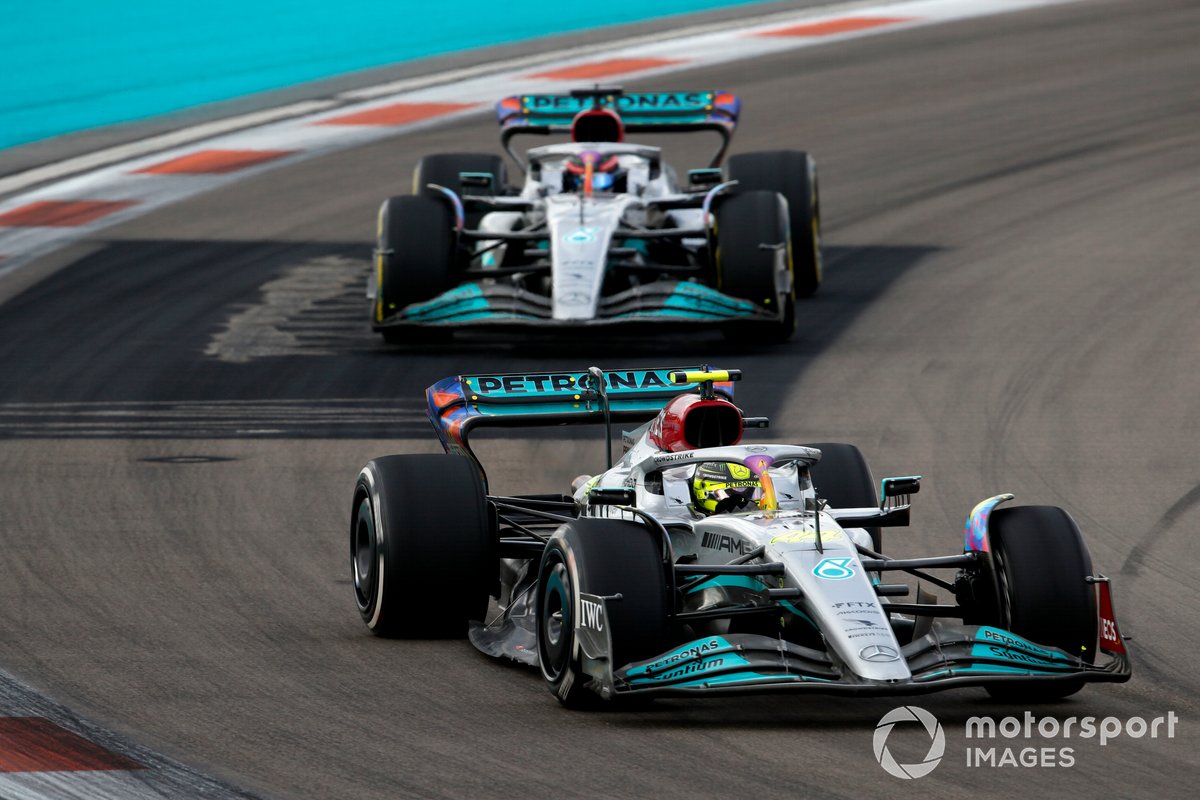
In Hamilton and Russell, Mercedes has arguably the strongest lineup in F1
Photo by: Zak Mauger / Motorsport Images
But, with that all established, it must be acknowledged that Mercedes was playing a different game in 2022. Its season was one of catch-up, the W13’s large-floor concept thought to be the ‘baked in’ weakness it needed this winter reset to address. Red Bull serenely ran to its first title double in nine seasons, while Ferrari’s challenge imploded.
But both squads had pressure on from the start. This meant team-orders flashpoints: Ferrari’s most visibly at Silverstone, but also evident in the Austria sprint race; Red Bull’s less of an issue overall in Austria and Spain, but with tensions apparently setting in behind the scenes following Perez’s Monaco qualifying crash.
A driver war was one problem Mercedes didn’t have to worry about in 2022. But, if it can indeed get back in the hunt this time around, the delicate issue that team boss Toto Wolff has been concerned about managing correctly since things broke down so badly between Hamilton and Rosberg in 2014-16 could return. After all, even the ever-placid Bottas was left unhappy with team orders calls at times.
Russell is well aware that such a situation could change his relationship with Hamilton. It’s worth recalling that his team-mate vowed to be better than ever in response to his 2021 title defeat and how his level dipped when resources – for both team and driver – had to be directed at fixing the W13. If Hamilton is armed with a potent W14 package and his fighting talk of February 2022 resurfaces, it’s unlikely that he would be left with the impression “I don’t really feel anything about it” should Russell again finish ahead in the championship.
“I mean, naturally if you are fighting for 1-2s there will be a slightly different dynamic and that’s only natural,” points out Russell. “But I think the thing we have going for us is the fact that we are at very different stages of our career. It kind of feels like we are in this together, really. If we’ve got a car that’s capable of 1-2 finishes, we will have a huge amount of pride in thinking we have contributed together in helping the team achieve this.
“Then we go about our business. But we’ve got no reason to have conflict. We’ve got a good relationship. We need to give each other respect. We recognise the importance of that within the whole team. If our relationship starts to break up, it’s going to have an impact on the team and, ultimately, it’s going to go full circle and affect us as well. I think we can continue to build off this and, if anything, our relationship will probably get closer as time goes on.”
Whatever happens in 2023, Russell has proved he has what it takes to succeed at one of F1’s best squads. After spending three years at Williams, his step up to Mercedes was such a success that Wolff mused that he had perhaps spent “maybe a year too long” learning his F1 trade at the lower end of the grid.
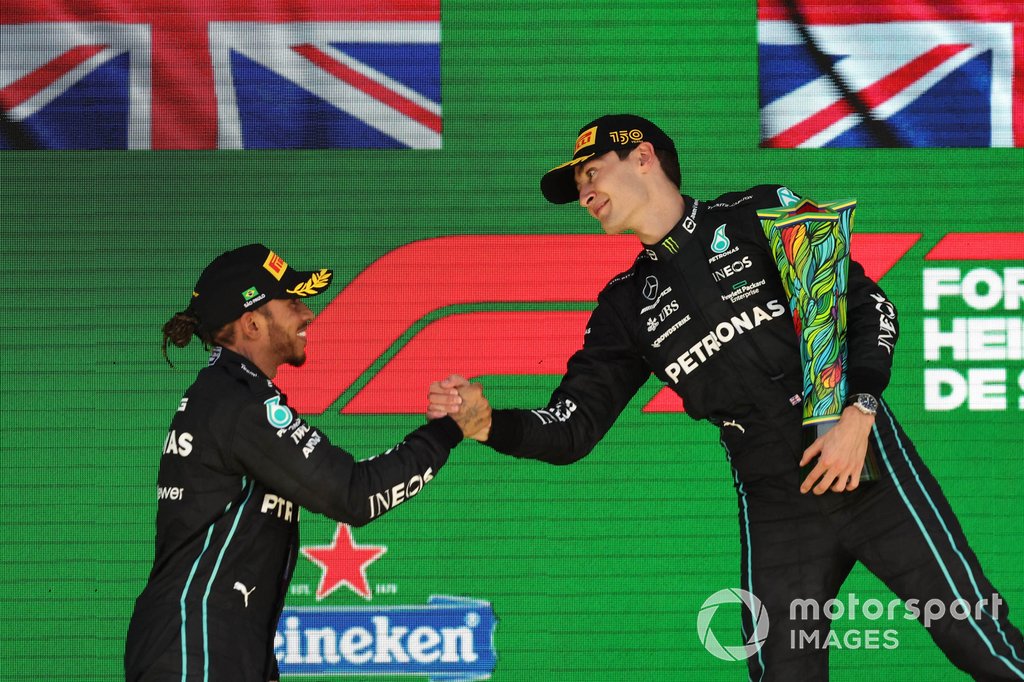
Russell sees no reason for hostilities to arise with Hamilton should Mercedes produce a car capable of fighting for 1-2s on a more regular basis
Photo by: Steve Etherington / Motorsport Images
Mercedes insiders also suggest that his Williams apprenticeship served Russell well when it came to dealing with the W13’s awful, unpredictable handling issues. Although these were much better come the end of the season, the car could still bite – as Russell found out in qualifying at Interlagos. But when the W13 was at its worst early in 2022, Mercedes has suggested that Russell was able to cope better than Hamilton because he was used to a challenging car that couldn’t compete for top results, racing in the pack rather than leading it. He simply adapted better to the early challenge.
Russell had arrived at Mercedes eager to deploy his technical knowhow and understanding from Williams, where his precise and direct feedback was appreciated. But, in fact, that challenge was made all the more difficult because, just as Russell was learning how to operate with the full might of a factory squad, Mercedes was forced to vastly and quickly upgrade its design tools.
It had to do this as part of its urgent work to address its porpoising problems, which eventually became a big floor and front-wing upgrade package at May’s Spanish GP, with Russell and Hamilton required to alternate each week on trying new parts or alterations. Famously, Hamilton’s early struggles to adapt to the W13 meant he was also trying extreme set-ups; just learning the process was hard enough for 24-year-old Russell.
PLUS: How a Honda F1 failure demonstrates massive Mercedes progress
“In some regards, I almost felt like a bit of a rookie because of the level at which this team works,” Russell explains. “We were talking about things that I’ve never even spoken about before in Formula 1. So, that took me some time to understand – what the team’s processes are during a race weekend, how I can make the car faster in terms of set-up – and that’s why I’ve felt a bit of a rookie at the start.”
"He’s got an awful lot of spare brain capacity to talk about what the car is doing while he’s driving it. He’s very detailed and very methodical in how he works" Andrew Shovlin
But his results didn’t reflect the feeling. A poor Q3 final flier after overdoing it on his out-lap meant starting ninth for the Bahrain season-opener, which meant he had to move through the pack before coming home adrift of Hamilton and missing the shock first Mercedes podium of 2022 (thanks to Red Bull’s late double retirement). But after finishing fifth and looking more solid than his illustrious team-mate next time out in Saudi Arabia, it was Russell who scored the surprise glittering result in Australia when Verstappen suffered his second fuel-pump problem in three races after Sainz spun out early.
Russell’s path to the podium in Melbourne was in large part eased by Hamilton stopping just before the second safety car, but he put himself in position to capitalise. It spoke of Russell’s character that he picked his shock Spa performance from 2021 as his preferred result of the two, given the circumstances of his first visit to the podium for Mercedes.

Russell's first Mercedes podium in Australia came after Hamilton was disadvantaged by the timing of the safety car
Photo by: Steve Etherington / Motorsport Images
Russell’s early form continued, and he ended up outside the top five just once in the first 16 races – that aberration was after his first-corner shunt with Pierre Gasly and Zhou Guanyu at Silverstone. There, Russell earned praise for climbing from his wrecked car to check on the Alfa Romeo driver, who was trapped between the barriers and catchfencing. Consistency became the buzzword of Russell’s season, but his intelligence and learning capacity in less high-profile areas impressed his team.
“He’s very much the sort of modern breed of Formula 1 drivers,” says Mercedes director of trackside engineering Andrew Shovlin. “He works hard, he’s completely dedicated to his own goals of what he wants to achieve in the sport.
“Whether it comes from the gaming that [young drivers] do, but he’s got an awful lot of spare brain capacity to talk about what the car is doing while he’s driving it. He’s very detailed and very methodical in how he works. And he also doesn’t get overly emotional about where the car is in any given weekend, he’s trying to do his job of just getting the best out of it.
“I think his apprenticeship at Williams in a way put him in good stead, because there he realised there’s only so much you can do as a driver if the car is not quick enough. And that was useful in the early part of the year because he was fairly matter of fact about it and got on with trying to work out how to deal with what was really a very tricky car.
“But he is very much part of the team. He’s settled in really well. Him and Lewis work well and he’s a good addition to the squad.”
The remarkable finishing streak, inevitably, couldn’t last. In Singapore, Russell collided with Bottas and Mick Schumacher, then made a lambasted “what the hell happened there?” radio call when clearly at fault for moving over on the Haas in the latter incident. It could be said he was often hot on the mic in battle – for example after his botched move on Perez in the French GP. He recovered with a pouncing pass at the late virtual safety car restart, and has vowed to be more “controlling” in 2023.
After a neat lap netted a surprise first career F1 pole in Hungary, pushing too hard in qualifying in Mexico cost a possible second – another element Russell has set himself to address in the coming campaign. As hard as it must seem for a racing driver, less can sometimes lead to much more. He reflects that overdoing it just a touch again, and leading to a critical misjudgement, was also behind his clash with Sainz at the first corner of the US GP.

Russell admits he felt like a rookie at times in 2022 - which led to pushing too hard on occasion, which resulted in Austin clash with Sainz
Photo by: Zak Mauger / Motorsport Images
“I’m trying to push these limits,” he explains. “And going back to that feeling of me almost being a rookie in some regards – you’re racing at the front for the first time. It’s a totally different story compared to when you’re racing at the back. How you approach Turn 1 is totally different when you have a few cars ahead of you, rather than the concertina effect of 15 cars in front of you.
“There’s a lot more dirty air when you’re behind 15 cars, compared to when you’re behind three cars. I spent three years racing at the back, I’ve only got 20 races under my belt racing at the front. You learn the little uniqueness of being there, the same way I learned what it was like being at the back.”
Early-race battling was something Russell struggled with when Williams eased out of its backmarker status in 2020, and even in 2021 his racecraft was sometimes questioned – such as his hurried pass on Bottas leading to their spectacular Imola shunt. But if he is to be chastised for the Singapore and Austin errors, it’s only right to praise his incredible driving in other wheel-to-wheel efforts.
In 2023, with a possible world title or not, Russell can seize a unique piece of F1 history for himself by becoming the only F1 team-mate to beat Hamilton twice
This centres on his fights with Verstappen, of all potential rivals, in Spain and Brazil. The first came early in the season, well before Mercedes had finally been able to make the W13 more of a contender with its next big floor and front-wing upgrade at Austin. But Russell fearlessly and ruthlessly kept the admittedly dodgy-DRS-hobbled RB18 at bay for five laps at Barcelona – his first time in a lead battle as a full-time Mercedes driver – and his efforts forced Red Bull into giving Verstappen an altered strategy to beat a slower car.
PLUS: The five best race drives of F1 2022
In Brazil, he attacked Verstappen three times before surging ahead on a superior tyre strategy in the sprint, and this established his path to a famous first GP victory with a commanding drive from the front the following day.
The interview that forms the basis for this piece was actually conducted three days before Russell became an F1 winner for the first time. Even with all he had achieved at that stage, it was clear that he is comfortable, established and thriving in the surroundings he longed to race in for five years as a Mercedes junior.
And with his Interlagos win(s), it’s intriguing to wonder how much stronger Russell will be in the coming seasons given he no longer has to chase that first success. After all, being so close in the challenging late wet conditions of the 2021 Russian GP contributed to Russell’s long-time rival Lando Norris pressing on in the rain when pitting would have been a better call, even if it meant losing the victory to Hamilton. Such urgency can sometimes be a problem…

Will Russell's first win give him new confidence for his second season at Mercedes?
Photo by: Steve Etherington / Motorsport Images
That, then, is how Russell enters 2023 – confidence brimming and the renewed expectation of a possible title challenge. He can still make gains, with Hamilton shading him on race pace in most of the events where Mercedes was a genuine victory threat (Brazil excepted).
But the differences between the pair were usually rather minimal, and Russell was actually 0.3s per lap quicker on average on the hard tyres they had been set to take to the finish at the Dutch GP, where they heaped pressure on Verstappen before circumstances took things away from Mercedes.
The circumstances of 2022 overall were, of course, a massive reason behind Russell joining the Button-Rosberg club. But any sportsperson can only play what comes before them. And in 2023, with a possible world title or not, Russell can seize a unique piece of F1 history for himself by becoming the only F1 team-mate to beat Hamilton twice. Now, wouldn’t that be something?

Should Russell beat Hamilton in 2023, he would be the first driver ever to do so twice
Photo by: Steve Etherington / Motorsport Images
Russell the F1 drivers’ advocate
Now that Sebastian Vettel has retired from racing in Formula 1, George Russell is now the only director of the Grand Prix Drivers’ Association still competing.
The Briton has been in his role, beneath chairman Alex Wurz and alongside fellow director Anastasia Fowle (the first non-driver director and the GPDA’s former legal advisor), since the start of the 2021 campaign. His direct approach to communication, as well as an appreciation for F1’s broad scope of issues and politics, are valued by his fellow competitors.
In 2022, driver safety was in the headlines during the wet race in Japan, as well as after the Silverstone start crash, while the racers were heavily involved in talks over continuing the Saudi Arabian GP after the missile attack. The FIA is organising a study that may lead to F1 cars being fitted with temporary wheel covers during extreme wet running following driver feedback.
"I don’t know where the line is drawn. If you keep making it heavier, heavier, heavier, stronger, stronger, stronger – actually you get to a point where you cross over that line" George Russell
These are now the heaviest racing beasts in F1’s history, which Russell acknowledges is a potential problem, even though much of the near-200kg weight increase over the past 20 years comes from developments regarding safety structures. Given his position with the GPDA, his words carry added importance.
“There’s a lot of positives to take from this regulation change, but, equally, the big one is the weight,” he says. “The weight is extraordinary. At the moment, the low-speed performance is not great. We keep making these cars safer and safer, but obviously the heavier you make them, when you have an impact it’s like crashing with a bus compared to a Smart car. You’re going to have a greater impact if you’re going the same speed with a car that weights 800-odd kilos or over 900 kilos at the start of a race, compared to 15 years ago when they were at 650.
“I’m sure there’s analysis going on about striking that right balance because I don’t know where the line is drawn. If you keep making it heavier, heavier, heavier, stronger, stronger, stronger – actually you get to a point where you cross over that line that too heavy is actually not safer.”

Actions such as checking on Zhou after his dramatic Silverstone crash helped GPDA director Russell to earn the respect of his contemporaries
Photo by: Mark Sutton / Motorsport Images


Why Britain’s role in Formula 1 endured a troubled start

Why Bottas believes his F1 reserve driver role is the fastest route back to a race seat

Why Norris is now ready for his final exam

The key advantage for Bottas vs Perez in the 2026 F1 return race

Why Ferrari's management is under pressure after its bad start to F1 2025, not Hamilton or Leclerc

Why Red Bull can’t solve its second F1 car problem with a simple paint job

Hirakawa replaces Doohan at Alpine for Japanese GP FP1 outing

How Alonso and Bortoleto can be F1 rivals in a unique driver management deal

Herta still aiming for F1 by 2028

Collard "absolutely devastated" after losing British GT title at 2026 finale

Vinales set for Tech3 KTM comeback at Japanese GP

How superb Sutton sealed the BTCC crown ‘his way’
Subscribe and access Autosport.com with your ad-blocker.
From Formula 1 to MotoGP we report straight from the paddock because we love our sport, just like you. In order to keep delivering our expert journalism, our website uses advertising. Still, we want to give you the opportunity to enjoy an ad-free and tracker-free website and to continue using your adblocker.


Top Comments