




Ranking the top 10 Formula 1 drivers of 2021
The 2021 Formula 1 season will be remembered for the titanic championship battle that was only decided on the very last lap, amid great controversy. In the final year of the outgoing regulations before a planned 2022 shakeup, Autosport ranks the 10 best performers across the 22-race campaign

The unforgettable 2021 Formula 1 season was packed full of drama right down to the final lap and beyond, as for the first time since 2018 Mercedes faced a sustained challenge from a rival team. Red Bull and Max Verstappen reached new heights to take on seven-time world champion Lewis Hamilton in a battle for the ages, but the year certainly wasn't short on subplots beyond the heavyweight duel for the crown.
With six drivers from four different teams - including two ending long droughts - gracing the top step of the podium and 13 taking away silverware, the final season of the high downforce regulations first introduced in 2017 was closely fought all the way down the field. That meant plenty of drivers had their chances to shine, making it a tough job to determine who would miss out in our annual top 10 ranking.
Here are Autosport's top 10 drivers of F1 2021.

Perez defended expertly from Hamilton in Turkey to earn a podium finish and aid Verstappen's title push
Photo by: Mark Sutton / Motorsport Images
10. Sergio Perez
Down 4
Perez is boosted into this position because of the way he took the fight in wheel-to-wheel battles against his team’s principal rival better than did Valtteri Bottas, which ultimately made a difference in Max Verstappen’s triumph against Lewis Hamilton. His aggressive, yet always fair, defending in the Turkey rain against the Mercedes was one example, as was his Abu Dhabi performance.
PLUS: How Perez's Hamilton defiance was vital to Verstappen's Abu Dhabi triumph
The problem is that Bottas was better on an individual level, with Perez unable to regularly get near Verstappen’s performances on pure pace. Only one front-row start in the season’s best package is a poor return, and there were Q2 eliminations in Bahrain and Qatar.
That said, there were enough occasions where he did what Red Bull needed him to – supporting Verstappen, or being a strategic problem for Mercedes (Baku, Paul Ricard). Perez also showed his typical prowess with tyre management to make big gains from lower starting spots, such as in Monaco, where he overcut three rivals – including Hamilton – to make a late charge towards the podium positions.
He learned that the only way to be fast in the RB16B was to go along with Verstappen’s set-up. After finding that changes made mid-season to make things more comfortable slowed him down even if they made the car easier to drive, he demonstrated that he can make progress with plenty of hours in the simulator. This resulted in his late-season run of three consecutive podiums.

Alonso made a battling return to F1, capped by a superb podium in Qatar - his first since 2014
Photo by: Alpine
9. Fernando Alonso
Re-entry
Formula 1 is a much better competition with Alonso in it. His inch-perfect driving in several battles was thrilling. George Russell went toe to toe with him in the Austrian Grand Prix and lost his shot at his first Williams points to Alonso’s tenacity, and the Spaniard was incisive to pass Pierre Gasly in the early corners in Qatar, which would be crucial to his first F1 podium finish for seven years.
But it was his scrap with Lewis Hamilton in the closing stages of the Hungarian GP that will live longest in the memory. Alonso used the narrow confines of the Hungaroring to keep the resurgent Mercedes back for 10 laps, and this proved critical in preventing Hamilton from jeopardising Alpine team-mate Esteban Ocon’s lead.
PLUS: The “heart-breaking” call that led to Ocon’s Hungarian GP triumph
There were errors, such as clattering Mick Schumacher in Turkey and spinning solo in Jeddah. But what impressed most in the first season of Alonso’s comeback was how he made gains over a single lap against a rapid team-mate. In the end he defeated Ocon 11-10 in qualifying and was a regular opening-lap star.
He also showcased his own knack of keeping tyres alive on many occasions, which might have got him onto the podium in Russia were it not for the rain arriving, and him staying out too long when it did. It definitely paid off in Qatar, where he made a difficult and risky one-stopper work to great effect ahead of Sergio Perez.

Bottas had his share of tough days in 2021, but there were strong weekends too, including at Monza where he topped qualifying and won the sprint
Photo by: Zak Mauger / Motorsport Images
8. Valtteri Bottas
Down 1
Bottas’s 2021 campaign summed up why he lost his Mercedes seat to George Russell for 2022, but also showed how close he came to saving it.
On the positive front, he topped three qualifying sessions (but is daftly credited with four poles thanks to F1’s rules regarding engine-change grid penalties and the sprint-race results), which demonstrates his enduring pace compared to Hamilton. And he managed well in tricky conditions for Mercedes in Monaco when it came to getting the softer tyres up to temperature where his illustrious team-mate could not.
He won brilliantly in Turkey – and obliterated the memory of his humiliation there nearly 11 months earlier – ahead of Verstappen, a wet-weather star. Overall, he was excellent at Monza and overcame the worst of Mercedes’ reliability woes with his typical controlled, understated class. And he ended up as the top sprint winner in 2021 with two victories.
Insight: 10 things we learned from F1's 2021 Turkish Grand Prix
But he couldn’t produce his best consistently, and when things were bad they were disastrous. In between getting outfoxed by Charles Leclerc on the first laps in Bahrain and Spain, he was so far from the front at a wet Imola, where he couldn't fire up his intermediate tyres, that he was lapped. Then came the crash with Russell. Baku was poor, with similar tyre warm-up struggles. Also, his inferiority on tyre management compared to Hamilton prevented him pulling off many of Mercedes’ strategy choices.
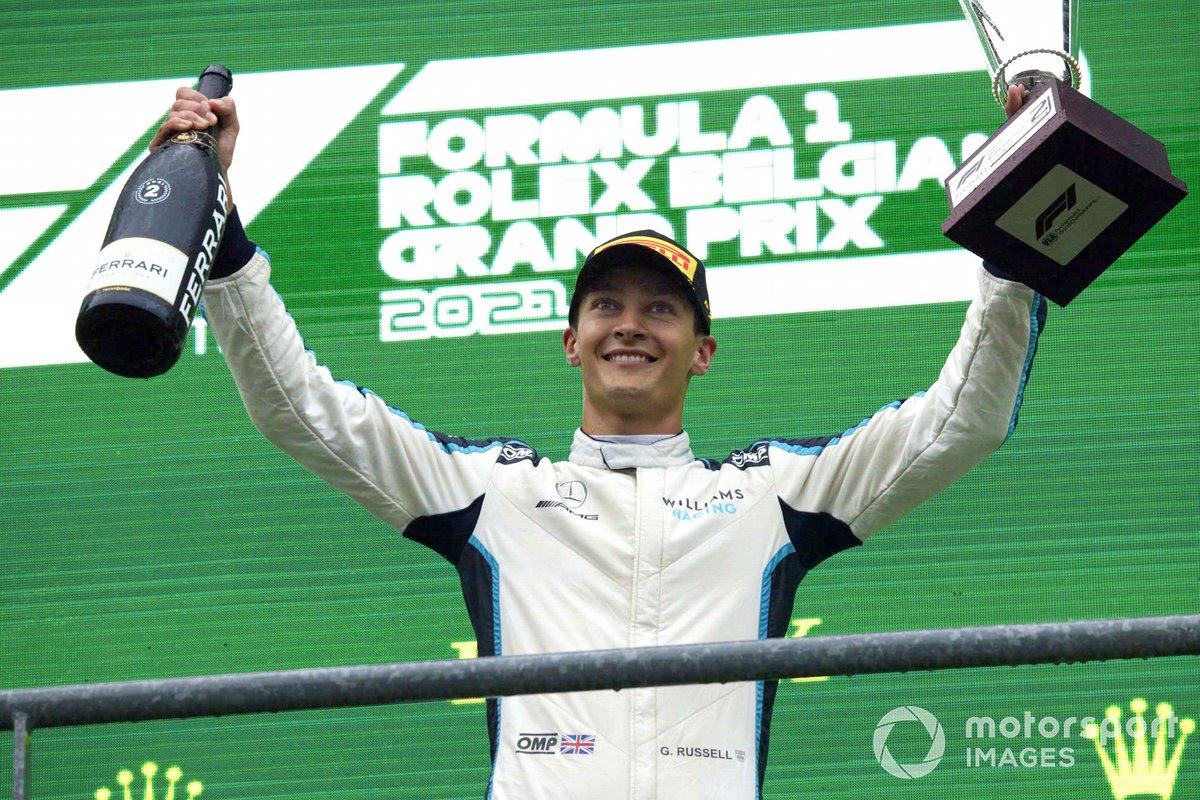
Superb qualifying performances characterised Russell's final year with Williams, leading to his first podium at Spa
Photo by: Steve Etherington / Motorsport Images
7. George Russell
Up 1
There’s no doubt that the Williams squad has been steadily working its way back up the pecking order since its disastrous years in 2018 and 2019, but the team really benefited from having one of the grid’s top talents completing a third season.
Russell’s one-lap speed was again the highlight in a Williams package and operation that excelled at getting high-profile results against the clock – the team knew it could afford to take all-or-nothing calls, and that Russell would generally deliver when they mattered. Although this sometimes backfired, as in Q2 in Turkey, his speed under pressure resulted in a Q1 escape run that stretched to 10 races. And it led to his Spa front row and podium in the washout that followed. He again put a Williams where it had no place being with his third place in qualifying in Sochi.
PLUS: How Russell left Mercedes with little real choice over his F1 promotion
Williams insiders say Russell’s best assets include his adaptability, self-assurance in taking decisions, and galvanising those around him, while his Grand Prix Drivers’ Association directorship and confidence with the media demonstrate his maturity. He’s also getting better on in-race matters such as tyre management, as Paul Ricard proved, and wheel-to-wheel battles – his Austrian GP scrap with Alonso was stirring. But there’s still a slight impetuosity that he must keep under control, such as his Imola crash with Valtteri Bottas. And his season rather fizzled out with a lack of late highlights too.

Gasly capably led the line for AlphaTauri and negotiated the late chaos in Baku for third place
Photo by: Charles Coates / Motorsport Images
6. Pierre Gasly
Down 3
Gasly’s comfort at AlphaTauri, which produced a forgiving package for last year, continued in 2021 – no surprise given the car carryover requirements in the rules – and he had a second consecutive excellent season. There was no win this time, but Gasly shone again.
He nailed his target of being more consistent this year, and he also felt he delivered as a more complete driver. He still struggled occasionally when things weren’t going totally smoothly, such as when AlphaTauri didn’t have the best strategy, as in Qatar where he fell from second on the grid. Or when he was trapped in the pack, or couldn’t get everything prepared properly, such as in Abu Dhabi qualifying.
But in general, Gasly delivered excellent performances time and again, particularly in qualifying. He used a handy set-up approach to keep high-corner speed while pushing at turn-in and still have the car stay compliant, which generally paid off massively and rewarded Gasly’s confidence when the pressure was on. The only thing that makes assessing the Frenchman’s performances this year tricky was his team-mate Yuki Tsunoda being a rookie who delivered inconsistent results across the season.
Gasly can’t be blamed for that and he led the line superbly for AlphaTauri all year. His best result was when he capitalised on the Baku chaos while dealing with a power problem to take third, but his Ferrari-beating performances at Zandvoort and in Mexico were even better.

Sainz took opportunistic third place in Brazil sprint, fending off Perez in an excellent first year at Ferrari
Photo by: Mark Sutton / Motorsport Images
5. Carlos Sainz Jr
Up 4
Sainz’s start to his Ferrari career has been excellent. It must be noted that the team went into the year with no chance of battling for titles, or wins in chaos-free races, but a driver can only shine in the circumstances put before them. And Sainz did that. His biggest weak point versus team-mate Charles Leclerc came in qualifying, where he was beaten 13-8, but that in itself is far from a bad record, and Sainz produced some sterling against-the-clock drives in 2021.
The highlight was his front-row start in Sochi, where he led the early stages ahead of Lando Norris before having to pit during the graining phase on the mediums because Ferrari was still scarred by its tyre-wear disaster in France.
PLUS: How Sochi showed Sainz's turnaround
There was a tricky run through the summer and early autumn with a string of heavy practice crashes, but Sainz was able to work his way past this by resetting his approach to the weekend, and trying to ensure that he was peaking pace-wise when it mattered. Also, he targeted better starts and produced these by the end of the year, culminating in his fine sprint race third place in Brazil, where he demonstrated his nous by spotting falling temperatures on the grid and plumping for soft tyres.
He ended the year with four podiums – a fine return – and showed no signs that the pressurised Ferrari atmosphere will change his focused and engaging attitude.

Leclerc had fewer podiums than Sainz, but also reached higher peaks - and nearly defied Hamilton to win at Silverstone
Photo by: Glenn Dunbar / Motorsport Images
4. Charles Leclerc
No Change
Once again, Leclerc shone for Ferrari in 2021. He may have ended the year with just a single podium visit to his team-mate’s four, but he also came closest to ending the team’s victory drought and was a regular best-of-the-rest in races where no drama befell the frontrunners at Red Bull and Mercedes.
Frustrating occasional errors also popped up again, often in qualifying, although this remained his strongest suit since he’s so fast overall. A heavy kerb strike led to a cracked chassis and Q2 exit in Qatar, and then of course there was his Monaco Q3 crash that proved to be both blessing and curse on home soil.
But that shouldn’t dampen what was another excellent season, where Leclerc had to deal with a string of misfortune. This included the red flag stealing the results of his tremendous driving to all but seal third place in the damp first half at Imola; the engine-mapping problem holding him back when in the lead at Silverstone; and Lance Stroll wiping him out at the start in Hungary.
His race at the British Grand Prix was his highlight. He defied Lewis Hamilton in tough, hot conditions in the post-restart first stint when tyre wear had been Ferrari’s big weak point a month earlier in France, but his silverware-less results in Spain, Turkey and the United States were utterly brilliant too.
PLUS: Why Ferrari is sure its long-term Leclerc investment will be vindicated

Norris led comfortably in Sochi but was undone by the weather, allowing Hamilton to scoop victory spoils
Photo by: Mark Sutton / Motorsport Images
3. Lando Norris
Up 7
From charming in-house up-and-comer to, in effect, McLaren team leader – it was quite a progression for Norris in 2021. He’d come into the year with a new team-mate – a very highly rated one in Daniel Ricciardo – but he turned any concerns about what this might do for his reputation into an enhanced and enshrined standing.
Norris was rapid from the off, finishing as best of the rest in Bahrain and nearly claiming a shock pole at Imola. That would come in Sochi, where he lost a first F1 win to a combined misjudgement of the worsening weather conditions with his McLaren squad, but before that were three podiums in the season’s first half and then a career-best second place backing up Ricciardo at Monza, where he had the edge on pure pace.
PLUS: Why Norris doesn’t expect Mr Nice Guy praise for much longer
He still needs to be better at adapting his driving when his car hasn’t got the perfect set-up, and knows a calmer approach in a repeat Sochi scenario is what’s needed. But he can pinpoint his struggles with corner-entry instability, and this year was unafraid to voice his opinions to help McLaren chase an optimum set-up.
Norris was also unlucky with his pair of late-season punctures ruining good results, although must cop the blame for moving over on Carlos Sainz Jr at the Sao Paulo GP start. But he can reflect happily that whenever there was the chance of a glittering result left by the top teams, he seized it.

Verstappen became the first Dutch world champion after the controversial Abu Dhabi finale
Photo by: Steven Tee / Motorsport Images
2. Max Verstappen
No Change
A worthy and brilliant world champion who only misses out on the top spot in this list by a fraction – the combined result of his needlessly over-aggressive driving in Jeddah, and Lewis Hamilton producing a slightly higher peak when up against it in Brazil.
Verstappen was superb in 2021, although his campaign was peppered with small mistakes, such as throwing away the early lead in the French GP. But he battled back to take a famous win, undoing Mercedes’ previous dominance at Paul Ricard in a brilliantly executed strategic race with a late tyre-life advantage. This really summed up how far he and Red Bull had come.
He was able to deal with immense pressure yet seemed to bow to it at different times. He had a stunning victory in front of a demanding home crowd at Zandvoort and produced a brilliant double pass to get back ahead in Mexico after his squad had messed up qualifying. Then there was his Qatar yellow-flag gaffe, Jeddah Q3 crash and Abu Dhabi Q2 lock-up.
PLUS: The line Verstappen finally crossed in F1's first Jeddah race
But when he needed to be inch perfect – in two passes in the season finale, only one of which came off – he delivered and then the circumstances came to him. But perhaps the finest glory of his season is that he remained the only driver able to get the best out of the tricky Red Bull package, even with a proven quantity such as Sergio Perez alongside him.

All but one of Hamilton's wins came after completing crucial moves, such as on Verstappen in Portugal
Photo by: Charles Coates / Motorsport Images
1. Lewis Hamilton
No Change
This was not Hamilton’s best F1 campaign overall, but he produced the very highest levels of driving skill in 2021 and did so with what must go down as just about the slightly inferior package compared to the Red Bull.
There were errors – and big ones. At Imola, Hamilton was desperate to avoid dropping early points and that resulted in his slide into the gravel in traffic. The red flag saved him from going a lap down, but his charge back to second was a lesson in dealing with adversity. He put Baku down to a “mechanical problem” – a mistake waiting to happen with the ‘magic’ brake bias alteration button unguarded – but he still pressed it when he hadn’t before.
And although Hamilton regularly turned out of contact with Max Verstappen, wisely knowing it was better to survive without damage to bank regular points, he still had to give as good as he got. This came at Silverstone, where Hamilton was penalised for the Copse crash, where he knew he couldn’t afford to back down again. He rightly copped a penalty there but, in the rest of their wheel-to-wheel clashes in 2021, it was hard to see how Hamilton could have done anything differently (other than not running Verstappen wide late on in Jeddah, which appeared to be more of an exasperated reaction in the confusing post-contact scenes).
He had to work hard with Mercedes in 2021. There were times when this went awry and in Monaco led to an off-weekend in which he struggled to build tyre temperature, but Hamilton was a regular visitor for simulator sessions where before that hadn’t always been deemed necessary. He and Mercedes grappled with getting the W12 and its rear-end instability set-up towards a specific handling sweetspot he felt they hit only once: in Brazil, where he won the race of the season with a terrific passing display.

Hamilton was supreme in his Brazil charge after qualifying disqualification and engine penalty
Photo by: Zak Mauger / Motorsport Images
Hamilton also felt he had to be more forceful with his team to drive it on to chase every last drop of performance from a package that did not have any major aerodynamic upgrades after July's British GP, although he was always full of praise for its efforts.
During the first half of 2021, Hamilton suggested he raced under the cloud of long-COVID, although stopped short of saying he definitely had the condition. But it was clear after his Hungarian GP charge that things were a real physical challenge, not helped by having to isolate so much to avoid missing a race as he did in 2020.
PLUS: The invisible enemy that’s made Hamilton’s title charge tougher
But by the end of 2021, any specific health fears were gone and the final races also highlighted again his worth as an off-track champion, with his public statements on human rights and homosexuality in Qatar and Saudi Arabia, and his rainbow helmet livery showing solidarity with the LGBTQ+ community for the final events.
The charges made his season. All but one of his eight wins – Qatar, where he dominated from pole – came in such circumstances, when he brought his supreme pace and tyre-management skills to bear brilliantly once again. The eighth world title wasn’t to be, and in controversial circumstances, but Hamilton is still at F1’s peak.
Autosport's in-depth 2021 Formula 1 season review supplement will be available on Thursday 23 December, free with our 124-page Christmas double issue

Jeddah victory over Verstappen put Hamilton level on points heading into the controversial finale
Photo by: Andy Hone / Motorsport Images


Why Britain’s role in Formula 1 endured a troubled start

Why Bottas believes his F1 reserve driver role is the fastest route back to a race seat

Why Norris is now ready for his final exam

The key advantage for Bottas vs Perez in the 2026 F1 return race

Why Ferrari's management is under pressure after its bad start to F1 2025, not Hamilton or Leclerc

Why Red Bull can’t solve its second F1 car problem with a simple paint job

Hirakawa replaces Doohan at Alpine for Japanese GP FP1 outing

How Alonso and Bortoleto can be F1 rivals in a unique driver management deal

F1 Singapore GP live commentary and updates - Leclerc tops SQ2

Is Antonelli favoured by Mercedes? Wolff responds to latest claims

Hyundai engine builder off the grid for BTCC 2027

"It should be banned" - F1 drivers still divided over cooling vests
Subscribe and access Autosport.com with your ad-blocker.
From Formula 1 to MotoGP we report straight from the paddock because we love our sport, just like you. In order to keep delivering our expert journalism, our website uses advertising. Still, we want to give you the opportunity to enjoy an ad-free and tracker-free website and to continue using your adblocker.


Top Comments