


The 10 best race drives of F1 2025
What were the star performances of the past season? Our writers select their 10 highlights
Oscar Piastri – Spanish GP (1st)

Unflappable Piastri met every challenge thrown in his path to take victory in Spain
Photo by: Andy Hone / Motorsport Images
During the summer break, Piastri pointed to Bahrain and Barcelona as two of his best drives; after that, his efforts in Qatar surely stand among them in a hell-for-leather exhibition of directed rage as McLaren’s strategy blunder cost him a near-certain win. Bahrain was dominant, but he faced little competition – team-mate Lando Norris qualified poorly and the Red Bulls were never at the races.
In Spain, however, Piastri demonstrated his racing chops while facing pressure from high-quality opposition behind him. From pole position, he had to fend off a fast-starting Max Verstappen when the reigning champion had threaded his way past Norris into Turn 1. Then, when Verstappen embarked upon a three-stopper and pitted earlier than the rest, the chasing Norris posed another issue to Piastri’s lead.
After their first pitstops, Norris cut the lead to 2.5s, Piastri having opted for the rope-a-dope and forced Norris into pushing his tyres too hard. Once the gap was at its lowest, the Australian pulled out the pace he’d been saving and used up his tyre life at the close of his stint to avoid the chance that Norris – who was pitting first – could get the undercut.
The gap came down again, with 2.3s between them after their second pitstops, then scythed down even further amid the late-race safety car, but Piastri was unflappable at every turn and covered off every situation that came his way. JBL
Nico Hulkenberg – British GP (3rd)

Finally, Hulkenberg breaks his podium duck – and in brilliant style, too
Photo by: Simon Galloway / LAT Images via Getty Images
Sauber’s motorhome was in raptures for a good few hours in the wake of Hulkenberg’s heroics at Silverstone. “Nico’s on fire,” the team personnel roared through the champagne spray to the tune of Gala’s Freed From Desire, although hadn’t managed to come up with a second line to the refrain.
It was a hugely popular result, albeit a surprising one: Hulkenberg’s first F1 podium in 15 years at the top table had emerged from seemingly nowhere after starting 19th on the grid.
In a flurry of early radio traffic, Hulkenberg vetoed a call to pit on lap two for medium tyres, instead choosing to come in at the end of lap nine for a fresh set of intermediates as the rain stood on the cusp of intensifying. This was a huge call, because the incoming precipitation left many of the cars ahead scrambling with worn inters, greasing Hulkenberg’s path to fifth.
He survived the safety cars, moving up to fourth when Max Verstappen went off, and then dispatched Lance Stroll to sit among the top three. But Lewis Hamilton was chasing, aiming to continue a streak of podium finishes in every Silverstone race since 2014, and attempted to undercut Hulkenberg in his switch to slicks when the circuit began to dry.
It was a lap too soon and Hamilton slipped off the road on his first foray with the softs; Hulkenberg responded a lap later, and had enough in hand to stay ahead of the Ferrari – much to the delight of absolutely everybody. JBL
Isack Hadjar – Dutch GP (3rd)

After starting an impressive fourth on the grid, Hadjar went one better in the race to secure his maiden F1 podium
Photo by: Erik Junius
It was early in his F1 career that Hadjar set out his stall with regards to his qualifying pace, particularly in outpacing Yuki Tsunoda in China (his second ever F1 race), but consistent race performance took a little longer to come to the Frenchman. Part of that was down to the Racing Bulls machinery at his disposal, part of it was unfamiliarity with the tyres – either way, he pulled it all together at Zandvoort.
After pulling out a fourth place on the grid, Hadjar had the unenviable job of keeping George Russell and, subsequently, a fast-starting Charles Leclerc behind him. It was the lengthy defence against Leclerc that was so impressive about Hadjar’s drive. He found his VCARB 02 comfortable on the brakes and could position it perfectly to resist Leclerc’s advances.
Towards the end of the second stint, Leclerc had been truly seen off by Hadjar and the gap between them grew to three seconds, prompting the Monegasque to take a pitstop that ultimately precipitated his race-ending collision with Andrea Kimi Antonelli.
Hadjar was set to match his grid position, but fortune had one more trick up its sleeve. Lando Norris’s oil leak took him out of second, allowing Hadjar to make up the final place needed to secure a maiden F1 podium finish.
The impressive part was that he’d almost matched Max Verstappen for pace, with just 0.1s between the two on average through the race. Small wonder he ended up on Red Bull’s radar… JBL
Carlos Sainz – Azerbaijan GP (3rd)

Sainz’s front-row starting slot then third-place finish in Baku a turning point in his first season with Williams
Photo by: James Sutton / LAT Images via Getty Images
Sainz hadn’t enjoyed an easy start to life at Williams. Although he’d put together a solid string of results at the start of the year, in qualifying he often paled in comparison to Alex Albon, and as a result Albon’s race-day results were much stronger.
But Sainz’s efforts in the Azerbaijan GP changed the narrative considerably, and very nearly ended in pole in a chaotic qualifying session. Only Max Verstappen was able to deny him with a last-minute effort, but Sainz could at least bask in the recognition of starting on the front row.
After qualifying, the race was a lot more straightforward. Sainz couldn’t quite keep up with the leading Red Bull but eased away from the third-placed Liam Lawson. When the Kiwi pitted, George Russell was freed up to chase after Sainz, who responded over the next six laps to keep the gap at 2.7s.
The difficulty for Sainz was that he’d started on medium tyres, while the hard-starting Russell could hang his car out for a few more laps. So when Sainz pitted at the end of 27, Russell was able to keep going and maintained strong, consistent pace while the Williams got its hard tyres up to temperature. Russell was then able to get the overcut 12 laps later, and managed to stay ahead to complete his leap up to second.
None of this can detract from Sainz’s efforts, however, and finishing third above a series of traditionally quicker cars was laudable. Something similar could be said of his podium in Qatar. JBL
George Russell – Singapore GP (1st)

Russell delivered a consummate performance in Singapore’s traditionally challenging conditions
Photo by: Zak Mauger / LAT Images via Getty Images
Two years ago, Russell crashed out in the final laps of the Singapore GP when a podium seemed on the cards. In 2025 he seemed an outside candidate at best even for this status, given Mercedes’ tendency to fare better in colder ambients, and that view gained credence when Russell smote the barrier at Turn 16 during second practice.
As it turned out, the car was good enough for pole in Russell’s hands, not just outpacing Max Verstappen and the McLarens but also 0.379s faster than team-mate Andrea Kimi Antonelli. This was the foundation for his win, but he would have to contend with Verstappen starting alongside him on softer tyres to offset the effect of that side of the grid being dirtier and slower.
Russell not only aced the start, he built a lead that gave him a useful tyre offset as Verstappen started to complain about brake-balance problems. Post-pitstop, Russell was unflappable as he came under renewed assault from Verstappen while trying to introduce his tyres properly, and he did a better job of cutting through traffic to slip away again in the second half of the race.
It was a consummate performance in the challenging conditions drivers must cope with in racing here.
“I’m a very different driver today to the one I was a couple of years ago and I feel more complete, more confident,” Russell said afterwards, putting words to that which he had already demonstrated. SC
Charles Leclerc – United States GP (3rd)

Podium finish at Austin a perfect illustration of Leclerc’s ceaseless effort and commitment
Photo by: David Buono - Icon Sportswire - Getty Images
With Leclerc you never get less than 100% effort and commitment. The US GP at Austin was one of those races where this approach was rewarded with a podium that his car’s performance didn’t quite merit.
Indeed, the Ferrari was miserably slow on the Friday – last of all in the sole practice session, having lost time to a gearbox issue, then 10th on the sprint grid. Leclerc said he and team-mate Lewis Hamilton had reached the effective performance ceiling of the car.
A change of set-up perhaps raised that ceiling a little bit but the SF-25 still looked difficult, most plainly when Leclerc spun in Q3 for the grand prix. He simply dusted himself down and tried again, this time annexing third – 0.006s off Lando Norris in a McLaren that was the class of the field most of the season. Granted, both McLarens were compromised after missing the sprint, but this was still a notable scalp.
Leclerc then started on the soft tyres in a bid to gain track position on the opening lap, and succeeded in beating Norris to the first corner. What a race this might have been had he done a number on polesitter Max Verstappen too, for he delivered a defensive masterclass in keeping Norris behind him.
Then he had to do it all over again after Norris’s pitstop, and once more he contrived to make the championship contender look meek at best. Norris got past eventually, but third for Leclerc was a decent reward for an excellent drive. SC
Lando Norris – Mexican GP (1st)
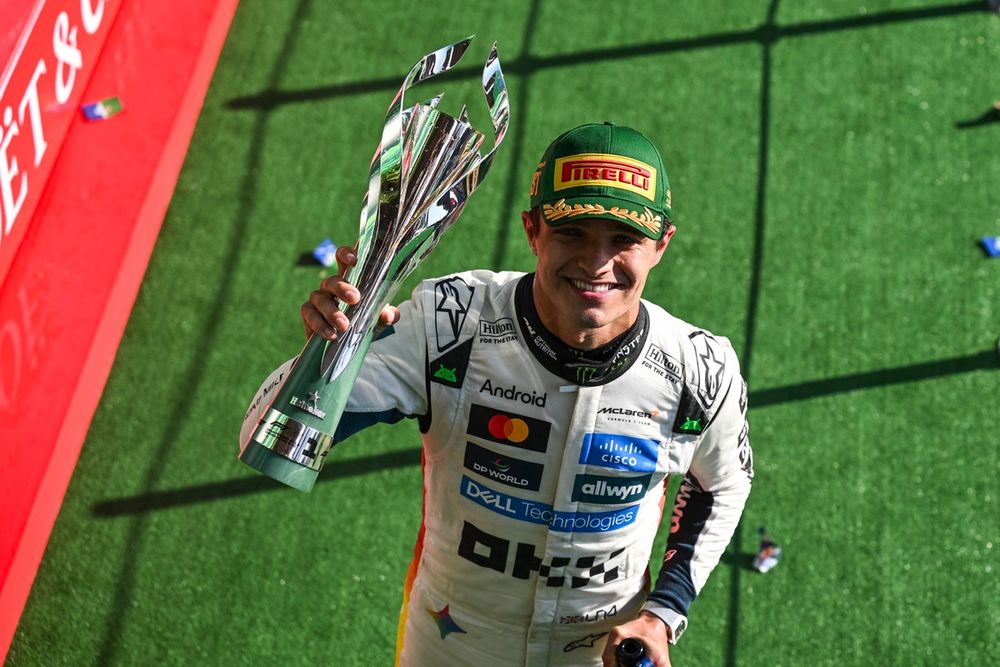
Arguably Norris’s most dominant victory of his career – and crucial in tipping the title balance
Photo by: Sam Bagnall / Sutton Images via Getty Images
This was the race that truly put Norris into the world championship frame. The Briton had been chipping away tiny chunks out of Piastri’s title lead, one that had grown significantly after Norris’s retirement at Zandvoort, but it was the difference between the two at the Autodromo Hermanos Rodriguez that gave Norris the swing needed to leave Mexico City with the championship lead.
While the low-grip track surface hurt Piastri, it played to Norris’s strengths; he hurled his car onto pole by almost 0.3s over Charles Leclerc, while Piastri could only qualify eighth.
When it comes to a Norris pole, it’s never certain whether he’ll be leading into the first corner such is his profligacy off the line, but on this occasion he absorbed a pincer attack from the Ferraris and evaded the Turn 1 off-track nonsense in which everyone else seemed to thrive.
Norris had put 1.7s on Leclerc by the end of the first lap, 3s by the end of the 10th, and 9s by the end of the 20th – there must be some logarithmic function for the non-linear gradient to the McLaren driver’s gap in front.
Once both drivers had pitted, Leclerc was a mammoth 16.5s behind the leader – and this was only at half-distance. With the Ferrari man distracted by the recovering Max Verstappen in the final laps, Norris could continue to forge arguably the most dominant victory of his career, with Leclerc trailing by 30.3s at the close of the race. JBL
Max Verstappen – Brazilian GP (3rd)

Pitlane-to-podium performance in Sao Paulo a classic example of a thrilling Verstappen fightback
Photo by: Mark Thompson / Getty Images
This ought to have been a weekend when McLaren put another wedge between its drivers and Verstappen in the championship, but the Red Bull man stemmed the potential losses with another one of those gritty back-against-the-wall drives through traffic in which he specialises.
In 2024 he won at Interlagos from 17th on the grid in changeable conditions; this season he raced to the podium from a pitlane start.
Red Bull palpably got its set-up wrong for the sprint race, as Verstappen continuously reminded the team over the radio while racing from sixth to fourth. In qualifying for the grand prix, disastrously, he was eliminated in Q1.
Given drying conditions on Sunday a repeat of 2024 looked unlikely, especially since Red Bull opted to make wholesale set-up changes including a new power unit, hence the further handicap of starting from the pitlane.
Verstappen started on the unfavoured hard tyre, but still made up places on the opening laps before a debris-induced puncture forced him into the pits on lap seven. That consigned him to a three-stop race but he still carved his way through the field, doing most of the legwork during two stints on medium tyres, before swapping to softs for a late charge that brought him to the cusp of relieving Andrea Kimi Antonelli’s Mercedes of second place.
Lando Norris won, but McLaren felt Verstappen would have done so if he had started even slightly higher on the grid. SC
Ollie Bearman – Brazilian GP (6th)

Bearman’s clean, consistent, under-the-radar drive netted his team a valuable points haul
Photo by: Zak Mauger / LAT Images via Getty Images
Despite a few high-profile mis-steps, the trend line of Bearman’s development trajectory followed an upward path through his rookie season. During the second half of the season he was a regular visitor to the points-paying positions, even before Haas introduced its biggest upgrade of the season ahead of the US GP weekend.
Fourth place in Mexico was a strong result, but it owed much to seizing the moment as drivers ahead tripped over one another, and the race ending under a Virtual Safety Car, which protected him from Oscar Piastri’s McLaren.
He built on that at Interlagos, albeit more so in the grand prix sessions than in the sprint. He was third fastest in Q1 and second fastest in Q2, then was surprised when his Q3 laps felt similarly good and yet were slower. Such is the capriciousness of ground-effect F1 cars.
Having lost eighth place to Alpine’s Pierre Gasly at the start, Bearman neatly recovered the position, then relieved Liam Lawson of seventh before undercutting Isack Hadjar in the other Racing Bulls car.
That left him in no-man’s land between the leading group and the rest of the midfield, where it would have been easy to make a mistake – but Bearman was clean, consistent, and faster than his would-be pursuers. It was the kind of mature drive that flies under the radar, but was critical to the Haas team’s campaign for seventh in the constructors’ championship. SC
Andrea Kimi Antonelli – Las Vegas GP (3rd)

Antonelli was hugely impressive in Vegas, completing all but two of the 50 race laps on the same set of tyres
Photo by: Zak Mauger / LAT Images via Getty Images
More so than his pole position for the Miami sprint, or his podium finish in Brazil, Antonelli signalled his underlying quality with a brilliant piece of execution against the odds in Las Vegas.
Coming after a summer in which the introduction of a new rear suspension failed to deliver performance uplift and threatened to shatter his confidence, it was a timely demonstration of the potential that Mercedes team boss Toto Wolff had seen in him.
Antonelli qualified 17th, knocked out in Q1 after locking up on his final flier, just as the track was improving after a wet start to the session. He started on the soft tyres for a flying start from his grid slot but was penalised for moving before the lights went out, a barely discernible twitch of the car as he released the brakes.
That dictated an abandonment of Merc’s Plan A, after an early stop under the safety car to get off the softs. Antonelli would not visit the pits again.
Thus he drove all but two of the 50 laps of the race on one set of tyres, enduring a worrying graining phase that would have terminally unsettled a lesser driver at this experience level, then pushing on when the graining cleared up.
The pitstop timing helped him get track position when others pitted ahead of him, but he was resolute in defence against Charles Leclerc and Carlos Sainz late on – both of whom had fresher tyres. SC

This article is one of many in the monthly Autosport magazine. For more premium content, take a look at the January 2026 issue and subscribe today.

Which performance gets your vote for best of the year?
Photo by: Zak Mauger / LAT Images via Getty Images


Mission control: Inside the FIA and F1's latest answer to football's VAR

FIA expects F1 races in Qatar and Abu Dhabi to run as planned

Why Piastri has struggled to show his best with this year's McLaren MCL40

Lights, Camara, action: How Haas picked F1's latest rookie for 2027

Horner's inside story of how Red Bull built its own F1 engine

Why Mercedes' latest 2026 F1 update is no downgrade

Singapore Grand Prix Driver Ratings 2026

What we learned from the 2026 F1 Singapore GP sprint race and qualifying

Verstappen warns COTA bumps are “unacceptable” and “out of control”

Why Colapinto spoke out against abuse targeting his own F1 team

Sainz yet to be "convinced" that F1 2026 will finish in the Middle East

Verstappen’s words explained: Why Red Bull’s turnaround is so different this time
Subscribe and access Autosport.com with your ad-blocker.
From Formula 1 to MotoGP we report straight from the paddock because we love our sport, just like you. In order to keep delivering our expert journalism, our website uses advertising. Still, we want to give you the opportunity to enjoy an ad-free and tracker-free website and to continue using your adblocker.


Top Comments