


Ranking Derek Warwick’s top 10 greatest races
An unheralded driver in Formula 1 who never quite managed to win a race, Derek Warwick enjoyed plenty of success in sportscars and short oval racing. Here are his greatest drives from a glittering career

Autosport Retro
Telling the forgotten stories and unearthing the hidden gems from years gone by.
Derek Warwick started 146 world championship grands prix, was a world sportscar champion and won Le Mans. And before any of that he was a rising single-seater star and short-oval king.
All that meant it was always going to be tough to pick out his 10 best races. Fortunately, the F1 driver steward was prepared to help Autosport on this quest.
So, here are Warwick’s greatest drives, based on his performances, the equipment and circumstances involved, and their importance.
10. 1991 Nurburgring 430Km

Coming a matter of weeks after the death of his younger brother Paul, Warwick raced to an emotional victory at the Nurburgring
Photo by: Motorsport Images
Car: Jaguar XJR-14
Started: 2nd
Result: 1st
Emotions were running high for round five of the 1991 world sportscar championship. Warwick had contemplated retirement following the death of younger brother Paul in a British Formula 3000 crash at Oulton Park just a month before. Then he was given a rude chop by Michael Schumacher’s Mercedes during qualifying, taking his left front wheel off. A furious Warwick then famously chased the German through the garages.
After Warwick qualified second to team-mate Teo Fabi, debutant David Brabham started the car. He fell to third at the start as Keke Rosberg’s Peugeot came by.
While Fabi led, there was a Peugeot-Jaguar-Mercedes battle for second before Rosberg spun thanks to an engine issue. That handed second to Brabham, who almost immediately took the lead when Fabi had a spin in traffic.
Just before his pitstop, Brabham got baulked by a backmarker and Mauro Baldi’s Peugeot move to the front. Warwick was catching the leading Peugeot, now driven by Philippe Alliot, when the 905 hit engine trouble.
During a safety car period thanks to the V10’s spectacular blow-up, Warwick was erroneously held at the end of the pitlane, handing the lead to Brabham, now in the XJR-14 started by Fabi.
Warwick put on a charge and passed Brabham, who was struggling with a handling problem. He reeled off the remaining laps to take a highly charged victory. “We needed this,” said father Derry.
“We raced hard all day and deserved the result, against a few problems” says Derek. “David was immense. He took so much pressure off me as he could in the media, knowing I was struggling with all the emotions of Paul’s death and having family there.”
9. 1986 Silverstone 1000Km

After a move to Lotus was vetoed by Senna, Warwick reminded everybody of his ability at Silverstone in the Jaguar
Photo by: Motorsport Images
Car: Jaguar XJR-6
Started: 3rd
Result: 1st
As a former president of the British Racing Drivers’ Club, Warwick has a special affinity with Silverstone and played his part in one of the circuit’s milestone moments.
Outqualified by a turbo Lancia and a turbo Porsche, Warwick’s normally aspirated V12 Jaguar looked strong in race trim and chased leader Alessandro Nannini in the early stages of Silverstone’s round of the 1986 world sportscar championship.
The Lancia was rapid, pulling away at a second per lap as Warwick and Tom Walkinshaw Racing team-mate Jean-Louis Schlesser quickly dropped the Porsches. Warwick upped his pace and caught Nannini before the end of the opening stint, Eddie Cheever taking over the XJR-6 and continuing the pursuit, with Andrea de Cesaris now in the LC2.
The American caught the Italian, took the lead and built a 15s cushion before stuttering with low fuel on his in-lap. That, combined with a slower pitstop, put the Lancia back ahead.
Warwick soon snatched the lead, Nannini retook it and then the Jaguar went back ahead at Copse in an enthralling dice. Warwick then broke off from the fight to pit with a suspected puncture, which turned out to be a loose wheel spat fouling the tyre.
That put the Jaguar out of sync with the Lancia. Cheever inherited the lead when de Cesaris stopped and thereafter the Lancia was slowed with flagging fuel pressure. That left Cheever and Warwick to cruise home, two laps clear of the Derek Bell/Hans Stuck works 962 after nearly five hours of racing. It was Jaguar’s first major victory since the 1957 Le Mans 24 Hours.
“Jaguar coming back and winning at Silverstone was emotional for everyone, including Tom Walkinshaw,” says Warwick. “The car was great in race trim, we had a bit of a drama at a driver change – Eddie and I had this love-hate relationship and of course we blamed each other, really with tongue in cheek; it really annoyed Tom and we got a lot of fun out of it.”
The success also came at an important time for Warwick before he made his way back to F1: “In 1986 I was in a pretty bad place, with the loss of the Lotus drive at the end of 1985 because of [Ayrton] Senna. I just got in and just drove it as fast as I could, with an eye over the shoulder finding a way to get back into F1.”
8. 1983 Dutch GP, Zandvoort

First F1 points for Warwick came aboard the Toleman TG183B Hart at Zandvoort in his third season
Photo by: Motorsport Images
Car: Toleman TG183B
Started: 7th
Result: 4th
Warwick’s early years in F1 were frustrating, thanks to uncompetitive and unreliable Toleman machinery. After 22 starts – not to mention 14 failures to qualify – he had yet to score a point. But Rory Byrne’s 1983 T183B was decent and Warwick finally got his breakthrough at Zandvoort, where he had taken his first F1 fastest lap the year before.
Thanks to a sensational start by Cheever’s Renault – as he went from 11th to second! – Warwick dropped a place to eighth at the getaway. But the Toleman had genuine pace and Warwick outbraked the Lotus of Elio de Angelis at Tarzan on lap three of 72. He rose to sixth when Andrea de Cesaris’s Alfa Romeo suffered engine failure three laps later.
Having survived an attack from Nigel Mansell, which resulted in the Lotus spinning off, Warwick allowed a flying John Watson (McLaren) by before making his pitstop.
When Alain Prost inadvertently took out both himself and title rival Nelson Piquet on lap 42, Warwick move into fifth. Then, in the closing stages, Riccardo Patrese’s Brabham lost boost and Warwick went by to finish fourth to score points at last.
“It was a great car – we had reliability and speed,” says Warwick, who went on to score in the final four races of 1983. “I was passing cars and not just picking up places when others dropped out. As the fuel came off it got better and better.
“The car responded to changes – unlike the 1981 and 1982 cars; you could put a JCB on the front and it wouldn’t make any difference! It was pretty disheartening so when it came together it was a massive accomplishment for all the team.”
7. 1990 Spanish GP, Jerez

When Warwick did belatedly get to race for Lotus, it was a largely disappointing experience although his Jerez qualifying effort was a standout
Photo by: Motorsport Images
Car: Lotus 102
Started: 10th
Result: Retired
This entry is less about a race performance and more about the human side of motorsport.
Late in Friday qualifying, Warwick’s Lotus team-mate Martin Donnelly suffered an enormous crash, the Northern Irishman being thrown out of the destroyed car at one of the fast right-handers behind the Jerez pits. It was the worst F1 accident for several years and it was widely regarded as miraculous that Donnelly survived, albeit with multiple injuries.
Warwick had rushed to the scene and, with the exact cause of the accident unclear, didn’t want to drive the following day: “I’d had that big crash at Monza [three weeks before], then we got to Jerez and Martin had his. I remember it vividly – I ran over to Martin because I wanted to be with him.
“That night I decided not to race, the car was too fragile and we had no idea what would break next. But when I went to the track I saw the guys had been up all night making a special titanium brace where the monocoque had broken.
“The team obviously wanted me to race and there was a lot of pressure from everyone, the team and sponsors. I shooed everyone out of the garage except my engineer and main mechanics and asked them, ‘Will it break?’ and they promised it wouldn’t break. But added we are not sure about the rest of the car…”
Warwick went out and qualified 10th, matching his best grid slot of the season in the difficult Lotus 102.

Warwick's qualifying effort at Jerez following the horrendous accident that befell team-mate Donnelly demonstrated remarkable bravery
Photo by: Rainer W. Schlegelmilch / Motorsport Images
“The first time through the corner where Martin crashed I was flat,” he says. “To qualify 10th was a monstrous effort and the whole team was emotional when I brought the car back in – at that point we still thought Martin was going to die. Without a doubt it’s the bravest thing I’ve ever done.”
Two years later, Autosport’s long-time F1 reporter Nigel Roebuck wrote: “Warwick’s behaviour that weekend was as plain courageous as anything I have ever seen in racing.”
Perhaps understandably, Warwick doesn’t recall much about the race itself. For the record, he ran ninth in the early stages following Jean Alesi’s off at the first corner. A slow tyre stop dropped him to 13th but Warwick was running seventh when his gearbox gave up with just 10 laps to go.
“I remember the car being shite!” he says. “It was difficult to drive, but I gave it 100%.”
6. 1984 British GP, Brands Hatch

Warwick took his only F1 podium on home turf with Renault at Brands Hatch in 1984
Photo by: Motorsport Images
Car: Renault RE50
Started: 6th
Result: 2nd
Renault’s pace should have yielded more in 1984 but reliability often thwarted the promising RE50. At his home race, however, Warwick had things fall his way for once.
The British GP weekend didn’t start like that, though. Turbo problems, a sticking throttle and a crash hampered his race preparation and Warwick lined up sixth with his new chassis.
While carnage broke out behind, Warwick quickly rose to fourth before the race was red-flagged when Jonathan Palmer crashed his RAM.
Following the restart, Warwick held fourth. He didn’t have the pace of the leading trio –Piquet (Brabham) and McLaren drivers Prost and Niki Lauda – but was soon well clear of the scrap behind. It was quite a lonely race for Warwick, who inherited second when Prost retired with gearbox failure and Piquet hit turbo problems. It was his third F1 podium and his first (and only) on home ground, which is what gets it onto this list.
“It was the first time I had all my family there, so getting on the podium in front of them was a bit of a buzz and really made the week for me,” says Warwick. “Finishing second in the British GP has to up there – it’s the British GP and it’s in F1! Mum was crying and I felt so proud.
“We were so much nearly men in 1984, I broke down in almost half of my races, so reliability played a big part in your career. Drivers today don’t have that problem, they’re really so bloody lucky because it almost never happens now.”
5. 1992 Le Mans 24 Hours

Warwick anchored winning Peugeot at Le Mans in 1992 alongside Dalmas and Blundell
Photo by: LAT Photographic
Car: Peugeot 905 Evo 1 Bis LM
Started: 2nd
Result: 1st
Having twice narrowly missed the world sportscar title with Jaguar, Warwick got the job done with Peugeot in 1992 and the Le Mans 24 Hours was the undoubted highlight. Having suffered a disaster in the race the year before, Jean Todt’s Peugeot squad left little to chance, completing extensive testing and arriving with three spare cars as well as the trio of race 905Bs.
Warwick had regular co-driver Yannick Dalmas and 1990 polesitter Mark Blundell in the #1 car and enjoyed the build-up.
“It was my choice to get Mark in, as you can imagine we had a lot of fun heading into Le Mans,” he says. “I was doing one of many stints at a Paul Ricard test and we’d put in a chicane before Signes – we wanted to simulate the two chicanes that were now at Le Mans. It was late into the night and I turned into the first part of the chicane to find Yannick and Mark both pulling moonies! I chuckled to myself for the rest of the lap.”
Come the 24 Hours, the main opposition came from Toyota and the sister 905 of Philippe Alliot/Mauro Baldi/Jean-Pierre Jabouille.

“Alliot and co wanted pole, but we didn’t care about that, we wanted a good race set-up in all conditions,” continues Warwick. “The car’s weakness was the gearbox, which was fragile and all I kept saying in ‘our’ car’s briefings was, ‘Gearbox, gearbox, gearbox’.”
In mainly wet conditions, Volker Weidler grabbed a brief early lead in the quickest of the Mazdas but the two leading Peugeots were never far behind. Warwick took over during a quick pitstop in the third hour and emerged in the lead, while one of the Toyotas and the third Peugeot had already been involved in an incident that dropped them from contention.
The Michelins on the Peugeots and Mazdas also had an edge over Toyota’s Goodyears in the damp conditions and Warwick led throughout a triple stint. During the night, the #2 Peugeot moved into second and there was some concern for Blundell in the misty, spray-filled conditions.

Wet conditions couldn't deny Warwick and co the first win for Peugeot at La Sarthe
Photo by: Motorsport Images
“The weather was dreadful during the night,” confirms Warwick. “Mark had done very little night racing and I’m not sure he’d driven the car at all in the wet and he was a little bit off the pace, so I got back in the car. But Mark gave us everything and definitely did his bit.”
At dawn they led the sister car by two laps, avoiding errors as many others – including Alliot – fell off the slippery circuit. Aside from an electrical problem, the trio continued serenely on. And Warwick was given the honour of the final stint, despite this being a French team with a French driver in the line-up.
“Jean put me in the car so I could finish the race,” says Warwick, who took the flag six laps clear of the second-place Toyota. “He knew there was something I wanted to pin Paul’s memory to and was a very good team boss.
“It was one of the hardest races I’ve had. We raced hard against Toyota and the other Peugeot for 22 and a half hours, then they had problems and we could ease off. And then you start hearing noises because the pressure is off.”
4. 1989 Canadian GP, Montreal

In difficult conditions at Montreal Warwick believes he should have beaten Boutsen to 1989 Canadian GP victory
Photo by: Motorsport Images
Car: Arrows A11
Started: 12th
Result: Retired
The 1989 Arrows was a solid mid-grid car at Montreal in dry conditions and rain on race day again provided Warwick with an opportunity to shine. “Senna was the best wet-weather driver in the world, but I always thought I wasn’t that far behind – I rated myself in the rain,” he says.
Warwick’s early progress was rapid, helped by Mansell and Nannini pulling in for slick tyres before the race even started. After two laps, the Arrows had climbed from 12th to seventh.
The conditions were unpredictable – starting wet, drying, then raining again – and Warwick stayed on wets as others dived in and out of the pits. When Senna pitted for the second time, Warwick moved into second spot.
He started catching leader Patrese and Warwick took the lead on lap 35 of 69 when the Williams came in for a new set of wets. It was the first time Warwick had led a GP since 1984.
Senna’s McLaren soon blasted by, but Warwick was still clear of everyone else – more than 40s clear of eventual winner Thierry Boutsen. Given that the Brazilian retired with engine failure late on, this race might have fallen to Warwick had he not already suffered his own blown Ford unit on lap 41.
“A superb drive for no reward,” reported Autosport’s Nigel Roebuck.
“We were on fire that day,” says Warwick. “Ayrton would have won the race without his failure but what pissed me off was that Boutsen won, and I was destroying him. I was furious after the race.
“The car was brilliant. We should have had more success that year but for reliability. The cockpit was very tight, typical Ross Brawn design, both Eddie and I struggled in it. I had to go down a shoe size to fit in the cockpit and my feet used to burn, I could hardly walk after a race.”
3. 1973 F2 Superstox world finals, Wimbledon
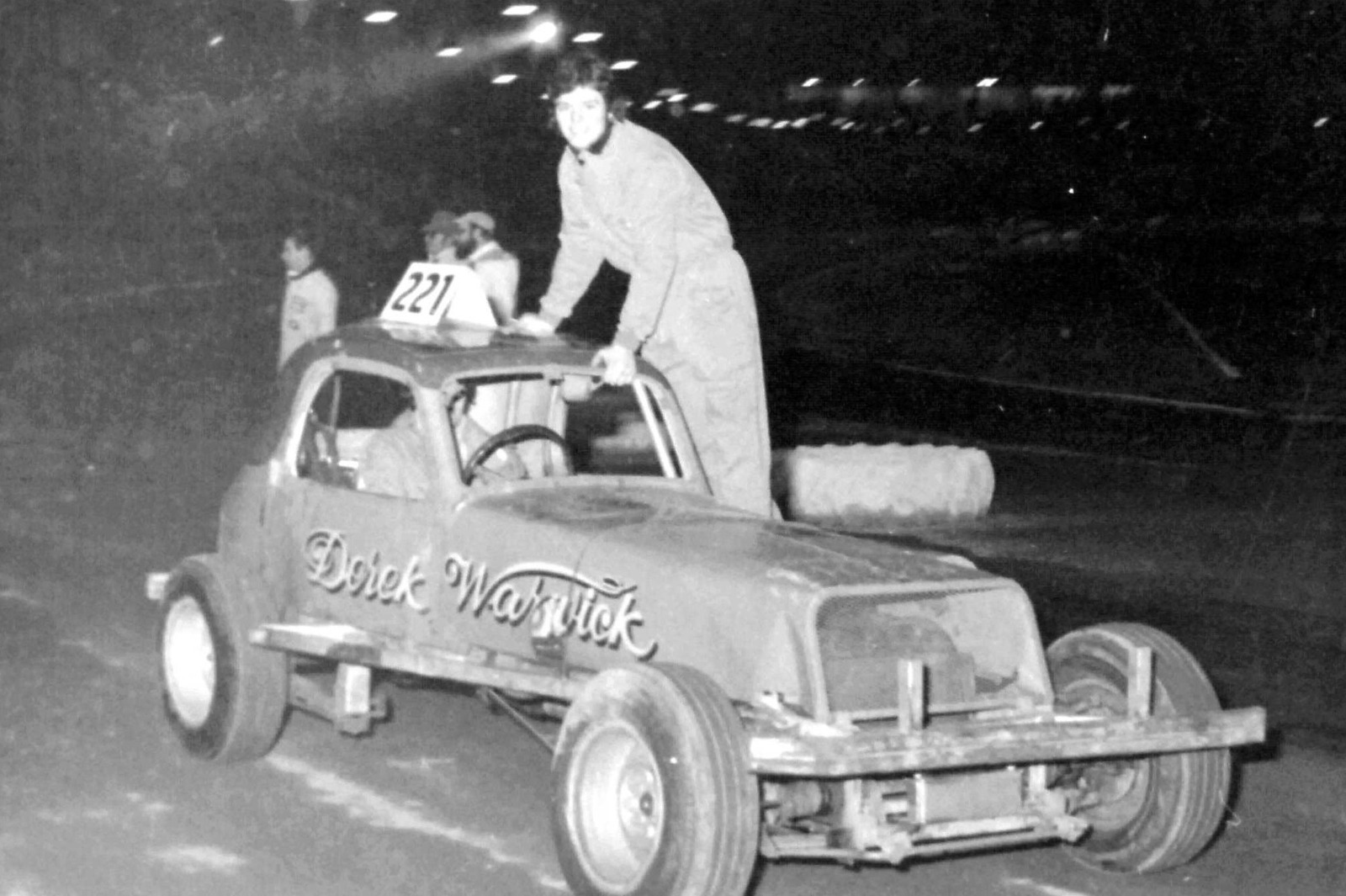
Warwick singles out his 1973 Superstox success as the most special moment of his life
Photo by: Fred Buss
Car: Warwick-built spaceframe Superstox
Started: 7th
Result: 1st
Long before he thought he could be a professional driver, Warwick was a part of the competitive and tough world of stock car racing. He had many memorable moments on the short ovals, winning the British, English and European championships. But it is his victory in the 1973 world final that stands out in his mind.
“I was racing with my dad and uncle – it was always a dream for the family to win the world championship, it meant so much to all of us, everything we did that year was to win the world championship,” says Warwick, who was then 19. “And the final was winner-takes-all.
“It was a random hat pick to set the grid, which we all disagreed with – I was pulled out seventh with legends Dave Pierce eighth, Geoff Goddard sixth and Tony May towards the back, which was good for me. Dad was mid-grid.
“I soon got by Goddard and was chased all the way by Dave and Tony, so the pressure was massive. There was an electronic leader board and dad got so nervous with 10-15 laps to go he just pulled in and watch from the centre – that’s how important it was to our family. Uncle Stan was in the grandstands with mum, sister and all my friends, so it was very emotional.
“Superstox was my world at the time – you were always passing cars, there were almost 40 cars at the world championship, on effectively a quarter-mile oval, so taking risks was always a part of it. I learnt a lot from building my own cars, suspension and engines, so it was a good training ground when I eventually went to circuit racing, I could feel the car and knew what it was doing.
“It really was the most special moment of my life.”
2. 1983 Brands Hatch 1000Km

Warwick had done most of the hard work already by the time conditions dried out at Brands Hatch in John Fitzpatrick's Porsche 956 in 1983
Photo by: Motorsport Images
Car: Porsche 956
Started: 4th
Result: 1st
“Warwick beats the works” said our cover following an event his co-driver later called the race of his life.
Warwick was a rising star in the second half of 1983. He was impressing with Toleman in F1 and had shone on his Porsche 956 debut at the Spa 1000Km, qualifying and running third behind only the factory cars. At Brands Hatch just two weeks later, he would do even better…
Warwick joined John Fitzpatrick for the European championship round and the duo lined up fourth, behind the two works 956s and the Joest-run machine of Bob Wollek/Stefan Johansson. But rain on race day swung the advantage away from the Dunlop runners and towards the Goodyear-shod Fitzpatrick car, which also had a special carbon fibre nose and engine cooling fan to allow the underbody air vents to be closed, costing power but boosting downforce.
Warwick swiftly dealt with Wollek, Bell and Jacky Ickx in the opening three laps before disappearing into the distance. After six laps he was 10s clear of Ickx, who then had a spin as he tried to keep the privateer in sight.
“Warwick’s driving was a joy,” reported Autosport’s Quentin Spurring. “Scything past the backmarkers whether they had seen him or not, he totally committed himself to the job of making hay while the rain fell.”
“The Rothmans Porsches were quicker in practice, but in the wet we had the better tyre and more downforce,” recalls Warwick, who lost some of his early lead due to a safety car period. “It was magic in the wet. In the first stint I lapped almost everyone except Ickx, an established rainmaster.”
And when Warwick came in for the car’s first scheduled stop, Fitzpatrick wasn’t keen to jump aboard: “At the first pitstop I was bursting for a pee, but Fitz said, ‘There’s no way I’m getting in the car, you do another stint and pee in the car if you have to’.”

Warwick remembers being handed a brown envelope with half of the prize winnings by Fitzpatrick after his wet weather heroics
Photo by: Motorsport Images
Warwick lapped second-placed Stefan Bellof during that stint before the track started to dry and slicks were fitted when Fitzpatrick climbed in. Now the advantage swung towards the works Porsches, Fitzpatrick not helped by being forced to spin to avoid an errant backmarker.
Warwick took over once more and, despite the pace of the works 956s, the gap was still over a lap as the six-hour race approached two-thirds distance. Better fuel consumption also helped and Fitzpatrick continued to lead during his second stint, though Bell (sharing with Bellof) and Ickx (co-driving with Jochen Mass) finally managed to get their 956s onto the lead lap.
The Fitzpatrick car gained time at the final stops, during which Warwick once again climbed in. At one point he was forced off the road by a backmarker and the engine started to overheat but Warwick held on to take a famous victory by 46s from a charging Bellof.
“As I left, Fitz was so excited and gave me a brown envelope with half the prize money – it wasn’t part of the deal, I just wanted to drive the car, I loved sportscar racing mainly because I was normally in one of the best cars, unlike F1,” adds Warwick.
“Giving me that money really meant a lot to me and showed the sort of person Fitz was. That race put me on the map to do other sportscar races.”
1. 1984 Belgian GP, Zolder

On a day when Michelins were not the tyres to have, Warwick split the Ferraris impressively at Zolder
Photo by: Motorsport Images
Car: Renault RE50
Started: 4th
Result: 2nd
The near-miss of the 1984 Brazilian GP, when Warwick got within 11 laps of victory on his Renault debut, is better-known, but his performance at that year’s Belgian GP was better. On a rare off day for McLaren that season, Warwick was the best Michelin runner in a Zolder event dominated by Goodyear.
He’d bruised his left knee in a karting accident, but qualified fourth, helped by aero tweaks to his RE50. Warwick stormed up to second at the start, getting between the Ferraris of dominant polesitter Michele Alboreto and Rene Arnoux.
The Renault briefly dropped to third behind Rosberg’s Williams when Warwick stopped for tyres but was soon back to second, miles ahead of the rest. Alboreto won by 42.4s but Warwick was the only non-Ferrari on the lead lap and the sole Michelin runner to score points.
“The car was very good and I didn’t get hung up on the fact everyone was saying a Michelin car wasn’t going to win,” remembers Warwick. “I’d got those four points finishes at the end of 1983 with Toleman and I was on a high. I didn’t think I got the kudos I deserved for that race.”
Warwick rates the drive above his Rio race, which ended thanks to suspension failure: “Niki Lauda came by and I made it difficult for him. He came over and just clipped my left-front wheel, which I didn’t think anything of at the time. Was it my fault? Yes and no. I could have made it easier for him, but you’re not meant to make things easy!
“But Brazil was easy – good car, good tyres. It’s much easier winning in a good car than finishing 20th in a s***box.”
Zolder was the high point of arguably Warwick’s best F1 season, one in which he was rated seventh in the Autocourse ratings, ahead of Senna and Mansell.
A book and a talk
Warwick’s autobiography, Derek Warwick: Never Look Back, will be available from June, courtesy of Evro Publishing. RRP £60. The 69-year-old will also give a talk about his career at Brooklands Museum on 15 August. For more info, click here.

Warwick believes he didn't get the credit he deserved for his Zolder 1984 drive to beat Arnoux
Photo by: Sutton Images


Top 10 F1 results changed by backmarkers – the passes

Top 10 F1 results changed by backmarkers – the clashes

Stars, cars and highlights from the 2026 Goodwood Revival

The Egal has landed – again

Autosport magazine: Antonelli and a Can-Am celebration

Top 10 Can-Am drivers

Top 10 Can-Am cars

Top 10 greatest F1 qualifiers

Five things we learned from MotoGP Japanese GP after tyre drama

Honda HRC to get new boss with Watanabe set to retire

What’s behind Marquez becoming so serious

Bahrain Grand Prix in Malaysia Driver Ratings 2026
Subscribe and access Autosport.com with your ad-blocker.
From Formula 1 to MotoGP we report straight from the paddock because we love our sport, just like you. In order to keep delivering our expert journalism, our website uses advertising. Still, we want to give you the opportunity to enjoy an ad-free and tracker-free website and to continue using your adblocker.


Top Comments