


McLaren's all-in suspension layout on its 2026 F1 challenger
McLaren unveiled its MCL40 in render form and, while it looks reasonably conventional from an aero standpoint, the front suspension demonstrates great attention to detail in this area. Here's an in-depth look at the Woking team's new machine

Autosport Explains
Our experts decode the most important stories in motorsport.
How do you follow up on a Formula 1 championship winner?
Although McLaren largely answered that question last year by producing a car that was simply stronger all-round than its predecessor, with enough innovation in its suspension systems to create something of a buffer over the rest of the field, 2026 presents a very different scenario. Per chief designer Rob Marshall, "every nut and bolt" on the MCL40 differs to the MCL39.
But, as he pointed out later at a McLaren launch event, it's the same team - same systems, same infrastructure, same predilection for orange hues. Or not, as the testing livery seems to be a tribute to the Ron Dennis era of 'dynamic, predatory grey' liveries; the real thing will emerge in February with a greater concentration of papaya.
The year of 2025 was a test for McLaren, one in which it has had to get the balance right between contending for the immediate titles and building up for 2026 and beyond. A decision to stop development early over 2025 precipitated the Max Verstappen-induced squeaky-bum time, as Red Bull made great strides with its RB21 and thrust the irrepressible Dutchman straight into the title fight. That half of the decision just about paid off as Lando Norris got the job done, but will the 2026 focus pay off?
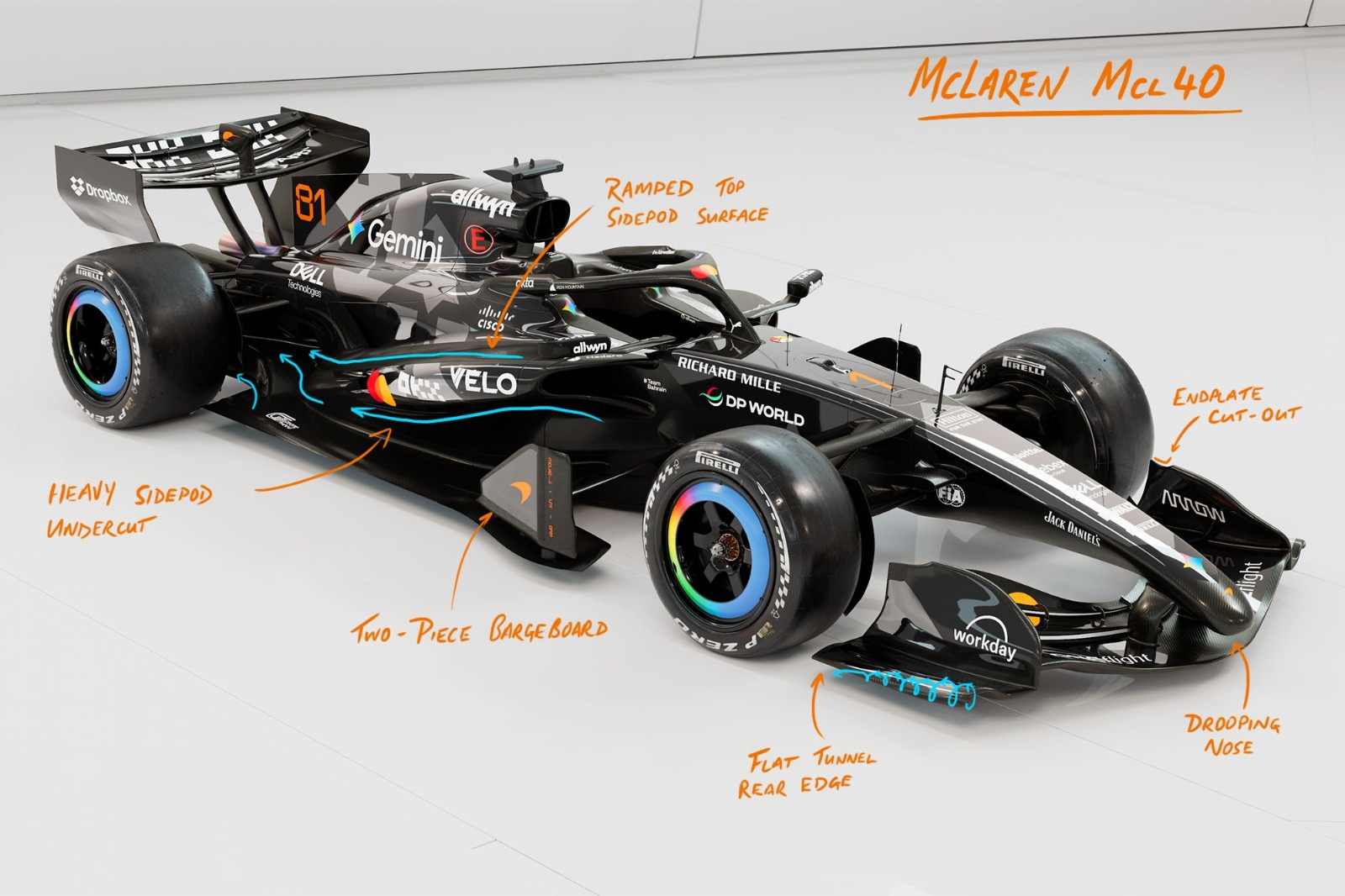
Set off by a drooping nose, the MCL40 has been shown with a curvaceous front wing that lifts up at the outboard sections to assist with trimming the front wheel wake. The endplates, featuring a small cut-out on the top edge, appear to be responsible for both in- and out-wash to contain that wake, ensuring the turbulence shed by the tyres is less likely to bleed into the underbody. The footplate features the standard vortex tunnel, squashed at the trailing edge to allow this to be fired outboard to enhance any out-wash wake management.
Behind this, McLaren has persisted with its dropped rear leg on the upper front suspension wishbone, bringing it very close to the mounting point of the equivalent leg on the lower suspension members - which in turn has been set back along the lower edge of the chassis bulkhead. There's more detail here to note: the steering arm has been mounted separately, running in parallel to the first lower suspension member - which itself does not form part of a conventional wishbone, as the rear leg is mounted higher on the front wheel upright.
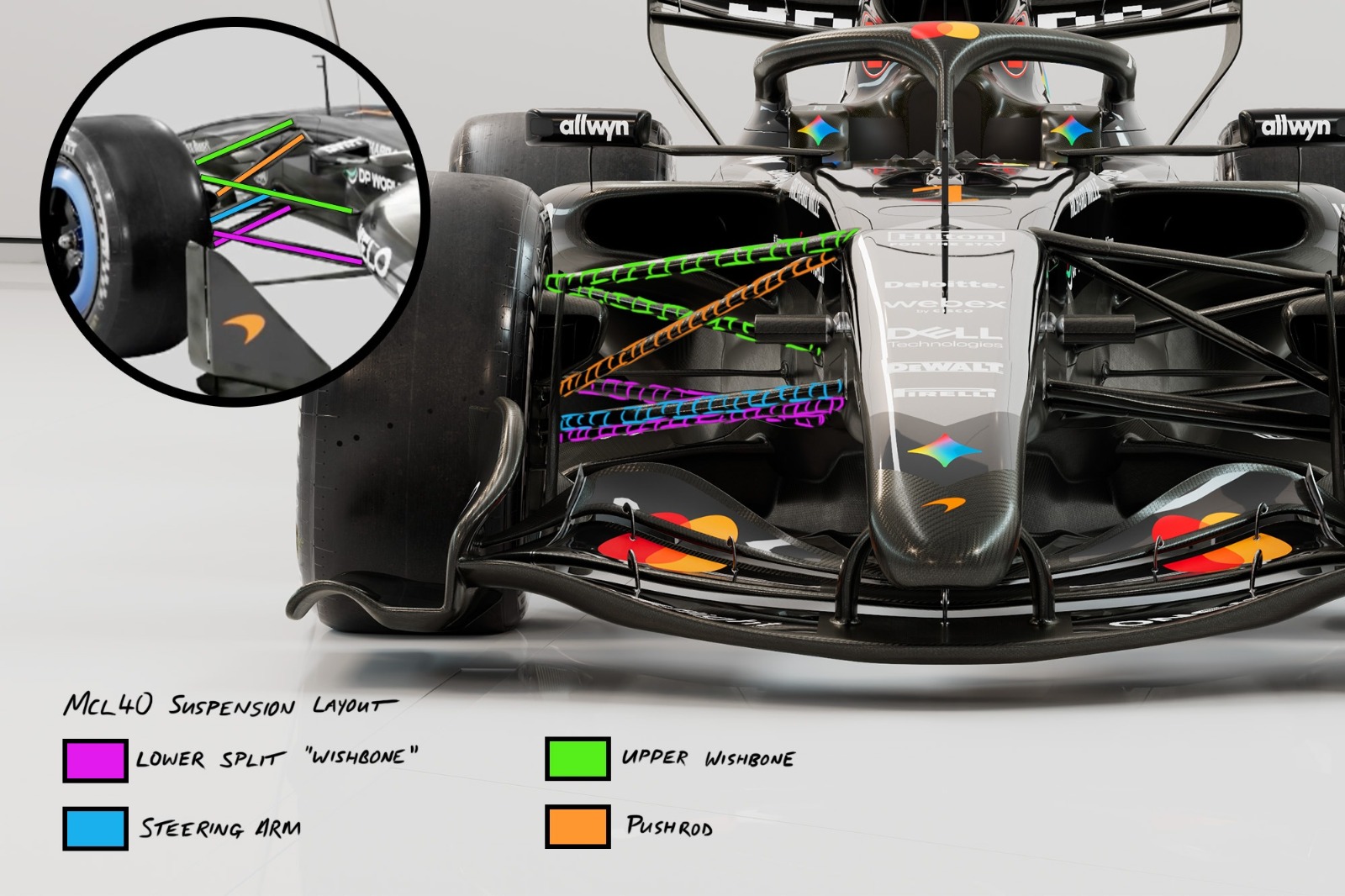
Evidently, McLaren has looked to continue with a similar ethos of platform control as it had last season, this time augmented by a switch back to push-rod suspension for the first time since 2021.
Marshall explained the difference, and that much of it falls to the aerodynamic interaction with the front wing. Since the nose occupied the central section during the 2022-25 ruleset, it meant that the pull-rod probably needed to be responsible for picking up flow in this area rather than allow it to wash around freely. With more front wing real estate offered by the new regulations, presumably this can be fulfilled by the wishbones alone.
"It really comes down to an aerodynamic choice on what front suspension set suits your new front wing," Marshall said at a McLaren launch event for select media. "Obviously, the new front wings are all new. I guess the way that the teams that you've seen so far have developed have basically organised their suspension sticks to suit their front wing package and their front-end package. It's really aerodynamically driven. Both are quite easy to do mechanically; they're not a particularly difficult mechanical challenge."
McLaren expects the car to be in a similar specification from Barcelona to Melbourne, as it wants to spend time understanding its new steed before it rings the changes. It's a prudent approach, one typical of an Andrea Stella-led McLaren
Versus many of the other designs seen thus far, McLaren's approach to the bargeboards looks comparatively simple - at least, on these renders thus far. It has a two-piece solution, the vertical leading edge piece feeding into a triangular second board, inwardly angle to capture the out-wash flow and tuck it in around the sidepods. This is held to the chassis with a horizontal stay, which should confer a small aerodynamic benefit. One might imagine the wakeboards here might receive a bit of attention - unless, of course, McLaren has found that less is more.
A heavy sidepod undercut drastically shortens the path of the overall airflow towards the upper surface of the diffuser. Furthermore, the top-side of the sidepods retain a ramp which tucks in at the rear to allow the two streams of airflow to merge together and feed the Coke bottle area of the car. Doing so pressurises the top surface of the diffuser, increasing the pressure differential between that and the underside - ultimately, contributing to downforce.
There's an intimation towards some degree of rake being used by the MCL40 too; for those who weren't around pre-2022, this is when the rear ride height is raised more versus the front, so it looks like the car 'leans' forward when viewed from side on. Doing this essentially creates more diffuser space and, in conjunction with the aero components around the rear corner of the car, can be done without exposing the diffuser to any low-energy air if sealed correctly.
"I think the amount of rake you run on the car is really going to depend on your aerodynamic package and where your peak is," Marshall added. "I guess the intention of these regulations was to try and force the rear ride heights up and I think that certainly, from our experience, our feel is that that will be the case. How high they go, we don't really know yet; how low you can go, we don't really know yet.
"There's a big journey to go on in Barcelona to try and find out where best to operate the car. In terms of running high rake is traditionally when you get a bit of free angle of attack on your wings - and if you can get the aerodynamics to hold on, then it's great.
"It offers you the opportunity to have more suspension travel as well as other tertiary benefits but ultimately you're chasing the peak of aerodynamic performance and you want your rear end to follow it. That might be high rake, might be low rake. I don't think it'll be low rake but it might be less high than people think or it might be higher than I think."
Marshall also made a small admission that, in defining the MCL40, he'd taken inspiration from the myriad cars on the McLaren Technology Centre boulevard - the main atrium in which the team's previous machines are displayed. But here's the multi-million dollar question: did he take inspiration from the championship contenders, or did he spend a worrisomely long time staring at the MP4/9?
The team will very much hope that it's the former. The MCL40 features a vast amount of innovation around its front suspension components, as it had done under the previous ruleset, and has pushed the boat out with its choice of mount-points and geometries to stabilise the car and simultaneously chase the local aero benefits.
McLaren expects the car to be in a similar specification from Barcelona to Melbourne, as it wants to spend time understanding its new steed before it rings the changes. It's a prudent approach, one typical of an Andrea Stella-led McLaren, but this approach sometimes manifests as overly cautious. And, while the car might look 'cautious' on the first glance - some of the finer details suggest that it's anything but.

Can the MCL40 contribute to a third consecutive constructors' crown?
Photo by: McLaren


The one aspect of the 2026 US GP that should be a blueprint for F1 2027

A strategic masterclass: How Antonelli put himself on the cusp of F1 title at the US GP

Leclerc and Hamilton's differing theories behind Ferrari's Austin qualifying disappointment

What we learned from Friday practice at the 2026 United States GP

The reasons behind Ferrari's US GP upgrades

Mission control: Inside the FIA and F1's remote operations centre

FIA expects F1 races in Qatar and Abu Dhabi to run as planned

Why Piastri has struggled to show his best with this year's McLaren MCL40

The one aspect of the 2026 US GP that should be a blueprint for F1 2027

Red Bull explains why Verstappen and Hadjar's 'silly' problems won't all be fixed in 2026

Why being "very adaptive" gave Norris the edge over Piastri at US GP

Smyth makes Formula Ford Festival history as he wins despite clash with team-mate Murray
Subscribe and access Autosport.com with your ad-blocker.
From Formula 1 to MotoGP we report straight from the paddock because we love our sport, just like you. In order to keep delivering our expert journalism, our website uses advertising. Still, we want to give you the opportunity to enjoy an ad-free and tracker-free website and to continue using your adblocker.


Top Comments