


Mark Donohue's tragic comeback
Mark Donohue returning from retirement to lead Roger Penske's Formula 1 team looked like a perfect match. As ADAM COOPER recalls, though, it ended in tragedy

When Mark Donohue died in Austria 40 years ago this week, motor racing lost not only a hugely successful driver, but also someone who would surely have enjoyed a long and productive career on the other side of the sport.
A mechanical engineering graduate from a wealthy New Jersey background, Donohue won everything in sight on the US scene, in every major category.
From 1966 until his death he enjoyed a close friendship and working relationship with Roger Penske, and together they were a formidable team.
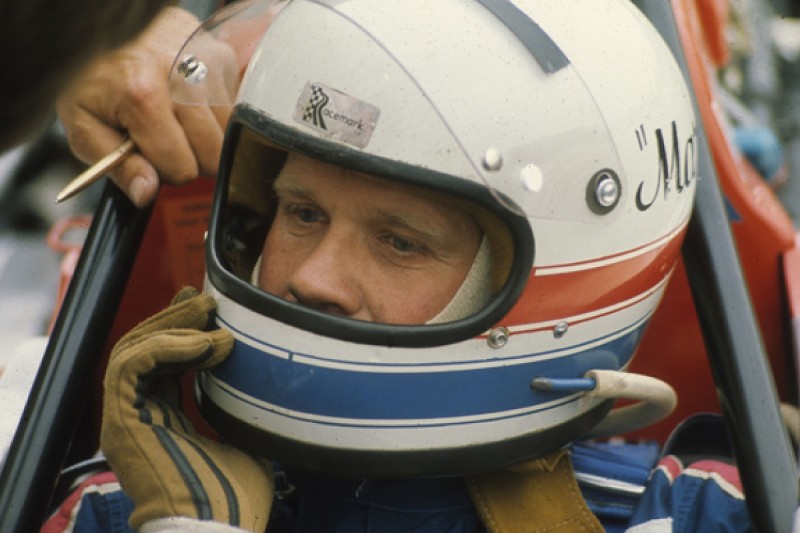
The tragic twist was that he had returned from retirement and a frustrating first stab at management to compete as a 38-year-old rookie in the one arena he had yet to conquer: grand prix racing. Sadly the F1 world would never see how good he really was.
"Mark was a very low-profile, down-to-earth guy," says Emerson Fittipaldi, who first got to know him in the IROC series.
"He was very intelligent. I would say he was an incredible talent, a very technical driver, very focused. He was extremely fast and consistent, one of the best drivers I raced against.
"He started everything with Roger, and it was a very strong relationship. It was similar to Colin Chapman and Jim Clark."
Donohue was far more than just the driver - he was an integral part of the Penske organisation, helping to lay the foundations of the operation that is still winning today.
Decades before studying telemetry and data became the norm, he dug deeper into the realms of car set-up than anyone before him, always in search of what he called 'the unfair advantage' - the name he gave to the book that helped to cement his image as the thinking man's racing driver.
Famously he liked to use a skidpad to explore the mechanical limits of a car - even running single-seaters without wings - as he tried to fine-tune suspension.
"He was very bright and very thoughtful," says former Penske engineer Don Cox. "And he really had a good feel for the car. He worked really hard in the car, and he worked really hard outside the car with the team, trying to organise things. He worked tirelessly, day and night. Roger and Mark were a perfect match."
 Donohue dominated aboard the Porsche 917-30 in 1973, dubbed the 'Can-Am killer' © LAT
|
As the years passed the workaholic spread himself too thinly, taking on too much in too many different categories, and his first marriage collapsed under the strain.
Having won the 1973 Can-Am title he announced his retirement from racing at the end of the season. He still found time to win the inaugural IROC series for Porsche 911s, which concluded in February '74, beating a field that included Fittipaldi, AJ Foyt, Richard Petty, Denny Hulme and Bobby Unser.
By then he was deeply involved in his new role as president of Penske Racing, with responsibility for all racing and engineering projects. He'd been doing much of that work anyway, leaving Roger to develop his other businesses, but now it became all-engrossing.
Even so, he found it hard to be on the other side of the pitwall, working with drivers with less understanding of the technology.
Early in 1974 Penske took on one of his biggest challenges when he launched an F1 project. There had been one brief earlier foray when he rented a works McLaren and Donohue finished third in a wet Canadian GP in '71. It was a superb debut performance, but the man himself was underwhelmed, frustrated that he had not been able to sort the car.
"Everyone told me how great it was that I finished third in my first F1 race," Mark wrote in The Unfair Advantage. "But it wasn't so great to me. It was only because of the rain. I was still disappointed in the car, and my lack of ability in getting it developed."
After years of fine-tuning other people's machinery, this time Penske wanted to build his own chassis. He acquired the former Leda/McRae Formula 5000 facility in Poole as a European base, and hired ex-Brabham man Geoff Ferris as designer.
Jochen Mass was initially touted as driver but, after trying the new PC1 on the skidpad and then testing it, Donohue agreed to 'unretire' and race the car. In his book he acknowledged that he was "putting my life on the line again". He was excited by the challenge, and knew it would take time. But it was clear that he had wrestled to justify the decision, both to himself and those around him.
 Donohue was third on his F1 debut at Mosport in 1971 © LAT
|
"Sure, I'm driving race cars again," he wrote. "But it's not so much that I changed my mind, as it's that I'm starting over. It's a different series, on different tracks in different countries, with different drivers in different cars, and it takes a different approach. I've even got a different attitude."
Intriguingly he added: "And to be quite honest, I needed the income."
After extensive testing, the PC1 made its debut in Canada 1974. On the same weekend the rival Parnelli squad also entered F1, with Mario Andretti - some three years younger than Donohue - at the wheel. It was a low-key start, as the Penske finished 12th at Mosport, and then retired with a suspension issue at Watkins Glen.
That winter Donohue married his girlfriend, Atlanta-born model and socialite Eden White, whom he'd met while recuperating from a huge 1972 Can-Am accident. It really was the start of a new life. The couple based themselves in a rented flat in Bournemouth so that Donohue could be near the Poole factory. When not lap-charting, White found time to sell antiques in the Portobello Road with the then partner of Stirling Moss.
The 1975 F1 season began with seventh in Argentina, a retirement after the rear wing began to come apart in Brazil, and eighth in South Africa. To his chagrin Donohue never qualified higher than 15th, disappointing for a man so used to setting the pace.
Back in Europe, things didn't get much better. At the Race of Champions he struggled with dire handling gremlins, eventually retiring after two spins. He earned a solid sixth in the International Trophy, but then crashed at Montjuich Park (on oil) and again in Monaco (where the front suspension had begun to flex). He then finished a lowly 11th at Zolder with a poorly balanced car.
By now there were even suggestions that Penske, who spent May overseeing his Indianapolis 500 effort, was losing interest.
Donohue couldn't get the PC1 to his liking, and matters were confused by regular swapping between two chassis, and experimenting with long/short-wheelbase and wide/narrow-track versions. For once his secret weapon - the skidpad - hadn't helped.
 The first of Penske's 16 Indianapolis 500 victories came with Donohue in 1972, but the team's F1 project was a grind © LAT
|
"Tyres I'm used to will come up to operating temperature and stay there," he told AUTOSPORT's Pete Lyons that summer. "But these tyres just get hotter and hotter on the pad, so you can't get the car to settle down."
He also struggled to adjust to the rhythm of F1 race weekends. The schedule didn't allow him the mileage he required to dial both the car and himself into circuits that he was experiencing for the first time.
In addition Penske was a small, one-car team and, despite its high-profile Citibank sponsorship, the budget was tight. Nick Goozee, then a mechanic/fabricator, and later to become boss of Penske Cars, has an interesting take.
"Although by no means an attention seeker, Mark was used to being the centre of attention," he says. "But the American F1 teams of 1975 were very much regarded as being the second string in the paddock. Mark was used to being able to wander up and down the pitlane and look at the opposition - who probably regarded it as being a bit of an honour - taking in the technical differences between cars.
"The F1 fraternity were not welcoming in that, or perhaps any other, respect. So much was different to driving an F1 car compared to the Can-Am and Indycars of the day. Mark became frustrated with the performance of both the car, and himself."
Goozee adds that PC1 designer Ferris found himself sidelined as Donohue took sole charge of engineering matters. This was a team used to buying a car and honing it, rather than working with the guy who had actually created it.
"In America things were different," says Goozee. "There the chief mechanic was omnipotent and he formed part of a triumvirate between himself, the driver and the team owner, who together took on the responsibility of the performance and the development of whatever car they were racing."
Off track Donohue had a boost when oldest son Michael - about to turn 11 - made a summer visit to the UK, although as ever work took priority.
"As soon as I landed we went to a test session at Silverstone," Donohue Jr recalls. "He and my stepmother were living in a flat in Bournemouth. I don't think he cared so much where he lived - it was just close to the race cars.
 A pair of GPs in 1974 yielded 12th in Canada and a DNF on home soil © LAT
|
"I hung around with them for a few weeks, but the only race I went to was Zandvoort. We took a day trip over to Italy to see some steering-wheel manufacturer! I don't think they came back to the States much - frankly money was kinda tight."
Donohue picked up Penske's first points with fifth in Sweden, and he finished eighth in the Netherlands, but he was still qualifying in the 16th-18th range.
It was time for a rethink, in part to keep an impatient title sponsor happy. The day after the Zandvoort race Penske personally rang AUTOSPORT to confirm he had bought a new March 751, having initially considered buying a Hesketh.
He insisted it was purely to give Donohue and the team a baseline as they worked to develop the PC1, and that there was no intention of actually racing it.
There was some optimism when the newly supplied chassis lapped Silverstone 2.5s faster than the Penske. It was soon clear that Donohue would indeed race the March, and the PC1 would be mothballed.
Alas the testing form was not backed up at the British GP weekend. Donohue was happier with the 751 - it seemed to respond well to his input - but he again struggled to get up to speed, qualifying 15th.
In the race he at least picked up another two points after being classified fifth, despite being one of many to crash in the rain before the red flag.
After Silverstone the battered chassis had to be substantially rebuilt before the Nurburgring, where Mark started 19th.
"In Germany we couldn't keep the front tyres on the car," recalls veteran Penske chief mechanic Karl Kainhofer. "We lost a left-front on the first lap, and then the next lap we lost the right-front, and that was the end of it, as he couldn't make it back to the pits."
In early August Donohue made a rare return to the USA to complete a project he and Penske had been working on for a while: an attack on the world closed-course record with a modified Porsche 917-30K Can-Am car.
 Penske's PC1 scored points just once from its 10 starts © LAT
|
After learning valuable lessons in an abortive effort at Daytona earlier in the year, and subsequently tinkering with the package, he lapped Talladega at over 221mph. Job done.
Donohue headed to the Osterreichring buoyed by the achievement, as Lyons noted: "He was still in the grip of a kind of quiet euphoria about it in Austria. 'It's the only thing I've accomplished this year', he said with a small grin."
Back in the F1 car, things didn't go as smoothly. It rained for much of Saturday and, unable to build up to a faster time, Donohue had to settle for 21st, set in a brief dry window early in the day. Along with Zolder, it was his worst grid position of the season.
Kainhofer says that Donohue was experimenting with low tyre pressures: "Mark being the engineer, he really called the shots on the set-up. He tried very hard to make the car work by adjusting the chassis and tyre pressures. We had a problem with the front end of that car. When you try so hard to make it work, you're bound to go in the wrong direction. Low tyre pressures create a lot of heat."
Early in Sunday's dry morning warm-up Donohue was approaching the fast right beyond the pits when he suffered a failure of his left-front tyre, heavily loaded through the previous corner.
The March slammed into the catchfencing, which bunched up underneath the car and helped to launch it over the barrier and into an advertising hoarding.
"I saw he'd crashed and I stopped my car," recalls Fittipaldi. "I went there and he recognised me. He used to call me 'Emmy', not Emmo. He said, 'Emmy, Emmy'. I said, 'Mark, are you doing OK?' He said, 'I'm fine, I'm fine'."
Donohue appeared to be uninjured, but he'd received a blow on the head, from either a catchfence post or the scaffolding poles supporting the sign. The March's trademark forward-facing rollhoop stays, which were bent, had at least protected him to some degree.
 The switch to a March chassis brought slightly improved results © LAT
|
"We took the helmet off, and he was sitting completely in a normal position," says Fittipaldi. "And then we walked him to the ambulance, myself and Rolf Stommelen, maybe 150 metres. He walked next to me. I held his hand, he was a little dizzy, but we walked. The ambulance was right where I parked my car."
Donohue was taken initially to the mobile grand prix medical unit that travelled to every race, where several people talked to him, including Kainhofer and Andretti.
After complaining of headaches and becoming disorientated he was then transported by a military helicopter to a hospital some 50 miles away in Graz, a facility known for its expertise in neurosurgery.
Meanwhile Kainhofer drove White back to the hotel on Donohue's scooter. They picked up Donohue's loaned Porsche 911, and raced to the hospital.
Donohue's condition deteriorated in the helicopter after a blood clot developed, and he was soon in surgery as doctors attempted to relieve the pressure. His father, his mother-in-law and Penske all flew from the US on Sunday night, arriving on Monday.
It was clear that the situation was dire, and on Tuesday evening Donohue lost his fight for life. A marshal, Manfred Schaller, also died as a result of injuries sustained in the accident.
Early in 1976 a legal action was launched by the Donohue estate, claiming that the tyre was defective. In 1984 the Rhode Island Superior Court made an award of $19.5 million against Goodyear, and following an appeal the case was finally resolved two years later with an undisclosed out-of-court settlement.
The whole affair proved disappointing for everyone who had worked with Donohue, who was well aware of the risks he faced every time he sat in a racing car.
It's easy to imagine Donohue, a month younger than Penske, still working with the organisation he helped to start. As for his legacy, it lies in the extraordinary success achieved by the team, which celebrates its 50th anniversary in 2016.
"I worked for Roger Penske for a number of years," says Michael Donohue. "He turned to me one time and said, 'You know, your dad taught me how to manage.' He was doing way more than what drivers do today."

Krack: Aston Martin F1 team no longer in “no-man’s land”

Gasly rues costly floor damage from Ocon contact in F1 Japanese GP

Andretti planning F2 and F3 entries to promote US talent to F1 team

Andretti F1 team formally opens new Silverstone facility

RB: Tsunoda “mentally on a different level” in 2024

Russell: Dirty air is causing F1 helmet turbulence problems

Vasseur: No guarantee that Ferrari F1 tyre issues are resolved

How an F1 underachiever became a Japanese political player

Super Formula Fuji: Iwasa wins as Ohta misses chance to seal title

MotoGP Indonesian GP: Bezzecchi leads Aprilia 1-2-3-4; Martin reclaims points lead from Marquez

Marquez protege Quiles wraps up 2026 Moto3 title in Indonesia

Supercars Bathurst 1000: Kostecki and Hazelwood win after leaders De Pasquale and Holdsworth run out of fuel
Subscribe and access Autosport.com with your ad-blocker.
From Formula 1 to MotoGP we report straight from the paddock because we love our sport, just like you. In order to keep delivering our expert journalism, our website uses advertising. Still, we want to give you the opportunity to enjoy an ad-free and tracker-free website and to continue using your adblocker.


Top Comments