


How Verstappen’s two subtly different laps beat Hamilton in Bahrain GP in Malaysia qualifying
Either of Max Verstappen’s Q3 laps would have been good enough for pole position ahead of Lewis Hamilton, and the differences between them are intriguing

"I think, in general, it’s been an incredible result for us," said Max Verstappen after annexing pole position for the Bahrain Grand Prix at its proxy venue, Malaysia's Sepang circuit. This was Verstappen's first pole position all year.
"Looking at the season, how it started for us and the progression that we have made. At some tracks we were kind of close, but now I think this weekend it was very positive for us. I think from FP1 we started quite well and from then onwards we’ve just been trying to improve the car further. It’s incredible, honestly. I’m very happy to be on pole here."
Considering how talkative and spiky Verstappen has been after some problematic qualifying and race outcomes this season, the rather anodyne nature of his discourse in the wake of his Saturday performance in Malaysia almost made you wish you could summon Angry Max back to explain it instead. This was a consummate performance in hostile conditions on a tricky circuit; and, in a car which has at best been a fringe candidate all season, either of Verstappen’s two Q3 laps would have been enough for pole position.
What’s interesting is that, while they were separated by just 0.12s, the two laps unfolded with subtle differences: in the faster of the two, Verstappen was actually slower through the first sector than he had been through the opening lap. If the improvement from one to the other had been purely linear, you could explain it through track evolution; but this was a different way of extracting more and demonstrates the fine nuances drivers have to explore in arriving at a 2026 Formula 1 car’s ‘optimal lap’.
Both Red Bulls had been mighty through Sepang’s first sector, where the outcome is largely dictated by one of circuit architect Hermann Tilke’s signature features: a first corner with a tightening radius, leading to another which opens out, but with a transition to negative camber. It’s designed to provoke mistakes, to encourage drivers to be too greedy on the brake at entry and throttle at exit.

This was Verstappen's first pole position in a troubled season
Photo by: Sam Bloxham / LAT Images via Getty Images
On his first lap, which was the faster of the two by a tenth of a second through this sector, Verstappen actually lost three tenths here relative to his later one before regaining all of that and more. Here he braked slightly earlier and overlapped with the throttle more to help the car to turn, then released the brake and reapplied it twice more as the nose began to plough slightly wide.
On the second lap he braked later, having already got off the throttle, and held on to the braking phase for longer before applying throttle more aggressively between the two apexes. This left him transiently three tenths up on his previous lap but, despite getting on the power again at an almost identical point, he was slightly slower through Turn 3 and onto the straight.
A factor of a slight decline in track temperature, or the vagaries of electrical deployment? Possibly the latter, since Verstappen was already carrying a warning for driving too slowly on a previous out-lap, so his power unit might have had fractionally less charge available.
A steeper speed decline while off the throttle for Turn 4 on the second lap suggests a little more energy being harvested under braking, and Max remained slower through sector two than his first Q3 lap despite lifting off less aggressively for Turns 5 and 6. On his second lap he was marginally quicker along the short straight towards Turn 7 and 8, but a feathering of the throttle while under power at the apex of Turn 8 sapped his impetus. He was then slower along the straight to Turn 9 and exited the sector over a tenth down on his previous lap.
The third sector is where Max’s second lap came alive and the inversion point is clear: he was able to get off the throttle slightly later at the transition from Turn 13 to 14, the tricky combined downhill double right hander where the second is tighter than the first, tempting drivers to be greedy. By the exit of Turn 14 he was even with his previous lap and stayed that way along the back straight, backing off slightly later for the final corner but being able to sweep round in a tighter line to find that crucial tenth before he’d even hit the throttle at the exit.
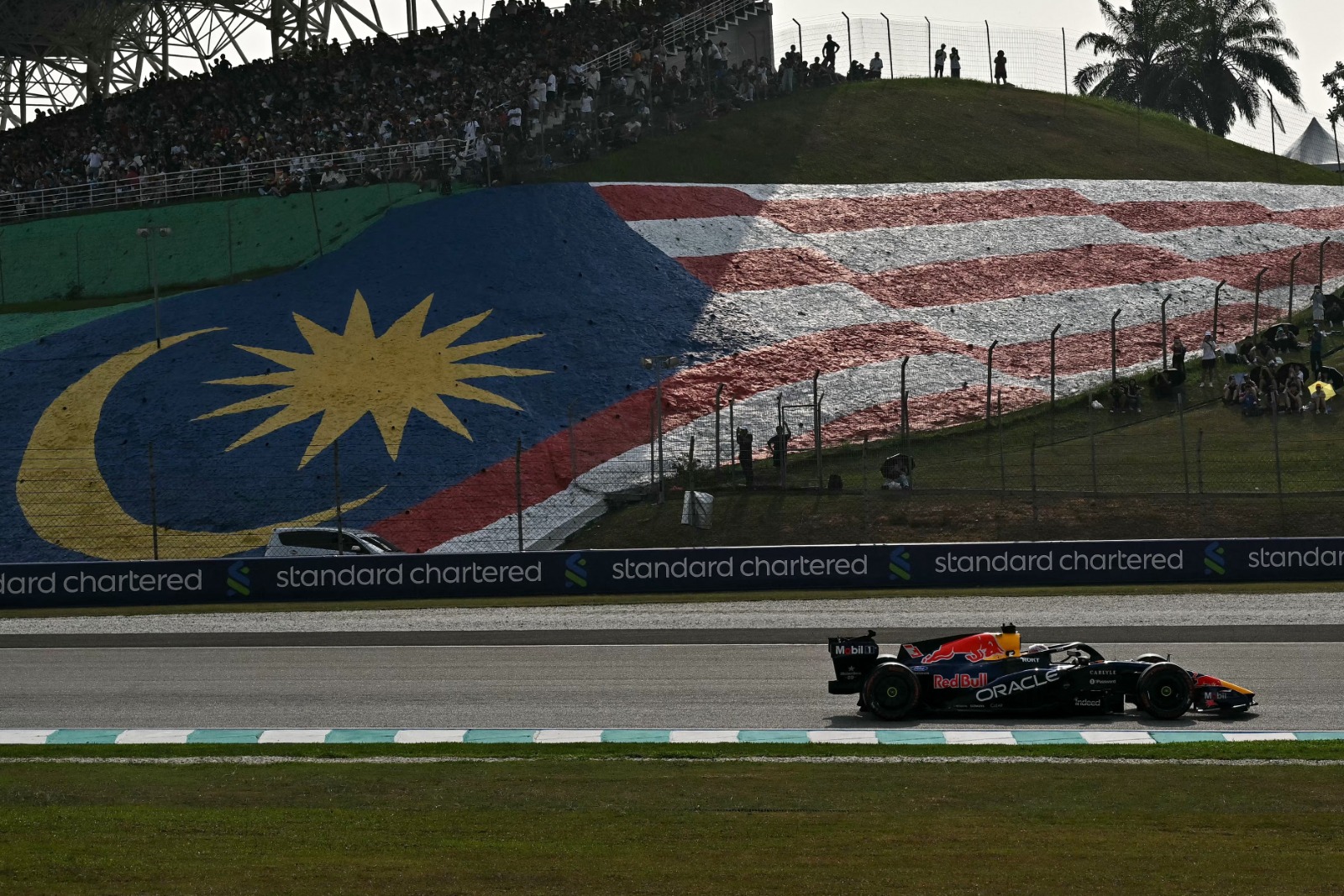
Red Bull seemed to suffer less understeer than others on the abrasive Sepang circuit
Photo by: Getty Images
Comparing Verstappen’s fastest lap with Hamilton’s to account for the 0.298s is a study in these cars’ different performance envelopes. The Ferrari usually thrives in slow corners but, despite Additional Development and Upgrade Opportunities (ADUO) work on the turbo compressor it’s still left behind on the straights.
Despite this, as our graphic shows, Hamilton lost a chunk of time to Verstappen through the fiddly opening complex, chiefly by having to be on the brakes for longer, but then mitigated this with the Ferrari’s greater low-down punch at the exit. He then lost more at Turn 4 before inverting the delta through sector two.
Where Verstappen had to go to half throttle through Turns 5 and 6, Hamilton only briefly dipped below 70%. He was then far later off the throttle into the following corners, carrying more speed through the following two.
Although the Red Bull then hit a higher top speed on the approach to Turn 9, Hamilton was later off the throttle again and enjoyed better punch out of Turn 9, a tricky left-hander which leads uphill, where it’s very easy to break traction and spin up the rear tyres. Hamilton was faster through this sector than Verstappen, and up on him overall, but then the gap evaporated in the final sector.
Once the Red Bull-Ford powertrain came on song up the hill through Turn 10, Verstappen was a full 13km/h faster than Hamilton. And although Lewis carried more speed through Turn 11 this barely stemmed the tide. All the way along the back straight, the Red Bull was just faster – mostly by 8km/h, though that widened dramatically as Hamilton lifted off earlier for the final corner, likely through having to harvest energy for the lunge to the tape on the next straight.

Hamilton had the upper hand in second sector but Ferrari is still losing out on top speed
Indeed, that fattened the deficit to half a second before Hamilton recouped a couple of tenths by getting on the throttle earlier at the final corner.
"The car felt great," said Hamilton later. "We’ve made lots of changes. I think they’ve got a great package. Red Bull have obviously been making some great progress. The only place we lose is down the straights to them. I think we’re losing three or four tenths on the straights to them, which we know of, and so we just work as hard as we can to try and maximise in the corners.
"But I think we were able to do that today. So, this is really down to the mechanics and the engineers. We all did a really great job together, and then also execution was really on point. So, if we could keep this up, hopefully we can get better results moving forwards."


Why Mercedes' upgrade is still a "big question mark"

The unpredictability to expect for F1's one-off return to Sepang in 2026

Ocon fighting for his F1 future - but is adamant he deserves to stay

Audi confirms plans for new F1 base

Why Mercedes is still quicker than McLaren

F1 Bahrain GP in Malaysia: Leclerc leads second practice from Hadjar

LIVE: F1 Bahrain GP in Malaysia updates - FP3

F1 Bahrain GP in Malaysia: Verstappen dominates for pole from Hamilton
How Verstappen’s two subtly different laps beat Hamilton in Bahrain GP in Malaysia qualifying

How the FIA plans to differentiate between Rally1 and Rally2 in WRC 2027

"The FIA needs to step in" - Russell's cooling vest comments explained

McLaren explains recurring Norris straightline speed issue after Bahrain GP qualifying
Subscribe and access Autosport.com with your ad-blocker.
From Formula 1 to MotoGP we report straight from the paddock because we love our sport, just like you. In order to keep delivering our expert journalism, our website uses advertising. Still, we want to give you the opportunity to enjoy an ad-free and tracker-free website and to continue using your adblocker.


Top Comments