


How Turkey was established as Tilke's F1 gold standard
When the Istanbul Park circuit first joined the Formula 1 calendar in 2005, it quickly won over the drivers. Reflecting 15 years later as it prepares for its F1 return, that same enthusiasm is unchanged

He's one of the most influential Formula 1 figures of the past two decades. But considering his relatively low profile, track design supremo Hermann Tilke is also one of its more divisive. While hardly to blame for all of F1's ills, 'Tilkedrome' has become a byword for modern circuits lacking in soul and frequently producing dull races.
Tilke does have a few uninspiring duds in his back catalogue - Yas Marina in Abu Dhabi and Sochi are perhaps the pick of the bunch - but to focus wholly on these wouldn't do justice to his contribution. Take the Istanbul Park track, which is making its welcome return to the F1 calendar this weekend for the first time since 2011. Back in 2005, when Turkey first joined the calendar, it made an instant impression with drivers and engineers alike, and quickly became a template for all modern F1 venues to follow.
Fifteen years since its maiden race, drivers from that landmark grand prix remember their first impressions of Istanbul Park with considerable enthusiasm.
"I think [Tilke] had a bottle of Tequila one night and said 'OK, I'm going all-in now, I'm going to really show what I've got!'" says Robert Doornbos, who finished 13th in the inaugural Turkish GP for Minardi. "Mega is all I can say.
"The long drafting straights where we had the two Red Bulls collide [in 2010], the uphill-downhill obviously, the eight-second [Turn 8] left-hander with 5Gs on the neck, it's an amazing track, and an amazing facility for that time. One of his best, if you ask me."
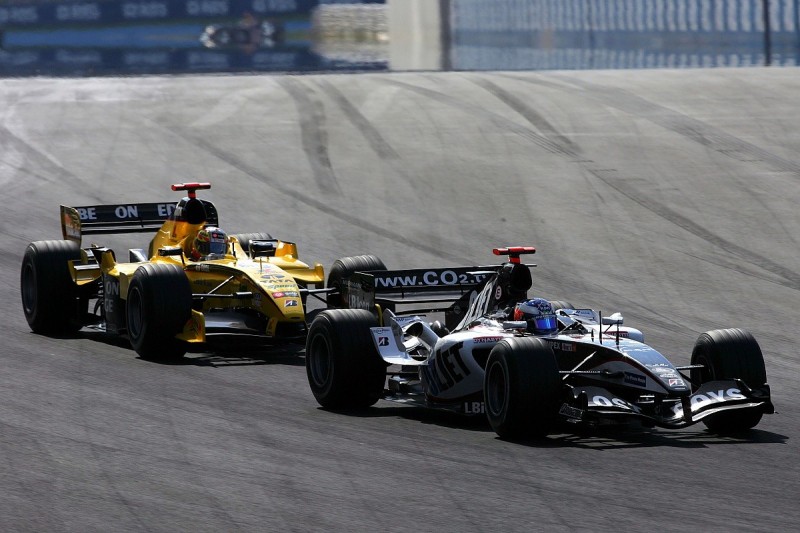
Former Jordan driver Tiago Monteiro, the last classified finisher in 2005, says of Tilke's tracks: "They look good sometimes on TV but are sometimes not always the most fun tracks to drive - but Turkey was probably one of the most amazing and most exciting racetracks. It has many exciting corners and of course the long triple left Turn 8 was just unbelievable. It would destroy your neck, destroy your tyres, destroy you completely."

As a counter-clockwise circuit, Istanbul Park is immediately in the minority among F1 venues. Together with another recent F1 returnee Imola and the aforementioned Abu Dhabi, it will be one of only three tracks on this year's calendar with a left-handed first corner (Baku, Singapore, Circuit of the Americas and Interlagos all being absent this year thanks to the pandemic). But that fact alone doesn't automatically qualify it as an instant classic.
Rather, it's the circuit's abundance of overtaking opportunities and constant elevation changes - much like recent Portuguese GP venue Algarve International Circuit - that make it a modern classic.
"I think we all really enjoyed it as a circuit," says 2009 winner Jenson Button, who charged back from a disappointing qualifying to finish fifth for BAR in 2005. "We loved going to new places and that was one of the good ones. It was like 'ahhh, this one doesn't feel like you're on an airfield'.
"There were lots of camber changes, undulating - a wicked circuit, I loved it. As a circuit, it's a bit like Portimao is now. People look at it as such a flowing undulating circuit and it was, that was our Portimao if you like."
PLUS: Why Istanbul could produce another slippery challenge for F1
"I remember struggling big time. You were having maybe 5Gs for many seconds and even though you are fit and prepared for racing, there's not many people that can sustain for so long" Tiago Monteiro
Former Red Bull race engineer Ron Hartvelt (below, right), who worked with Christian Klien in 2005, remembers being taken aback on the track walk by this very point.
"I remember Turn 3 and 4 where you have a right-hander and then a sharp left-hander, I was sitting on the asphalt together with Christian, and we thought 'man, you can't even see the next corner!'" he says. "The elevation is something that you normally never see, or never comes across so well on TV, but it is very much there."
Hartvelt also recalls it being a challenge for drivers to set-up their cars.
"The combination of corners varied from high-speed to low-speed and that differentiation in terms of mechanical balance versus aerodynamic balance is quite important," he says. "It's quite a wide variety of corners and that is the challenge in Turkey."

The result is a circuit that is tough to really nail a lap - especially so in 2005, when F1 was still using grooved tyres that had to last an entire race distance.
"It was a real tough one to get right," confirms Button. "Turn 8, if you could hold on, it wasn't too bad. You could gain a little bit there by pushing a bit harder and risking a bit more, but in a race situation it didn't make that much difference. It was more the corner after that, you had the downhill left-right which was really tricky braking into it.
"Then the last three corners, which are really slow, probably the most boring corners but the toughest to get right and you're in them for longer so there's more time to gain or lose. You could also go side-by-side as I did with Lewis [Hamilton] in 2010."
Button believes that the "unreal" suspension technology means that most drivers won't find Turn 8 too difficult this weekend - "they're floating on a cloud and for us that was probably the bigger thing because it was up and down the whole time" - in spite of the more advanced aero forces in the 2020 cars significantly increasing lateral loads. But in 2005, it was a very different story, with Klien asking Hartvelt for additional helmet support on the grid before the race.
"That's something we rarely used because those guys are all pretty fit," Hartvelt says. "But Christian said, 'oeer, let's put one on the right-hand side'."
But the Austrian, who went on to score a point for finishing eighth, certainly wasn't the only one.
"I remember struggling big time," says Monteiro, who suffered a tooth abscess, which was famously treated by his team boss Colin Kolles after qualifying. "You were having maybe 5Gs for many seconds and even though you are fit and prepared for racing, there's not many people that can sustain for so long."

Doornbos says he "didn't have the talent to be so trustworthy on my talent alone" and set out to make sure he was physically capable of hustling the Minardi around.
"I had to train harder than anybody because I never wanted to be struggling in the car thinking about my physique," he says. "If you see a picture from my neck back then and now, I look like a bull! I did a lot of hours in the gym with the weights on the helmet and I didn't struggle. But to be honest in the Minardi the G-forces are a little bit less..."
The single-shot qualifying format of 2005, with cars running in reverse championship order, exaggerated the effect of the constantly-evolving track and meant mistakes were heavily punished. Button suffered a high-speed wobble at Turn 8 that left him 13th on the grid, 3.3 seconds behind poleman Kimi Raikkonen and sharing row seven with Monteiro, while Michael Schumacher had to abort his lap after a spin. Doornbos also had a qualifying to forget when his brakes stuck on and caught fire.
"It's better than COTA. That's good because it has a bit of everything so you can overtake, so it works. But Turkey is definitely the best" Jenson Button
"They screwed the floor on, but the wire or the tube that went to the rear brakes got stuck in-between the floor and a part of the body," he says. "Basically, I was driving with the handbrake on!"
The resultant lack of power made it immediately obvious there was a problem, as the Cosworth V10 "was scarily fast even in the Minardi".
"I was flat out through the [Turn 8] left-hander, and I was easy-flat - in the Minardi it was never easy-flat," he says. "I came on the radio and said 'guys, something is wrong' and then they said 'yes, we can see you're on fire!' There was a rear-brake failure, so unfortunately I didn't do a flat-out qualifying lap."

After the drama of the build up to Turkey's inaugural grand prix, the race at the front wasn't hugely memorable. Raikkonen was jumped by Giancarlo Fisichella's Renault, only for the McLaren driver to capitalise on the Italian running wide exiting the Turn 10 chicane and retake the lead into the heavy braking zone at Turn 12.
Fisichella was ordered to let team-mate Fernando Alonso through on lap two and dropped out of contention with a fuel rig problem, but McLaren's superior pace meant Juan Pablo Montoya moved ahead of Alonso after the pitstop phase.
All was looking good for a 1-2, with Raikkonen continuing serenely in the lead, until Montoya lapped Monteiro and promptly moved across the Jordan's bows to take the racing line for Turn 12, catching Monteiro completely by surprise. Cue a spin for Montoya and damage to the diffuser, which contributed to his late off at Turn 8 and allowed Alonso back into second. Afterwards. both Montoya and Monteiro were summoned to see FIA race director Charlie Whiting, but no further action was taken.
"I think Charlie at the time understood exactly what happened, and I think with hindsight JP understood as well," says Monteiro. "He was pissed off but I just told him to f*** off because without even looking at the images I was really sure I didn't do anything wrong.
"You can brake at a certain distance if you have the downforce, but if you don't then there's no way the car is going to slow down in the same distance. When I hit the brakes, I had maybe 50% less downforce than I was supposed to because there was a car in front of me, which wasn't there half a second ago. I was really furious because we both hurt our races. But I think most of the people realised I wasn't the one at fault."
Thanks to Monteiro's incident, Doornbos beat both Jordans in the race, the maximum target a Minardi could attain that year.
"I remember coming back into pitlane and they were spraying champagne, they were really happy," chuckles Doornbos. "They had cake and everything. I thought 'what did I miss?' I really enjoyed my race, but we had no points."
Monteiro's woes were nothing compared to those experienced by Williams drivers Mark Webber and Nick Heidfeld, though. Both suffered repeat Michelin tyre failures and retired - although not after Webber had tangled with Schumacher trying to unlap himself at Turn 12. But, unlike two months previously at Indianapolis, where all the Michelin runners were unable to race due to fundamental construction problems, the issue was later traced to deflections in the floor damaging the tyre on out-laps when it was still coming up to pressure.
"I'm sure that as a result in terms of construction, Michelin might have been a bit more conservative," says Hartvelt, "but I can't remember us having particular issues."
F1's return to Turkey is likely to be a short lived one, even though a vacant slot remains open on the provisional 2021 schedule that was revealed on Tuesday. It would be a real shame if it were to fall off the calendar permanently so, for the time being, let's make sure to enjoy the fastest cars in F1's history on a circuit that could legitimately claim to be the very best that Tilke has to offer.
"Yeah, I think it is," says Button. "It's better than COTA. That's good because it has a bit of everything so you can overtake, so it works. But Turkey is definitely the best."


Archive: When Le Mans made its most controversial change

The man behind Japan's first Le Mans winner

Did Audi ‘give up’ on GT3 too soon?

Alex Zanardi’s top 10 moments

This retro-inspired Mercedes 190E racer is heading to the Nurburgring 24 Hours

Why Verstappen's Nordschleife approach is a win-win for motorsport

The new Mercedes star who had an unconventional route to success

Why Rast is leaving the DTM

Why F1's Madring debut was a wasted opportunity

Bruising F1 2026 will not be the end for Russell - Wolff

Haas confident of getting 2027 F1 budget closer to cap with new partner talks

Top 10 Can-Am drivers
Subscribe and access Autosport.com with your ad-blocker.
From Formula 1 to MotoGP we report straight from the paddock because we love our sport, just like you. In order to keep delivering our expert journalism, our website uses advertising. Still, we want to give you the opportunity to enjoy an ad-free and tracker-free website and to continue using your adblocker.


Top Comments