


How Tsunoda plans to achieve his F1 potential
Yuki Tsunoda arrived in grand prix racing amid a whirlwind of hype, which only increased after his first race impressed the biggest wigs in Formula 1. His road since has been rocky and crash-filled, and OLEG KARPOV asks why Red Bull maintains faith in a driver who admits he isn’t really that big a fan of F1?
When he was already a racing driver, Yuki Tsunoda attended a school in his native Sagamihara that years before had also hosted Ukyo Katayama, the man who up to this day still holds the record for most Formula 1 starts among Japanese drivers. It’s an amazing coincidence given that, before Tsunoda, F1 history included just 17 other racers from Japan, a country with a current population of 126 million people.
“And when I moved to a different high school, it was Takuma Sato’s old school,” a smiling Tsunoda reveals in a conversation with GP Racing. But then he admits right away that he only recently became aware of this - and, in fact, of who Katayama and Sato are at all.
It’s because Tsunoda was never an F1 fan – even though his father liked racing and even took part in local competitions.
“We went to a couple of F1 races,” he recalls. “First time was in Fuji when I was like seven. I remember it was raining. And I didn’t like the sound. It was so noisy, I was covering my ears all the time. All I remember is that I really wanted to go back home as soon as possible.
“When I was young, I didn’t like just racing. I liked all sports. Football, skiing, snowboarding, American football, basketball, any sport. So it wasn’t just about racing for me at that point. I watched it on TV really just a couple of times. Only during my F2 season [last year], from the middle to the end of the championship, I started watching Formula 1.”
It was another Japanese F1 driver who played a crucial part in Tsunoda’s career, however. When he was a member of Honda’s Suzuka Circuit Racing School in 2016, Tsunoda flopped in a final shootout for a spot on the manufacturer’s junior programme. But Tsunoda was bailed out by Satoru Nakajima, Japan’s first full-time Formula 1 racer and a former Lotus-Honda team-mate of Ayrton Senna’s.
“It was, I think, in November,” Tsunoda says. “Up until then I was quite good, always competing for P1 and P2. From March, because I had almost no experience, I started from quite low positions and improved a lot. But at that point, I was still really weak under pressure. At that last test there were three races. I did jump starts in two races in a row, and also went off track once.

Satoru Nakajima
Photo by: Mark Sutton / Motorsport Images
PLUS: How Japan's first full-time F1 racer accelerated Tsunoda's rise
“So first I heard that I was dropped. But Satoru Nakajima came to the last event. Nakajima was there just [the] last day, and was watching at the chicane, and said he was impressed by my driving, especially in the chicane. So he recommended to Honda to take me to their junior programme.
“If I would be dropped, I was planning to just retire from racing. So if he wasn’t there, I think I wouldn’t be here.”
Of course, Tsunoda didn’t really know who Nakajima was. He just wanted to drive fast cars. From then on, Tsunoda’s career developed rapidly. He won the regional Formula 4 series in 2017 and a year later dominated the national championship, winning seven races out of 14. After a successful Formula 3 test in Hungary, Honda then decided to move Tsunoda full-time to Europe, as he became a member of the Red Bull Junior Team.
"I tried to write [my feedback] on the track map – like, understeer, oversteer. At that point, that was enough. But last bits of details I didn’t know how I could explain" Yuki Tsunoda
Inevitably, it took him some time to adapt in Europe. As Tsunoda admits, he had difficulties expressing himself in English, which slowed down his progress in F3 a bit.
“Of course, Honda was helping me a lot,” he says. “For example, contacting with the apartments, things like that. I also had a personal trainer [from Red Bull], who helped me a lot. But I moved by myself, and in the first half of the season in F3 I struggled a little bit.
“As a kid, I went to international pre-school, and most of the time there I spent speaking English. Even when playing I had to speak English. So compared to most Japanese people my English was quite good. But I didn’t use it much from junior high school. So, to be honest, I forgot most of the vocabulary and, especially first three months after I moved to Switzerland, I was translating everything in my brain.
“First half of the season I struggled a little as well in Formula 3. I tried to write [my feedback] on the track map – like, understeer, oversteer. At that point, that was enough. But last bits of details I didn’t know how I could explain.

Yuki Tsunoda, Jenzer Motorsport, FIA F3 2019
“It took a little bit of time to make a perfect set-up for me. But I improved step by step, and from the second half of season started also to talk a little bit more about details. [The year after] I moved to UK and it helped also quite a lot my English. That was a good step.”
Whatever language troubles and difficulties he faced in adjusting to Europe, Tsunoda made up for through his natural speed. He scored his first F3 victory towards the end of 2019 and was competitive in F2 straight away in 2020. Only radio problems kept him from winning the third race of that campaign in the rain at the Red Bull Ring and, despite a few clumsy crashes, especially in early-season opening laps, Tsunoda would finish the year third, just a point off runner-up Callum Ilott.
That was more than enough to convince Helmut Marko that the rapid Honda protege deserved a shot at F1. The fact that the Japanese manufacturer was gearing up for its final season in the world championship might have influenced Marko – but he’s never particularly shy about rewarding the young and fast.
All in all, it took Tsunoda just two years after the Europe move to reach the pinnacle of motorsport. And F1 didn’t faze him – after all, he didn’t really know that much about it.
“For sure, it wasn’t what I expected,” Tsunoda says of his world championship debut. “I can say that before Bahrain I was really... I wasn’t scared or anything like that. I was even thinking I’d get a podium in first half of the season.”
Tsunoda was second-fastest in pre-season testing, aided by a DRS trick, and the first race left little cause for concern. He didn’t make Q3 – largely because he wanted to try getting through Q2 on the medium tyres, like team-mate Pierre Gasly – but even starting 13th and losing ground early on, he would climb to ninth, producing some stunning overtakes en route.
“After Bahrain, I was really happy about my performance,” he says. “I mean, not fully happy because I didn’t do well in Q2, but yeah, I was quite happy for the performance and also the feedback from people like Ross Brawn, Helmut Marko, Franz Tost. So at that point I think I was a bit too… I was thinking a little bit easy about the situation.”

Yuki Tsunoda and Helmut Marko 2021
After his first F1 race, Tsunoda was called “best rookie in years” by an F1 boss and “a future world champion” by his superiors at Red Bull. Half a year later, not many would agree with these assessments. And Tsunoda himself is ready to admit he probably underestimated the challenge.
“To be honest, yes,” he nods. “Of course, I was watching Formula 1 onboards [before]. And I thought there was just so much grip. Until Formula 2 you can control [the car] even if you have a big snap. And I was thinking that F1, if you have a big snap, you can also control it. Yeah, I underestimated it. Yep. Completely.”
The good news is, he’s in good hands. If there is one team in F1 that knows how to work with rookie drivers, it’s AlphaTauri.
"He is fast and he wants to win immediately, sometimes therefore he is too impatient, but this was also the case with other drivers" Franz Tost
“They all underestimate F1,” grins Franz Tost, whose team gave so many drivers their F1 debut. “He is Japanese, the first Japanese with us. But the rest, I wouldn’t say there is something unique. He is like the other Red Bull Junior drivers, very high-skilled. He is fast and he wants to win immediately, sometimes therefore he is too impatient, but this was also the case with other drivers.
“When they come to Formula 1, they all think they know everything – they are fast, and they easily can do it. And then they have a good race, maybe at the beginning, and then they think ‘so, now I will show them my real potential’. And then they crash.”
Tsunoda did crash, big time, in Q1 at Imola, then spun in the race while attempting to pass Lewis Hamilton on a damp track. Another difficult weekend in Portugal was followed by an outburst in Spain, where he questioned whether AlphaTauri was giving him the same equipment as Gasly, for which he apologised. Then he crashed again in FP2 in Monaco…
For a “best rookie in years”, Tsunoda was definitely making too many mistakes.

Yuki Tsunoda, AlphaTauri
“I said to him, already after the Bahrain race, that he’s on the limit, he can’t be faster, he should be careful now,” continues Tost. “Then in Imola he crashed [on] his first run in qualifying.
“But you can’t warn a driver [beforehand]. He must experience it. And, once he has experienced it, then he knows where’s the limit. But to find out the limit, you have to crash. Or at least to get into gravel with the car. And this happened with him, in qualifying, as well as in FP1. And we discussed this, we analysed everything. Fortunately, he is now in Faenza.”
Tost is being a bit facetious in suggesting there’s nothing unique about Tsunoda among Red Bull juniors. Were that the case, he would probably not have been moved from Milton Keynes closer to the team’s Faenza base – something that wasn’t done with any of the past drivers of the former Toro Rosso outfit.
Now under the team boss’s watchful eye, Tsunoda is learning more about F1, regularly conversing with engineers, training, improving his already quite solid English and even seeing a sports psychologist. Also, as Tsunoda himself admits, this means he’s spending less time “in front of the screen” playing computer games.
In terms of talent and raw speed, Tsunoda might well be one of the most gifted drivers to ever race for the Italian team. But he is definitely a rough diamond in need of much more polishing.
“Without talent, you can’t become successful, it’s clear,” says Tost of his primary criteria for an F1 driver. “The second point for me is always the passion. You must live for 365 days for 24 hours for Formula 1. And the third point is already the discipline. The physical training, the nutrition, the complete preparation, your living style, everything must be adapted to Formula 1.
“Now it depends on Yuki himself how fast he learns, how fast he accepts all this, and how fast he gets used to all this. From the speed, he is belonging to the top drivers. But, of course, he must learn now and he must be disciplined. This is in his hands. We can only advise him.”
The first half of Tsunoda’s rookie season is over. And there’s no talk of podiums anymore.

Yuki Tsunoda, AlphaTauri
“I would say overall it was not a good first half of the season in terms of results,” Tsunoda admits. “But I think I did a lot of experiments. So it was really up and down races and there was not any consistency. For example, I spun in France [in Q1], I did the second time [same] mistake. Which I was not doing much in the previous years. So yeah, a lot of things I am disappointed for my performance and also my driving. But I also learned from it.
“I need more laps. Hungary was a good example. I crashed in FP1 and I ruined my FP2. So I was in only one free practice totally until qualifying, and most of the drivers have three full free practice sessions to, you know, get used to it, to have experience. So I just need more laps. And to achieve that I need more consistency and I need more discipline, to be more calm.”
Before the summer break, Tsunoda stayed in a hotel when he moved to Faenza, but in August he finally settled on a home. He definitely plans to stick around Northern Italy for a while longer. And regardless of the early-season travails, his potential is still obvious.
"If I get P1 that will be great. But I think now I have to focus more to the consistency and laps" Yuki Tsunoda
“I think he improved a lot,” says Tost. “Otherwise he couldn’t have finished sixth in Budapest, because it was quite clever how he drove over there. All his experience and knowledge, and what he learned in the first half of the season came together. And he got it, he got it in a really good way. And I hope that we continue in the same manner.”
Japan has probably not had this fast an F1 driver before. Given Tsunoda’s ties with Red Bull, fans from the land of the Rising Sun may even dream that he’ll become the first Japanese driver to win an F1 race. Ukyo Katayama – yes, that man who went to the same school in Sagamihara some 30 years before Tsunoda – believes his young compatriot has the talent to reach that milestone. In one of his interviews in Japan, he even said he would cry if it happened.
“I’ll try to make him cry, then!” laughs Tsunoda, before sharply changing his tone. “Of course, if I get P1 that will be great. But I think now I have to focus more to the consistency and laps.
“Of course, I am really happy to be a Japanese F1 driver, especially since from Kamui Kobayashi there was no Japanese driver [for seven years]. So, I’m really happy. And it really is a shame there is no Suzuka this year, but I’m really happy if I can make Japanese fans happy with the results. But yeah… to achieve that I need more discipline and calmness. And laps.”
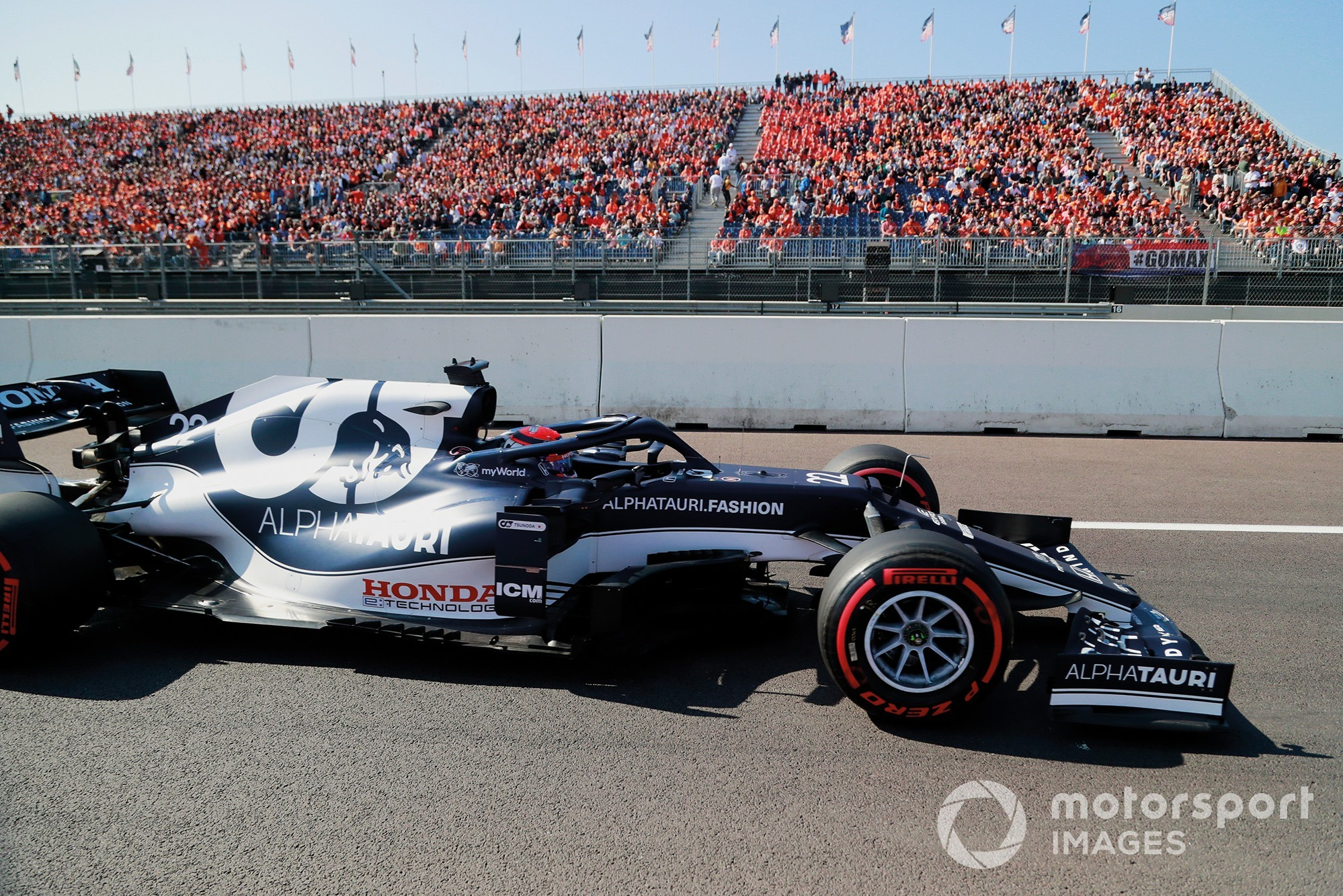
Yuki Tsunoda, AlphaTauri

How Ratzenberger beat the odds to realise his cruelly short-lived F1 dream

F1 uncovered: A weekend behind the scenes with a chief mechanic

When McLaren was pipped by Red Bull in a modern F1 classic

The big opportunity Sainz’s Williams switch affords to F1’s latest centurion

Inside the science of F1 fuel

How F1’s plan for rotating races could look in practice

The early decisions that set Sauber’s rookie for success

How F1 media coverage has evolved in line with its subject

How Toyota destroyed the competition to seal the WEC crowns

McLaren retains Fornaroli as F1 reserve and hands him WEC programme for 2027

How Andrew Jordan realised his teenage rallycross dream

Inside the competition building F1’s future engineering talent
Subscribe and access Autosport.com with your ad-blocker.
From Formula 1 to MotoGP we report straight from the paddock because we love our sport, just like you. In order to keep delivering our expert journalism, our website uses advertising. Still, we want to give you the opportunity to enjoy an ad-free and tracker-free website and to continue using your adblocker.


Top Comments