


How Silverstone exposed Formula 1's dire need for speed
Change is coming, and it cannot come too soon: the venue of the first world championship grand prix ruthlessly exposed the mediocrity of the current regulations

In April 1815 Mount Tambora in Indonesia erupted, sending vast quantities of debris and volcanic gases into the atmosphere and triggering a series of brief but traumatic climate adjustments. 1816 became known as ‘the year without a summer’, characterised by late frosts, flooding, crop failures and famine.
Formula 1 is enduring its own year without a summer, thanks to the fundamentally misconceived 2026 technical regulations. The best that can be said of their effects at Silverstone is that at least the same circumstances will not prevail next year, thanks to the coming changes (grudgingly) agreed by the stakeholders last month.
The problem with Silverstone, if that noun can correctly be applied to one of grand prix racing’s most historic circuits, is that the drivers only have to apply the brakes seven times around the lap in a properly downforce-endowed car, and even then only transiently. Given the baked-in limitations of a format enshrining a near-50/50 split of internal combustion engine power to electrical deployment, that yields very limited opportunities to recharge the battery through the lap via conventional means.
Thus the ghastly spectres of lift-and-coast and super clipping – perhaps more obvious to those watching onboard TV camera footage than to those sitting in the grandstands, but still a pustulent carbuncle on the backside of a category which pitches itself as the pinnacle of technology. There was a return, too, of the yo-yo racing enjoyed by some, derided by many (the drivers themselves fall into the latter camp).
The site of the former RAF Silverstone is hardly picture-postcard territory but the track features some of the most challenging and enjoyable corners in F1, as well as meaty top speeds. But it has long been known – among those with access to sim data – that the 2026 cars would be borderline ridiculous here owing to the energy privations.
‘Iconic’ is an overused term but it surely applies to the sweeping corners of Maggotts, Becketts and Chapel; not an overtaking area by any means in a high-downforce single-seater, but spectacular viewing for those out of the cockpit and a satisfying challenge for those within them.

Bearman going through the "charging station" of Maggotts, Becketts and Chapel
Photo by: Paul Foster
Ahead of the weekend, Fernando Alonso said this area would merely serve as “a charging station”. After the first few track sessions the most positive response you could squeeze out of any driver was that the cars hadn’t been as bad through there as they had expected.

“You cannot say it's fun to go around Maggotts-Becketts with 500 horsepower only, versus 1000 like we had last year,” said Carlos Sainz. “I'm just missing going on the throttle between Turn 9 [Copse] to 11 [Maggotts], getting back up to 310km/h and entering Maggotts-Becketts at 310 rather than at 270-280 like we are now. That's where you feel the true G-force of the car, and I don't think any driver feels like these cars are better or anywhere close to what it was last year. Hopefully next year it gets better.”
You could argue that the drivers are paid to entertain rather than be entertained, and the G-forces are invisible to the spectator, but the crowd are here to see them race Formula 1 cars rather than prat about in Lego facsimiles on the drivers’ parade. Although the tropes of late capitalism do demand the shoehorning in of sponsor products, no matter how incongruous, especially if ‘influencers’ lap it up.
"My ask of everyone is enjoy the race and try to ignore too much what happens this afternoon" James Vowles
When he set pole position for last year’s British Grand Prix, Lando Norris entered the Maggotts-Becketts-Copse complex at 311km/h, keeping the throttle pinned until he reached the third sweep, whereupon the speed had bled off through tyre scrub to 296kmh/h before he lifted for the sharper right-hander at Becketts, better known to unromantic engineering types as “Turn 13”.
An accompanying dab of the brake brought the speed to 237km/h at the apex, whereupon the full quotient of horsepower began building the McLaren’s pace to a peak speed of 319km/h on the Hangar Straight.
Compare and contrast Kimi Antonelli’s data trajectory through this section on his way to pole position in 2026. He (the blue trace in our illustration below) reached a higher top speed earlier than Norris (orange trace) on the old start/finish straight – 317km/h vs 314km/h. But the Mercedes’ speed also dropped off earlier as the electrical deployment entered its ramp-down phase. By the apex of Copse, taken flat out by both, it was travelling 17km/h slower.
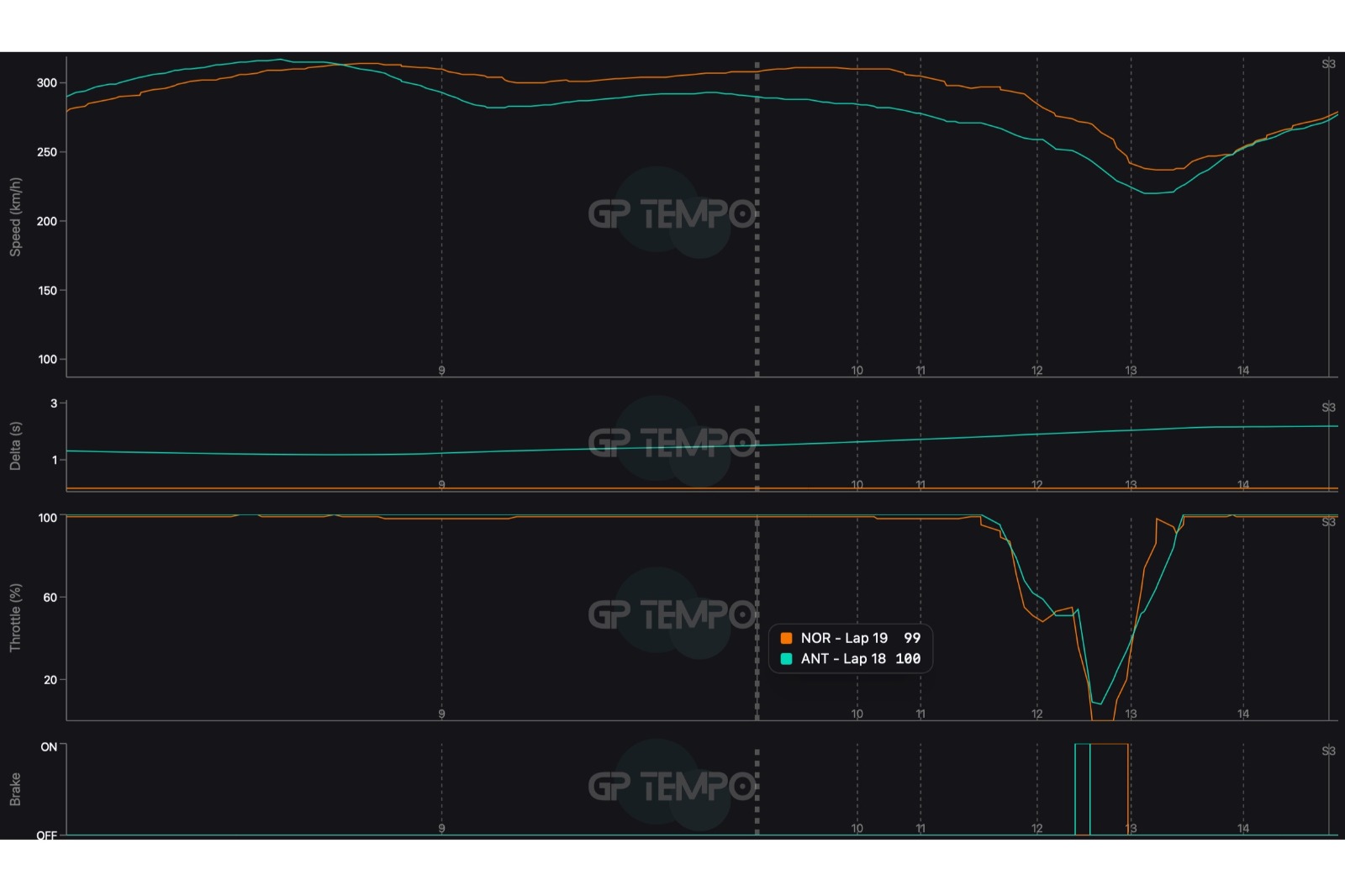
The pole position lap data comparison between Norris in 2025 and Antonelli in 2026
That deficit contracted only briefly before the approach to Maggotts, where Antonelli’s Mercedes peaked at 293km/h before dropping to 284km/h at the first apex. By the middle of the complex it was travelling 30km/h slower.
To put this speed differential in context, if you were to run at 30km/h, Usain Bolt would cruise past as you covered 100 metres in around 12 seconds. Now, if you were to use a Venn diagram to describe F1’s ever-growing audience, there will be an intersection between the areas depicting those who don’t care about this difference in speed with those who cannot discern it anyway. This writer fully expects to receive a querulous WhatsApp message from Mercedes’ comms department along these lines ere long.
Next year the power split is going to shift to 58/42 in favour of the internal combustion engine, fuel flow will increase by 5%, and maximum electrical harvesting per lap will also increase. From 2028 the power output ratio will move to 60/40, the intermediate step being a compromise to accommodate those teams who wanted to carry over their 2026 monocoques to next season.

In the background, Autosport understands FIA president Mohammed Ben Sulayem believes he has the necessary support to implement the much-vaunted return to V8s with a much smaller electrical component from 2030.
The short-term changes should at least serve to ameliorate the inadequacies of the current technical formula before it is expunged, leaving only its statistical quirks in the record books. If only the second-order effects had been interrogated rigorously before the format was agreed.
On the Friday at Silverstone, Autosport asked Williams team principal James Vowles if there were any potential upsides to the 2026 cars being power-starved around Silverstone – for instance, some strategic variety might ensue. Tellingly, his response didn’t address that point at all.
“Laying it out here, Silverstone and Spa are going to be difficult for energy,” he said. “That's just a fact. It was highlighted two years ago. But what we have changed in the sport, and this is what I'm really pleased about, is we've changed the aerodynamic regulations for next year, and the power unit regulations for next year and 2028 to combat this.

The flaws in F1's new rules are exposed by Silverstone's high speeds and minimal braking zones
Photo by: Andy Hone/ LAT Images via Getty Images
“So is qualifying going to have some amount of clipping? I'm afraid so. And I don't think it's right, which is why we've changed the regulations for next year.
“Can we do anything more about it today as I talk to you? No. But do I also think the racing is actually going to be quite exciting? Yes, I do at the same time. So it's not all bad. But my point I'm making to you is you're spot on. Is it going to be a discussion point? Yes, it will be because the fixes don't come in until next year.
“But at least as a sport, we're not waiting to go through this and then make changes. The changes are already made and all of that's in the journey. So my ask of everyone is enjoy the race and try to ignore too much what happens this afternoon [in practice and qualifying].”
So there’s the message: muddle through F1’s year without a summer and hope for the sunlit uplands to come.

Will F1's 2027 changes be enough to solve its problems witnessed at Silverstone?
Photo by: Colin McMaster / LAT Images via Getty Images


'Senior moment' or breakdown of trust? The implications of Hamilton's Singapore GP meltdown

Why Verstappen's dominance left rivals scrabbling for alternatives in Singapore

A "better job" or more engine power? Verstappen's Singapore pole unpicked

FIA reveals "human error" caused latest software glitch in Singapore sprint qualifying

F1 Singapore GP live commentary and updates - Verstappen takes sprint pole

F1 Singapore GP live commentary and updates - Verstappen wins sprint while McLarens collide

F1 Singapore GP live commentary and updates - Verstappen on pole

LIVE: F1 Singapore GP - Verstappen dominates to victory from Leclerc, nightmare for Hamilton

The not-so-obvious chance Leclerc missed to usurp Verstappen

Cheshire cats de la Roche and Musgrave grin after Silverstone Historic F3 thrillers

Dramatic Mini fight goes to the wire as Ovenden wins title by a point at Brands Hatch

How Ingram made his mark on the 2026 BTCC campaign – before going out with a bang
Subscribe and access Autosport.com with your ad-blocker.
From Formula 1 to MotoGP we report straight from the paddock because we love our sport, just like you. In order to keep delivering our expert journalism, our website uses advertising. Still, we want to give you the opportunity to enjoy an ad-free and tracker-free website and to continue using your adblocker.


Top Comments