


How pitstops evolved into an F1 art form
A Formula 1 pitstop is a rapid-fire blend of high technology and human performance. PAT SYMONDS describes how the science of margin gains makes stops so quick
How long has it taken you to read this sentence? There are many ways of expressing time and you might answer ‘just under three seconds’ or you might say ‘a little longer than the Red Bull team generally takes to change all four wheels on one of its cars at a pitstop’. In Hungary, Red Bull set its fastest time of the season, completing a tyre-change in just 1.88 seconds.
So fast are F1 pitstops now that the FIA has had its interest awakened and has issued further directives on what is regarded as acceptable practice, explaining how much automation can be used and what human intervention is necessary to ensure safety takes precedence over speed.
So how is this achieved and how is the balance between technology and human performance managed? If we go back in time, we can see that while pitstops have been intrinsic in motorsport for many years, for a long time the role they played in competitiveness was overlooked. Pre-war pitstops could take over 30 seconds. In the modern era the organised pitstop really emerged in the early 1980s when Brabham introduced refuelling and the pitstop became a strategic part of the race.
When refuelling was reintroduced in 1994, a limit on fuel flow rate meant that changing wheels was a relatively leisurely affair, but when refuelling was banned again in 2010 wheel changing agility returned to prominence.
In this period, the art evolved from one of just continual practice with primitive equipment to a holistic view that combined focused practice with a leap in technology for wheel guns, jacks and even wheelnuts and axles. The drivers too came to realise the role they played, so getting maximum safe braking performance into the pit area combined with precision stopping within 10cm of the desired spot, fast reactions to the signal to go and a good launch, all carved those vital tenths from the procedure.
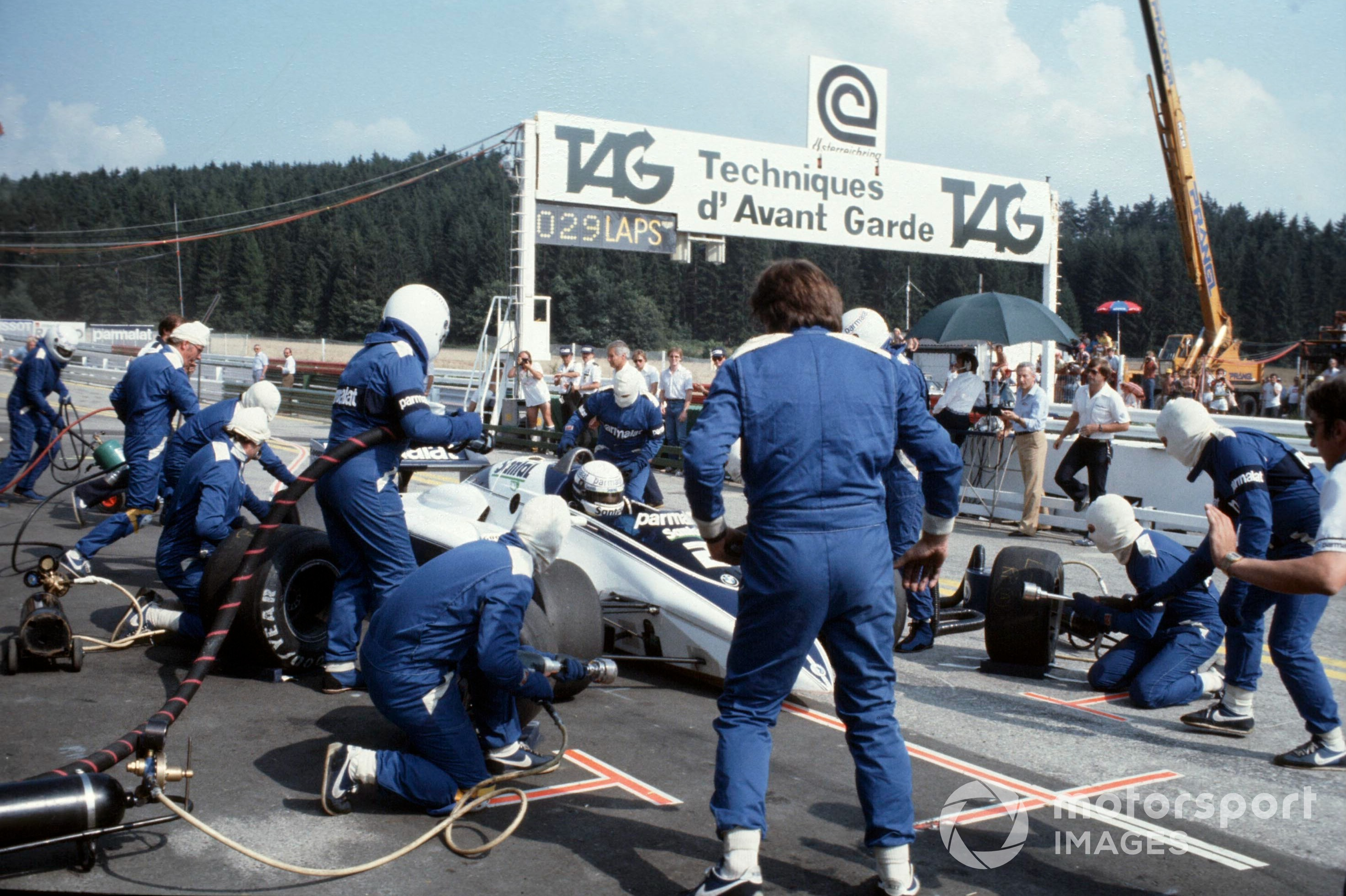
Riccardo Patrese in the Brabham comes in for a pitstop in the 1982 Austrian GP
Photo by: Ercole Colombo / Motorsport Images
In terms of equipment, the pitstop guns came in for attention first. These are air-driven impact wrenches specifically designed for large nuts. It was soon found that the original design could be improved by gas-flowing all the ports much like an engine’s cylinder head. Before it was regulated that only air or nitrogen could be used to power the guns, other gases were adopted that showed lower viscosity and hence drove the guns faster. The guns themselves were also lightened and custom grips made, individually shaped for each mechanic to achieve the best ergonomic performance.
Jacks were next looked at with simple quick-lift jacks replaced by quick-release items that collapsed at the touch of a button to save time in lowering the car. Onboard jacks such as are used in sportscars were investigated but were always outperformed by a well-operated external jack.
The pitstop area was also improved by painting graduated markings on the ground around the stopping area. Overhead cameras were installed in gantries so video could be examined to determine how accurate the drivers were at stopping on the mark. Any error forces the gunman to rotate, which loses time and increases the chances of not getting a clean hit on the wheelnut, which can damage it and lead to cross-threading.
One of the biggest improvements was to use electronics to link these mechanical improvements together and it is this that has caused the FIA concern
Wheels, wheelnuts and axles changed considerably to assist rapid stops. In the early days the wheels were driven by drive pegs on the axle which engaged in elongated holes in the wheel. It was found to be much quicker to lock the wheel to the axle using a serrated drive, which was easier to engage as it was not so reliant on exact indexing of the wheel and axle. The axle threads also changed considerably, from relatively fine threads to ones with a pitch of over 1mm to clamp with the minimum number of turns.
The materials too were investigated, as the nuts needed many compromising attributes. Too soft and they would be cleaved by the axle thread if not square, and too brittle it could be damaged by the gun. In addition, they had to maintain strength at very high temperatures. Even now there are different solutions in the pitlane, but the use of titanium axles with sophisticated aluminium wheelnuts probably holds sway.
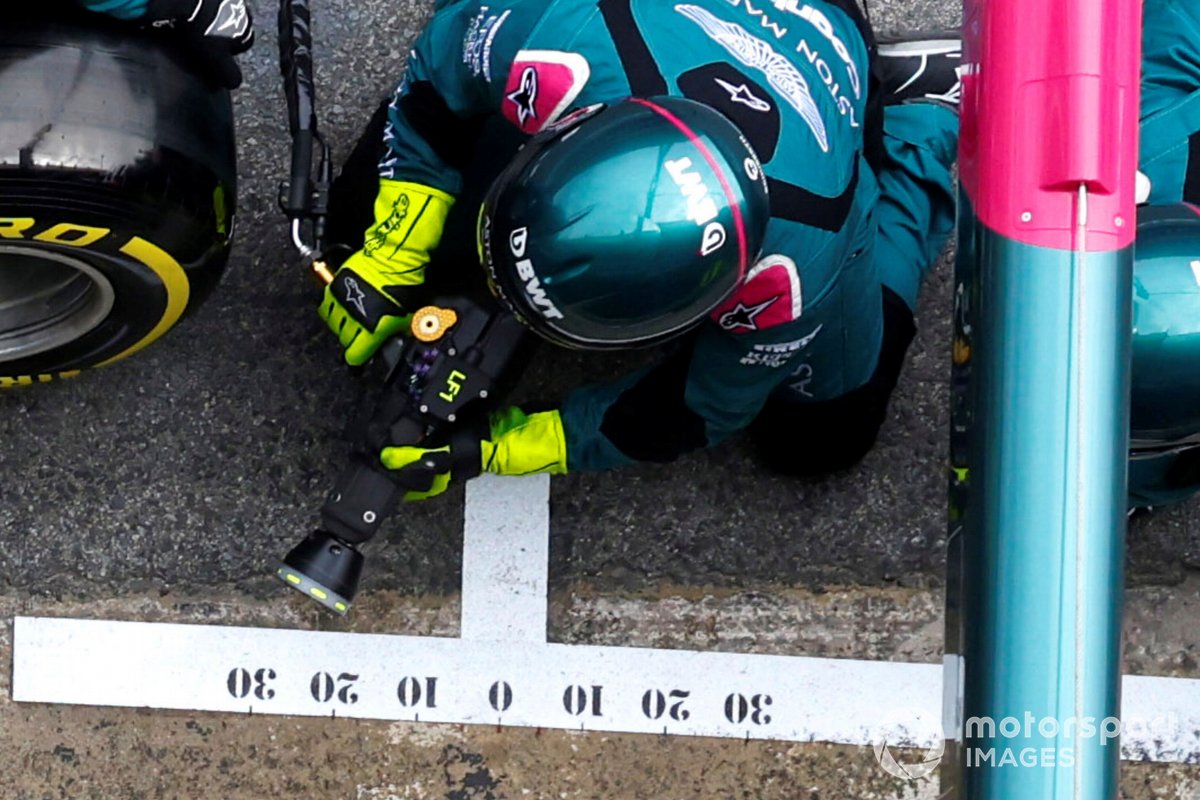
Aston Martin wheel gun detail
Photo by: Glenn Dunbar / Motorsport Images
One of the biggest improvements was to use electronics to link these mechanical improvements together and it is this that has caused the FIA concern. A computer monitors sensors on all the devices. It knows when the car is in the air, when the wheels are removed and when the wheelnuts are once again tight. At one time this computer would release the jacks and change the pitstop light from red to green based on a signal from all four wheel guns.
With the latest guidelines from the FIA, a manual signal from the gun operator must be given before the jack sequence can start and this signal must be based on a physical indication and physical acknowledgement from the wheel gun operator.
One must not forget the human performance aspect as well. When I was at Williams, we were the best in the pitlane at pitstops but we didn’t just train senselessly. We had an automated pitstop rig in the factory that was fully instrumented to train the mechanics on, and the whole process was overseen by a sports scientist/osteopath to extract maximum performance from our ace mechanics. Finally, a 20-page report was written for each event, even if there had only been a single pitstop for each car in the race, and this was analysed and discussed in detail to seek the incremental improvements that are so necessary for peak performance.

Valtteri Bottas, Mercedes W12, makes a pit stop
Photo by: Steve Etherington / Motorsport Images

How Ratzenberger beat the odds to realise his cruelly short-lived F1 dream

F1 uncovered: A weekend behind the scenes with a chief mechanic

When McLaren was pipped by Red Bull in a modern F1 classic

The big opportunity Sainz’s Williams switch affords to F1’s latest centurion

Inside the science of F1 fuel

How F1’s plan for rotating races could look in practice

The early decisions that set Sauber’s rookie for success

How F1 media coverage has evolved in line with its subject

No denying it now – the one reason why F1’s ‘horrible’ start in Malaysia could be a good thing

Inside Alonso's decision to contest the 2027 Dakar Rally with Aston Martin

The greatest F1 campaigns with no wins

MotoGP to introduce sprint qualifying amid 2027 format changes
Subscribe and access Autosport.com with your ad-blocker.
From Formula 1 to MotoGP we report straight from the paddock because we love our sport, just like you. In order to keep delivering our expert journalism, our website uses advertising. Still, we want to give you the opportunity to enjoy an ad-free and tracker-free website and to continue using your adblocker.


Top Comments