


How Hill's steel lifted Williams post-Imola 1994 and carved out F1 glory
Ayrton Senna’s untimely passing 30 years ago thrust Damon Hill into the Williams team leader role – and into a title battle that raged until the final round. But even though he would go on to win the world championship after the tragedies and disappointments of 1994, MARK GALLAGHER discovers that Hill faced a difficult journey of self-discovery…
Mention Damon Hill, Adelaide, 1994 and the memories start. Usually with an image of Michael Schumacher’s Benetton B194 on two wheels following a collision with Hill’s Williams FW16B. Those who witnessed it will never forget – and Hill fans will never forgive – a cynical spur-of-the-moment act by Schumacher to win the world championship, eliminating his rival using blunt-force trauma.
Hill often gets asked about it but, whatever the emotion at the time, he has long since put that particular incident to rest. Claiming the 1996 drivers’ championship will have helped, but so too the knowledge that it was not the only time Schumacher took his win-at-all-costs approach beyond acceptable limits. Think Jerez ’97, Monaco 2006 and Hungary ’10.
“He [Schumacher] was ruthless,” says Hill, who recently visited Adelaide for the first time since winning the 1995 Australian Grand Prix. “He didn’t show anger in the way that Ayrton [Senna] did, when Ayrton got out of the car you could tell he was fired up.
“This was a cool kind of ruthlessness that Michael seemed to have. A dispassionate approach to things which was ‘I have to do this, I’m terribly sorry, you might not like it but I’ve got to do it, nothing personal!’”
Having a world championship decided by a collision between rivals was nothing new. Senna and Alain Prost had seen to that in Suzuka 1989 and 1990, but 1994 was different.
When you mention that season the memories shift, to Imola, to life and death, to Ayrton Senna and Roland Ratzenberger. That the 1994 title was decided by an accident, an apparently intentional one, underscored a year most already wanted to forget.

Schumacher and Hill contested the title between them in 1994 before the fateful crash in Adelaide that decided the season in the Benetton man's favour
Photo by: Ercole Colombo
This was Hill’s second season with Williams, his third in F1. If Ollie Bearman raised eyebrows by making his Formula 1 debut for Ferrari at the age of 18, think of Hill arriving in the paddock for the first time when aged 31 (Ratzenberger was 33 when he got his break, though he massaged his ‘official’ age downwards). Replacing Giovanna Amati after her sponsorship failed to come through, Hill found himself behind the wheel of the unloved, uncompetitive, underfunded Brabham BT60B.
The Middlebridge-run Brabham team was already on its knees but Hill cemented his reputation as a fighter. Unable to qualify the car in his first five races, he eventually made the grid at the 1992 British Grand Prix, repeating the feat in Hungary, Brabham’s final event.
"What was annoying was that even when I had shown Williams what I could do they still didn’t seem to show confidence in me"
Damon Hill
On the upside, Hill had been a Williams test driver since 1991, supporting Nigel Mansell and Riccardo Patrese. That line-up continued into 1992, but in 1993 Hill got the nod from Frank Williams to go racing as team-mate to Alain Prost in the FW15C, complete with anti-lock brakes, traction control and active suspension.
PLUS: The gizmo-laden Williams F1 car that allowed Prost to retire on top
Nothing seemed easy about being selected by Williams. Hill was only ever offered single-year contracts until joining Jordan GP in 1998, yet his opinion may surprise.
“I think everyone should only have one-year contracts,” he says pointedly. “It’s about how you perform, week-to-week.
“Maybe we should have race-to-race contracts!” he laughs. “Honestly, I’m being serious, I think that [one-year contracts] were important for me. What was annoying was that even when I had shown Williams what I could do they still didn’t seem to show confidence in me.”
Confidence, that all-important quality in racing, whether it be a driver having confidence in his car or in himself.
This is a low
In his remarkable autobiography Watching the Wheels, Hill opens with a summary of his battle with depression. Here was a world champion, a star to many, famed for his determination, admitting that his mental health had taken him to dark places.

Hill was on good form when he sat down with Gallagher for GP Racing
Photo by: Motorsport Images
Mid-career, despite his inner conviction, Hill lacked the outer confidence of a Schumacher whose paddock strut exuded focus and high expectation. At the end of 1995 Hill saw a BBC programme which included an interview with Mary Spillane, an American performance coach. Discussing their body language, she contrasted the haunted look of the put-upon British hopeful against the upbeat, entitled demeanour of Germany’s world champion.
Hill invited Spillane to his home for a chat and, in return, she gave him “the most valuable piece of advice I ever had”. She talked to him about focus, staying positive, ignoring the tittle tattle, correcting the critics when they are wrong, speaking only when needed.
That conversation caused him to approach 1996 differently. It would become his world championship-winning year. Williams still had him on that one-year deal, and this time it decided to sign Heinz-Harald Frentzen for the following season, leaving Hill, a freshly minted champion, without a drive.
“There wasn’t much left on the table,” recalls Hill, “and Arrows wasn’t exactly the juiciest morsel. But I looked at them and thought, ‘well, there’s a chance.’ I could see Tom [Walkinshaw] was ambitious. There was method in my madness because, for once in my life, I wanted a one-year contract.”
Hill’s plan was to drive for Arrows in ’97 before switching to McLaren in 1998 where he would reunite with designer Adrian Newey and partner Mika Hakkinen. As things transpired he turned down Ron Dennis’s offer, instead opting for a two-year deal with Jordan.
“I had to turn down Ron’s offer, which wasn’t very appealing,” he says. “I probably did the right thing because frankly I had had enough of trying to prove myself to people.” Times had changed.
End of a century
At the end of 1993 Hill had finished third in the world championship behind team-mate Prost and McLaren’s Senna. He had won three grands prix to Prost’s seven, Senna’s five and Schumacher’s one. Not at all bad for a first full season in F1, but even then critics pointed at the FW15C and said ‘it’s the car!’.

Both Williams drivers found the first post-gizmo car a handful at the start of 1994
Photo by: Motorsport Images
Then came 1994, the ban on electronic aids and the start of the season with Schumacher dominant in the Benetton B194. Senna was now alongside Hill, of course, Prost having retired, and they found the Williams FW16 a handful. Tech guru Newey has often spoken of how he “screwed up” the aerodynamics in the transition back to passive suspension, delivering a fundamentally unstable car.
Senna was frustrated by it and, although he qualified on pole position in the opening races in Brazil and Japan, both were notable for DNFs. He spun off in Interlagos and was collected by Hakkinen’s McLaren in Aida, which meant that Senna came to Imola with zero points in the bag.
Hill remains convinced Senna’s fatal accident in Imola was caused by the FW16 bottoming heavily while attacking the racing line at Tamburello corner on tyres not yet up to temperature. The race start had been marred by the serious start-line accident involving JJ Lehto’s Benetton and Pedro Lamy’s Lotus. A five-lap safety car meant tyre temperatures fell away.
"I saw them crushed after Imola. Literally every member of the team, their heads were down" Damon Hill
Senna’s death came the day after Ratzenberger’s fatal accident at the wheel of his Simtek. Two weeks later Formula 1 would regroup in Monaco, Hill driving a solitary Williams, only for Karl Wendlinger to suffer a sickening shunt at the Nouvelle Chicane. One which led to him being placed into an induced coma. Then came Spain and another major accident, Simtek’s Andrea Montermini almost losing his right foot as a result.
“The [1994] season was defined by Imola,” says Hill. “Up until that point there was racing in the way that there always had been and then, after that, the whole thing changed. Everything was a consequence of that.”
Hill was left with the job of helping the Williams team recover from the Imola catastrophe. It was a task he was not unfamiliar with, father Graham having done the same for Team Lotus following the death of team-mate Jim Clark in 1968. Paired with the greatest talents of their generation, the Hills dealt with teams distraught by the loss of their superstars.
“I saw them crushed after Imola,” recalls Hill. “Literally every member of the team, their heads were down. There was this awful, black cloud hanging over the team and the people who worked in it. What I wanted to express to them was that, as drivers, we put our faith in the team, in the designers and the mechanics, and we accept the risks.
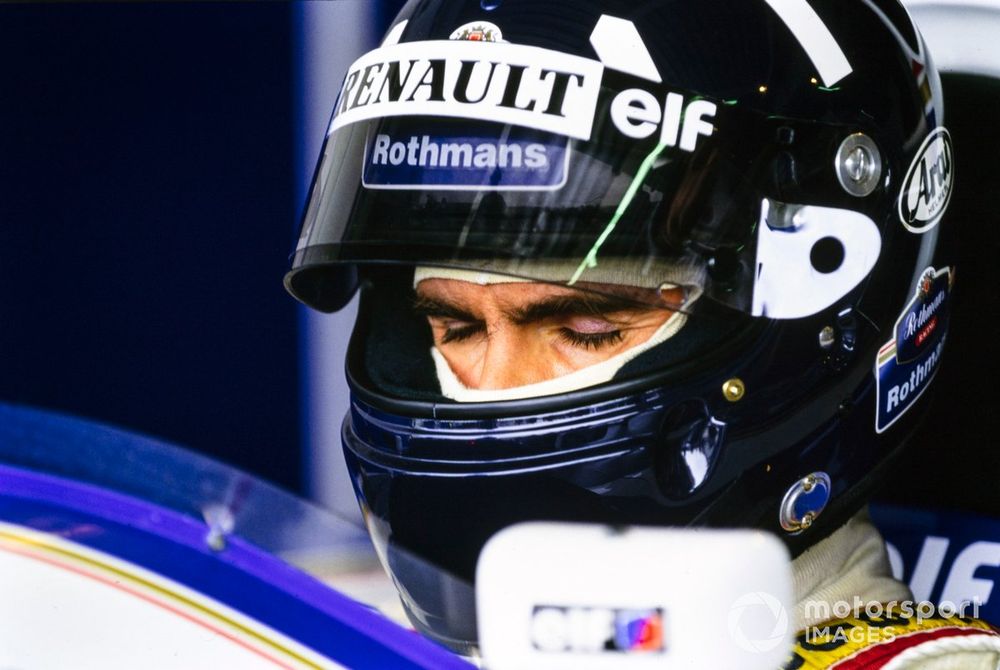
The Williams team was crushed after Imola, and it fell to Hill to lift spirits from the cockpit - not a small undertaking
Photo by: Motorsport Images
“This was something I felt was important for the team to know. We know as drivers that you are doing your very best and, occasionally, drivers make mistakes, engineers make mistakes, mechanics make mistakes. That’s part of the bag, I wanted them to know that and the only way to show it was to jump in the car and give it the full beans they were expecting and wanted to see.
“It was difficult in Monaco. Our cage was rattled again by what happened to Wendlinger. Niki Lauda summed it up when he said that for a long time God had had his hand on the sport and then he took it away. Suddenly it was like he was ‘OK, you’re on your own for a bit and now see what happens’ and we were being pummelled by very serious accidents and injuries.”
There’s no other way
“I think it did spook me,” admits Hill. “I remember going into the Benetton truck after Montermini’s big shunt in Barcelona. Their engineers and Michael [Schumacher] looked a bit startled that I was there. I’m going, ‘This is not right, something’s got to be done about it’, but I got a real blank look from them.
“I thought it was unnaturally spiteful, what was happening, but we pressed on and we know what happened. I won the race in Spain, helped put the spring back in everyone’s step. That was our first victory after we’d lost Ayrton and, spookily, the same grand prix my dad won after Jim was killed. I’m not overly superstitious but it is a strange coincidence.”
Williams’ recovery accelerated as Hill won in Silverstone and then scored a hat-trick of victories in Spa, Monza and Estoril, aided in part by Schumacher landing a two-race ban. But it was in Suzuka that Hill upped the ante, winning a duel even he admits was unrepeatable.
It was arguably the drive of the season, certainly the drive of Hill’s career.
“All the ingredients added together for the whole year, to the point where you were being put to the test in the most extreme circumstances you could possibly imagine. Suzuka, one of the most terrifying, fastest, trickiest tracks, and then you have a typhoon, poor visibility, and you’re up against Michael Schumacher. Then it turns out, they only managed to change three of my four wheels in the pitstop, so unbeknown to me, I was racing a tyre that was bald!
“I let myself go, because I didn’t have any choice. You trust in some other mechanism by which you will survive, so you let the thing that actually will stop you falling do its job. That requires letting go, it’s a very spooky experience.”

Hill was outstanding in Suzuka as he won to keep the title alive to Adelaide
Photo by: Sutton Images
Risk was writ large across Formula 1 in 1994, but it’s a topic Hill has spent his life managing.
“My dad survived 17 seasons of Formula 1 in an era that was absolutely lethal,” he says. “The irony being, of course, that he didn’t live very long after he stopped racing and an accident got him outside of the sport.”
Graham Hill’s fatal plane crash came only six months after he had been unable to qualify his Hill GH1 in Monaco, a race he had won five times. The accident also claimed the lives of driver Tony Brise, design engineer Andy Smallman, the team manager and two mechanics. It left the Hill family grief-stricken and facing straitened finances thanks to liabilities involving both the Embassy Hill team and legal fall-out from the plane crash.
"The medium through which you communicated in our day was the press, so you had to choose your words carefully. What happened after that was beyond your control" Damon Hill
For 15-year-old Damon, the loss of his father had far-reaching consequences. It is hard to convey just how famous Graham Hill was. These days it’s commonplace for people to say that only drivers such as Lewis Hamilton have transcended the sport, but Graham Hill was known far beyond Formula 1.
A friend to royalty, Hollywood stars and celebrities, a regular face on British TV, whether on sports programmes or panel shows, Graham Hill was ever-present. For years Damon would be introduced as ‘Graham Hill’s son’. The loss of his father threatened an existential loss of identity.
On your own
Fortunately Damon Hill had a bloody-minded determination not to disappear under the weight of his father’s legacy, turning to motorcycle racing while working as a dispatch rider at the age of 21. Success at national racing level led him into four wheels in 1983, after which Formula Ford beckoned.
His subsequent trajectory through to Formula 3, initially with Murray Taylor Racing and later Intersport, marked Hill out as a genuine talent. His next move, stepping up into Formula 3000, helped give birth to his reputation for driving the wheels off anything he was handed – so while Footwork’s Mooncraft MC-041 seemed an unlikely machine with which to prove anything, it led to Hill’s 1990 drive in Middlebridge Racing’s Lola. Formula 1 then came calling in the form of the Williams test drive.
Looking at the category today, Hill is keen to emphasise how technology has given today’s drivers a far great degree of control over their story, the images they share and the professional narrative they create.

Determination was a hallmark of Hill's career as he sought to carve out opportunities
Photo by: Motorsport Images
“Communication has multiplied hugely,” he says. “The iPhone is only 17 years old, which seems impossible. When I was racing we had mobile phones without the tricks and gizmos you have on a mobile phone which can disseminate information at the touch of a screen, globally, in a fraction of second. The medium through which you communicated in our day was the press, so you had to choose your words carefully.
“What happened after that was beyond your control. The press chose the photograph to use and the story to emphasise and you didn’t have a right of reply. The sport was governed by very limited media outlets whether it was the TV channel, the newspapers or magazines that were around at the time.”
One other thing in Hill’s favour was his relationship with commentator Murray Walker, the voice of F1.
“I think Murray had a bit of a soft spot for me,” he says, “so I think that came across in some of his comments about me, particularly and most famously when he said he had to stop because he had a lump in his throat. But he’d been around, he was a fan of my dad, he grew up in that era, and he knew the whole Hill story. I think he saw it in the context of that father-son thing, and maybe that was partly where the paternal attitude came from.
“He could be critical of me,” Hill adds, “there’s no question about it, he didn’t give me any free rides. But the other thing to say is I was a fan of Murray, I’d grown up listening to him on Nigel [Mansell] so, when Murray comes to interview you, you were kind of excited to talk to him because he was a personality in his own right.”
For tomorrow
Hill sees the current generation of drivers as being fundamentally better prepared for their careers, both in and out of the cockpit.
“I think that the coaching they get in preparation for the spotlight must be very good because they come out incredibly adept at an early age, talking to the press about what they’re doing and also being professional within the team. That side of things is very impressive.”

Hill believes his relationship with Murray Walker was beneficial to his career
Photo by: Motorsport Images
He is somewhat less impressed with the radio chatter that has become the hallmark of broadcasts today.
“I’m left open-mouthed sometimes at how grown up they are at a very early age. But at the same time my beef is with radio communication and this kind of apparent ‘stating the bleedin’ obvious’ from engineer to driver or vice versa, and complaining about other drivers. Don’t even bother, don’t waste your breath, what’s the point? Just get on with driving, it does seem like we have become a little bit nannying of the driver.”
No one nannied Hill. He fought hard to reach F1, to secure the approval of Williams through four successive one-year contracts, scoring 21 GP wins in the process and clinching the 1996 drivers’ title. Even then he wasn’t done, a year at Arrows netting him that nearly-win in Hungary, followed by a two-year sojourn at Jordan where he claimed the team’s famous maiden win in Spa.
"I agree there was a Hill determination, a never-say-die kind of thing which you can’t give up until you’ve got the answer" Damon Hill
Helping teams to raise their game seems to have been a hallmark of Hill’s career. From giving Brabham its best result of the season in the team’s final race through to aiding Williams in its recovery from Imola ’94, winning the world championship and helping small independents like Arrows and Jordan threaten the established giants.
“I did have a steely determination,” he admits. “And I think it’s that I wanted to find out what I was made of, and I think that’s to do with my dad. How do you know what is you and what is simply trying to measure up to your father, the ghost of your father or whatever it is?
“We all have to go about things in our own unique way. I think I did that in my own career, but I agree there was a Hill determination, a never-say-die kind of thing which you can’t give up until you’ve got the answer.”
The answer, it seems, was to emulate his father Graham, to lead a team out from the shadows of tragedy, secure a world championship title and fear no one in the process.

Hill today is a respected paddock voice not only for his achievements but for his approach to racing
Photo by: Motorsport Images

How Ratzenberger beat the odds to realise his cruelly short-lived F1 dream

F1 uncovered: A weekend behind the scenes with a chief mechanic

When McLaren was pipped by Red Bull in a modern F1 classic

The big opportunity Sainz’s Williams switch affords to F1’s latest centurion

Inside the science of F1 fuel

How F1’s plan for rotating races could look in practice

The early decisions that set Sauber’s rookie for success

How F1 media coverage has evolved in line with its subject

F1 champion Norris completes first full test in McLaren’s Le Mans Hypercar

How Solberg lit up WRC title fight in Chile

F2 adds extra Baku feature race and insists Qatar, Abu Dhabi still on – what does this mean for F1?

Healeys, MGBs and Lotus Elans top Castle Combe Autumn Classic
Subscribe and access Autosport.com with your ad-blocker.
From Formula 1 to MotoGP we report straight from the paddock because we love our sport, just like you. In order to keep delivering our expert journalism, our website uses advertising. Still, we want to give you the opportunity to enjoy an ad-free and tracker-free website and to continue using your adblocker.


Top Comments