


How box office Alonso is still proving his star quality in F1
Fernando Alonso's return to Formula 1 in 2021 with Alpine has so far not reached the heights that made him a legend, but there's no doubting his status and ultimate target. After his outstanding exploits away from the grand prix scene, the Spaniard opens up on his driving performance level, F1's future and how he's really viewing his comeback - and in doing so reveals just what he really brings to motorsport's top tier

Formula 1 is better off having Fernando Alonso involved. The double world champion has still got it. And his legend continues, after a period of years in which he has added sporting tales that few of his grand prix racing peers can match.
Yes, Alonso is still a driver worth listening to. Thanks to his time racing IndyCars, sportscars and off-road machines, he’s perhaps uniquely placed to comment on modern motorsport – which, of course, he’s not afraid to do.
There’s naturally a debate to be had about ageing superstars retaining a place in motorsport’s top tier, when these days so many young drivers never reach it (although perhaps not so much in 2021, a year in which three rookies have progressed from Formula 2). But Alonso’s star status is unwavering, even as he continues one of F1’s hardest tasks: making a successful comeback with Alpine.
What Alonso is trying to do, and what he brings to F1 just by being him, demonstrates his worth to the championship. Because of who he is, people pay attention – and well they might.
“It’s a challenge,” he says of his F1 return. “And it’s a challenge this year also because of the midfield timing. Normally, it has been a challenge. But your team or your position was quite defined. A supreme weekend doing 105%, or a bad weekend performing 90%, normally you can be between ninth or 11th. While this year, with the midfield as it is, you can be seventh or 15th, [with a difference of just] 0.2 seconds, if you don’t perform perfectly right. We need to go for that perfection every weekend.”

Fernando Alonso, Alpine A521
Photo by: Erik Junius
Autosport is part of a small group of media speaking to Alonso ahead of his first home F1 race since 2018 – the recent Spanish Grand Prix. It’s something of a ‘classic’ Alonso media meeting – there’s self-aggrandisement, withering assessment of the media itself, the barest hint of point-scoring against one of his former teams. But, of course, there’s fascinating substance too, offered by an experienced and engaging character.
In the race at Barcelona, Alonso came home 17th – the worst result of his comeback so far. But that doesn’t tell the real story.
His 2021 got off to a difficult start. Alonso missed Alpine’s rebranding pre-season launch event after being hit by a car while cycling. He suffered a fractured jaw and had to have a pair of titanium plates inserted in surgery following the incident. This, plus the restrictions on travel to the UK at the time, also meant that he was only able to return to Alpine’s simulator shortly before the restricted pre-season testing began.
"I had one weekend where I was not totally comfortable – in Imola, and the problem is that in Formula 1 there is a lot of media, a lot of articles, and unfortunately two weeks between races. Because, if it was back to back from Imola to Portugal, there [would have been] much less talk" Fernando Alonso
At the same time, his Alpine squad was grappling with “a few issues in the windtunnel that slowed us in terms of development”, according to team executive director Marcin Budkowski.
The team was struggling with the impact of the tweaked rear floor rules for this year, and it was an issue that was compounded by a hardware problem in the tunnel itself. The knock-on effect for Alpine was that it fell several weeks behind in its pre-season preparations and design development.
In Bahrain testing, the team appeared somewhat understated as it worked to assess how the new aerodynamic rules were working in practice. But it was clear that things weren’t looking as promising as they had when 2020 ended, a moment where the former Renault squad was buoyed by its three late-season podiums with Daniel Ricciardo and Esteban Ocon. In the season-opener at the same venue, this translated into no points and the sixth fastest car.

Fernando Alonso, Alpine A521, Sebastian Vettel, Aston Martin AMR21
Photo by: Mark Sutton / Motorsport Images
Alonso impressed by making it through to Q3 at that Bahrain event, before retiring due to remarkable bad luck, with a sandwich wrapper trapped in a rear brake duct. But the second race of his comeback was the chaos at Imola, where Alonso qualified at the back of Q2, damaged his front wing going off at Tosa in the pre-race rain, spun in the early moments of the race suspension following the George Russell and Valtteri Bottas crash, and eventually took an on-the-road 11th behind Ocon.
“I had one weekend where I was not totally comfortable – in Imola,” Alonso explains. “And the problem is that in Formula 1 there is a lot of media, a lot of articles, and unfortunately two weeks between races. Because, if it was back to back from Imola to Portugal, there [would have been] much less talk!
“And it was also a coincidence of not only me, but a few other drivers not being totally confident in Imola. Some of them, they changed team this year. And that was a coincidence that induced a lot of talk. But, overall, I’m not overthinking too much of this, not worried too much.”
At the same time, Alpine’s early-season place in the pecking order reinforces the perception that 2021 is all about building to what comes next: F1’s 2022 rules reset. Alonso acknowledges that this is “difficult to say” because “every weekend you are on a race track, you are just a competitive person, and you want to deliver and you want to perform well”.
The gladiator element of his legend is, naturally, never weary of battle. “But,” he adds, almost effusively, “on the overall picture, yes, 2021 is preparation year – it’s no doubt. I think everybody on the grid, after the delay of the 2021 rules into 2022, we understood and we accepted that 2021 is a preparation year. It’s a post-COVID season with more or less similar cars of last year. And it’s a season to test things like the sprint races.
“It’s a test season, in a way, for many things. Just waiting and hoping for 2022 not [being] continuation, maybe revolution in 2022. That’s what we will want.”

Fernando Alonso, Alpine A521
Photo by: Glenn Dunbar / Motorsport Images
It’s going to be a while before F1 finds out if that hoped for change becomes a reality – perhaps, as Alonso also suggests, maybe even longer than many people are thinking. But, based on the two races that followed the Emilia Romagna Grand Prix, he can at least be pleased by Alpine’s progress.
At Imola, the team had finally run its 2021-specification front wing and an updated nose cape. At the Algarve Circuit, Alpine made changes to its diffuser, which it tweaked again for the Barcelona event. Small changes in the grand scheme of things – such is the way in this restricted season for car development – but ones that worked.
Alpine remained the sixth fastest team at Imola, but had closed a whopping 0.458% of the average deficit compared to the fastest laps produced by Mercedes, and effectively matched by Red Bull. In Portugal, that gap crept down by another 0.156%, but at this event Alpine was F1’s fourth-fastest team, a position it held onto in Spain.
"The cost cap, the 2022 rules, the sprint races – they are all things that are there just to produce better racing and better entertainment for everybody. So, I’m happy with all the things that I see in the sport" Fernando Alonso
Since the Bahrain GP, it has been Ocon grabbing Alpine’s best results. He qualified a brilliant sixth in Portugal, slipping back to finish seventh in the GP as Lando Norris and Charles Leclerc edged ahead in their faster respective McLaren and Ferrari. In Spain, he went one better against the clock, taking fifth on the grid and coming very close to a sensational fourth.
In the race last time out, Alpine stuck to the one-stopper most teams had initially tried before adapting to two-stoppers, which left its drivers exposed late on. Ocon fell to ninth by the flag, nearly caught by the charging Pierre Gasly on the final tour. Alonso, meanwhile, was hauled out of his race-long (and just-lost) battle with Aston Martin’s Lance Stroll on the fringes of the points to take a second stop, which resulted in his unrepresentative finishing position.
A glance at that 17th place in the history books won’t record how hard Alonso fought Stroll as his medium tyres were giving up, but the zeal was really there.

Fernando Alonso, Alpine A521
Photo by: Jerry Andre / Motorsport Images
Following the difficulties of Imola and Alpine’s pre-season struggles, it begs the question as to whether Alonso has felt the need to reassess his own pre-season proclamations that he was driving at his best level, which in turn fed his desire to return to F1 and chase a third world title.
PLUS: Fernando Alonso's 10 greatest F1 races
“No,” he replies, inevitably unequivocal. “I’m still thinking the same that I am at one point in my life where I feel good, and I feel capable of driving better than ever. But that doesn’t mean that you don’t find difficulties while entering a new adventure, or in this comeback.”
After sampling the delights of the wider motorsport world in the past four years, Alonso’s comeback contains regular questions regarding F1’s overall health, as well as the state of the championships he has recently tried. This all feeds the Alonso legend. Again, he’s worth listening to.
So, with sprint races, Netflix popularity and, perhaps most importantly of all, new financial rules allied to a modest form of performance balancing via design tool allocation usage being introduced to F1, has he returned to a championship that is evolving in a way in which it wasn’t before he exited in 2018?
“No, I think it was already in this mood in 2018,” Alonso replies. “I think from the arrival of Liberty Media, the sport went into a better knowledge of what the fans needed. What the show means, as a part of the sport itself, and the performance and the engineering wall that is inside F1, we need also to listen to the fans and we need to put on a good show on Sundays. And I think Liberty understood this from day one. They just needed a couple of years to settle down and to produce new ideas.
“The cost cap, the 2022 rules, the sprint races – they are all things that are there just to produce better racing and better entertainment for everybody. So, I’m happy. I’m happy with all the things that I see in the sport. I hope these sprint races are a success this year, and we can even make it better for the future. This year is just a test. Maybe we see things that are good, we see things that are not so good, so maybe there are more small improvements for the future. I think we are all in the same boat. And we are all very [much] trying to help Liberty on this because the benefit of one will be the benefit of everybody.”

Fernando Alonso, Alpine F1
Photo by: Andy Hone / Motorsport Images
But for all that is changing about F1, the critical factor will always be results. It’s a never-ending tussle between a ‘win-now’ mentality, grappling with a competition that can take teams and drivers years to perfect, the result of certain moves only fully playing out months or even years down the line.
PLUS: Why Alonso's eyes have returned to his first motorsport prize
It’s that dancing, almost deceiving, circus that meant questions were put to Alonso in the aftermath of the Imola race about his form and the perception of how challenging an F1 comeback really is. But he’s not entertaining such a line of questioning just yet. And this is where the Alonso legend really comes into play – he’s earned the right to not be written off on the back of a few bad results, and he’s essentially not afraid to say it.
“No, no, I don’t think so,” he says to rebuff rather hasty suggestions that he’s struggling in a way that other drivers who made F1 comebacks did not. “I don’t tend to agree with this, and things are getting bigger than what it is. I was the first to admit that I was not 100% in Imola, and not comfortable, and probably underperforming. But it was one race, and one race that with that underperformance I finished two tenths [actually 0.8s] of a second behind my team-mate! So, you know, it cannot be a big thing.
"With time, you still rely on your instinct, but you are driving more as a part of the team and try to optimise things. It’s not that you lose the speed, but you are driving in what you believe is the most efficient way of driving the car" Fernando Alonso
“At the end of the year, we talk. At the end of the year, if I underperform the whole season, and everything was more difficult than expected, OK, maybe there is a point to really discuss and go deep into the questions of why it is more difficult than previously or something. But, in Bahrain, I was happy and probably overperforming. In Imola, underperforming. We need a couple of races to settle down everything.”
Alonso produced a brilliant late charge in Portugal to take his first on-the-road top-10 finish of his comeback (his 10th at Imola came after Kimi Raikkonen’s post-race penalty), and was battling fiercely in Spain. He’s aware that this weekend’s Monaco GP, where Alpine will adjust his car’s power steering to better suit his preference as another minor tweak to improve the A521, will be a stern test of his progress.
That development is about building speed and confidence again, and it’s a process about which Alonso has been very open so far this season. For instance, he knows his qualifying form since Bahrain has let him down.
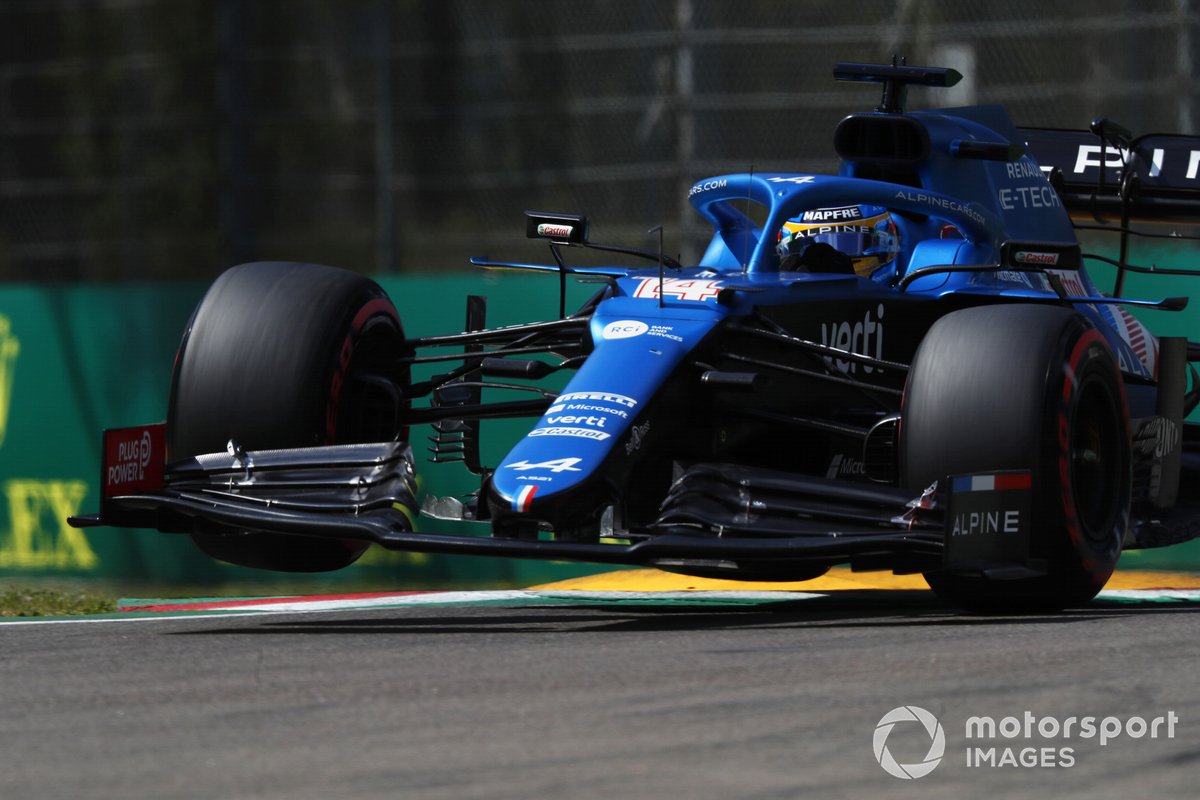
Fernando Alonso, Alpine A521, lifts a wheel
Photo by: Charles Coates / Motorsport Images
Intriguingly, he’s doing his learning again in the F1 spotlight 20 years after it first struck him, with Minardi back in 2001 (as part of a rookie class with Raikkonen at Sauber, Juan Pablo Montoya at Williams and Enrique Bernoldi at Arrows). Now, with all that experience, he can lay out what is different in delivering as a 39-year-old compared to the 19-year-old newcomer.
PLUS: The forgotten member of F1’s greatest rookie crop
“First of all, you are more mature now and you are working closer with your team,” Alonso outlines. “You learn, with experience, that all the people around you, all the technicians, they have all the parameters and all the knowledge of helping you how to optimise the performance of the car. How to optimise the tyres, your driving, your braking etc.
“When you come into Formula 1 and you’re young, you listen to everyone, yes, you try to understand what they’re trying to tell you, but then it comes to your instinct of driving – when you close the visor, and you’re just racing hard. Because your background, until that point was only karting and younger formulas, that you have to, let’s say, survive by yourself only. You didn’t have that amount of people just helping you. So, you’re still driving and feeling like that.
“Then, with time, you still rely on your instinct, yes, but you are driving more as a part of the team and try to optimise things. It’s not that you lose the speed, but you are driving in what you believe is the most efficient way of driving the car. And maybe sometimes it’s even against your instinct of what you would do if you were alone on track. But, eventually, you understand and you believe and you trust that you are doing the best way for the overall performance.”
Alonso has already touched on what will likely be the most crucial point of this latest chapter in his lengthy legend. When the current campaign reaches its conclusion, and Alonso eventually reflects on his first season back in F1, the hoped-for rules reset will finally be right around the corner.
For every team that has trailed in Mercedes’ wake these past seven years, next season offers hope of transforming their competitive circumstances with the dramatically different car designs, to revisit old heights from which some have fallen, and for others to climb to previously unattained levels. (Although, given the ultra-competitive drive at the Black Arrows squad, there’s just as much chance that Mercedes makes it two rules resets successfully navigated…)
Alonso now strikes a surprisingly pessimistic tone when considering whether any team will be able to score major success from the start of next season. After all, a relatively minor rule change introduced for 2021 has just significantly shaken the competitive picture between Mercedes and Red Bull, even if the former is still leading the way in 2021 so far.

Fernando Alonso, Alpine F1
Photo by: Mark Sutton / Motorsport Images
“In terms of fighting for the championship and other possibilities in 2022, difficult to know,” he says. “I think the first year [of new rules], there is always one team that gets something extra when there is a new regulation set, that interprets the rules a little bit different and maybe get an advantage. But, hopefully, after two or three years, that new set of regulations that comes in 2022 will [mean] very close action between many teams and is better for the future.
“I don’t know if it will come in 2022, but for sure it will come, this close competition, because I think all the regulations are made to cover as many as possible all the clever things and make all the performance parts of the cars quite standard for everybody, and try to have a better and a closer competition.”
While that assessment may be tough to hear for any F1 observers hoping that next season will feature a dramatically different competitive picture across the grid, it does hint at something that should nevertheless please the championship.
"Hopefully, after two or three years, that new set of regulations that comes in 2022 will [mean] very close action between many teams and is better for the future" Fernando Alonso
Alonso may be holding fast against premature conclusions about the success of his comeback, but he’s already looking to the battles to come after 2022. If he can reach the results and achievements that made him a legend in the first place, perhaps after scrutinising exactly how he measured up to his own high expectations at the end of comeback year one, then the famous tale will have the thrilling ending that Alonso returned to F1 to capture.
But even if that moment never arrives, the final entries in the tale, which may be a fair few years from being written as things stand, will be worth watching all the same. Because, he’s still Fernando Alonso.

Fernando Alonso, Alpine A521
Photo by: Erik Junius


Why Britain’s role in Formula 1 endured a troubled start

Why Bottas believes his F1 reserve driver role is the fastest route back to a race seat

Why Norris is now ready for his final exam

The key advantage for Bottas vs Perez in the 2026 F1 return race

Why Ferrari's management is under pressure after its bad start to F1 2025, not Hamilton or Leclerc

Why Red Bull can’t solve its second F1 car problem with a simple paint job

Hirakawa replaces Doohan at Alpine for Japanese GP FP1 outing

How Alonso and Bortoleto can be F1 rivals in a unique driver management deal

How Norris unfurled a surprising - and "unrepeatable" - Spanish GP pole lap

F1 drivers criticise Madrid circuit, Verstappen laughs: "I'll sort it out"

WRC Chile: Solberg maintains lead as Neuville and Armstrong suffer rolls

Why Marquez opted for an offset strategy in MotoGP San Marino GP sprint
Subscribe and access Autosport.com with your ad-blocker.
From Formula 1 to MotoGP we report straight from the paddock because we love our sport, just like you. In order to keep delivering our expert journalism, our website uses advertising. Still, we want to give you the opportunity to enjoy an ad-free and tracker-free website and to continue using your adblocker.


Top Comments