


Horner: Red Bull advantage at high altitude not just Honda F1 power
Red Bull Formula 1 boss Christian Horner believes his team's straightline speed advantage at high altitude is just as much down to downforce levels as it is engine power


Rival teams had singled out Red Bull engine supplier Honda's advantage in the Brazilian Grand Prix as Max Verstappen took pole position and then went on to win the race.
There was a suspicion that the thinner air at high altitudes played into Honda's hands against Ferrari and Mercedes.
But Horner believes set-up differences also played a part in the disparity.
"I think you have to look at downforce levels as well," he said when asked at the Brazilian GP.
"I think Mercedes ran a higher level of downforce for us, which assisted them in the race, but maybe didn't help them in qualifying.
"You can see they were very competitive in the race and arguably at the end of the stints they were a little bit stronger than we were.
"So it's that compromise of how you generate your lap time."
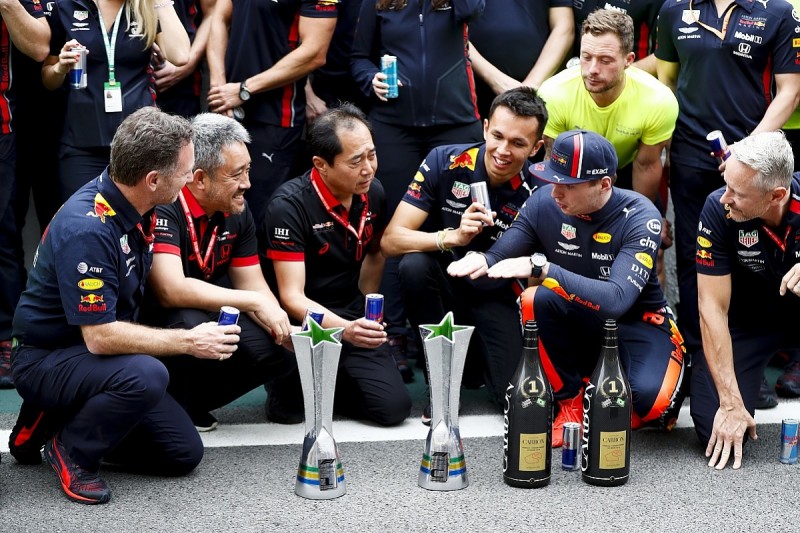
Honda's F1 technical director Toyoharu Tanabe also agreed that it was impossible to single out the power unit as the key factor for Red Bull's advantage.
- Honda's 2019 season
- Future under review
- Closing in on three-way fight
- Importance of Brazil win
- First victory with Red Bull
"High altitude affects not only PU but also aero," he said "So, as a package, we had a better, or a strong, package in Mexico and here. I don't have any clear answer for it."
Horner added that Honda was building momentum in F1 after a promising year in which it has taken three races wins and two pole positions, drawing closer to Mercedes and Ferrari's engines.
"When I saw that the last five pole positions [in Brazil] have all been Mercedes, it was fantastic for Honda for the first time since 1991 to score a pole," he said.
"Then to get the victory as well, it shows their hard work is paying off and it really feels that we're building a good momentum."
Share Or Save This Story


Brundle awarded OBE in King’s New Year’s honours

The new rules dilemma that will define the 2025 F1 season

Jon Noble: An unfair perception or a genuine concern? Lifting the lid on Red Bull’s Tsunoda scepticism


Eight shock Formula 1 team principal changes

How Honda F1 missed a two-week window to sign Vettel

Why Red Bull's Honda takeover is a gamechanger for its F1 mindset

Acosta's long road to his maiden MotoGP win

MotoGP Austrian GP: Acosta finally claims maiden win

Great debate: Which circuit should host the F1 2026 finale if the calendar has to change?

Live: MotoGP Austrian Grand Prix updates as it happens
Subscribe and access Autosport.com with your ad-blocker.
From Formula 1 to MotoGP we report straight from the paddock because we love our sport, just like you. In order to keep delivering our expert journalism, our website uses advertising. Still, we want to give you the opportunity to enjoy an ad-free and tracker-free website and to continue using your adblocker.


Top Comments