


British GP preview: The home drivers aiming for glory as F1 returns to where it all began
Silverstone’s place in F1 history endows it with a special significance, no more so than for Britain’s four grand prix drivers. We examine their prospects at their home race
Seventy-five years and a couple of months ago, a windswept former airfield near Towcester held the first race counting towards the world championship for drivers.
Formula 1 had only recently taken on that title – it had previously been known as ‘Formula A’ – and yet many of the cars competing in the category predated it, since racing in the immediate post-war era was a make-do-and-mend affair that leaned heavily on machines built in the 1930s.
Arrive at Silverstone today and you would have to send a drone up to see the evidence of its wartime role, but one thing remains a constant reminder of the site’s history: the wind, which made this plateau such an attractive location for an airfield.
RAF Silverstone enjoyed a service life of just two years, as a training ground for Vickers Wellington bomber crews, before the end of the Second World War rendered it redundant and the gates were locked.
Not securely enough for local residents and former flyboys who craved a level of risk and stimulation now absent from their lives.
Silverstone’s origin myth enshrines Maurice Geoghegan, a resident of the nearby village, as the one who identified its potential as a race track – or at least an area where he could exercise his new Frazer Nash without having his collar felt for speeding on a public road.

Reg Parnell leads the field away in a Maserati 4CLT in 1948
Photo by: Getty Images
Word eventually reached the Royal Automobile Club, which was looking for a new venue since Brooklands and Donington Park had been rendered unusable, and the circuit in London’s Crystal Palace park was considered unsuitable.
The first RAC International Grand Prix in October 1948 used a curious layout based on two of the three runways, linked by the perimeter roads. For safety reasons this was quickly dropped in favour of using the perimeter roads alone, and the race moved to May in the hope of better weather.
The fundamentals of this layout prevailed until 2010, when it was adapted to include a new infield section.
While the war may have ended in 1945, Silverstone has been the object of many battles in the years since – not least with former F1 ‘ringmaster’ Bernie Ecclestone, who apparently had an avid dislike of the facility and those who ran it.
The British GP at Silverstone is now held up by Liberty Media as an exemplar of what these events should be like
Since the present commercial rights holders forced Ecclestone into retirement there has been rather less ire from that direction. Indeed, the British GP at Silverstone is now held up by Liberty Media as an exemplar of what these events should be like – not just a race, but a full weekend of entertainment with a festival atmosphere.
The British crowd is known to be knowledgeable as well as enthusiastic, but that doesn’t mean it isn’t partisan – so this year passions are likely to be running high, with at least one British driver in a very good position to win… Stuart Codling

Can Norris go one better than his previous best Silverstone finish?
Photo by: James Sutton / Getty Images
Lando Norris
Age 25
Silverstone GP starts 7
Best Silverstone GP finish 2nd
2025 championship pos 2nd (201 pts)
Patience has become a way of life for long-time McLaren enthusiasts. Nine years between wins 182 and 183; 26 years between constructors’ championship trophies; and as for a first drivers’ title since Lewis Hamilton got it over the line by a single point at a wet Interlagos in 2008, the wait goes on.
Lando Norris emerged as a genuine title contender last season, marking another waypoint on his journey to becoming a Silverstone crowd favourite. Seizing the moment to (briefly) lead the 2023 British Grand Prix demonstrated his candidacy for the top tier and, even though it didn’t work out for him last year, Lewis Hamilton’s win against the run of recent form compensated somewhat for Norris being defeated by Max Verstappen.
McLaren’s resurgence, and Norris’s new-found confidence, was just what the wider Formula 1 ecosystem needed as ennui began to creep in after two and a half seasons of dominance by Verstappen and Red Bull.
Coming immediately after Lando and Max had banged wheels at the Red Bull Ring, the British GP weekend felt like an upping of the stakes. Further clashes were to come as Verstappen ultimately went 10 grands prix without winning, setting up an exciting title run-in where Norris fell short.
This season the narrative has shifted again and there are three drivers in this battle – four if you count George Russell, whose gradual slip into fringe candidacy status was interrupted by his Canadian GP win.
At the beginning of the season it was generally expected that McLaren would have one of the best cars on the grid, challenged closely by Red Bull and Ferrari. What emerged was a picture of McLaren enjoying a margin of superiority at most tracks, having developed its car wisely over the winter.
Some of that was concealed in the wet at the season opener in Melbourne but, as F1 visited some of the warmer environs on the calendar, McLaren’s ability to keep Pirelli’s sensitive rear tyres in the right temperature ‘window’ proved decisive.
By contrast Ferrari, having developed its car into one of the strongest on the grid in the final races of last season, hasn’t carried that momentum forward. Red Bull, meanwhile, has contrived to make its car even more difficult to drive – and by the second round of the season was following its usual modus operandi of blaming the second driver for not being in Verstappen’s league.

Norris enjoyed a brief stint in the lead at Silverstone in 2023
Photo by: James Sutton / LAT Images via Getty Images
So a competitive picture has emerged of the drivers’ championship battle being predominantly fought out by the two McLaren team-mates, Norris and Oscar Piastri, while Verstappen maxes out his points take at those tracks where his RB21 is competitive.
Verstappen has been helped in this objective by Pirelli succeeding in making its tyres less prone to ‘graining’ and thermal degradation, making many races one-stop affairs even when F1’s tyre supplier had nominated compounds a step softer than last year.
This, and convergence of performance adding to the difficulty of overtaking, has set up scenarios such as that which played out in Japan, where the McLaren duo underperformed in qualifying and Verstappen ‘occupied the crease’ (to borrow a cricketing term) to win the race after getting to the first corner first.
After spinning in the wet in his home round and finishing ninth, Piastri has been more consistent than his team-mate and less discombobulated by the MCL39’s snappiness when pushed.
What adds an extra dimension to Norris’s appeal – to the younger generation, if perhaps not to older aficionados – is his heart-on-sleeve openness
He rebooted his season with victory in China and then three consecutive wins in Bahrain, Saudi Arabia and Miami to annex the championship lead. He was helped in this cause by Norris making a proverbial dog’s dinner of the Bahrain round, qualifying five places behind Piastri and then picking up a costly penalty for a startline infringement.
The papaya pitwall will be relieved that the sturm und drang has been going on between Norris’s ears rather than playing out between the McLaren drivers, although he’s facing increasing pressure following a string of mistakes culminating in hitting his team-mate in Montreal.
What adds an extra dimension to Norris’s appeal – to the younger generation, if perhaps not to older aficionados less inclined to engage in such dialogues – is his heart-on-sleeve openness.
This facet of his personality has been very much on display this season because, while McLaren continues to have the fastest car in most circumstances, some of the developments that added performance have come at the cost of ‘feel’ as the MCL39 approaches its limits.

Norris was beaten into third place by Verstappen in last year’s race
Photo by: Zak Mauger / LAT Images via Getty Images
By and large Piastri has done a better job of executing during qualifying, while Norris has found small mistakes compounding into larger ones as he chases lap time.
As a result, more than once he has cut a dispirited figure in post-qualifying or in post-race media sessions, where his tendency towards self-flagellation is at its rawest ‘in the moment’. He’s even cast doubt on his ability to drive.
There are those who watch these kind of displays and scent weakness, particularly in comparison with Verstappen’s stereotypically alpha-male robustness.
And yet what matters is what works – and in being open about the negative thoughts that sometimes trouble him, Norris is exposing and working through issues common among many elite sportspeople. It’s just that most of them repress those neuroses and save them for their autobiographies.
“It’s tricky,” he says. “Sometimes you don’t [dispel the negatives], even when you want to be thinking of all the positives and things like that. But I think what I’ve learned more to do is turn those thoughts into productive things.
“Turn them into ways to improve, to understand things. Turn them into positive attributes, I guess, rather than letting them bring me down as much.
“I’m sure a lot of people have similar things. Everyone has those great days. Everyone has bad days. But yeah, I don’t need other people to tell me things. I have my own team, my own people around me who tell me when I’m doing good and when I’m not. And that’s all I really need.
“I don’t need other people, and I don’t need to listen or look at anything else. I only care about those people who are closest to me, who understand me. But also, having them around – like having a good team around me – is probably one of the most important things because I still love those trickier days.

Celebrating his Monaco victory with team boss Stella and Piastri
Photo by: Kym Illman / Getty Images
“But, yeah, the main thing is understanding them and learning how to turn them into productive, positive things.”
In terms of that support network he speaks of, it’s been noticeable that Norris has brought his family to more races this season. Perhaps more germane to the immediate task of delivering the goods on track, as opposed to dealing with what happens on it, Norris has been leaning in further to the expertise of his engineers.
Earlier in the season he spoke of the difficulty in finding his rhythm in the MCL39; team principal Andrea Stella alluded to it having a slightly ‘numb’ feeling as it approached its limits, so Norris was having to second-guess his instincts, introducing time-sapping inertia.
An effective workaround has been more intensive preparation in the simulator for each round, combined with more proactive communication while qualifying sessions are on.
The implementation of new front-wing deflection tests provided an egg-on-face moment for those who had been predicting it would bring a massive change in the pecking order
This was manifest in Monaco, where race engineer Will Joseph gave continuous feedback over the radio about the effectiveness of braking efforts and cornering lines… and the result was pole position by a tenth of a second from Ferrari’s Charles Leclerc. A small margin but, at a track like this, a significant one.
In fact, though other teams (chiefly Red Bull) have complained about the aero-elasticity of the MCL39’s front and rear wings, and the supposed use of phase-change materials in the rear brake assembly, marginal gains have underpinned McLaren’s advances this season.
So it’s fitting that Norris has taken the same approach to improve his own mind management during qualifying laps.
Flexi-wings and heat-management trickery went unproved, and the implementation of new front-wing deflection tests at the recent Spanish GP provided an egg-on-face moment for those who had been predicting it would bring a massive change in the pecking order.

Norris came off best after thrilling contest with his team-mate in Austria
Photo by: Andy Hone / LAT Images via Getty Images
Perhaps most irksomely for Red Bull, which had been lobbying for the new tests to be implemented earlier, Verstappen was three tenths off Piastri’s pole position in qualifying – a perhaps unexpected margin at a circuit whose characteristics should have favoured the RB21.
“There were a lot of complaints about our car, and they introduced this TD [technical directive on the front wings] and changed nothing,” says Norris. “The team have done a very good job to just give us a good all-round car.
“There’s still places where we’re vulnerable, especially in qualifying as it gets very close. They’ve been split by hundredths and thousandths, and there hasn’t been smooth sailing for us in every single one.
“So, I think that will be the case in future ones. It’s clear we just have the best car on average, and we still seem stronger in the race. Although, it’s clear that the others are catching up. We just need to keep our heads down and keep working hard.”
It all adds up to a season that continues to defy any attempt to establish certainties. McLaren is usually the fastest in terms of race pace, particularly in hotter conditions, but the margins aren’t always decisive.
Red Bull thrives on circuits like Silverstone, where fast corners predominate, but its rear-tyre management isn’t quite as good as McLaren’s. Ferrari and Mercedes can be there or thereabouts in qualifying but tend to fall off on race pace – unless it’s cold, in which conditions Merc’s W16 thrives. So McLaren, at least, will be hoping the great British summer delivers a scorcher… Stuart Codling

Russell will be counting on it being a bit parky for his Mercedes to flourish
Photo by: James Sutton / Getty Images via Getty Images
George Russell
Age 27
Silverstone GP starts 7
Best Silverstone GP finish 5th
2025 championship pos 4th (146 pts)
If anyone’s hoping for the Great British summer to reach last year’s chilly extremes, it’s George Russell. Last year’s less-than-tepid conditions at the British Grand Prix were more befitting that of an April club meeting, rather than the heights of July, but the dull-and-damp aura that suffused Silverstone rather played into Mercedes’ hands.
Then, it was Lewis Hamilton who claimed his first victory since losing the title in 2021, while Russell was denied the opportunity to play in the rain, ironically, due to his own water leak.
A year later, Mercedes retains strengths in colder conditions, a trait that tips into the realms of weakness when the temperatures start to rise. As any person who resides in the United Kingdom will know intimately, it could go either way when the circus makes its yearly stop-over in Northamptonshire.
Since Hamilton’s departure to Ferrari, Russell has assumed the team leader mantle with aplomb – although the man himself might argue that he was regularly beating the seven-time champion last year.
“Nobody would have expected anybody to beat Lewis as his team-mate in Mercedes. I entered there, and from race one I was performing” George Russell
“At the end of 2021, Lewis was the hottest driver on the grid,” Russell told our sister publication Motorsport-Total. “Nobody would have expected anybody to beat him as his team-mate in Mercedes. I entered there, and from race one I was performing. I fully backed myself.
“The reputation he had is the same of which Max [Verstappen] has. Nobody believes Max is touchable. That was the same view everyone had against Lewis. People forget Lewis came in as a rookie and was on the podium in his first six races with a two-time world champion as his team-mate. So that says a lot.”
Mercedes has helped the situation with its development of a less-troubled car for 2025, albeit simultaneously blessed and cursed with its rapid tyre warm-up attribute, and Russell has led the charge as new team-mate Andrea Kimi Antonelli learns his trade in the sister machine.
Versus the same point in his 2024 season, podium placings have been much more forthcoming; yet breaking the deadlock set by the triumvirate of Oscar Piastri, Lando Norris and Verstappen has proven to be a tough ask.

Victory in the Canadian GP was his first success since Las Vegas last November
Photo by: Sam Bagnall / Motorsport Images via Getty Images
On qualifying pace, the Mercedes W16 can be a match for the McLaren MCL39 and Red Bull RB21 – on its day, at least. Russell usually tends to keep well clear of the rank-and-file on the rest of the grid and situate himself among the usual suspects at the front of the order, but the prevailing winds across the race distance generally blow open a void between the McLarens and everyone else.
In Mercedes’ case, that knife-edge thermal management costs it much more on a Sunday, although Russell has been able to coax strong results from the car – even when the chips are down. Even so, a podium position is effectively a race win for anyone not dressed in papaya.
“It’s not quite straightforward,” Russell says of the W16’s foibles. “It’s just isolating temperature, track temperature. It’s also a function of how smooth the Tarmac is, and how soft the tyres are.
“At Saudi, we did the majority of the race on the hard, C3 tyre. Imola was the C4 tyre. Bahrain, it was pretty hot, that was the C2 tyre. There’s never one reason. But the strength is there.
“And the pace we showed in Imola – it wasn’t actually too dissimilar to what we saw in Miami. But Miami, everything was very smooth, and things went for us. And that’s when we got on the podium. [At Imola], probably without the safety cars and VSCs, we would, I’d say, probably have finished fifth, which is the same as what we showed in Jeddah. On a good day, we were third. On a bad day, we were P5, P6.”
Russell is simply not content to chase podiums and notional victories, he wants the real thing. The thing is, he’s never had the opportunity to stand on an F1 podium at his home race; after three seasons in uncompetitive Williams machinery, Russell has suffered two retirements at home since moving to Mercedes (one in 2024, the other in 2022 when tangled up in Zhou Guanyu’s car-flipping first-turn accident) and managed a high score of fifth in 2023.
You’d have to go back to his title-winning 2018 F2 season for his last brace of podium results at Silverstone, and the 2017 GP3 feature race win for Russell’s last visit to the top step of the podium on home ground.
Russell benefited from Piastri’s misfortune amid the sudden downpour at the Australian GP to collect third place in the season opener behind the duelling pair of Norris and Verstappen. And, after nudging his way between the two McLarens in qualifying for the Chinese GP a week later, Russell’s attempts to cover Norris off at the start could not delay his fellow Briton for too long.

Russell was caught up in Zhou Guanyu’s shunt at the start of the 2022 British GP
Photo by: Gongora / NurPhoto via Getty Images
He eventually had to be satisfied with another third after being gazumped on the opening lap, although Norris’s failing brake pedal did offer a faint sniff of retribution in the latter stages of the race.
There was little opportunity for Russell to find a third consecutive podium in Japan, where the race largely finished in starting order among the top 10. Nonetheless, he’d ladled the pressure on Charles Leclerc throughout as he got into a groove in the cooler conditions, carrying Antonelli with him in his wake.
Until Russell’s victory in the Canadian GP, his first success since Las Vegas last November, Bahrain had been the high-water mark of his season. If you were feeling particularly uncharitable, it could be suggested that Norris’s qualifying misfires rather did a lot of the heavy lifting behind Russell’s front-row effort (prior to a penalty), but polewinner Piastri was only 0.168 seconds clear of the Mercedes driver on the Saturday.
What was more impressive was Russell’s retention of the runner-up spot in the GP, despite an ever-growing clutch of electrical glitches in the car. His car’s transponder initially went on the blink, before his brake-by-wire systems and steering wheel also began to suffer a series of faults. Grappling with limited information and a long brake pedal, Russell nonetheless managed to fend off a recovering Norris.
Russell felt that the punishment was completely worth the joy he’d got out of a few clean-air laps of the Monaco circuit
But, as Mercedes wilted in the Saudi Arabian heat, Russell was unable to follow up on that in Jeddah. Regardless, clinching fifth in a race of toil was not too terrible a result, indicating the improvement that Mercedes had found over the off-season.
He also claimed another podium in Miami, despite being upstaged by rookie Antonelli in the sprint and grand prix qualifying sessions.
The hot-conditions pitfalls gaped wider at Imola, and Russell managed to fend off Carlos Sainz’s Williams to clinch seventh in a tough afternoon for Mercedes. This precipitated a difficult European trilogy, with the Brackley squad going scoreless in Monaco after Russell’s car conked out in qualifying; it shut down after he ran over a bump at Beau Rivage.
Forced into lockstep with the rest of the lower midfield as the teams ahead backed up the pack to build gaps for their lead cars to pit into, Russell chose to cop a penalty rather than put up with it any longer and passed Alex Albon off the road at the Nouvelle Chicane.

Russell’s last victory at Silverstone was in GP3 in 2017
Photo by: Malcolm Griffiths / Motorsport Images
A drive through the pitlane served as penance for that rather blatant infraction, but Russell felt that the punishment was completely worth the joy he’d got out of a few clean-air laps of the Monaco circuit.
Did that bely his prim-and-proper, statesmanlike standing as a Grand Prix Drivers’ Association director? To a degree, yes – although he chose to smooth it over with his explanation that Monaco allowed such play to be rewarded.
As the summer months have prevailed, Mercedes’ weaknesses look set to rear their heads either side of the summer break – although, almost counterintuitively, this coincided with the team’s most prosperous patch last year.
Three of the four wins that the team accrued over 2024 arrived at the heights of summer, albeit through perhaps fortuitous means; the Austrian GP was defined through the coalescence of Verstappen and Norris at Turn 3, and Russell picked up the pieces.
Let’s not forget that Russell also crossed the line first at last year’s Belgian GP, but was stripped of his win when his car was found to be underweight before the fuel had been fully drained from the car.
It was suggested at the time that Russell’s adherence to a one-stop strategy, a tactical call he’d made himself, had just nudged him over the line following the marginal weight loss in his tyres. Russell’s own gallows-humour verdict on his disqualification was that he should have had an extra steak with dinner.
To take his first British GP win, Russell will need the good fortune he may feel is owed to him after that Spa weekend. The conditions and the circumstances may well need to align to yield home-race glory, and any skew towards the hotter end of the British summertime spectrum will make the task far more arduous.
Conversely, should the clouds loom overhead and chilly winds whip around the Silverstone bowl, then Russell might well fancy his chances. Ticking off a first F1 podium on home soil has to be the minimum target.
Now he’s been able to chalk up his first win of 2025, Russell’s market value will continue in the ascendancy as he and Mercedes close out talks for a contract extension. That said, if the German marque’s 2026 powertrain is as advanced as rumour suggests, Russell’s probably going to want to stick around for a shot at title glory. Jake Boxall-Legge

Hamilton’s mojo needs just the lift that Silverstone’s fans provide in abundance
Photo by: Erik Junius
Lewis Hamilton
Age 40
Silverstone GP starts 19
Best Silverstone GP finish 1st (x9)
2025 championship pos 6th (91 pts)
Sir Lewis Hamilton has been energising the British Grand Prix crowd since the weekend of 10-11 June 2006. Over the course of two mesmerising days, what had been a diminished turnout – ‘Schumacher fatigue’ had long been acting as a drag on ticket sales, and football’s World Cup added to the distractions – feasted on Lewis’s brilliance in two dramatic GP2 races on the Formula 1 support bill.
The most exquisite moment came when Hamilton took advantage of championship nemesis Nelson Piquet Jr’s battle with Clivio Piccione to slipstream them both and come out ahead as they went three-wide into the right-hander at Maggotts.
“I think Lewis killed Piquet this day,” is how Hamilton’s ART GP team principal Fred Vasseur would later recall this as a significant momentum shift in the title battle. Nineteen years and seven F1 world championships later, Vasseur is Hamilton’s boss again – this time at Ferrari. Sadly, it’s fair to say outcomes have yet to match up to expectations.
When Hamilton announced his departure from Mercedes early last year, the response from the paddock and the fan community naturally divided according to their loyalties.
On track Hamilton remains as committed as ever, but F1’s new ground-effect era has not provided many opportunities for his skill set
While the ‘Hamfosi’ saw the move to Ferrari as a much-needed opportunity for a new challenge with a great brand after Mercedes had slid into the doldrums, Hamilton’s detractors sneered at what they saw as a spent force ‘cashing out’ via one final big earner.
The latter is a rather absurd premise since Hamilton is not only hugely rich already, on account of being F1’s top-earning driver for many years, but he has long since reached a point where using his star power for the greater good has overtaken wealth accumulation as his off-track focus.
He launched his Mission 44 charity in 2021 to help the push towards a more inclusive future for young people around the world, and last month met senior UK government ministers to discuss educational initiatives.
Mission 44 also recently announced a partnership with Ferrari title sponsor HP to provide young people with access to technology, training, digital skills and mentorship.

Spain was a low point, finishing sixth while Leclerc made the podium
Photo by: Joan Valls / Urbanandsport / NurPhoto via Getty Images
On track Hamilton remains as committed as ever, but F1’s new ground-effect era has not provided many opportunities for his skill set. His phenomenal feel under braking, and his ability to live with rear-end instability, have been nullified by a generation of cars that are heavier and more stiffly sprung.
To protect the sensitive rear tyres, teams habitually dial in understeer, which Hamilton abhors. These factors would have militated against Hamilton continuing his phenomenal championship run – six world championships between 2014 and 2020 – even if Mercedes hadn’t spectacularly dropped the ball in the ground-effect era.
Time and again, the Silver Arrows have failed to take flight; peaky, overly sensitive aerodynamics and a tendency to over-work the rear axle have made successive Mercs since 2022 difficult to set up and prone to vast swings in performance depending on track conditions.
Last year’s British GP was one of those now-rare moments where the Mercedes technical package gelled to enable George Russell to secure pole and Hamilton to run to victory after Russell was sidelined by an engine cooling issue.
But Lewis’s critics continued to point out that qualifying, once his strong suit, was now an area in which he was regularly bettered by his team-mate.
Statistically that was the case with Russell, and so it has come to pass again in Rosso Corsa with Charles Leclerc. The contrast between Hamilton’s artfully curated maiden appearance at Ferrari’s Maranello factory and his downbeat demeanour during the majority of the grand prix weekends this season has been striking.
Ferrari finished last season having transformed its SF-24 car into one of the most competitive on the grid. A habit in previous seasons of bringing performance upgrades that didn’t yield the expected results appeared to have been cured; Ferrari shut down its wind tunnel last summer to replace the conventional steel-belt rolling road with a surface that more closely approximated asphalt.
Subsequent updates included a new floor and upper bodywork for September’s Italian GP, followed by a new front wing in Singapore, all of which appeared to deliver on Ferrari’s stated aim of making the car more raceable and friendlier to its tyres. Until that point, the SF-24 had often been quick in qualifying, but its drivers went to the grid knowing they were likely to go backwards in the race.

Buoyed by Ferrari fans while trying to close the gap to Leclerc
Photo by: Mark Sutton / Formula 1 via Getty Images
Thus it was widely accepted that Ferrari would carry on this momentum to the SF-25, especially since it had invested such effort into developments that could carry over to the new season.
Reality delivered a brusque response in the wet season-opening Australian GP, where Leclerc finished eighth and Hamilton was 10th. Lewis’s own verdict, that it “went worse than I thought it would go”, was something of a statement of the obvious.
He only looked in contention for a podium finish for a brief moment in the final stages of the race, when he stayed out on slick tyres while others pitted for intermediates as more rain threatened.
The downpour proved more intense and widespread than Ferrari expected – or had communicated to Hamilton – so he eventually had to capitulate, and engaged in the first of what would prove to be many rather tetchy dialogues with race engineer Riccardo Adami.
F1 TV is alert to the slightest hint of rancour and broadcasts every scrap (sometimes out of context), which then provides fodder for endless memes, TikTok videos and clickbait ‘assets’
In an era where the news agenda is driven by social media shareability and the requirement to crystallise every situation into a soundbite, the occasionally awkward exchanges between Hamilton and Adami have become a self-fulfilling phenomenon.
F1 TV is alert to the slightest hint of rancour or misunderstanding and broadcasts every scrap (sometimes out of context), which then provides fodder for endless memes, TikTok videos and clickbait ‘assets’. Vasseur clearly finds this maddening, especially when it inevitably becomes a go-to topic in post-race media sessions.
Hamilton worked with his previous engineer, Peter Bonnington, for over a decade at Mercedes and the pair grew to understand the best means of communicating with each other.
Adami’s previous two drivers were Sebastian Vettel and Carlos Sainz – both of whom liked a continuous flow of information from the pitwall about where they were relative to the cars around them, so they could ‘strategise’ by themselves.

Hamilton was a sensation in GP2 across the weekend in 2006
Photo by: Formula Motorsport Ltd
By his own admission, Hamilton dislikes a running commentary. “I’m not one that likes a lot of information in-race, unless I ask for it,” he said after the Australian GP.
It’s clear that Adami hasn’t yet found a ‘sweet spot’ where he can be sure how much data to pass on and when; this, plus the fact that he’s communicating in a second language, gives a halting quality to his side of the dialogue that could be interpreted as a lack of confidence.
Contrast that with Bonnington’s delivery, which resembles an airline pilot telling their passengers that cruising altitude has been reached, no turbulence is expected, and there is a fine view of Paris from the right-hand side of the aircraft. Even then, Hamilton was occasionally moved to snap at ‘Bono’ to cut the chat.
Alongside this somewhat distracting soap opera, Hamilton’s season has continued to heap sorrow upon disappointment. The sprint race win in China briefly lifted hopes, only for them to be dashed the following day when he was excluded for excessive ‘plank’ wear and Leclerc was also struck from the record for being underweight.
Naturally this led to questions over the slickness of Ferrari’s race operations as well as the basic competitiveness of the car itself; it certainly indicated how close to the margins it was having to run the SF-25.
Every team on the grid has had to ponder the timing of when to pivot towards developing all-new cars for the incoming 2026 ruleset. Ferrari has been industriously trying to improve the SF-25 nonetheless, adding a new floor as early as Bahrain in April, then revised underfloor detailing along with further bodywork modifications for the Emilia Romagna GP at Imola.
Substantial changes were made for the Austria round, with revisions to the floor edge, fences and body, plus tweaks to the diffuser to work in unison with the upgraded floor. And at the time of writing new rear suspension was due to appear at Silverstone.
What’s been especially damaging to Ferrari in general is the SF-25’s deficit in peak performance. It’s believed that Ferrari has had to accept an unwanted level of set-up compromise, particularly at the rear, to avoid the issue of plank wear.

Everything came together for last year’s fairytale Silverstone win
Photo by: Andy Hone / Getty Images
This has had a disproportionate effect on slow-corner performance and held back the car most in qualifying, where it has struggled to ‘switch on’ the tyres on both axles.
Given the compression of the field this season, small time losses there equate to many places on the grid, giving the drivers too much to do on Sundays. It’s hoped that the combined floor and rear-suspension update will do away with this need for compromise.
While Leclerc has often said after qualifying that he has extracted the SF-25’s maximum, Hamilton has been lucky to get within three tenths of his team-mate when it counts.
He’s put it down to not being fully accustomed to Ferrari’s control mechanisms and baked-in performance quirks, which are at odds with the ‘muscle memory’ he developed for the Mercedes control interfaces.
The Ferrari’s more abrupt engine-braking characteristics have also been a problem. He reached the nadir of his season in Spain, where he laboured to sixth place despite outqualifying Leclerc, who finished on the podium. “Where do you go from here?” he was asked in the post-race ‘pen’. “Home” came the response.
To quote a popular hit from Hamilton’s youth, the only way is up – he’ll certainly be hoping for better in front of his home crowd, even if he doesn’t surpass his record of nine British Grand Prix wins. Stuart Codling

First home grand prix is a big deal for Bearman and his family
Photo by: Peter Fox / Getty Images
Ollie Bearman
Age 20
Silverstone GP starts 0
Best Silverstone GP finish n/a
2025 championship pos 18th (6 pts)
Of the quartet of British drivers preparing for Silverstone, Ollie Bearman is the only one not to have tasted a Formula 1 grand prix on home soil.
The Haas driver only turned 20 in May, but will line up on the grid with plenty of good memories of days spent at the circuit as both a fan and a successful racer – he has scored podiums there in GB3 and F3.
Bearman will head to the race after showcasing his burgeoning talent during a number of races in his rookie F1 campaign, building on the reputation he earned following his stand-in appearances for both Ferrari and Haas last season, particularly in finishing seventh for the famous Italian team in Saudi Arabia.
He joined a squad that turned up for pre-season testing with what appeared to be the slowest of the 2025 cars and so it proved in Australia, where Bearman started from the back of the grid before finishing 14th, the lowest of the classified runners.
Improvements followed with upgrades at the Japanese Grand Prix, Bearman getting to grips with an updated floor much quicker than his experienced team-mate Esteban Ocon.
“Over this year, I was really happy with the Bahrain race [round four],” offers Bearman. “We had a tough weekend up until the race, and we managed to bring home a point from that. And in terms of personal performance, I actually feel like I’ve been performing in a good way.
“I’ve been happy with my driving. So even if the results haven’t quite reflected that, it’s still important to take those little victories and keep working and improving on yourself. I’ve been building up step by step and I’m happy in line with what I expected at this point of the season.
“Unexpected things are probably just the variation through different weekends, how some tracks simply don’t suit our car. Sometimes that’s a difficult thing to manage because that’s never really been the case in other categories. Normally if you drive well then you’re quick and if you don’t drive well then you’re not fast.

Bearman’s clutch of points for eighth in the Chinese GP was followed up by top-10s in Japan and Bahrain
Photo by: Clive Mason / Getty Images
“But sometimes you can have one of your best weekends from a personal performance, and simply this track and car combination is not the one that is putting you in Q2 or Q3. And sometimes that’s a tough pill to swallow.
“I think the other thing is, despite having so many laps compared to what I’m used to in Formula 2, the importance of each lap is still exactly the same because everyone has that amount of laps.
“Therefore you need to build them up step by step and they’re all as important as the previous ones. So I think those are the things that have surprised me more than others, but in a good way.”
A number of the circuits are new to Bearman, given the stage he is at in his career, but while he has not raced an F1 car in anger at Silverstone, the track holds a special place – even if he now calls Italy home, after relocating upon joining the Ferrari Driver Academy.
“If you go back on the broadcast, you can hear a little kid screaming ‘Ferrari!’. And that was me” Ollie Bearman
That, however, was not the beginning of Bearman’s draw to the Prancing Horse, as he explains when reminiscing over his early Silverstone memories: “I remember my first grand prix that I ever went to was Silverstone in 2015. And seeing the F1 cars up close in the flesh and the speed of them and the race was incredible. Lewis won, but there was a Ferrari on the podium [Sebastian Vettel finished third].
“I was kind of underneath the podium, standing at the final chicane. Actually, if you go back on the broadcast, you can hear a little kid screaming ‘Ferrari!’. And that was me. It was so special. And now, 10 years on, to be lining up on the grid for the first time for Silverstone, I really can’t wait.”
Bearman may have been standing under the podium in 2015, but he got a taste of the Silverstone champagne seven years later when he finished third in the Formula 3 feature race, coming home behind Arthur Leclerc and compatriot Zak O’Sullivan.
“That was a great race,” he says, his eyes lighting up as we speak in the paddock in Montreal. “I mean, I had fantastic pace and couldn’t quite overtake for the victory, but I was really close in Formula 3. And yeah, I would love to repeat that one day in a Formula 1 race, that would honestly be a childhood dream.”
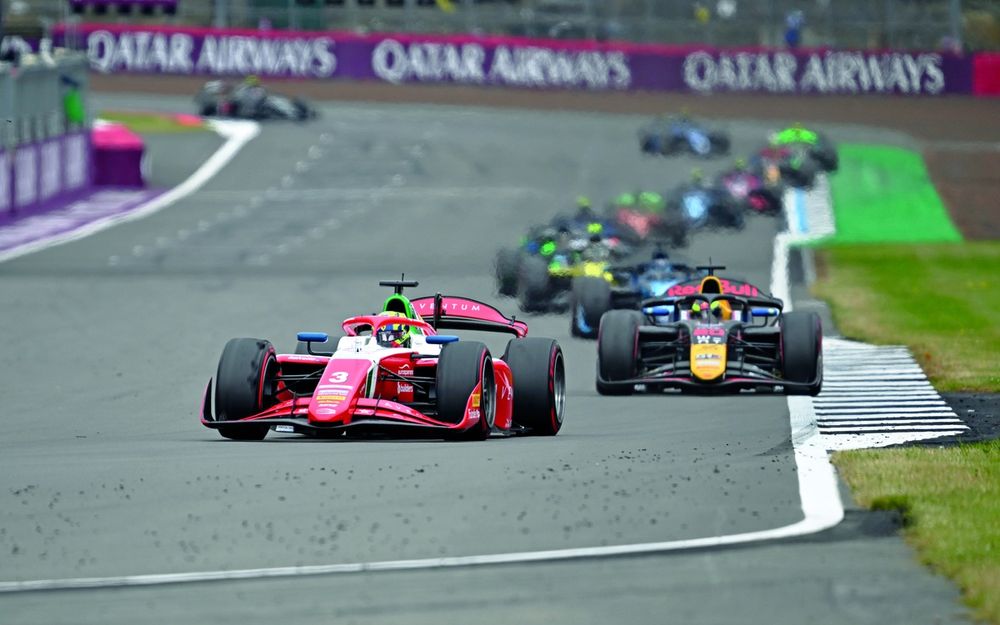
Silverstone spotlight will be rather more intense than in F2 last year
Photo by: Formula Motorsport Ltd
Bearman admits it might be some time before he is challenging for podiums and victories in F1, but he has impressed among a raft of rookies who entered the series this year and says he shares a “good relationship” with the other newcomers.
That relationship with Mercedes teenager Andrea Kimi Antonelli is stronger than some others, given the pair drove together as F2 team-mates at Prema Racing last year.
“I’m really happy he’s in F1, of course,” affirms Antonelli of Bearman. “I mean, I think after what he did in Jeddah last year, it was pretty obvious he was going to be racing. But I’m really happy that he got the same opportunity as me.
“It’s really nice to have him on the grid as well, because last year we were F2 team-mates, and we got along pretty well. And still this year we managed to carry on this nice relationship. Definitely he’s doing pretty well.
“And it’s something I expected, to be honest, because even in F2, he showed on many occasions what he’s capable of.”
For all of the anticipation of a maiden British GP, there is another key reason why the race weekend will mean so much to Bearman, since the occasion will be a family affair.
Joining F2 and F3, two non-championship British F4 races will run as support to the Formula 1 centrepiece on 5-6 July, meaning Bearman’s 15-year-old brother, Thomas, will also be racing.
The younger Bearman races in F4 for Hitech and has just claimed his first victory in his maiden campaign – now the Bearman family will be able to cheer on the siblings.

Haas racer will be rooting for his younger brother Thomas in F4
Photo by: JEP
“I think the bit I’m looking forward to the most is sharing the weekend with my brother,” agrees Ollie. “That’s going to be so awesome. I’m really excited to be able to support him. It’ll be the first race of his that I’ve been able to actually go to because I’ve been busy for all the other ones. So that’s going to be fantastic.
“It will be a special weekend for many reasons. And that is a particular reason why I can’t wait. There will be a lot of us [the Bearman family] there for the weekend.
“I think it’s incredible. My ultimate dream is to share a real F1 race with my brother. And I’m really excited for him to have that chance to be on the Formula 1 weekend for the first time. I prepared him that he’s going to be waking up incredibly early because there’s going to be a few early starts for him, but I’m sure he’ll love it.
“It’ll be a great moment for my family, my parents and my grandparents to see us both sharing the weekend at Silverstone. I’m really happy for them.”
“I would say I’m really enjoying the bond we have with the team. I get along with everyone really, really well and I’m really enjoying being here” Ollie Bearman
The feeling of family will extend beyond blood ties, with Haas also expected to have a heavy presence in the grandstands around the circuit. While it’s an American team, Haas has its base in Banbury, and Bearman is keen to get as many of the staff along as possible to cheer on he and Ocon across the weekend.
“We managed to give away a few tickets to the team because it was also the team’s home race,” he explains. “I think it’s an amazing thing that all of these people get to work in Formula 1 but never get to share it, unfortunately, with their loved ones, with their wives, with their kids, with their husbands.
“We were lucky enough that, as a British driver, I get an allowance of tickets in the grandstand for the weekend, which we were able to give away to the team, and hopefully they can raffle it and share the experience of an F1 race weekend with their other halves, with their kids and stuff like that. It’s a really cool thing.
“I would say I’m really enjoying the bond we have with the team. I get along with everyone really, really well and I’m really enjoying being here. We always have a laugh and have a big smile on our faces.”
There is no doubt that Bearman’s grin when he arrives in Northamptonshire will stretch from ear to ear as he prepares for a first home F1 race, with his brother on the support card and his family and colleagues cheering him on. Mark Mann-Bryans
This article is one of many in the new monthly issue of Autosport magazine. For more premium content, take a look at the August 2025 issue and subscribe today.

“A great race” netted a podium for F3 racer Bearman back in 2022
Photo by: Formula Motorsport Ltd

After Antonelli’s Italian GP win, is the F1 title fight over? Our writers have their say

Farewell Zandvoort: Our writers' personal highlights from the F1 Dutch GP

Has McLaren just scored an own goal in Qatar GP? Our writers have their say

Should McLaren back Norris now in F1 title fight? Our writers have their say

F1 predictions for the 2025 triple-header finale

Did Piastri deserve penalty for Brazil GP clash? Our writers have their say

Should McLaren now just let Norris and Piastri race with no rules?

Autosport's F1 experts review 2015

Multiple BTCC winner announces retirement

F1 Singapore GP: Verstappen wins chaotic wet sprint after Russell's crash

Bezzecchi brushes off Fernandez's anger after Indonesian GP sprint crash

F1 Singapore GP live commentary and updates - Verstappen wins sprint while McLarens collide
Subscribe and access Autosport.com with your ad-blocker.
From Formula 1 to MotoGP we report straight from the paddock because we love our sport, just like you. In order to keep delivering our expert journalism, our website uses advertising. Still, we want to give you the opportunity to enjoy an ad-free and tracker-free website and to continue using your adblocker.


Top Comments