


Can Mercedes up its game sufficiently to make a driver-signing sensation happen?
Toto Wolff has made no secret of his courtship of four-time world champion Max Verstappen but, after only middling success in the ground-effect era, his team needs to boost its credentials

Reaction among Formula 1 aficionados to Christian Horner’s recent dismissal from his post at Red Bull, after 20 years in charge, has been interesting to browse.
Why, some have asked, is Toto Wolff still in charge of Mercedes given its precipitous slide from outright dominance to three straight seasons in the upper midfield?
That’s an easy one to resolve: he’s a one-third shareholder, so inviting him to clear his desk is a much more challenging proposition than issuing marching orders to a mere employee.
Despite fellow one-third shareholder Sir Jim Ratcliffe’s recent wielding of the axe at the association football club he co-owns, it’s unlikely they’ll be playing Spin The P45 in the Mercedes GP boardroom in the immediate future.
But Wolff is shaping up to bet big on that future. It’s an open secret within F1 that he has been in conversation with Max Verstappen and his management group about the possibility of him joining Mercedes at some point.
Naturally Wolff and his spin machine have been evasive about the seriousness of such discussions – but if a world champion is likely to be on the market earlier than expected, it pays a team principal to know. If nothing else, it’s useful ammunition in contract negotiations with their current drivers.
But if Wolff really wants Verstappen, all other considerations aside, then he must be able to offer him what he wants: a competitive F1 car. And there are reasons to doubt whether Mercedes can do that, since recent history is not on its side.
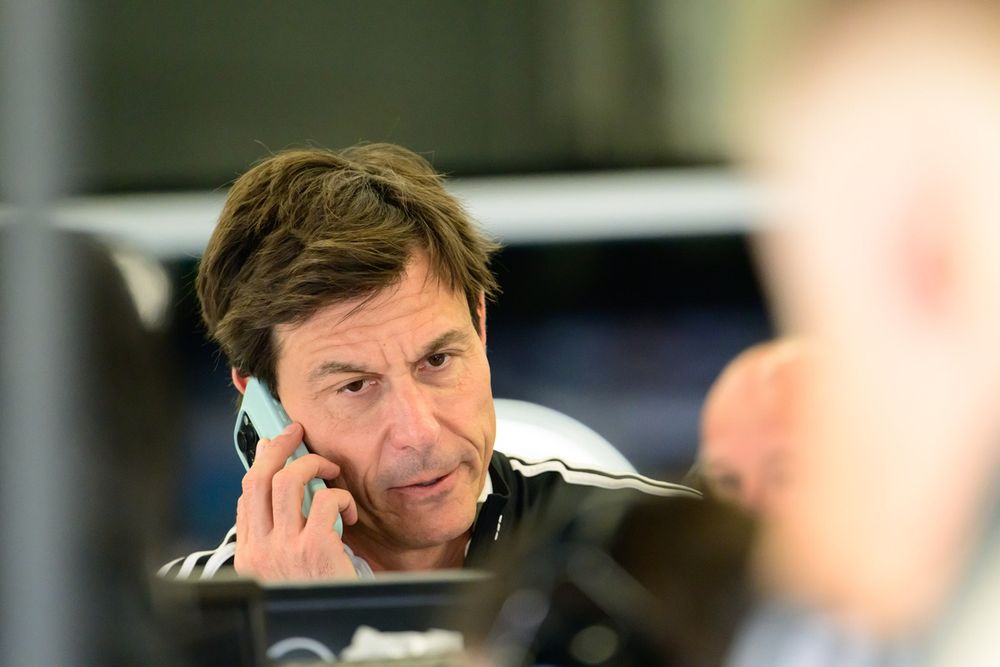
Wolff has high-stake questions to weigh up over Mercedes’ future driver line-up
Photo by: Erik Junius
Reasons to be fearful
Horner’s removal from Red Bull Racing after the British Grand Prix weekend is understood to have been motivated by desperation at board level to mollify an increasingly angst-ridden ‘Team Verstappen’.
Max is contracted until the end of 2028, but all such arrangements have exit clauses on both sides – and Verstappen’s is believed to be triggerable if he is below third place in the drivers’ championship come the summer break. At the time of writing, ahead of the Belgian GP, he is third, 18 points ahead of George Russell – Mercedes’ highest-placed driver.
The question Verstappen will have to weigh is whether Mercedes will offer a performance upgrade if he were to activate his exit clause now and move there in 2026. On that issue the auguries are somewhat mixed given the position of both squads.
According to well-sourced paddock gossip, Mercedes’ engine project for the new 2026 technical package is considerably more advanced than any of its rivals’ – and Red Bull, which is splitting from Honda at the end of this season, is in the process of developing its own power unit from scratch with financial backing from Ford.
Aside from a handful of outlier wins, Mercedes has at best been at the front of the chasing pack behind Red Bull and, more recently, McLaren
Major changes to the technical rules are traditionally seen as an opportunity for one team to dominate if it nails its solution to the new regulations better than others. The last time the engine formula changed to this extent was at the beginning of the hybrid era in 2014, and seven years of Mercedes dominance eventuated.
But rivals eventually caught up. And while Mercedes occasionally started some of those seasons with a temperamental car, the problems were not insurmountable. The last time the chassis regulations changed significantly, though – the reintroduction of ground-effect aerodynamics in 2022 – Mercedes adapted poorly.
A combination of overly ambitious solutions and a failure to understand the nuances of exploiting ground effect led the technical team down the proverbial blind alley.
Perhaps more significantly for any top-line driver considering a Mercedes seat, the team continued to get it wrong season after season. Aside from a handful of outlier wins, Mercedes has at best been at the front of the chasing pack behind Red Bull and, more recently, McLaren.

Mercedes has had another mixed season so far, from Monaco disaster to a superb 1-3 in Canada celebrated here
Photo by: Sam Bloxham / Motorsport Images via Getty Images
After the failure of the first ground-effect Mercedes, the W13, Wolff instigated an engineering reshuffle in which former chief technical officer James Allison returned to the frontline as technical director.
Since then, the messaging from Merc’s Brackley base has generally been to blame correlation issues with the aerodynamic research tools, and occasionally the rules themselves. Sometimes this will be leavened by a frank admission that the team still doesn’t fully understand why the car isn’t performing as hoped and expected.
Some characteristics seem almost woven into the DNA over successive cars. This year’s W16 has broadly followed a pattern of performing better in colder conditions; of the W15’s four victories in 2024, three – Lewis Hamilton’s wins in Britain and Belgium, Russell’s in Las Vegas – came in cool ambients. The outlier was Austria, where the leaders collided and third-placed Russell collected the benefits.
Cool runnings
Beyond the headline results, this pattern has played out during practice and qualifying sessions on other weekends, where Mercedes has encountered huge swings in performance on the same track when conditions change from day to day.
Recent Mercedes have been sub-par in terms of managing tyre temperatures, particularly the rear, which is a costly flaw given that on most circuits the rear axle is the limitation rather than the front.
Managing tyre temperatures always requires a balance in F1 since the Pirellis are so sensitive – fall below the operating ‘window’ and they provide no grip, exceed it and the surface experiences rapid thermal degradation.
What Mercedes has been reaching for, with little success until recently, has been means of extracting temperature from the tyres as they come under duress, and/or reducing the thermal stress they come under in the first place.
Broadly speaking, a car with more downforce will slide less in corners, making the tyres less likely to experience ‘spikes’ in surface temperature. But this must be balanced against the additional drag that generally comes with more downforce. Other teams have been finding more subtle means, such as suspension geometry.

Silverstone conditions should have helped Mercedes but the strategy and circumstances did not fall its way
Photo by: Simon Galloway / LAT Images via Getty Images
There has also been much speculation about the source of McLaren’s better thermal management of the rear axle: one theory enthusiastically propagated by Red Bull centred on the use of so-called ‘phase-change’ materials to extract heat from the wheel rims.
This season Russell kicked off with two podium finishes, one in the wet in Australia and another at Shanghai, a front-limited track owing to a layout which places high stresses on the front-left tyre.
But after a remarkable second place in Bahrain, where an electronics failure in the race left him unable to access key systems, the trend line was generally downwards.
Mercedes introduced a new rear suspension geometry for round seven, the Emilia Romagna GP at Imola, but then reverted to the previous one for the next round after it appeared to not perform as expected.
As midsummer beckons and Mercedes, as with other teams, pivots fully towards 2026 development, the second half of the season remains a tantalisingly open book
It introduced new floor geometry for the Spanish race including the visible ‘fences’ at the front, plus a reprofiled rear wing, then reintroduced the new rear suspension for Canada in mid-June.
It’s too early to describe the combined update as transformative, but on a relatively sunny weekend – it can go either way in Montreal at that time of year – Russell put his W16 on pole and led definitively to the flag on what proved to be a muted weekend for McLaren, crowned by Lando Norris driving into the back of team-mate Oscar Piastri. Russell’s rookie team-mate Andrea Kimi Antonelli took his first F1 podium in third.
From this high came two crushing lows as Russell finished fifth in Austria, a minute off the victorious Norris, then a long Virtual Safety Car period in the early phase of the British GP nixed any advantage Russell might have earned from pitting for slicks at the end of the formation lap. Russell’s best home finish thus remains his fifth in 2023.
As midsummer beckons and Mercedes, as with other teams, pivots fully towards 2026 development, the second half of the season remains a tantalisingly open book. Given the unknowns in play, it would be remarkable indeed if Verstappen chooses to do anything other than wait and see what comes next.

Will 2026 rules allow Mercedes to jump ahead of the pack again, as it did in 2014 with the W05?
Photo by: Getty Images
Verstappen in the mix
Eighteen months ago, Hamilton’s announcement that he would be leaving Mercedes for Ferrari in 2025 threw Wolff’s carefully aligned succession timeline into flux.
Having signed Hamilton to a so-called ‘one-plus-one’ contract (essentially a two-year deal with a break clause) in late 2023, Wolff believed he would see out the full term of the deal, enabling Mercedes to fully prepare Antonelli to replace him in 2026.
“Everybody has a shelf life,” Wolff would reason out loud later – and drivers, especially multiple world champions, are usually the last to realise when their own has passed.
Hamilton’s decision to trigger the break forced Wolff to accelerate the Antonelli development programme and introduce him as an F1 rookie in the 2025 season after just one year in F2, in which he took until the middle of the campaign to gel with the car. In itself this was a risk, but generally the Italian has acquitted himself well.
To give himself a fallback position in case Antonelli floundered, Wolff began talking to Verstappen and his management – but the mood music at the beginning of 2024 was that Max was happy at Red Bull.
This began to change as the scandal involving Horner’s alleged coercive and abusive behaviour towards a female employee revealed an ugly picture of internecine political strife at the top of Red Bull Racing: a power struggle between Horner and ‘driver advisor’ Helmut Marko.
In parallel with this imbroglio, key engineer Adrian Newey joined the list of people announcing their departures from Red Bull and car performance went off a cliff.
With the increasingly disgruntled Verstappen now on the market – unofficially at least – Wolff has had to recalibrate his timelines once again. If Max was willing to move to Mercedes but wanted to wait and see which team handled the 2026 technical reset best, that presents a challenge in terms of keeping the current Mercedes drivers in play until then.

Who of Verstappen, Russell and Antonelli will find themselves driving for Mercedes next season?
Photo by: Getty Images
Both Antonelli and Russell are out of contract at the end of this season. Although both are products of the Mercedes driver-development programme, Russell has been part of the picture for longer and therefore more likely to be considered a mature enough prospect to be allowed to make his own way. Plus he has had his own manager, Harry Soden, superintending his affairs for many years.
Wolff is more directly involved in Antonelli’s management and has said recently that the rookie will require three years in F1 to achieve his potential, which many have taken as confirmation that he will stay. Certainly Antonelli has performed well enough to avoid the prospect of being ‘benched’. Such a move would seem harsh.
Hence Russell has been kept in a holding pattern until summer while Verstappen works out his next move. It’s understood that the best offer on the table for the Briton at the moment is a one-plus-one deal – which, given his fine performances this year, could be read as rather insulting.
“Toto has made it clear to me that how I’m performing is as good as anybody,” Russell said in the FIA press conference ahead of the Austrian Grand Prix. “There is only one driver that you can debate in terms of performance. And these are his [Wolff’s] words and not my words, and that is why I have no concern about my future.
Verstappen expects – demands – priority treatment, and in any case he and Russell are on less than cordial personal terms
“But there are two seats to every team and I guess he needs to think who are those two drivers going to be for those two seats and I guess that’s what the delay is.”
No prizes for guessing who that “one driver” is: Max Verstappen.
Wolff has had to weigh two key questions this summer. Firstly, would Verstappen represent a significant performance upgrade over Russell? And secondly, if Verstappen were to replace Russell, what would the effect on Antonelli be of having the most focused and ferocious driver in F1 in the garage next door?
Another possibility would be to ‘park’ Antonelli and partner Verstappen with Russell, but this is unlikely since it would have a negative effect on a young driver whose career trajectory is building nicely.
It would also invite conflict, since Verstappen expects – demands – priority treatment, and in any case he and Russell are on less than cordial personal terms. Wolff has been here before, with Hamilton and Nico Rosberg, and he didn’t enjoy the experience.
This article is one of many in the new monthly issue of Autosport magazine. For more premium content, take a look at the Summer 2025 issue and subscribe today.

Bold W13 of 2022 was the start of the team’s struggles in the current ground-effect era, which are ongoing
Photo by: Clive Mason / Getty Images


'Senior moment' or breakdown of trust? The implications of Hamilton's Singapore GP meltdown

Why Verstappen's dominance left rivals scrabbling for alternatives in Singapore

A "better job" or more engine power? Verstappen's Singapore pole unpicked

FIA reveals "human error" caused latest software glitch in Singapore sprint qualifying

F1 Singapore GP live commentary and updates - Verstappen takes sprint pole

F1 Singapore GP live commentary and updates - Verstappen wins sprint while McLarens collide

F1 Singapore GP live commentary and updates - Verstappen on pole

LIVE: F1 Singapore GP - Verstappen dominates to victory from Leclerc, nightmare for Hamilton

What Verstappen knew about Red Bull’s big upgrade when he signed his new F1 deal

Colapinto urges fans to stop online abuse: “You’re not helping me or my future”

Evans given a hero's homecoming after WRC title triumph

How an unspectacular showing in a kart race is such good reason to celebrate
Subscribe and access Autosport.com with your ad-blocker.
From Formula 1 to MotoGP we report straight from the paddock because we love our sport, just like you. In order to keep delivering our expert journalism, our website uses advertising. Still, we want to give you the opportunity to enjoy an ad-free and tracker-free website and to continue using your adblocker.


Top Comments