


A look at McLaren and Audi's Baku F1 updates
McLaren and Audi have made very clear visual changes to their 2026 F1 cars for the Azerbaijan Grand Prix - and here's an explainer of them

Autosport Explains
Our experts decode the most important stories in motorsport.
While both Williams and Red Bull have brought updates to the Azerbaijan Grand Prix, mostly concerning the floor areas of their Formula 1 cars, McLaren and Audi have also turned up with visually different cars in Baku.
Up until now, McLaren has used a version of the 'ramped' sidepods that were in vogue last year, driving airflow from the top of the car towards the upper surface of the diffuser to help build the pressure differential and thus the rear-end downforce.
However, there has been a greater trend towards undercutting the rear part of the sidepods, essentially maximising the scope of the 'Coke bottle' section around the rear of the car and shorten the path of this airflow. Doing this minimises the friction expending the flow's energy at the rear part of the car.
McLaren has now followed suit in this practice, something that Mercedes and Ferrari had implemented at the very start of 2026. While the ramped sidepods had been particularly common across the previous ground-effect era, as the floor needed to be worked in a different manner, it appears that teams are prioritising 'inwash' qualities over downwash.
The interesting part about McLaren's interpretation of this lies in the inlets, covered by the green fairing. This is noticeably square and squeezed closer to the centreline, allowing the outer part of the leading edge to be used entirely to assist the flow along the undercut.
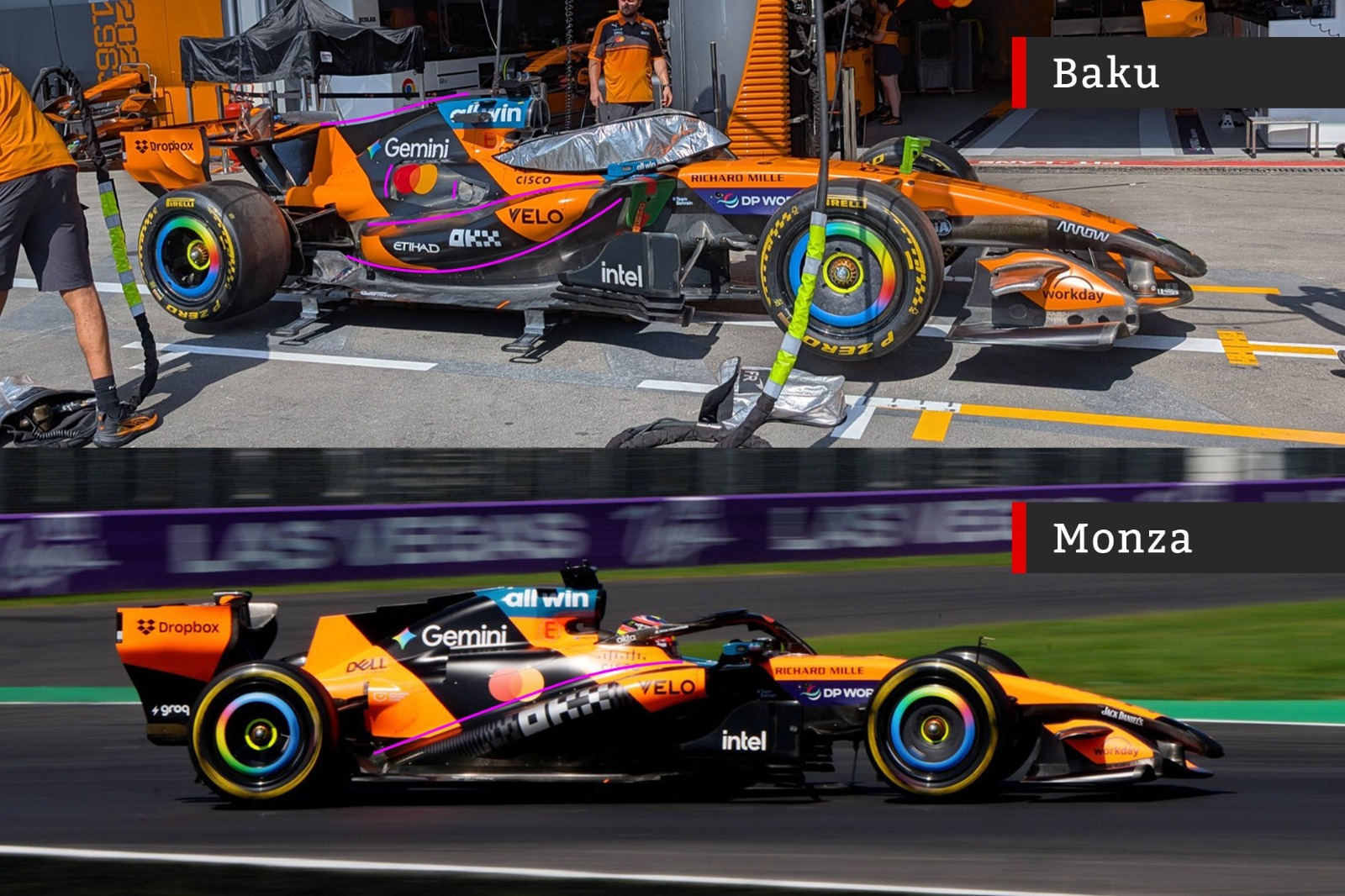
Photo by: Ben Vinel/Alex Bierens de Haan
Further back, the jagged 'shark fin' used along the top edge of the engine cover has been replaced with something more conventional, perhaps to manage the airflow to the rear wing in a different manner; this also contains a series of small centreline cooling fins. McLaren has also reworked the cooling panels either side of the engine cover (below the Gemini logo) to fit with the revised bodywork.
Audi registered a swathe of changes to its R26 chassis; although 14 were officially declared in the FIA's pre-event technical notes, this is not necessarily an indicator of how many actual updates a team has brought to the track; teams do not need to list them all.
This is most visible around the front end of the car, with a greater curvature to the front wing. The mainplane has been raised at both outboard points, creating a more spoon-shaped quality to the centre of the assembly, while the trailing edge demonstrates a bit more variance in its chord length (the distance from the front edge of the wing to the rear) across the span.
Furthermore, the endplate diveplanes have been reworked to a more delta-like winglet, with a longer-chord junction to the endplate.
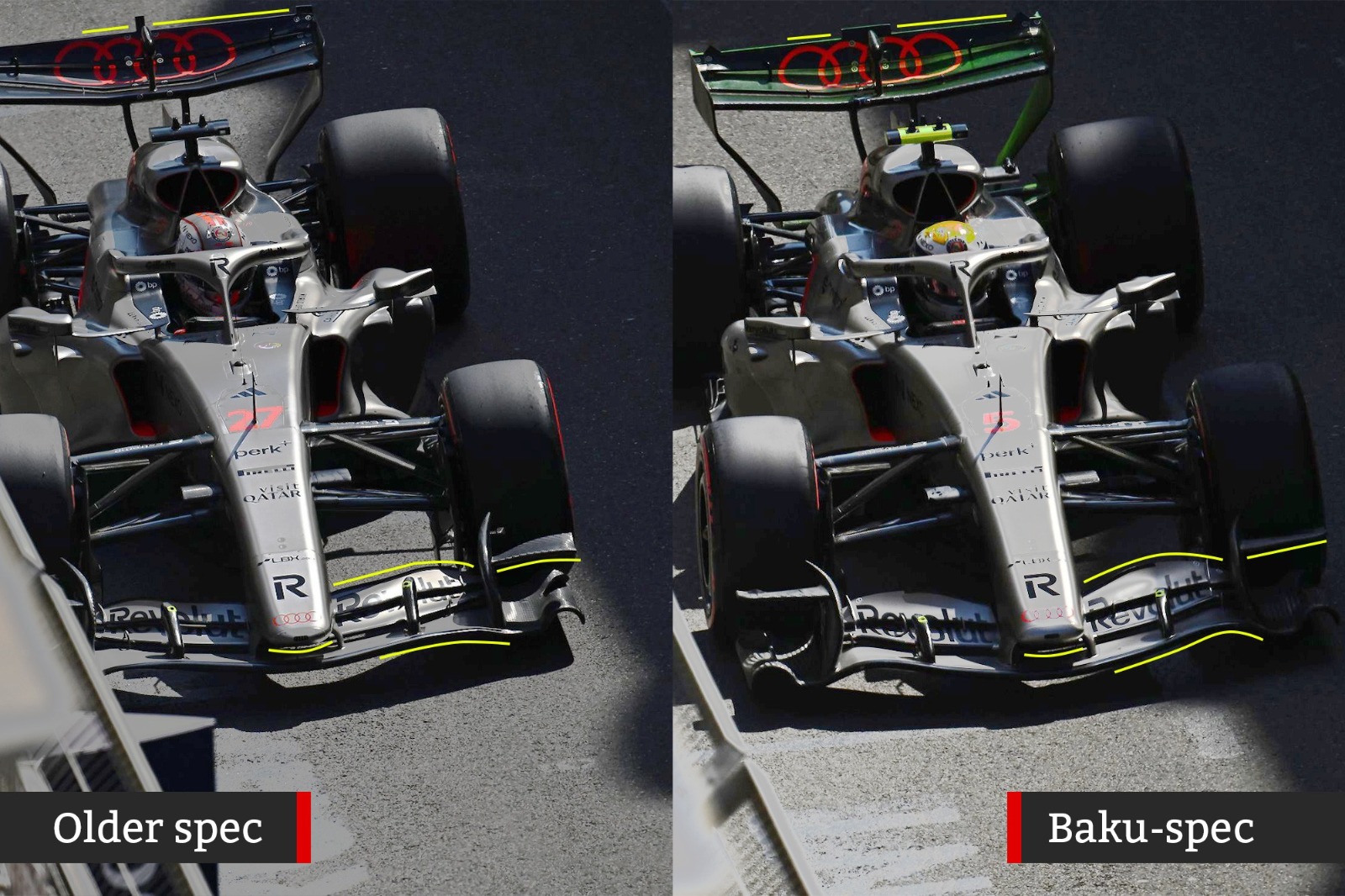
Photo by: Guido de Bortoli/LAT Images
To set these front wing changes off further, the nosecone is noticeably squarer and slightly higher up, presumably to help funnel airflow through the centreline of the car.
At the rear wing, the team has introduced changes to the trailing-edge tabs to help build more load; the outer edges follow Red Bull with the triangular tabs here, while the centrepiece has been extruded outwards.
Audi has persisted with the outboard straightline-mode actuators, giving it more space to work with around the nosecone. Ultimately, this will change the way that the airflow moves around the car; the front wing sets up the flow for the elements further downstream, aligning with the revised front suspension fairings and changes to the floor. Helpfully, Audi ran these back-to-back in FP1; Nico Hulkenberg had the old specification, while Gabriel Bortoleto ran with the new parts.
Racing Bulls had a small change to its front wing, shaving off a chunk out of the upper plane. The team stated in its notes that "The new front wing geometry helps establish a clean flow field, which leads to improved performance from the components downstream of it."
This has been paired with some revised front suspension geometry and a new brake duct and lip assembly within the wheel hub.
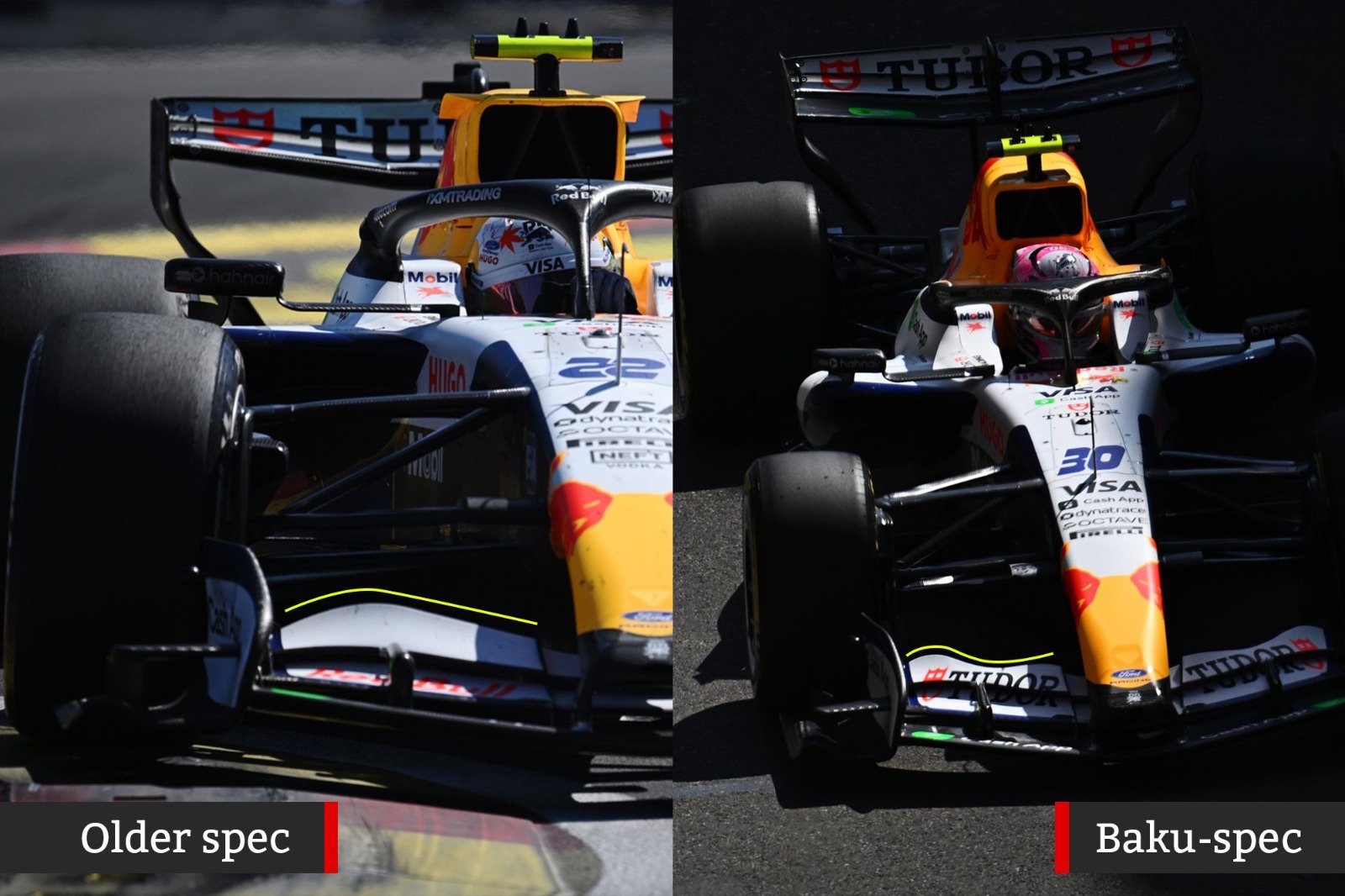
Photo by: Sam Bagnall/Guido de Bortoli


"Free agent" Ocon talking to other teams with Haas yet to confirm F1 2027 line-up

Ten years of Baku: Can F1 2026 bring back the fear factor?

F1 approves shorter races for 2027 to fit revised power unit plan

Haas confident of getting 2027 F1 budget closer to cap with new partner talks

F1 doesn't need to change its VSC rules despite Norris' Spain loss

Spanish Grand Prix Driver Ratings 2026

How Norris unfurled a surprising - and "unrepeatable" - Spanish GP pole lap

Audi’s long road back to the top of grand prix racing

LIVE: F1 Azerbaijan GP updates - FP2 under way
A look at McLaren and Audi's Baku F1 updates

F1 Azerbaijan GP: Russell fastest in first practice as Antonelli's Mercedes breaks down

LIVE: F1 Azerbaijan GP updates - Russell leads FP1 as Antonelli's Mercedes breaks down
Subscribe and access Autosport.com with your ad-blocker.
From Formula 1 to MotoGP we report straight from the paddock because we love our sport, just like you. In order to keep delivering our expert journalism, our website uses advertising. Still, we want to give you the opportunity to enjoy an ad-free and tracker-free website and to continue using your adblocker.


Top Comments