


Toto Wolff: Horner's Formula 1 2018 engine concerns his own fault
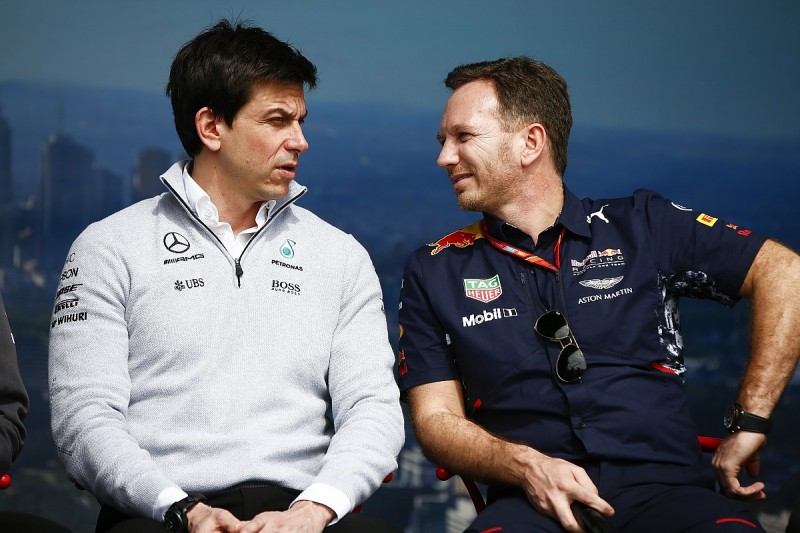
Mercedes boss Toto Wolff says Red Bull's Christian Horner only has himself to blame for Formula 1's move to three engines in 2018, despite his push to ditch the limit

Horner said over the Abu Dhabi weekend that F1 was 'barking mad' to go down from four to three engines for each driver next year and McLaren racing director Eric Boullier said the rule is "not Formula 1".
The ruling could impact Red Bull with Renault's unreliability a problem this year, as well as Honda's similar struggles, and Horner has raised concerns that three engines per driver could lead to a 'wave of grid penalties.'
But Wolff is unimpressed with Horner's stance and says the decision to go down to three engines came about because customer teams like Red Bull pushed so hard for cheaper deals.
"If it's barking mad, they shouldn't have pushed for a lower supply price, and we shouldn't have agreed to give that in order to achieve lower supply price," said Wolff, when asked by Autosport about the ongoing controversy.
"We're going to go down from four engines, which was bound in the regulations, to three engines. This is where we are - the regulations stood for four engines for next year - and we were perfectly fine for that.
"All manufacturers were pushed, let's call it strongly encouraged, to optimise on the supply price - and this is what we did and this was the consequence. And everybody, as far as I remember who was on the table, was part of it.
"It's a massive struggle for all of us, but it's out of what we have discussed."
Williams technical chief Paddy Lowe backed Wolff's stance, saying the calls from customer teams to end the three engine limit were misplaced.
"Whilst there is a burden to give out engines that last longer, that burden's been put on the manufacturers and the cost of it," said Lowe. "And as customers, we see the benefit through a lower price tag.
"I think that's the important point to understand. I think it's good news that, when there are good things for Formula 1, we should understand and appreciate them, that helps the smaller teams and going back to four engines inevitably required price increases."
Asked if he had any sympathy for Red Bull and McLaren's view, he added: "It fails to recognise that point I just made, it was that very important point. You can't divorce the two things.
"You're always free to take a penalty, take an engine then that will cost you more money. Or you can not run your engine with so much power, that's the formula.
"I'm not familiar with other engines but if you took a Mercedes engine today and ran it at lower power, you could get through the season already on three engines.
"It's what power level you select will dictate the life to a large extent so that's [where] the development [is] going."
Share Or Save This Story


Brundle awarded OBE in King’s New Year’s honours

The new rules dilemma that will define the 2025 F1 season

Jon Noble: An unfair perception or a genuine concern? Lifting the lid on Red Bull’s Tsunoda scepticism

The battle Susie Wolff refuses to give up on

Wolff: Mercedes won't be "flirting" with other F1 drivers

Why Mercedes won’t leap into choosing a Wolff successor

Evans set for “all in or nothing” approach to WRC title showdown

WRC Sardinia: Title wide open as Solberg takes Sardinia lead into final day

Why Malaysia would be the perfect place for F1’s first wet-weather race in 2026

You Ask The Questions: Emerson Fittipaldi
Subscribe and access Autosport.com with your ad-blocker.
From Formula 1 to MotoGP we report straight from the paddock because we love our sport, just like you. In order to keep delivering our expert journalism, our website uses advertising. Still, we want to give you the opportunity to enjoy an ad-free and tracker-free website and to continue using your adblocker.


Top Comments