


F1 starts made more difficult for drivers in 2017
Formula 1 drivers will face a much greater challenge in making clean starts at grands prix this year due to new rules imposed by the FIA


As part of an ongoing push by the governing body to reduce 'driver aids', there have been a number of restrictions imposed to reduce the influence of engineers in race starts.
Initially that began with limits on radio communications and clutch bite points, and last year that expanded to forcing drivers to use only a single clutch paddle.
Further changes have been made for this year, with new limits on clutch control, plus the movement and location of the paddles.
The biggest change comes in how the paddle on the steering wheel now controls the clutch, because there now has to be a linear torque control.
Previously it was possible for an engineer to map the settings in a way that most of the movement on the steering wheel paddle would be in the 'sweet spot' of the clutch, meaning the starts remained straightforward for drivers.
Kevin Magnussen explained: "You just had to release it between 10% and 80%.
"Somewhere in there was a flat map that would be set to the grip, the tyres and fuel loads.
"So the start was 100% up to the engineers before. But now it is completely down to us."
Now with linear settings, if a driver wants to hit the perfect spot for the clutch he has to find the exact place with the clutch paddle to avoid wheelspin or bogging down.
Sauber's Pascal Wehrlein said: "Now we have a situation like in a normal road car.
"As a driver you have to find the bite point completely by yourself.
"Before, was more down to the engineer whether the set-up was OK and the clutch was biting correctly.
"Now you do it with your hand and you don't have any adjustment possibility anymore."
EXTRA RESTRICTIONS IN PLACE
There are further limitations about the clutch paddle design that will make things harder.
To prevent teams putting devices behind the steering wheel to help a driver feel where the right clutch spot should be, there are now exclusion zones in place.
Teams have been told that there must be a 50mm gap between the clutch paddle and any other control on the wheel.
The only exception to the 50mm gap is if teams put in place a stop mechanism that restricts a drivers' hand from feeling elsewhere - something Mercedes and Force India are understood to have done.
Furthermore, there is a maximum limit of movement for the clutch paddle of 80mm.
Without the 80mm limit, teams would have been tempted to allow excessive movement of the clutch paddles to try to help make it easier for drivers find the perfect spot.
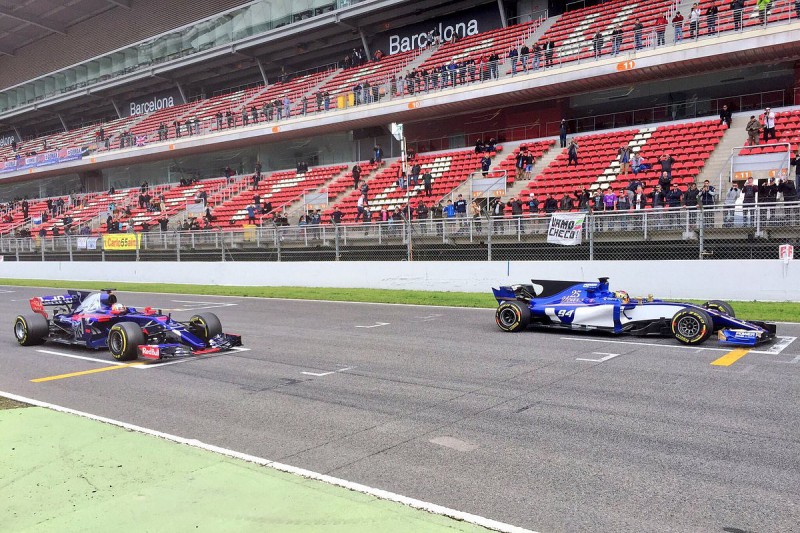
Early feedback from practice starts at Barcelona testing this week suggests the changes have succeeded in making it more challenging to get off the line.
Wehrlein said: "The starts will be very difficult for the drivers.
"You can have a bit of luck and get a good start, but you can also have bad luck and you get a very poor getaway."
Share Or Save This Story


Brundle awarded OBE in King’s New Year’s honours

The new rules dilemma that will define the 2025 F1 season

Jon Noble: An unfair perception or a genuine concern? Lifting the lid on Red Bull’s Tsunoda scepticism

MotoGP Australian GP: Marquez wins sprint to seize points lead, Martin crashes

MotoGP Australian GP: Marquez crashes and then takes pole in wet qualifying

What we learned from Friday practice at the 2026 United States GP

Honda rider Marini withdraws from Australian GP due to virus
Subscribe and access Autosport.com with your ad-blocker.
From Formula 1 to MotoGP we report straight from the paddock because we love our sport, just like you. In order to keep delivering our expert journalism, our website uses advertising. Still, we want to give you the opportunity to enjoy an ad-free and tracker-free website and to continue using your adblocker.


Top Comments