
How Extreme E’s charging solution could transform motorsport
The new off-road SUV series aims to go boldly into the unknown on several fronts, but perhaps its most significant measure will involve the energy source powering its fleet of cars

Engineering
Our experts' guide on how you can become a better racing driver
Extreme E has yet to turn a wheel in competition, yet its A-list roster of teams, drivers and owners has captured column inches the world over in anticipation of the first all-electric rally raid series. The 2016 Formula 1 championship protagonists Lewis Hamilton and Nico Rosberg do battle once more as owners of their own XE outfits, while 2009 F1 title winner Jenson Button will get behind the wheel of his own team’s ODYSSEY 21 chariot to boost an already-impressive cast of racers.
The premise of the series is to draw attention to areas of the globe ravaged by climate change by racing on them, then working with scientists and ecologists to restore those affected zones. A noble and worthwhile cause, no doubt, which is especially pertinent as more attention has begun to fall on worldwide social and environmental issues. That said, producing a racing series with such a strong social mission statement would be for naught if, say, it fell into the trap of operating on a logistics system with little regard for eco-friendliness. But XE has thought of that.
Firstly, the paddock will not be transported from event to event through the medium of air travel. Instead, the XE ecosystem will set sail to each event on the RMS St Helena, a passenger/cargo ship that will ferry the paddock to each round. Quite how it will reach the more inland areas is an unknown, given a seafaring vessel’s inability to cope with the insurmountable challenge of land…
But that’s not the point. The ship has been refurbished with engines that run on low-sulphur marine diesel to control emissions, and the series even prides itself on upcycling its interior to reduce waste. That’s perhaps a drop in the ocean (if you’ll pardon the pun) compared to the emissions produced globally, but it remains true to the mission statement.
But the source of power for XE’s fleet of ODYSSEY 21 SUVs is the key part of its commitment to remaining as emission-free as possible. Unlike its sister series Formula E, which charges its cars with glycerine generators to reduce NOx and carbon emissions, XE has pushed the boat out and opted for hydrogen fuel cells to charge the cars. Hydrogen fuel cell-produced electricity has long been touted as the silver bullet towards ensuring that electric vehicles can derive their power from a clean and sustainable source, given the only byproduct following the intra-cell electrolysis reaction is water.
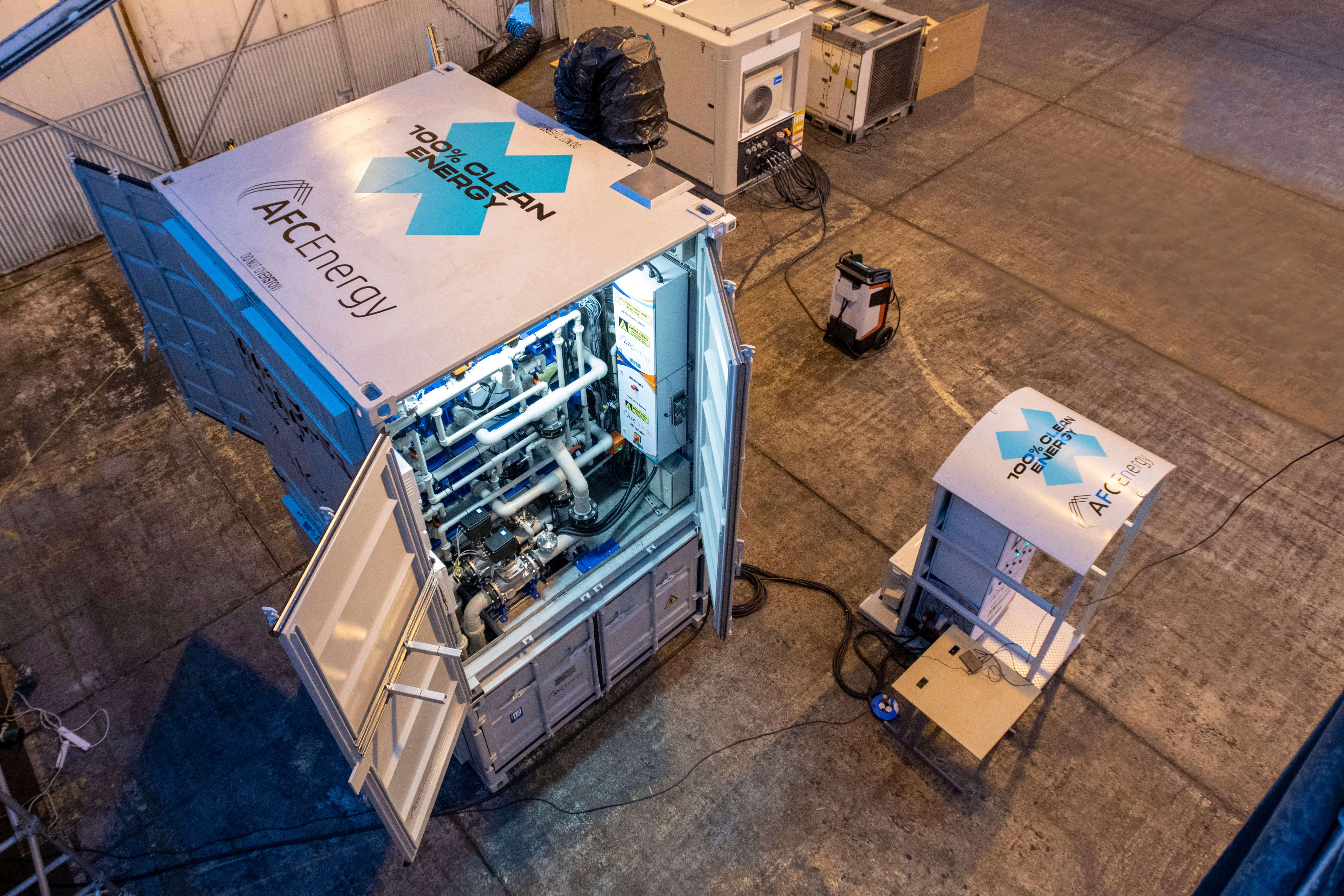
AFC Energy XE charging unit
Photo by: AFC Energy
Provided by XE partners AFC Energy, the use of hydrogen to power up the cars is yet to reach motorsport’s mainstream, and has only ever appeared in futuristic concepts from the more notorious championships. Although the proposed HYRAZE series – set for a 2023 launch – plans to use hydrogen fuel cells within the cars directly, XE’s partnership with AFC Energy is the first high-profile application of hydrogen fuel within a motorsport setting.
But how will it work? AFC CEO Adam Bond explains the ins and outs of XE’s source of power, and how it’ll work logistically with the upstart series.
“It’s the most common question we’re asked,” says Bond. “In simple terms, the bespoke charging system that AFC Energy has developed for Extreme E is made up of four primary components: the fuel production, alkaline fuel cell, a battery storage unit, and the charger itself.
Where green energy often has the propensity to contradict itself is in the power used to develop those solutions. In the UK in 2020 (up to the third quarter, according to government figures), 40.2% of power was accounted for by renewable sources, but that still leaves 59.8% using non-sustainable sources
“In the days leading up to each race weekend, hydrogen will be generated from a combination of portable solar arrays powering electrolysers. The hydrogen generated will be stored in low pressure metal hydride cylinders ready for use over the weekend. For the race, our fuel cell will utilise the green hydrogen to generate clean power, which will then be capable of being fed into each of their ODYSSEY 21 race vehicles via a battery storage unit to buffer power in order to meet peak charging times between races.”
Bond reveals that discussions regarding a partnership with Extreme E began in January 2020.
“What was also clear at that point,” he continues, “was the need to agree a bespoke specification and design with them given the varying conditions and challenging logistics of the series – from the heat of the desert, to the cold of Greenland, and then the high altitude of Tierra del Fuego! Our system therefore provides zero-emission, off-grid power that can be deployed in a range of climatic conditions.”
Of course, where green energy often has the propensity to contradict itself is in the power used to develop those solutions. In the UK in 2020 (up to the third quarter, according to government figures), 40.2% of power was accounted for by renewable sources, but that still leaves 59.8% using non-sustainable sources to build or supplement those renewable sources. There will eventually be a crossover in those figures, but as it stands there is a rising reliance on natural gas for power.

Saudi Arabia Extreme E recce
Photo by: Extreme E
In the electric series that exist, the plug-in nature of powering up batteries still produces emissions, even if Formula E’s Aquafuel glycerine source has cut those emissions from diesel. But XE has built on that with the hydrogen fuel cell to take emissions to near-negligible levels, with a view to showcasing AFC Energy’s technology and helping the company develop its products. Within that is a key component of the modern-day motorsport partnership – aligning yourself with a championship to accelerate a product’s development.
“Extreme E needed a zero-emission power system to charge their ODYSSEY 21 vehicles to tie with the purpose of the series, and our H-Power fuel cell provided the perfect base technology to deliver it,” says Bond. “The system therefore removes the need for diesel generators to power the cars, significantly reducing emissions while providing a global platform to showcase the charging technology.
“As a twist for the Extreme E series however, AFC Energy is also configuring an upstream fuelling element. At each race location, we will be creating the hydrogen fuel on site in the days leading up to the race, using a combination of electrolysis and renewable solar power such that not only is the fuel cell zero emission, but so too is the manufacture of the hydrogen fuel. This is a world first in the off-grid powering of sporting events.”
Motorsport is at a crossroads. After being powered by fossil fuels for so long, series have branched off into hybrid formulas (such as F1, and soon to be British Touring Cars and the World Rally Championship), and battery-electric series such as FE, with HYRAZE’s proposed full hydrogen fuel cell-powered fleet of cars on the horizon. For now, XE will bridge that gap between the latter two examples.
In the short term, the likes of F1 will increase the amount of biofuels present within the fuel that each car uses. A switch to E10 fuels in 2022 will precede the desired move to complete biologically replaced products for 2026 and beyond, creating another technological battleground to help the world’s petrochemicals giants produce fuels with greater efficiency. But even so, there will come a time where fuels containing pollutants become even more unfashionable, and XE’s and AFC’s combined aspirations to steal a march on the popularity of hydrogen is evident.
“Top-flight motorsport in the past has been dominated by considerations on power, weight and aerodynamics, with the combustion engine at its very centre,” Bond explains. “Since the inception of Formula E, how vehicles are powered is now a material consideration for series around the world.
“I think there has been a realisation that, with the growth of hybrid and EV products ‘on the road’, there needs to be further outlets to showcase the technology on the track or off-road. Extreme E has responded to that challenge, and I think it will encourage the creation of new all-electric race or rally championships across the world.”
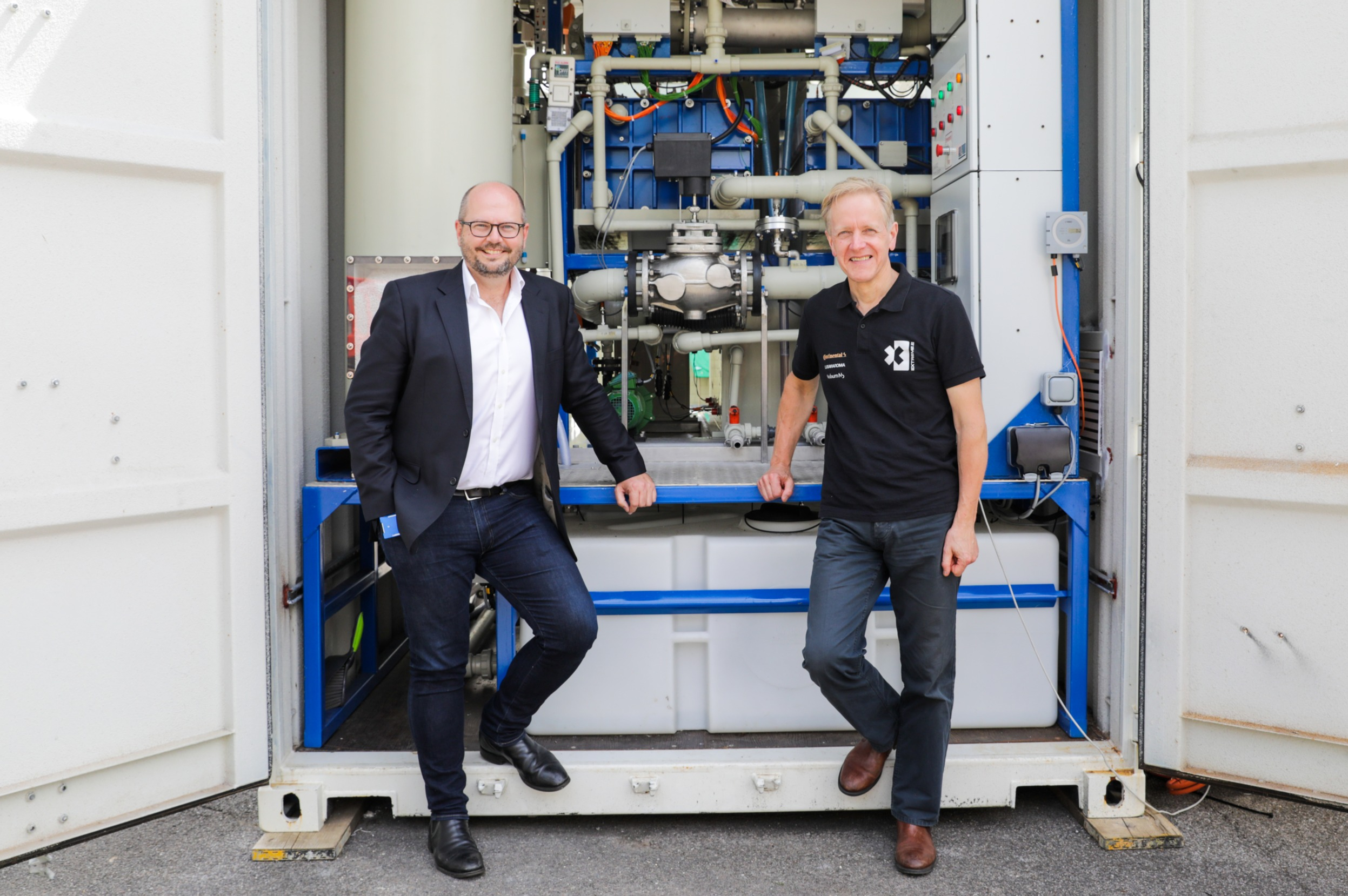
Adam Bond, AFC Energy, Andy Welch, XE
Photo by: AFC Energy
And, Bond reasons, the growth of renewable sources should have the potential to change the face of motorsport forever.
It’s not as simple as just snipping off a few molecules away from water; ironically, it requires a lot of energy to pull it off. But if motorsport can help to make those advances, then XE and AFC will have played an admirable part in that
“I think motorsport is already in the process of adapting itself,” he says. “Clear progress has been made in the past few years through Formula E, the use of hypercars at Le Mans, and Formula 1 setting its overall green objective to move towards a net-zero carbon footprint, with all power units to be fuelled by fully advanced, sustainable fuels by 2030. I think Extreme E’s inaugural season will further accelerate this transition.”
Although hydrogen is clearly going to be an attractive future propulsion source, problems do lay in creating hydrogen gas, storing it and ensuring that it remains affordable. On a small scale, XE has the means to do so, but a bigger achievement will be the series’ ability to help energy companies upscale their operations to allow for a greater quantity of applications worldwide.
It’s not as simple as just snipping off a few molecules away from water; ironically, it requires a lot of energy to pull it off. But if motorsport can help to make those advances, then XE and AFC will have played an admirable part in that. With hydrogen finally making its way into motorsport, the winds of change are surely picking up pace.

Andretti Autosport, Chip Ganassi Racing Extreme E test
Photo by: Extreme E
The power of hydrogen
Hydrogen is the most abundant chemical element in the universe. In terms of mass, hydrogen makes up around 75% of everything, but in terms of molecular quantity, it’s closer to 89%. It forms part of almost all of our favourite liquids, solids and gases. But because it readily forms compounds with other elements, it’s very hard to isolate the H2 molecules required to form the hydrogen fuel. This is usually done via the electrolysis of water.
Electrolysis uses a positively charged anode and a negatively charged cathode in a solution, separated by a permeable membrane, to form new chemical compositions. At the anode, the hydrogen and oxygen split to form hydrogen ions, free electrons and oxygen. The H+ ions and electrons then join forces to form H2 gas to be packed up and used in a fuel cell.
A hydrogen fuel cell takes the hydrogen molecules and breaks them again into hydrogen ions and electrons. The electrons generate the current required to develop an electrical charge, which can be stored by the car’s batteries. The hydrogen ions then recombine with the electrons and with oxygen to create water as its sole byproduct. That water, theoretically, could be used again in an electrolysis reaction to reclaim the hydrogen gas, or used elsewhere.
Although there are many different types of fuel cell, they all generally work on that principle, and multiple cells can be combined in various ways to deliver different levels of current or voltage, depending on the purpose.
For XE, this is done externally to plug in and charge the batteries on the car, but future hydrogen-electric cars will have an onboard fuel cell and a hydrogen tank to produce that reaction internally.
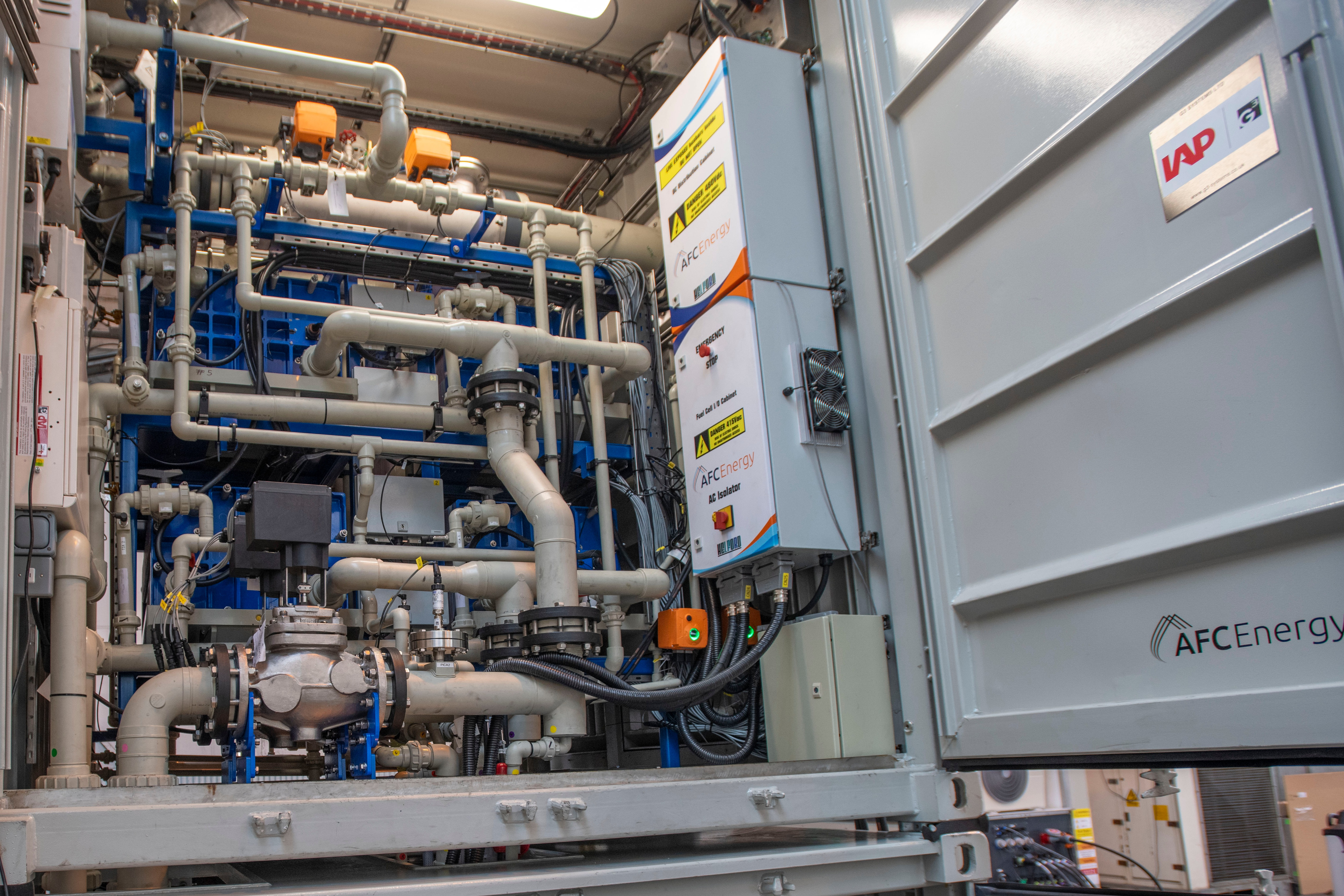
AFC Energy XE charging unit
Photo by: AFC Energy


What we learned from the 2026 F1 Singapore GP sprint race and qualifying

The political minefield set out by F1’s recent cost-cap grievances

What caused Mercedes' pace deficit at Sepang despite upgraded W17?

Three kings: F1's generational stars shone at Sepang

Bahrain Grand Prix in Malaysia Driver Ratings 2026

The slick tyre gamble that hurt McLaren and Ferrari's chances in Bahrain GP in Malaysia

The wide world of strategy options expected in F1's Bahrain GP in Malaysia

McLaren explains recurring Norris straightline speed issue after Bahrain GP qualifying

What Max Verstappen will change after Red Bull’s poor F1 starts in Malaysia and Singapore

A "better job" or more engine power? Verstappen's Singapore pole unpicked

What we learned from the 2026 F1 Singapore GP sprint race and qualifying

McLaren to talk internally after "simply not acceptable" Norris-Piastri clash
Subscribe and access Autosport.com with your ad-blocker.
From Formula 1 to MotoGP we report straight from the paddock because we love our sport, just like you. In order to keep delivering our expert journalism, our website uses advertising. Still, we want to give you the opportunity to enjoy an ad-free and tracker-free website and to continue using your adblocker.


Top Comments