
Can 2027 regs fix the World Rally Championship?
A blueprint to ensure the future of rallying’s top tier sets out to preserve its current strengths while dramatically reducing costs and bringing more teams on board

Amid ongoing uncertainty over the future participation of at least one manufacturer, there is a lot riding on the success of the FIA’s 2027 regulations for the World Rally Championship. Even before the governing body’s announcement of the rules in December last year, there was growing anticipation for the release of the WRC’s pathway.
The current Rally1 ruleset, introduced in 2022, produced spectacular cars, made incredible advances in safety, embraced hybrid power until 2024, and led the way in pioneering the use of sustainable fuel. But these cars come at an eye-watering cost of almost €1million each, far exceeding the original target. The regulations also failed to deliver on one key objective – attracting new manufacturers to the championship.
Under Rally1, the category has rarely gained more than 10 cars per round, which stakeholders agree is not enough. There is a widespread feeling that a reset is required to ensure that current marques Toyota, Hyundai (yet to commit beyond 2025) and Ford via M-Sport remain on board, while breathing new life into the WRC by increasing the number of competitors and cutting costs.
“Look at the product, do we have a good product? Yes, but there are issues we have that can be fixed. I believe with the new regulations we can go forward” Mohammed Ben Sulayem
“It is not about the time fixing it, it is [about] fixing it,” said FIA president Mohammed Ben Sulayem when asked about addressing the current issues at the season-opener in Monte Carlo. “If it takes three years or four years, it will take as long as it takes, but [we should not] let it slip. The more we let it slip, the harder it will be, and then it will be beyond repair.
“Look at the product, do we have a good product? Yes, but there are issues we have that can be fixed. I believe with the new regulations we can go forward. It is about listening to people, and I feel the drivers, the fans, the OEMs and media have a lot to say. Things are moving in the right direction and at least we have a [FIA] department that is listening.
“We have to make sure that the regulations we approve are flexible, but strict down the road and affordable. Then the promoter has to make sure this product is polished. We have a good product, but we have to sell it.”

FIA supremo Mohammed bin Sulayem stresses the necessity to sell this “good product”
Photo by: Red Bull Content Pool
What has been proposed?
After months of consultation with manufacturers and stakeholders, the FIA’s blueprint for the future of the WRC appears to tick many boxes. To be known as ‘WRC27’, the regulations will operate over a 10-year cycle, instead of the previous and more traditional five-year period.
The cars will be more versatile and built to a cost cap of €345,000, which the FIA says is a 50% reduction in costs from the current formula. It hopes that this will encourage more teams and manufacturers to compete, while tuners will also be eligible to build chassis and buy parts from manufacturers in order to participate.
The spaceframe chassis concept introduced alongside Rally1 cars in 2022 will remain, but it will be versatile to incorporate various powertrains, and will theoretically enable the use of hatchback, saloon and SUV body types.
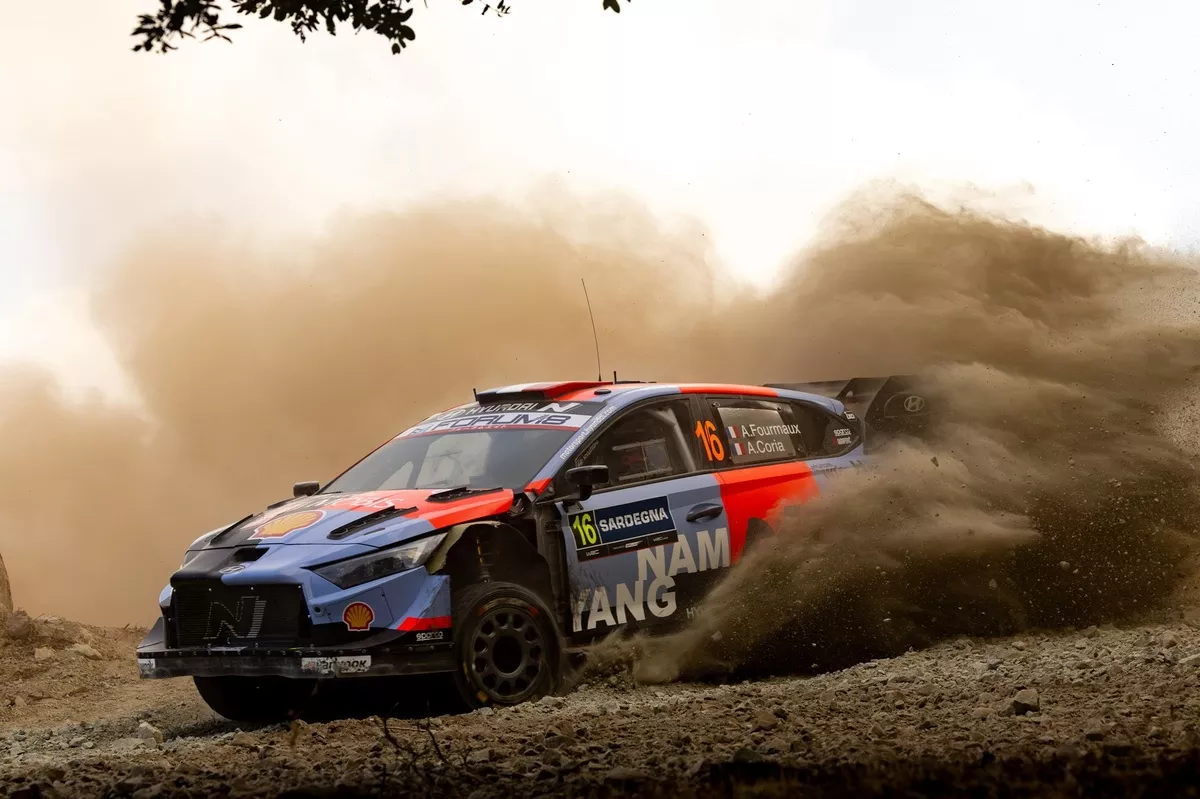
In order to meet an ambitious cost cap, cars will be largely based on the current Rally2 regulations, including the engine (which will be powered by sustainable fuel) and featuring less downforce, with speeds expected to be similar to 2016 WRC machinery. Cheaper and more durable materials are likely to be used for many components. Simpler double-wishbone suspension will also be incorporated to limit costs.
Running costs for teams are set to be reduced by limiting personnel, reducing logistics costs, plus increasing the use of local facilities and data connectivity to aid offsite engineering.
When the regulations were announced, there was a big focus on flexibility in powertrains, allowing the prospect of EV and hydrogen-powered cars. This is the FIA’s eventual goal, but it has since clarified that only internal combustion-engined cars will contest the championship from the outset of the new regulation cycle in 2027.
Should a competitor wish to build a programme around a car featuring a non-ICE powertrain, then it is anticipated that the FIA will manage the equivalence of technology by using a torque meter – a process already used in the Dakar Rally.
From 2027, the championship will effectively run under one main class. It will feature the new WRC27 cars and the current Rally2 machines before the latter class reaches the end of its lifespan.
“We have good contact [with manufacturers] so we know the future will be good,” said the FIA’s technical director, Xavier Mestelan Pinon.

Performance levels are set to mirror 2016 World Rally Championship machinery
Photo by: McKlein
The reaction
It’s a lot of information to digest and the clock is ticking – the average timeframe for a new player to build and develop a car for a major motorsport programme is more than a year. Toyota, Hyundai and M-Sport have been largely receptive to the plan, but there remain several grey areas up for discussion.
M-Sport, which runs as a semi-works operation, can see the advantage of opening up the ability for ‘tuners’ to build chassis but has concerns over the scenario of WRC27 cars and Rally2 machinery competing against each other.
“I think 2027 is quite close so it’s good that we have the vision and the regulations mostly in place, but the next three or four months will be vital because to create a car by 2027 is pretty hard going,” says M-Sport team principal Richard Millener. “I think [the price] is ambitious.
“We should think outside of OEMs as there are not so many of them anymore. Maybe we need to get semi-works teams or privateer teams supported by OEMs” Richard Millener
“Is what has been proposed good enough for a top category and are we sure we want to compete directly against the Rally2? I guess it will depend on the number of teams that commit to 2027. If there is not the possibility to commit for 2027, maybe there is more time to tweak the regulations for 2028.
“I think 20 cars in the top category is too much, the perfect number for me would be 12-15. I do think that the spaceframe chassis and the direction are really interesting. If someone like M-Sport is capable of building the chassis and the drivetrain, then the team can be run by anybody. We should think outside of OEMs as there are not so many of them anymore. Maybe we need to get semi-works teams or privateer teams supported by OEMs.
“At the same time, to move the sport forward there’s an element of OEM versus private investment as well, and private teams buying the chassis off teams and running their own body – like Formula 1, where teams buy engines. That works and that’s where I think it should go, but there is still a lot to finalise.”
Millener isn’t alone in questioning whether the WRC27 cars are “good enough” to be considered top-category machines. Drivers have also raised concerns that slower cars won’t be as spectacular for the crowds, one area in which Rally1 has been a huge success.
“There are some positive points, but there are still a few things that are unclear,” says Toyota’s championship leader Elfyn Evans. “I don’t understand the obsession of making the cars so slow. But I think the [current] cars are unnecessarily expensive for the level of performance we have at the moment, and this [2027 regulation] is a step towards [being more affordable]. We have the safest cars ever and there is an obsession to make average speed the safety point of the cars, which I don’t understand at all.

Popular Rally2 rules will provide the basis for the new cars
Photo by: McKlein
“I think the cost targets are a bit unrealistic, but other than that there is still a lot of positive stuff. Using less composites to make the panels to try and keep the costs under control and a more sensible engine platform is all really welcome. It should open up the category. It still needs to be spectacular – that is an asset we have as a sport at the moment.”
Toyota “is happy” with the concept in general. While admitting that the €345,000 cost cap represents a challenge, technical director Tom Fowler says there would be “no point in it existing” if it was easy to work within.
“We are happy with the overall direction of the regulations in the sense that it fits the situation and the priorities in the WRC, which is to increase participation,” opines Fowler. “To go into another regulation where you can build multi-million-euro cars, where potentially there might be only our five cars... while it might be nice for our drivers and engineers, if there’s nobody to race against it doesn’t make any sense.
“In that sense the Rally2 car is at the moment a very popular and attractive formula for many people, and to take what is good from that and what is good from the top-flight Rally1 and combine those into a more affordable and practical package is what has to happen for 2027 to increase the participation.
“A really good goal would be to retain everyone that [currently builds] a Rally1 car and Rally2 car and if one or two tuners join, then we’ve got a really good situation. If one or two of the current ones don’t want to do a car and they are replaced by one or two tuners, then we are still in quite a good place.”
While currently no marque or team has officially confirmed its participation in 2027, the manufacturer over which there is significant uncertainty regarding its short-term future is Hyundai. The 2027 vision could prove crucial in determining the South Korean car maker’s direction following its recent decision to embark upon a World Endurance Championship programme under its Genesis brand.
“It is still a work in progress both on detail and the more fundamental questions,” reckons Hyundai team principal Cyril Abiteboul. “We should not lose sight of the fact that these regulations need to be designed for attracting more manufacturers and for keeping the current manufacturers, as well as attracting a wider audience and providing new business and monetisation opportunities.
“First and foremost the regulation should increase the number of competitors. That is where we need to receive some guarantees or some understanding from the FIA and the decision makers. We really need to understand where the sport is, and what its fundamental objective is.”
This article is one of many in the new monthly issue of Autosport magazine. For more premium content, take a look at the May 2025 issue and subscribe today.

The sport’s spectacular nature is one of its key strengths and needs to be preserved, reckons Elfyn Evans
Photo by: Toyota Racing


FIA ratifies key 2027 WRC sporting regulations

How Andrew Jordan realised his teenage rallycross dream

Evans given a hero's homecoming after WRC title triumph

M-Sport’s 2027 WRC Fiesta Kit car breaks cover

Loeb testing for Project Rally One ahead of WRC debut

Where Pajari can improve after WRC title near miss
The USA’s WRC return and 2027 key calendar questions answered

WRC expands 2027 calendar to 15 rounds as USA, UK return

How Antonelli levelled up his character to be F1 2026's world champion-elect

FIA set to close F1 cost cap loophole with new rules

Norris promises to make "better decisions" following fresh talks over Singapore GP clash

FIA expects F1 races in Qatar and Abu Dhabi to run as planned
Subscribe and access Autosport.com with your ad-blocker.
From Formula 1 to MotoGP we report straight from the paddock because we love our sport, just like you. In order to keep delivering our expert journalism, our website uses advertising. Still, we want to give you the opportunity to enjoy an ad-free and tracker-free website and to continue using your adblocker.


Top Comments