
How Sauber upset the odds to win Le Mans
Sauber was the dominant manufacturer as Group C came to a close, but twice in three years its cars didn't make the start of the biggest sportscar race of them all. When its one and only Le Mans victory finally came, it was amid unlikely circumstances

When the #63 Sauber Mercedes C9 of Jochen Mass, Manuel Reuter and Stanley Dickens crossed the finish line to win the 1989 Le Mans 24 Hours, it did so at a crawl. But rather than due to any mechanical maladies, such as those that forced Al Holbert's factory Porsche 956 to come to a shuddering halt yards after taking the flag in 1983 with its engine seized, there was an altogether different reason for Mass slowing almost to a stop.
Throngs of crowds had gathered on the pit straight to greet the flotilla of Silver Arrows, Mass followed by the sister #61 of Mauro Baldi, Kenny Acheson and Gianfranco Brancatelli that had finished second and fifth-placed #62 of Jean-Louis Schlesser, Jean-Pierre Jabouille and Alain Cudini.
The 1-2 emulated the result of the 1952 race - three years before the 1955 tragedy that prompted Mercedes' 33-year exile from motorsport - and was to prove the first and last victory for long-time Le Mans entrant Peter Sauber, who had enticed Mercedes back with an engine deal that became a full works effort in 1988.
PLUS: The manufacturer tie-up that put Sauber on the map
It was a highly popular result and perhaps an even more unexpected one. That might seem strange considering how the Swiss-built C9 had become the package to beat in the second half of 1988, winning more races in the World Sports-Prototype Championship than eventual champion Jaguar, and started 1989 in a similar vein with a 1-2 at Suzuka. But its recent record at Le Mans didn't make for encouraging reading. No Mercedes-powered car had made it past half distance in four years of trying.
After John Nielsen back-flipped the Sauber C8 practising for the 1985 race, both of the Swiss cars retired in 1986 - failing to manage 150 laps between them - and the C9's debut in 1987 was little better. Its nadir came in 1988, when Klaus Niedzwiedz suffered an unexplained high-speed blowout on the Mulsanne Straight and, understandably jumpy given the tragedy of 1955, Mercedes ordered that both cars would be withdrawn from the race.
"The expectations [in 1989] were not too high, we knew the car was quick but reliability was a big issue," says Reuter. "We had to lift off the power always one or two times - but really smoothly - on the Mulsanne Straight and go back on again. It was quite difficult to change from left to right because of the camber of the road, and to lift as well..."
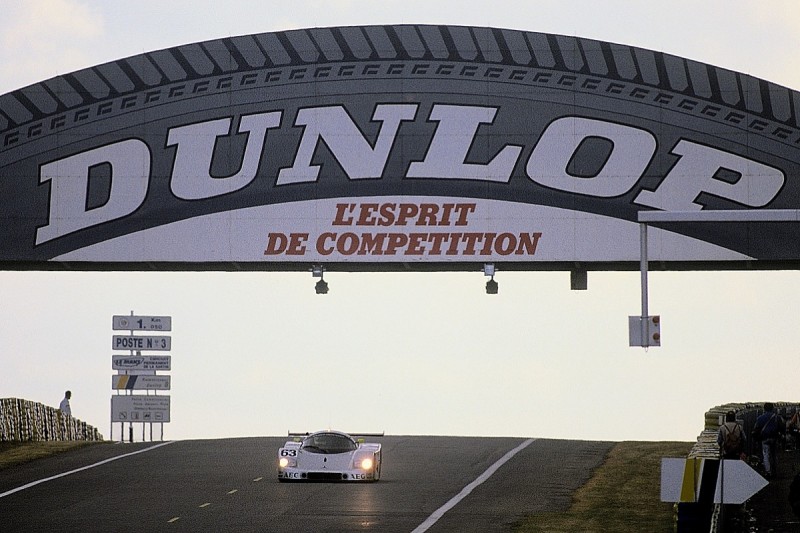
It was apt therefore that the same chassis in which Niedzwiedz had the blowout, C9-88-03, should take the laurels at Le Mans in 1989, adding to its WSC successes the year before at Sandown and the Nurburgring with Schlesser/Mass.
But while the C9's speed was not in doubt - Schlesser's pole time in #62 was over three seconds quicker than the best non-Merc, the #1 Jaguar XJR-9LM of defending winner Jan Lammers, Patrick Tambay and rookie Andrew Gilbert-Scott - even if one were to bet that a Mercedes could survive the distance, the sensible money would not have been on the #63 car starting 11th after gearbox problems in qualifying.
That its driver roster featured a perennial bridesmaid, a young hand who had last driven a C9 in anger two years previously and a third driver who had only tested once beforehand hardly helped its credentials.
Having been given his first career shot by Mercedes project manager Jochen Neerpasch while at Ford in the early '70s, it was little surprise when long-time Porsche works driver Mass was signed to the Mercedes roster for 1988. The 1975 Spanish GP victor had been a regular winner in the Group C era and twice finished as runner-up at Le Mans in 1982, but the WSC title had proved elusive.
"Looking back now I have to say Le Mans '89 was one of my worst races I have done. I was not prepared for it" Manuel Reuter
He shared with Jacky Ickx at every WSC round in 1983 except Le Mans, where the 956 he shared with Stefan Bellof suffered a rare engine failure, so was the odd man out in the end-of-year celebrations. He finished runner-up in both 1984 and '85 to Bellof and Derek Bell/Hans Stuck, and at Mercedes was again cast as the foil for leading man Schlesser, two years his junior. Baldi meanwhile was supported by Acheson in the second full season car, but had switched to join Schlesser at Suzuka when Mass was taken ill. That non-score at the opening round had seemingly ruled Mass out of another shot at the title.
But at Le Mans - which in 1989 did not form part of the world championship - Mass would have lead driver status of his own car as Sauber expanded to run three C9s for the first time. The #61 was the 1989 Suzuka winning chassis - C9-88-04 - which Baldi and Stefan Johansson had also driven to victory at Spa in 1988, while the #62 chassis - C9/02 - had won at Jerez (Schlesser/Mass/Baldi) and Brno (Schlesser/Mass) but not been raced in 1989.
Mass would be joined in #63 by reining Japanese Prototype champion Dickens and promising tin-top driver Reuter, although neither had much experience in the car. Indeed, Reuter (below, right, with Dickens and Mass) hadn't managed to race in either of the two world championship events for which Sauber entered him in 1987.
Unable to start the second leg of the two-part Norisring round after the original C9/01 he shared with Mike Thackwell had retired from the first heat with cooked brakes, Johnny Dumfries shunted C9/02 at the Nurburgring, ruling it out of the rest of the weekend. While ex-F1 man Dumfries was rewarded by being transferred to Thackwell and Henri Pescarolo's sister car, Reuter had to pack his bags for home.

After spending 1988 with Brun, finishing fourth at Jarama and Spa, the 1987 DTM runner-up was offered a DTM drive with Mercedes for '89 that had the potential to parlay into a Le Mans seat. But when the offer duly materialised, Reuter admits he was unprepared come raceday having only had one test to get refamiliarised with the C9 at Paul Ricard.
"It was difficult, looking back now I have to say Le Mans '89 was one of my worst races I have done," says Reuter, who would go on to win Le Mans a second time in 1996. "I was not prepared for it, there was a massive gap between the touring cars and the Sauber C9.
"At this time I was running a DTM car with 300 horsepower and then you jump in a machine like this, the last time without chicanes running close to 400 km/h down to the Mulsanne [Schlesser had managed 408km/h in practice], it was a really big shock!
"I was really young, inexperienced and there were no simulators, nothing where you could properly prepare for it. But Jochen was really experienced and on top of the game and also Stanley with his experience in sportscar racing helped a lot."
Dickens too admits to feeling ill-prepared, having only driven the C9 for the first time in a test at Dijon before Le Mans. That the Swede was part of the line-up at all is interesting given he was originally slated to drive a Brun Porsche with Harald Huysman, and had to extract himself from the deal. Given the poor reliability record of the Mercedes cars at Le Mans, Dickens concedes the move was "a little bit of a gamble", but one he judged worthwhile to get himself into a works team for the first time.

"I felt my career was on the right path," says Dickens, who had finished third at Le Mans in 1988 in a Joest Porsche shared with Frank Jelinski. "The week before Le Mans I did an IMSA race at Mid-Ohio with Gianpiero Moretti in the Momo Porsche and we came third, so I had good self-confidence.
"Anyway I got this contract and I did a test at Dijon. That was the first and only test we did before Le Mans and then it all happened!"
Dickens compares the C9 favourably to the "rough and heavy" 962 - "once I came into the Mercedes I felt like in the old times in the single-seaters and the lighter [C2] sportscars, it had a much lighter feeling to drive" - and enjoyed the responsiveness of its "fabulous" V8 turbo engine. But he concedes that a spin at Dijon knocked his confidence and continued to play in the back of his mind at Le Mans.

"The Michelin tyres were very good but they were a little bit tricky to understand," he says. "At Dijon when we did the test, I had a spin which came just all of a sudden, I couldn't understand it because I was not driving on the limit.
"I talked to Jochen and Manuel about it and they said they both had the same experience, so it felt like something we had to live with on these tyres."
The C9 may have been easier to handle than the burly 962 but, as Reuter points out, it still wasn't a cake walk.
"At Le Mans you ran such low aero because of the Mulsanne Straight that basically all cars in this period were quite difficult to drive, they were really loose in the rear," he says. "Through the Porsche Curves the car was really light and you had to build up the confidence step by step that you can trust the rear is stable enough.
"It was horrible this night, was praying 'hopefully the car will break so I don't have to jump in!' Can you imagine this situation?" Manuel Reuter
"At this time the information from the engineers was less, so you were depending a lot more on the driver to understand your car, how you should lift and how you go back on the throttle, how you shift every gear.
"At this time it was a normal H box, so far away from paddle-shifting or sequential box. With every shift you could do a big mistake and that would mean you retired."
At the start, Baldi in Mercedes #61 led from Schlesser in #62 but, by the end of lap two, both had been passed by Davy Jones in the #3 Jaguar, with Nielsen moving up to second in the #2 Jag and Julian Bailey's Nissan third. But when Bailey locked up at Mulsanne Corner on lap four and ran into the back of the Jaguar, it caused terminal suspension damage to the Nissan and forced Nielsen to pit for repairs to his exhaust. Jones would continue to lead the opening stages but, after handing over to Derek Daly, the XJR-9 dropped out of contention when the car jammed in gear on the Mulsanne.
Already two of the fancied Jaguars had fallen by the wayside - the #3 car would retire on Saturday evening with engine trouble, #2 suffering a similar fate just after half-distance - and it promoted the #9 Joest Porsche of Hans Stuck and Bob Wollek to the lead from Mass.

"With basically no experience, you jumped in and suddenly you were in your first or your second stint running in front and have no clue what you were doing there!" says Reuter, whose previous appearance in 1988 had ended after 91 laps when team-mate Walter Lechner crashed. "It was weird but on the other side it was really cool."
However, shortly after taking over the controls, Reuter hit a stray exhaust pipe on the Mulsanne and ripped a hole in the floor, requiring two unscheduled visits to the pits. But fortune was on his side.
"We were really lucky, after the hit with this exhaust the water cooler was damaged but then we had only a big hole in the floor," he says. "From this point on, we had nothing to lose [from] going out, every stint trying to do the best we can. At the end of the day we were lucky enough, the car ran without any single problem."
As a testament to how seriously it was taking the event, Mercedes had enrolled the services of renowned physician Willi Dungl - the man who got Niki Lauda race-fit in six weeks after the Nurburgring crash in 1976 that almost killed him - and completely changed the drivers' diets.
"So we got some special vitamins and oils and all kinds of stuff," says Reuter. Not that it helped him though.
"Especially during the race weekend and during the night, I got vomiting and nausea," he recalls. "It was horrible this night, was praying 'hopefully the car will break so I don't have to jump in!' Can you imagine this situation?"
With Reuter sidelined for much of the night, Mass and Dickens had to do most of the heavy lifting. But it wasn't until a stint running in Acheson's wheel-tracks that Dickens admits he felt fully able to optimise the car's potential.
"Because I didn't have so much driving in the car before we came to Le Mans, I was still a little bit unsure about everything," he says. "I was a little bit concerned about this spin I had at Dijon and I felt a little bit unsure about the tyres, so I was careful on the throttle."
Dickens' preferred driving style in Porsches was to have a very neutral set-up that he could point and squirt out of the corners.
"I always wanted to try to adjust the car so that I had maximum grip in the rear, because I wanted to push the throttle full as quick as I could," he explains. "The earlier I could push the throttle, the better it was and that was how I used to make my Porsches work.
"The Mercedes was set up by Jochen as the regular driver, and that was fine, but it was obviously different than I was used to and maybe that was the problem for me, because I wanted to use the power much more than the car actually allowed.
"Suddenly I felt the seriousness of the whole thing because until then I really didn't realise what could happen if we could win" Stanley Dickens
"At one point in the race when I was following Kenny in the #61 car for several laps, I noticed that he had a different driving style of rolling the car into the corners and I decided to try to adapt that. All of a sudden I think I cut my times by one or two seconds! After that, I was much quicker and safer in the car, which was thanks to Kenny actually."
Stuck and Wollek continued to lead until nightfall, but a water leak from the 962's radiator cost 15 minutes, forcing it into pitting more frequently than the opposition. It would eventually finish third.
Joest's woes promoted the #1 Jaguar of Lammers, who had stopped at end of lap one with a suspected puncture and later required exhaust repairs, to the lead for five hours until a gearbox rebuild just before 7am cost 50 minutes. It was a much faster turnaround than TWR had managed for the sister #4 car that brothers Alain and Michel Ferte shared with Eliseo Salazar - which had to be completed in the dark - but fourth was the best it could hope for thereafter.
With the #62 Mercedes slowed by electrical problems, it was left to the #61 and #63 cars to fight for victory, and the balance swung the way of #63 when Baldi spun out of the lead. Its pursuit was curtailed by gearbox worries - the car stuck in fifth - which could not be easily remedied in the pits and turned attentions merely to finishing.
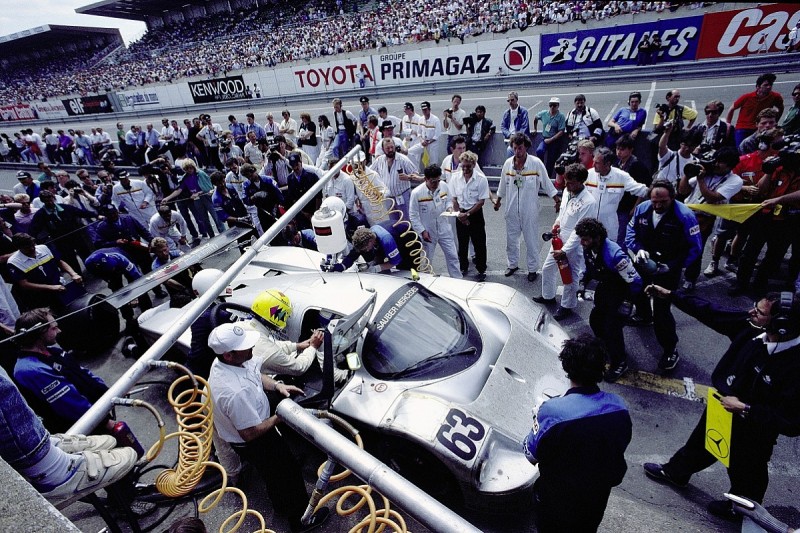
Fears abounded that the #63 car could also be affected, but Dickens doesn't recall any problems in the closing stages before handing over to Mass to take the flag.
"We were running smoothly all of the time actually, I don't remember any particular problem," says Dickens, who became the first Swedish driver ever to win the 24 hours.
"The thing I remember most from the race is when I came up to the lead and [team manager] Max Welti on the radio said to me, 'Stanley, now you are leading the 24 Hours of Le Mans, please take it to the finish line and don't do any mistakes - the world is watching you'.
"Suddenly I felt the seriousness of the whole thing because until then I really didn't realise what could happen if we could win."
Standing on the podium with Peter Sauber, for Reuter the emotion of being in the traditional old pits - replaced for 1991 - only heightened the accomplishment.
"It was really hard to believe that we won it," he says. "Especially for me to jump in and to win one of the biggest races in the world was unreal. It was like a movie where you stand beside yourself and the film is going around you."
Mercedes returned to running two cars for the remainder of the year, and Dickens returned to racing Porsches for Brun, while Reuter was deemed too old for the new-for-1990 junior team and instead went to race for Richard Lloyd's Porsche squad.
Dickens admits he didn't push too hard to get another shot with Mercedes, but was invited back for Le Mans in 1991 - the team having skipped the '90 race which once again was not part of the world championship - with the C11 that had won eight from nine races the previous year. But its hopes of a glorious return were scuppered when Mass, sharing with Schlesser and Alain Ferte, lost a three-lap lead with three hours to go when the engine overheated.

Dickens, sharing with Jonathan Palmer and Kurt Thiim, had already retired just after 7am when debris pushed through the floor - that had caused the engine to vibrate and lose power - eventually resulted in a broken engine mount. Consolation came with Michael Schumacher, Karl Wendlinger and Fritz Kreutzpointner's car finishing fifth, but that car too had suffered multiple delays after Wendlinger's early shunt.
"I had my contracts in Japan and so on, so I was quite happy with my situation," Dickens says. "But I kept in very good contact with Peter and Max and I was invited to do the '91 race, so I was quite happy with that.
"Peter Sauber is so friendly and I think his attitude showed in the whole team and made everyone very comfortable and very cooperative" Stanley Dickens
"I must say it was a very nice team, it was all very cool and laid-back, not at all the discipline that I was used to in German teams and Swiss teams [Joest and Brun]. Peter Sauber is so friendly and I think his attitude showed in the whole team and made everyone very comfortable and very cooperative."
At the end of the year, Mercedes withdrew from sportscar racing with its unreliable new C291 prototype only managing a single win for Schumacher and Wendlinger at the final world championship round, Autopolis.
But Saubers would continue to be campaigned in a world championship series using 3.5-litre engines from 1993 and, whatever came next, nothing could not take away from its exceptional achievement in 1989.
"Because the expectations to run for 24 hours without problems were really small, it was a really big and great achievement for us," says Reuter. "In the world championship they were anyway the class of their own and the icing on the cake was Le Mans."


Archive: When Le Mans made its most controversial change

The man behind Japan's first Le Mans winner

Did Audi ‘give up’ on GT3 too soon?

Alex Zanardi’s top 10 moments

This retro-inspired Mercedes 190E racer is heading to the Nurburgring 24 Hours

Why Verstappen's Nordschleife approach is a win-win for motorsport

The new Mercedes star who had an unconventional route to success

Why Rast is leaving the DTM

What makes Norris say “I don't have a car to fight for the championship”?

FIA explains safety car formation lap after F1 driver criticism at Dutch GP

Norris made his own life difficult again - but his recovery was stunning in Zandvoort's swansong

BTCC Donington Park: Morgan doubles up with dominant victory
Subscribe and access Autosport.com with your ad-blocker.
From Formula 1 to MotoGP we report straight from the paddock because we love our sport, just like you. In order to keep delivering our expert journalism, our website uses advertising. Still, we want to give you the opportunity to enjoy an ad-free and tracker-free website and to continue using your adblocker.


Top Comments