
The story behind the original Super Tourer
This Vauxhall Cavalier started its racing life as a rear-wheel-drive machine before the BTCC's halcyon period began, and is now a regular fixture of the club motorsport scene
The single-class Super Touring ruleset created a golden era for the British Touring Car Championship from its 1991 introduction. But the oldest example of its genre dates back another year – and is still going strong, 35 years on.
Ditching its traditional multi-class structure, the BTCC had only two divisions – split at two litres – for a transitional 1990 season. And it was the new two-litre formula that would serve as a blueprint for touring car racing worldwide. While BMW downsized its 2.3-litre Group A M3 to fit the regulations, Vauxhall – BTCC winner with John Cleland’s Class C Astra GTE in 1989 – was the first manufacturer to design a car specifically for the class.
The Cavalier GSi now owned and raced by Jim Pocklington was built for 1990 by works squad Dave Cook Racing Services. It spent three years with the team, another among the privateer ranks and, since 1994, has been raced regularly at club level.
“This was the very first one that started it, the very first of the Super Touring type,” says Pocklington, who acquired the car in 2002 and restored its works colours a few years later. “I put the car back into the livery which it left the factory in at the end of 1992. But that caused a little bit of confusion, because people thought it was the car that Cleland had the ding-dong with Steve Soper in. But it’s not that car, and I’ve never professed it to be that car.”
While not involved in the BTCC’s most infamous title decider, Pocklington’s car is still a significant model with its own tales to tell. It was built to experiment with rear-wheel drive while Cleland began 1990 in a front-wheel-drive sister car. The regulations offered scope for a RWD configuration if a four-wheel-drive base model was available. With top-level ‘pullers’ in their infancy, it was worth exploring – just as Andy Rouse did later with the first Ford Mondeo. But, while the Mondeo never raced in that configuration, the Cavalier did – once.
Two-time BTCC champion Chris Hodgetts joined the field at Oulton Park. The experiment was unsuccessful, and the second car subsequently ran in FWD format for a rotating cast of drivers, including Hodgetts, Bob Berridge and German racer Markus Oestreich. Pocklington believes it was his chassis in which future 13-time grand prix winner David Coulthard made his only BTCC start, at Brands Hatch in August.
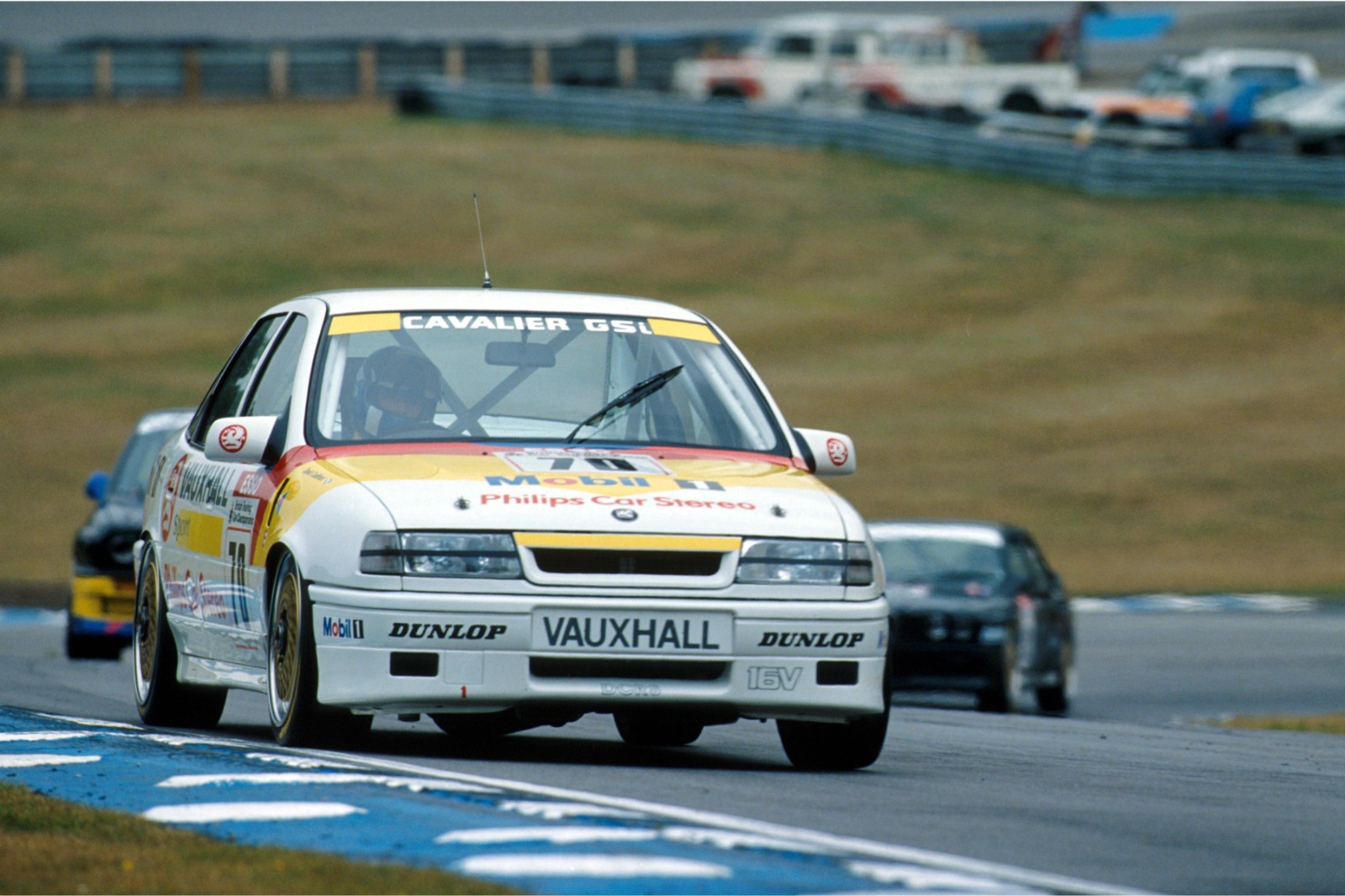
It is believed Coulthard raced Pocklington's Cavalier upon his 1990 BTCC one-off
Photo by: Motorsport Images
“When you look at the angle of my rollcage through the side windows, it is a different angle to its sister car from 1990,” Pocklington explains. “The cage goes down to where the differential would be, as opposed to the top of the suspension mounts. And you can pick this out quite clearly in all the pictures.”
Serving as a spare car for the next two years, it returned to service, piloted by Cleland, after team-mate Jeff Allam’s was written off in a multi-car accident at Donington Park in July 1991. It then spent 1993 in the hands of ex-Formula 1 and Indycar driver Ian Ashley, initially as part of Team Maxted’s two-car outfit alongside Ian Khan, before running under engineer Colin Davids’ own banner in the second half of a season yielding only two top-10 finishes.
By now, the BTCC’s development race had rendered the old warhorse obsolete. It was acquired at auction in 1994 by North London motor parts trader Andy Clarkin to replace his Lotus Sunbeam in Modified Saloons. Clarkin found it also suited the ailing Thundersaloons category before focusing on its de facto successor, Formula Saloons.
In the meantime, Vauxhall’s works BTCC operation had switched from DCRS to Ray Mallock’s RML squad, winning the 1995 title with Cleland in the Cavalier’s final iteration before the replacement Vectra arrived. Clarkin snapped up RML’s leftover Cavalier spares, allowing Cambridgeshire-based Empress Race Developments – which tended the car on his behalf – to add the aero appendages that BTCC cars had begun sprouting. But still lacking competitiveness against more modern machinery coming into Formula Saloons, Clarkin upgraded to a 1996 Honda Accord, leaving the Cavalier surplus to requirements.
“It’s never going to be the quickest car out there, but the fun value of me pedalling it around with those cars is where it is for me, and I love driving it” Jim Pocklington
Enter Pocklington, an Essex-based Rolls-Royce specialist who has now owned the car for 23 years. Coincidentally, given the Cavalier’s own predecessor, Pocklington had been driving a Vauxhall Astra GTE in Road Saloons and was eyeing the next step.
“I had done well in business and I fancied a touring car,” he says. “So I bought this and I thought it was the bee’s knees. I remember doing a trackday at Brands Hatch and I got on OK with it. But then, when I turned up for the first meeting in Formula Saloons, boy oh boy, that was a fish out of water for me.”
Pocklington persevered for a couple of years before switching series. “When Formula Saloons folded, I went and did Classic Thunder and they wouldn’t let me run it with those wings,” he reveals. Aero ditched, Pocklington won at Mallory Park and Brands before campaigning a newer Nissan Primera in the Dutch Supercar Challenge. He even spent half a season in the BTCC, driving a Super 2000 BMW, before deciding to fully restore the Cavalier.

Ashley raced the Cavalier in Demon Tweeks colours during 1993
Photo by: JEP
“I wanted it back as it was,” he says of the car, which runs a Swindon engine mated to straight-cut six-speed H-pattern Xtrac transmission. “The car was rebuilt with absolutely everything original that I could. The gearbox in it is totally original. The engine is not the original block and head, unfortunately, but I have got them. And there are internals in it from the 1990 engine.
“The front suspension, the top mounts under the bonnet, they look a bit tatty where they’ve been reused. People look at them and I say, ‘Yeah, OK, but they’re original. They are 1990.’ I would rather have slightly tatty, patinated parts that were original. Likewise, a group of lads at Brands Hatch were looking at the airbox, and were saying how rubbish it was, not understanding that I was the owner standing there with them! Little did they know that that was carbon fibre from 1990.”
Pocklington contested the Historic Sports Car Club’s Super Touring category and appeared at the Goodwood Festival of Speed before his enthusiasm waned after losing good friend Steve Parker to cancer. “He was the man that used to put me in the car and do my belts up,” Pocklington explains. “He was with me forever.”
One last outing at the 2013 Oulton Park Gold Cup – with actor and future BTCC racer Kelvin Fletcher at the wheel – raised money for Prostate Cancer UK before the Cavalier was parked up. Eventually, Pocklington decided it had sat for too long. He reveals: “I was sitting here with my wife and we were talking, ‘I’ve got to do something with the Cavalier – either I’ve got to race it or I’ll split, because it’s silly it just sitting there’.
“That’s when the CTCRC started Super Tourers [in 2022], and I thought, ‘That’s ideal. I’ll have a drive around Silverstone, and it gets the car seen. If I get out of it and say that’s it, I’ve had enough, we’ll sell it.’ So we went to Silverstone, and I got out of it absolutely on fire again, loving it.”
Addressing the previous misunderstandings about its 1992 livery, Pocklington reverted to its 1990 colour scheme. The bug had bitten once more; he’s been a regular in the series and its flagship Super Touring Power event ever since, proud to be driving the oldest car in the field.
“It’s just such a lovely car to drive,” he concludes. “It’s never going to be the quickest car out there, but the fun value of me pedalling it around with those cars is where it is for me, and I love driving it.”
This article is one of many in the new monthly issue of Autosport magazine. For more premium content, take a look at the March 2025 issue and subscribe today.

TV actor Fletcher with the car's owner Pocklington (left) at Oulton Park
Photo by: Pat Cranham

Early BMW Super Tourer and Polley Toyota recreation among Touring Car Rewind highlights

How a young driver is using his illness to help others

Marshall amplifies Civic Cup fight with Snetterton success

Marshall lays down the Porsche Sprint Challenge law with Oulton Park treble

Title-winning BTCC Peugeot and Harvey in an MG among Touring Car Rewind: North highlights

Edmundson stars in Minis as the BTCC supports entertain at Brands Hatch

McLaren junior leads the way in British F4 as BTCC support series begin at Donington Park

Special Alpine and victorious Vectra among Cadwell Park BARC highlights

How Antonelli levelled up his character to be F1 2026's world champion-elect

FIA set to close F1 cost cap loophole with new rules

Norris promises to make "better decisions" following fresh talks over Singapore GP clash

FIA expects F1 races in Qatar and Abu Dhabi to run as planned
Subscribe and access Autosport.com with your ad-blocker.
From Formula 1 to MotoGP we report straight from the paddock because we love our sport, just like you. In order to keep delivering our expert journalism, our website uses advertising. Still, we want to give you the opportunity to enjoy an ad-free and tracker-free website and to continue using your adblocker.


Top Comments