


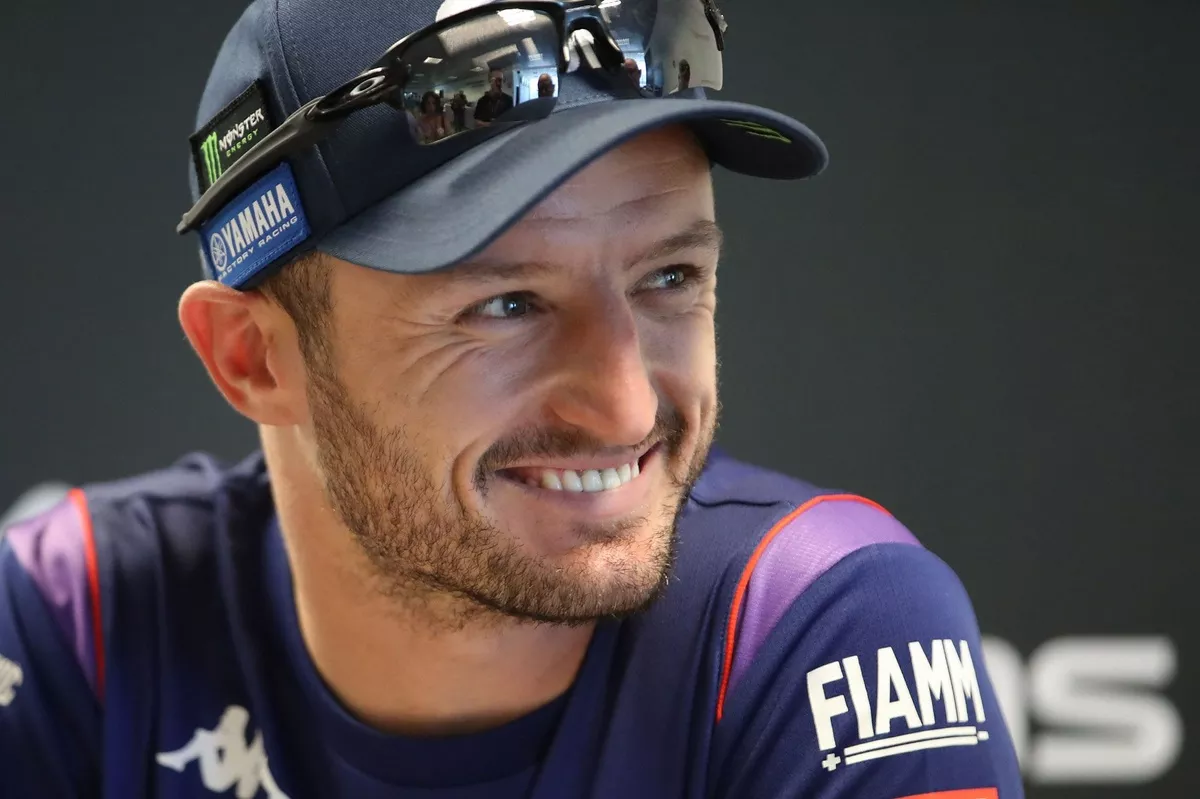


The radical changes in search of a Yamaha revival
After two years of dismal form and Valentino Rossi's public call for changes, Yamaha has finally reacted with a wide-ranging overhaul. But will those return the manufacturer to its title-winning days?

New colours, new sponsor, new bosses, new test team, new faces in both sides of the garage - it's clear that after two difficult years in MotoGP, change is in the air at Yamaha.
Yamaha has been humbled not only by old rival Honda in recent seasons, but also by Ducati, and it slipped to third in the manufacturers' standings last year for the first time since 2007.
The hope was that '17, which started well but then tailed off dramatically, was just a temporary blip. But after a handful of races last year it became clear Yamaha was in danger of falling into a prolonged slump.
No doubt spurred on by near-constant calls by Valentino Rossi to do something - anything - to arrest the decline, Yamaha has reacted. No doubt chastened by a 25-race win drought that was finally broken by Maverick Vinales last October - which was still Yamaha's only victory of 2018 - the firm's bosses have been busy plotting a route to recovery.
One of the first steps was to create a European-based test team spearheaded by ex-Tech3 rider Jonas Folger. Yamaha was the last of MotoGP's Japanese manufacturers to set up such an operation - lagging behind Suzuki and Honda.
Those two manufacturers could call upon the services of Sylvain Guintoli and Stefan Bradl respectively to assist their progress last year. But, as Rossi said at the time, Yamaha made its intentions clear: better late than never.

Then Kouji Tsuya, the man ultimately responsible for the YZR-M1's on-track performance, was moved on to Yamaha's production bike division. He has been replaced by Takahiro Sumi, hitherto the man in charge of chassis design, while Hiroshi Ito has been appointed general manager of the motorsports development division, a further sign of Yamaha's commitment to MotoGP.
Besides the overhaul in senior personnel, more emphasis has been placed on getting the various divisions within Yamaha - engine, electronics, chassis - to work in unison instead of simply pursuing individual targets. The team's base in Lesmo outside Milan has also been expanded to include new vehicle dynamics and electronics management groups.
These changes likely represent a final roll of the dice for Rossi in his MotoGP career
Team boss Lin Jarvis is convinced all these changes will have an impact that goes well beyond the YZR-M1's striking new black-and-blue livery.
"We made a change of the group leader, and that really will bring about kind of a reset," explained Jarvis at Yamaha's season launch in Jakarta.
"We realised we need to be in general more aggressive, and we need to use more outside collaboration.
"Sometimes you get a bit of an island mentality - the chassis group over here, the electronics group over here, the engine group over here. You need to pull it all together and make sure it's all working. The new group leader, Sumi, is the former head of chassis design, so he's got a lot of experience under his belt. He worked very closely with Tsuya as well.
"What gives me confidence with him is that he's very much a group-orientated person. He's a guy that understands and recognises the importance of every element and everybody working together. I think that's the most important thing. And the interaction between Japan and Italy is going to be important. It brings more importance to our Italian engineering operations.
"So many improvements, but all working together, no island mentality for a common bike. Sometimes a change is good to give a reset and a new way."

For Rossi, who turns 40 next week, these changes likely represent a final roll of the dice for his MotoGP career. He's signed up at Yamaha for this year and the next, and isn't realistically going anywhere else before he hangs up his helmet. Equally, it can be assumed he has a ride at Yamaha as long as he wants one.
He hasn't exactly been uncompetitive lately, besides the other perks he brings. The good news for those that yearn to see 'The Doctor' fight for an elusive 10th world title is that Rossi is encouraged by the changes that have been made, after spending a year wondering in public whether Yamaha's Japan bosses ever listen to him.
"I know the new project leader [Sumi] well, and I think he is good," said Rossi in Jakarta. "We talked with [Kouichi] Tsuji [who remains Yamaha Motor Racing President] and all the Japanese engineers, and the things that we have requested are quite clear. I know in Japan they have been working hard this winter and there will be new things to try, but we have to wait until we go on track in the first test.
"I don't expect to be super-competitive, but I hope to see improvements to understand that we are working in the right direction. In modern MotoGP the most important thing is managing the tyres, so we have to work on all the aspects of the bike to try and wear the tyres out less and be fast even in the final part of the race, which is what we missed last year."
The importance of this week's Sepang test can barely be overstated for Yamaha, since it represents the final realistic opportunity to settle on a specification of engine for the 2019 campaign. By the middle of last season, it had become clear that the M1's main problem was an overly harsh engine character that was overwhelming the common electronics and chewing up the rear tyre.

But much like Suzuki in 2017, there was little the team could do to resolve this, given that the engine is frozen all season for non-concession manufacturers.
Jarvis said there will most likely be two specs of engine to try in Sepang, which have been "fine-tuned" since they last appeared in post-season testing in Valencia and Jerez last year, but are not "radically" different to those units. Then Yamaha's engineers will make a decision, informed by the feedback provided by both Rossi and Vinales, regarding which spec to commit to for the season.
It's important to note that Yamaha is fairly restricted in what it can do in an era of spec tyres, spec electronics and (mostly) frozen engines.
Its gains late last year were borne out of a combination of incremental improvements, such as a new seat unit, and pushing the envelope with set-up at a point in the year when Rossi and Vinales both had little left to play for in the riders' standings.
Ahead of his home race last year at Mugello, Rossi invoked the progress Yamaha made between 2007 and '08 when Masao Furusawa was in charge, hoping his team could attempt to make a similar jump forward more than a decade later. But such an enormous leap is simply unrealistic in today's MotoGP.

"If you go back to when Furusawa joined [in 2003], we were out of the game," said Jarvis. "And then Valentino joined and we made some important decisions. But that situation is very different to today."
"The Furusawa era was different in many ways. At that time, Valentino was the most dominant rider, and there were only two main competitors in the championship, Honda and Yamaha.
"Now Ducati is very strong, Suzuki has come back, so now I would say there are four top manufacturers.
"So it's much more competitive. Everybody is forced to use the same electronics, the same software, the same ECU.
"You cannot develop Honda-style or Yamaha-style [electronics]. Back in those times it was more revolutionary because we could develop our own technologies."
The days of Rossi having a sizable machinery advantage are long gone. If he's serious about a 10th world title, he'll need to dislodge his spiritual successor Marc Marquez, winner of five of the last six titles for Honda, as well as Andrea Dovizioso, an increasing threat on the Ducati in the past two years.

Then there is Honda convert Jorge Lorenzo, the unknown quantity that is Danilo Petrucci on a works Ducati, and Alex Rins spearheading a revitalised Suzuki. And that's to say nothing of Vinales, who - Rossi's Malaysia near-miss aside - was getting the better of his team-mate towards the end of last year.
Vinales was by far the happier of the factory Yamaha pair after post-season testing, declaring that the team was ready to fight for wins regularly again while Rossi cast doubt on whether the early 2019-spec machine was up to scratch.
But there were quite a few occasions last year when Rossi seemed to rule himself out of contention on Friday or Saturday, only to spring a surprise come race day.
While MotoGP has changed plenty since Rossi won his last title in 2009, the man himself seemingly has not, despite his advancing years.
He remains as motivated as ever - even if Yamaha's lack of competitiveness has provided about as stern a test of patience as he can handle at this stage of his career. It stems from a justified belief he can still mix it at the front of the field.

Few would contend the Italian is still a match in raw pace terms for the likes of Marquez, Lorenzo and Vinales, but Rossi's knack for perfecting race-day set-ups and extracting the most from his machinery has kept him in the hunt. It might be a cliche, but in his case it really does seem age is just a number.
"At 40 years old, you still have everything you need to ride a MotoGP bike at the limit," said Rossi. "Fortunately, in our sport the physical aspects are important but not fundamental as they are for a 100m sprinter or a cyclist.
"Generally speaking, when you are 25 you can have more fun, because even if you don't sleep so well you're still fit the next day. You can eat more. When you get older, you have to be more careful about these things, you have to make a little more effort at home to have the stamina and strength.
"But I have a contract for two more years, and the challenge is always to try and be competitive and fight to win. The biggest motivation for me is to ride the bike, because I love it, but also the feeling you get after a good race, knowing you can have fun and fight for the podium. This is good motivation.
"Unfortunately it's been a long time since my last title. Since then, depending on how you look at things, either many things have changed, or nothing has."
Rossi's mission in 2019 will be to prove that, at least in terms of his own competitiveness, nothing has changed. Then it will be down to a new-look Yamaha operation to do the rest.


Super Formula Fuji: Iwasa wins as Ohta misses chance to seal title

Super Formula Fuji: Fraga wins while Ohta closes on title

Toyota-backed Tsuboi to make switch from Super Formula to F2

Tsuboi demands Super Formula engine overhaul as Toyota 'can't compete with Honda'

Super Formula Sugo: Fukuzumi gifted victory over Fraga by safety car drama

How a Le Mans winner is changing the game for female racing in Japan

The rising Japanese star with his sights set firmly on IndyCar

Suzuka returns to opening round as Super Formula unveils 2027 calendar

MotoGP Australian GP: Marquez wins sprint to seize points lead, Martin crashes

MotoGP Australian GP: Marquez crashes and then takes pole in wet qualifying

What we learned from Friday practice at the 2026 United States GP

Honda rider Marini withdraws from Australian GP due to virus
Subscribe and access Autosport.com with your ad-blocker.
From Formula 1 to MotoGP we report straight from the paddock because we love our sport, just like you. In order to keep delivering our expert journalism, our website uses advertising. Still, we want to give you the opportunity to enjoy an ad-free and tracker-free website and to continue using your adblocker.


Top Comments