Williams has been vocal on sacrificing 2025, but what does that actually entail?
Williams team boss James Vowles has his eyes fixed firmly on the future, hoping to guide the Grove team to glory when F1's new regulations come on song in 2026. That involves, in his words, sacrificing 2025 - but, despite his best wishes, this year still comes with a price that must be paid
A little less than a year remains on the timer for Formula 1's current technical regulations: one more year of curly wings and deep-pan Venturi tunnel floors, and one more year of MGU-Hs and fuels derived from lifeforms that wandered the earth millennia ago. There's quite a lot for the 11 teams to prepare for.
Until then, there's the small matter of the 2025 season. When F1 came to the end of the previous ruleset, which was supposed to end at the close of 2020 before COVID pushed the return of ground-effect floor designs back by a year, it resulted in a 2021 season that was defined by converging technical platforms and a thrilling title battle between two titans of modern motorsport.
It was a good year to be an F1 fan, unless you're an F1 fan that abhors any kind of confrontation, and 2025 could yet offer a comparable sheen of close competition if last year's compressed field is anything to go by.
Although one anticipates that three or four teams will be in victory contention again this year, there are also teams openly stating that they'll pay 2025 minimal attention to reduce the compromises taken for 2026. This happened to a greater level in 2021, as the regulations made it such that teams could only enact minor upgrades to their 2020 cars to mitigate the effect of financial losses through the pandemic, but some took even that to an extreme; Haas, for example, updated its 2020 car to satisfy a change to the floor regulations but left everything else the same.
Williams is one of a few teams to be open about its decision to shift most of its resources away from 2025 as soon as it can.
"I always said from the beginning we're going to sacrifice 2024 and 2025," team principal James Vowles stated. "It was part of the agreement from the get-go when I joined, which is no one, neither side, wants any short-term fixes. Everything is doing right for the future. Nothing should be a sticking plaster."
Teams face a tough choice when risking 2025 points for 2026 success
Photo by: FIA
One rather takes the idea of sacrificing a season as granted and, if it's obvious that a team won't be at the very sharp end, it seems like a good idea.
There will be others who release their grip on 2025 development early and start putting more into their 2026 designs; in theory, one could now switch over completely to 2026, as "development work" was only permitted to start from 1 January.
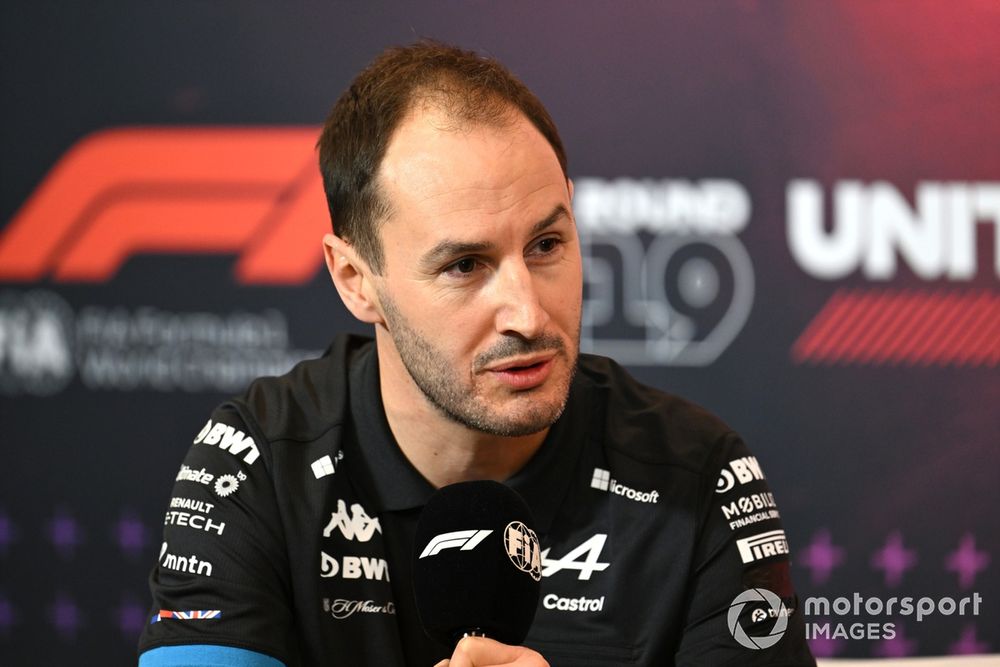
However, it was in a transcript of Alpine team boss Oliver Oakes, in an interview conducted by Autosport's Fil Cleeren, that the idea of effectively giving up on a season didn't seem make a whole lot of sense - at least, certainly not before a certain point.
There was plenty of time and resource that could still remain free for 2025, as Oakes alluded to in his assessment. And it would be silly not to use it. It's not a true sacrifice, then
"[Balancing 2025 and 2026], that's the daily topic at the moment, I think because some teams have been quite vocal about sacrificing 2025," Oakes began. "How much of that you believe or not, I don't know. Maybe they're sort of trying to move some pressure off themselves, because most teams know already in December where they're looking for 2025. And you wonder when teams come out with comments like that...
"I'm new in the job, but I find it quite interesting reading stuff online that a lot of people don't take into context, the sort of background and the build-up to things. And the situation we were in as a team, it wasn't just because of the winter. Things were signed off way earlier. And I think it's always important to look at the global view. "
For Oakes, this is the first time he's been in charge of an F1 team going through the winter preparations going into a new season. In many ways, he's the audience surrogate, relaying his experiences of something he's seeing for the first time and where his expectations were misplaced by the narrative.
In that extract, he brings up an interesting view behind the curtain - but one point we'll focus on is this: can you really sacrifice a season, and how does it really work?
Oakes is going through the process of managing a winter development programme for the first time
Photo by: Sam Bagnall / Motorsport Images
Certainly, the declaration of sacrifice isn't quite that straightforward, as there's still plenty to work through in 2025 preparations; a group of designers can still make a breakthrough, or testing might expose an issue that requires a redesign. There's still plenty of reason to put time, effort, and resource into the upcoming season.
It's true that, although "development work' for 2026 was outlawed before the New Year, this would not stop teams from formulating plans and ideas of what to include in their next-generation cars. The powertrain manufacturers already have prototype units being tested, and so key bits of information (weight, size, the requisite intake and cooling mass flow rate of air, gearbox geometry, etc) are already known and can be accommodated for. The engineers could put together a plan around that and, once Jools Holland has done his thing on BBC2, get to work implementing those ideas and parameters into the design process.
Before that, there was plenty of time and resource that could still remain free for 2025, as Oakes alluded to in his assessment. And it would be silly not to use it.
It's not a true sacrifice, then, especially as the work on 2025's machines probably began quite early on into 2024 - if not sooner. The development curve experienced over the last year will also feed in directly into this year's cars; experimental data from the track will influence the new designs, as will items for further investigation.
It's likely that each team pinpointed a 'design freeze' around November, where a snapshot of the 2025 car is put into production; subsequent developments are loaded into the pipeline to be distributed later on.
A team isn't going to waste the wind tunnel time either. They might still have their eye on "sacrificing" 2025, but this doesn't mean that the parts on the next cars have never seen any level of simulation whatsoever; again, 2024's aerodynamic testing allocations could not be spent on 2026.
As Williams was ninth in the championship at the time the aerodynamic testing restrictions were reallocated, it earned 10% more wind tunnel testing time and CFD processing capacity for the second half of the year - so it had more resource to fold into 2025's development process.
Williams has more aerodynamic testing allowance than this time last year, something that could aid early development for 2026
Photo by: Glenn Dunbar / Motorsport Images
Helpfully, Williams does not have to adjust its aero testing allowance for the start of 2025, given that its brief hopes of securing eighth in the championship were shattered by Alpine's double podium in Brazil. Here are the allowances of the teams that finished seventh, eighth, and ninth in the 2024 constructors' championship, for a two-month period:
Haas
RB
Williams
Success multiplier
100%
105%
110%
Windtunnel Runs (#)
320
336
352
Wind On Time (hours)
80
84
88
WT occupancy (hours)
400
420
440
Geometries (#)
2000
2100
2200
CFD Solving (MAuh)
6
6.3
6.6
Williams thus has a few more hours per testing period to play with; it could theoretically pump it all into the 2026 project, or keep some of it back for 2025 validation exercises and contingency measures. But it'll be the case that, if any time is used in the opening few months to augment 2025's package, it will be minimal.
If there's a toss-up between having something that benefits 2025 and using the money for 2026, then the sacrifice is a little more obvious; 2025 will not be the priority
Then there's the cost cap, which has a small knock-on effect. For Williams, the spend on repairs over 2024 given its heavy surplus of accident damage had, per Vowles, meant that some of the spend expected for 2025 had to be either reduced, cancelled, or delayed.
If there's any necessary spend that had to be effectively amortised across 2024 and 2025 to fit the cap, then this is finance that cannot go into 2026. But if there's a toss-up between having something that benefits 2025 and using the money for 2026, then the sacrifice is a little more obvious; 2025 will not be the priority.
Cost also influences the stocks available of parts. After a carbon-shattering 2024, Williams might be forgiven for wanting surplus stock of 2025 parts but, in reality, it cannot afford to carry the bloat of extra bits that it might not need. Balance is needed here: does Williams build an additional front wing, or does it use the money for a designer's yearly salary? Only today's necessity might deny tomorrow's luxury.
In short, the notion of 'sacrificing a season' is a lot less stark than it initially appears; a team still prepares as one would normally for a new year, develops a car with the express intent to be competitive, and use testing and the early season to address any minor issues or design flaws.
Weighing up how many spares it needs to guard against unforeseen accident damage is a tough call
Photo by: Sam Bloxham / Motorsport Images
The sacrifice comes later; expect Williams' FW47 to receive very little in the way of development, aside from the circuit-specific wings and any additions that were too late to make the design freeze but got some attention ahead of the new year.
It's very likely that most will limit their development processes in 2025; Williams might be the most vocal about it, but there's plenty of teams who could get away with a couple of early upgrade packages before calling it a day for the development race. Other teams might experience a more situational need to develop more in 2025, depending on their position in the championships and if another outfit has emerged for the new season with a powerful, but eminently replicable, new upgrade.
That all being said, Red Bull risked developing heavily in 2021 and still turned up in 2022 with the best car - so it's not guaranteed that the sacrifice will be worth it...
Could Williams emulate Red Bull's success with a risky 2025 plan?
Photo by: Erik Junius
We want to hear from you!
Let us know what you would like to see from us in the future.
Jake studied engineering at university, as his original ambition was to design racing cars. He was bad at that, and thus decided to write about them instead with an equally limited skillset. The above article is a demonstration of that. In his spare time, Jake enjoys people, places, and things.
Subscribe and access Autosport.com with your ad-blocker.
From Formula 1 to MotoGP we report straight from the paddock because we love our sport, just like you. In order to keep delivering our expert journalism, our website uses advertising. Still, we want to give you the opportunity to enjoy an ad-free and tracker-free website and to continue using your adblocker.






Top Comments