


Why Verstappen was untouchable after "crucial" Mexican GP Turn 1 pass
After its shock Mexican Grand Prix qualifying defeat to Mercedes, Max Verstappen and Red Bull needed a big response on Sunday. He duly delivered at the start with a superb double pass around the outside, after which he was never challenged due to an innate advantage Red Bull brought to the Autodromo Hermanos Rodriguez

Some motorsport moments are just magic. Bits of driving that are just spine-tinglingly good, showcasing supreme skill, flair and sheer bloody mindedness. Max Verstappen’s start to the 2021 Mexican Grand Prix had it all.
So much of what the Dutchman displayed last Sunday at the Autodromo Hermanos Rodriguez on his way victory was brilliant, but his breath-taking double pass on the Mercedes drivers will surely be what lives longest in Formula 1’s collective memory. Doubly-so if, whisper it, this for-the-ages campaign ends in a championship victory…
The whole Mexico City weekend was about his Red Bull squad, really. The team that was expected to be in command thanks to the track’s high altitude and high-downforce requirements had badly underperformed in qualifying. Getting caught out on the temperamental softs as temperatures climbed in Q3 was its main failing, but it, and sister squad AlphaTauri, also badly messed up the tow game (for everyone except the majestic Pierre Gasly). But Red Bull hit back on race day.
And it did so at the precise moment Mercedes – which had shocked itself with its front row lockout, Valtteri Bottas heading Verstappen’s title rival, Lewis Hamilton – knew it was most vulnerable. This was the run to the Turn 1 braking point – the longest of the season.
The Mercedes duo had vowed to work as a team to keep Verstappen behind when the lights went out, but a positive here actually quickly became a negative for the Black Arrows.
“Lewis got a better jump than Valtteri,” Mercedes’ director of trackside engineering, Andrew Shovlin, explained afterwards. “None of the actual launches were bad at all, but Lewis got a good jump and that put him alongside – so he was then unable to tow from Valtteri.”
Verstappen was the grateful recipient of that slipstream. For all of Red Bull team boss Christian Horner’s later assertions that “it transpired being on the second row was actually probably the best place to be starting this race”, he still had a lot to do, which he surely wouldn’t have chosen coming into the weekend – at a place where the tow-effect is limited anyway.

Verstappen braked later than the Mercedes pair to his inside at Turn 1 and powered past both into the lead
Photo by: Glenn Dunbar / Motorsport Images
Horner hailed Bottas’ actions next as those of a driver that “played fair”, with the Finn not trying to block Verstappen’s run to the left once he’d shot up the back of the polesitter’s rear wing. In fact, Bottas’s main move off the line actually brought him close to the faster-starting Hamilton, left with nowhere else to go but the inside as he “was trying to keep whichever Red Bull I could see in my mirror behind”. The world champion rued his team-mate’s split-second decision making, feeling Bottas “left the door open for Max”.
Once he was alongside Bottas, Verstappen pulled off one of the moves of the season when the pack eventually barrelled into the Turn 1 braking zone. He stayed off the brakes longer than his rivals, swept in imperiously at incredible speed and yet kept enough of his car on the right side of the exit line to seize the lead.
Red Bull also has a slightly bigger maximum downforce rear wing to bolt on at Monaco, in Hungary and here in Mexico – where the thin air requires the full might of every team’s aerodynamics. And Mercedes just doesn’t have a max-downforce rear wing to match its rival
Horner suggested Verstappen had “rehearsed it in his mind" by braking "right there" on his reconnaissance lap ahead of the start. But his charge insisted “you can’t really practice how a start is going to go, because you end up left, middle, right – depending on what happens”.
What did happen, from Verstappen’s perspective of his move and the point where his rivals braked, was this: “Once I was on the outside and basically on the racing line, I knew exactly where I was going to brake. It’s always a tricky one, especially [for] the car on the inside [that] is fully into the dirt because nobody is really driving there [usually]. So, they can never brake as late as the car on the outside, also because of the angle going into the corner.
Verstappen continued: “I knew where I was braking that was really on the edge because you could see I was also getting close to the white line on the exit. I just went for it, and it worked.”
He was able to pull off his brilliant move because of exactly why Red Bull had the faster package compared to Mercedes last weekend. For once in Mexico, it wasn’t because of Honda’s high-altitude power prowess.
“I don't think there's any advantage at altitude anymore,” said Horner – acknowledging how Mercedes has optimised its engine to need less cooling in such conditions since 2019.
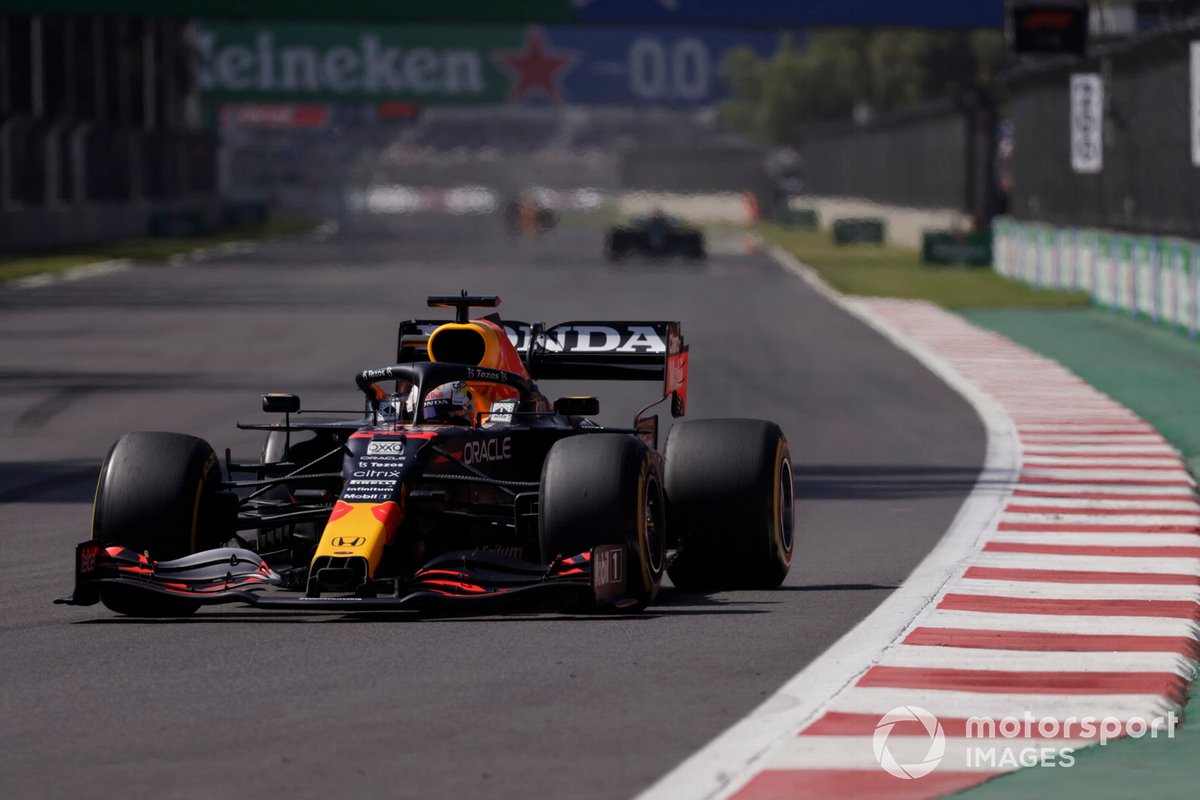
Running higher downforce than Mercedes, with a full Monaco-spec rear wing, helped Verstappen execute his key Turn 1 move
Photo by: Glenn Dunbar / Motorsport Images
It was all about downforce. The RB16B has long had the edge on the W12 in this critical consideration, but Red Bull also has a slightly bigger maximum downforce rear wing to bolt on at Monaco, in Hungary and here in Mexico – where the thin air requires the full might of every team’s aerodynamics. And Mercedes just doesn’t have a max-downforce rear wing to match its rival.
So, Verstappen used that advantage to be able to jump on the brakes much later than Bottas and Hamilton to his inside, knowing that he’d have the grip to make the move stick from the racing line. Plus, the front row starters were also weaker here for a second key reason.
Both Hamilton and Bottas had been locking up and going off the road here throughout practice – with the world champion earning a reprimand in FP1 for not going left around the bollard far behind Turn 2. This rule was superseded by an instruction from race director Michael Masi on race day, which allowed the drivers to cut Turn 2 and rejoin immediately, but only at the start or a subsequent standing start restart.
Hamilton acknowledged the Turn 1 braking zone had been “an issue for me all weekend – I went on twice in Turn 1 through practice, qualifying – locking [up]”. He added: “just our car, for some reason, this weekend has been quite poor in that area and that’s a particular area in which they’re a lot stronger than us. Of course, when you put more load on the car, it does help, but we couldn’t match them load-wise in terms of wing setting this weekend.”
Verstappen led Hamilton into Turn 2, which was basically as close as the world champion really got for the rest of the afternoon. Proceedings were soon interrupted because as they were racing through the second corner, Bottas had been tipped into a spin at the Turn 1 apex by McLaren’s fast-starting Daniel Ricciardo.
This triggered scenes of chaos as the pack avoided the tyre-smoking, spun Mercedes – many drivers legally cutting Turns 2 and 3 per Masi’s late instructions. In doing so, this triggered a chain of events that led to Yuki Tsunoda and Mick Schumacher sandwiching Esteban Ocon and both immediately getting enough damage clattering the Alpine to force their retirements. Ocon was able to scamper on.
The safety car was required while the track was cleared, which meant Verstappen had a restart with which to deal. And he aced that as well, dropping Hamilton as they accelerated out of the stadium section to resume racing at the start of lap five of 71 – the leader already ahead by 0.9 seconds when they crossed the line with the green flags flying.

After Verstappen had perfectly judged the safety car restart, Hamilton never got close to Verstappen
Photo by: Charles Coates / Motorsport Images
And from there, Verstappen just checked out. Without needing to worry about the softs that had undone Red Bull in Q3 thanks to all the leaders traversing Q2 as expected on the mediums, his pace was in happier territory with the yellow-walled rubber in the opening phase. He quickly went down to the 1m21s-bracket compared to Hamilton initially struggling to leave the 1m22s – the Briton and his Mercedes team soon realising he did not have the race day pace to stay with his title rival.
“In the even hotter conditions [in the race] we were struggling a bit more with rear grip,” explained Shovlin, the Red Bull’s extra downforce affording it another vital benefit – stopping Verstappen from sliding around as much and so keeping his rear tyre temperatures under control.
That was key for any driver to do well last Sunday, in addition to managing the typical brake and engine cooling requirements the high-altitude setting demands. While doing all of this, Verstappen romped clear by 0.3s a lap in the 24 tours that followed the restart – Hamilton unable to follow him and keep his tyres alive in the heat. That meant Verstappen’s advantage was 9.2s by the start of lap 29. That point matters because it was when Hamilton became the first of the leaders to pit.
"If you exit the last corner well, it’s very difficult to launch an attack. These cars are quite difficult to follow when you’re on a hot circuit, the overheating makes it awkward. We were perhaps grateful of that effect with Lewis, because Sergio had a better car" Andrew Shovlin
After Bottas had disappeared from the lead fight and Verstappen hadn’t hung around, Mercedes knew its main threat to maximising its result was going to come from Sergio Perez. The home hero had tracked Hamilton on the run to the first corner, but didn’t get a chance to try a move up the inside because he was being overcome by Ricciardo – soon to lock his fronts heavily, get back off and back on the brakes with better control, then tap Bottas as he was still too fast at the apex to avoid anyone coming across – as indeed was the Mercedes.
Perez cut Turn 2 and loudly protested his innocence – not that it mattered given Masi’s directive. After the restart he fell back from Hamilton, but was never more than 3.4s adrift in the phase that followed, which gave Mercedes a headache – made worse by only having one car left in the lead battle.
“Once we could see that Max clearly had the legs on Lewis and that Perez was also able to keep up, we kind of shifted our focus,” said Shovlin. “[That was] making sure we didn’t lose P2 rather than trying to achieve the impossible with Max – because it was pretty clear that it was not a day that we had a car to win.”
Perez’s engineer, Hugh Bird, had been urging his driver to cut the gap to Hamilton and when he got back within 1.5s at the end of lap 28, Mercedes acted – bringing Hamilton in next time by to ward off the undercut threat, just as the pair were approaching a gaggle of backmarkers.

Accepting it couldn't beat Verstappen, Mercedes turned its attention to fending off an undercut from Perez
Photo by: Steve Etherington / Motorsport Images
The world champion rejoined on the hards after a 2.4s stop, with Red Bull soon moving to send Perez long in a bid to gain a significant tyre life off-set advantage for the closing stages – what Mercedes had done against Verstappen two weeks earlier at Austin. The long-gone leader had been brought in four laps after Hamilton’s stop – his advantage easily maintained.
Red Bull left Perez out until the end of lap 40 before bringing him in for his hards, with the gap to Hamilton at the end of his out-lap 9.6s. That set-up a 30-tour charge to score try and score a Red Bull 1-2.
Mercedes thought Perez would be in striking distance by the very end of the race, but he gained so quickly on Hamilton that he was in DRS range by lap 61 – his pace 0.46s better per lap getting there on his much younger white-walled rubber. But, as was the case for Hamilton in the USA, albeit with much longer left to run for Perez’s chances to make a pass this time around, getting to the back of his rival stalled the Mexican’s charge.
“If you exit the last corner well, it’s very difficult to launch an attack,” Shovlin explained. “These cars are quite difficult to follow when you’re on a hot circuit, the overheating makes it awkward. We were perhaps grateful of that effect with Lewis, because Sergio had a better car.”
There was also the traffic factor, which at various points helped and hindered Hamilton. Just before Perez got into DRS range, Hamilton had come up behind Lando Norris and soon reported that his tyres were “getting hot” in the McLaren’s wake – while he was still too far behind to trigger blue flags, saying “it’s crazy I can’t get close”. But after two-and-a-half laps he was finally waved by, after which he closed in to lap George Russell (for the second time) and Fernando Alonso – the time spent passing this duo this time costing Perez more.
It all added up to Perez being 2.1s back with five laps left to run and although he recovered back to under a second at the start of the penultimate tour, he never got beyond having a speculative last-lap look from very far back heading into the Turn 4 left at the end of the second straight.
“We didn’t have really much left on the tyres at the end but where there’s a will, there’s a way,” Hamilton reflected. “We managed to just keep them behind. One more lap, I think it would have been over, but I’m happy that I still got second.”

Despite a significant tyre offset, Perez couldn't get close enough to pass Hamilton
Photo by: Charles Coates / Motorsport Images
He also picked up one other minor late glimmer thanks to Bottas. The Finn had engaged in a 32-lap long pursuit of Ricciardo after dropping behind his Turn 1 nemesis when catching a slide passing the rejoining Lance Stroll at Turn 6 following the safety car restart. No matter what he tried, for the reasons Shovlin outlined above, plus having to work to cool his brakes, he couldn’t repass the Australian, who had lost his front wing in the first corner fracas.
Bottas might’ve got by with a second stop overcut attempt on lap 40, but was left stationary for 11.7s as Mercedes “couldn’t get the wheel off once we’d undone the nut”, per Shovlin, as “something had got caught there”. He therefore rejoined three places back from Ricciardo with no hope of gaining points himself, so Mercedes opted to use him to take them off Verstappen.
Verstappen didn’t have everything go as he ultimately wanted last Sunday, but considering the flap Red Bull had got itself into on Saturday, it was a critical win
The leader had been briefly freed from his lift-and-coast demands on lap 52, at which point he pumped in a 1m18.999s. This was what Bottas was aiming at when he rejoined from a third stop – now on the softs. But he actually came out directly behind Verstappen, who quickly spotted what was happening and took measures to try and spoil Bottas’s flying lap attempt.
On lap 67, Verstappen backed off by nearly 3s compared to the previous tour and then let Bottas by running onto the pitstraight. Then he raced after him to activate blue flags and ruin another fastest lap attempt, then being allowed back ahead at the start of lap 69. Cunning, all around, if a silly consequence of a silly rule.
“We were side by side, but it was all good,” said Verstappen. “We lost a lot of time, but it was alright, to be honest, for me. I know Valtteri, he’s a clean driver anyway and I was never [thinking] that something would happen.”
Mercedes acted again by pitting Bottas for a fourth time get him away from Verstappen at the end of the race’s 69th lap – holding him in his pitbox to ensure he’d have plenty of free air into which he could then charge. That he did, setting the race’s fastest lap with a 1m17.774s on Verstappen’s final tour. As Bottas finished a twice-lapped 15th, no bonus point was awarded.
Verstappen therefore didn’t have everything go as he ultimately wanted last Sunday, but considering the flap Red Bull had got itself into on Saturday, it was a critical win. And one that will always be remembered for his sterling start, something he hailed afterwards.
“It was crucial for me to get ahead there,” Verstappen said. “I could just do my own pace from there onward.”

Verstappen lost the fastest lap to Bottas, but still extended his points lead over Hamilton
Photo by: Zak Mauger / Motorsport Images


Why Britain’s role in Formula 1 endured a troubled start

Why Bottas believes his F1 reserve driver role is the fastest route back to a race seat

Why Norris is now ready for his final exam

The key advantage for Bottas vs Perez in the 2026 F1 return race

Why Ferrari's management is under pressure after its bad start to F1 2025, not Hamilton or Leclerc

Why Red Bull can’t solve its second F1 car problem with a simple paint job

Hirakawa replaces Doohan at Alpine for Japanese GP FP1 outing

How Alonso and Bortoleto can be F1 rivals in a unique driver management deal

FIA expects F1 races in Qatar and Abu Dhabi to run as planned

Top five roles on Motorsport Jobs this week

Champions crowned at incident-filled Donington Park 750 Motor Club meeting

Why Toyota’s 2026 WEC triumphs have put it into the all-time greatest endurance racing team debate
Subscribe and access Autosport.com with your ad-blocker.
From Formula 1 to MotoGP we report straight from the paddock because we love our sport, just like you. In order to keep delivering our expert journalism, our website uses advertising. Still, we want to give you the opportunity to enjoy an ad-free and tracker-free website and to continue using your adblocker.


Top Comments