


Why McLaren's expanding agenda will benefit its F1 resurgence
In the 1960s and 1970s, McLaren juggled works entries in F1, sportscars and the Indy 500 while building cars for F3 and F2. Now it’s returning to its roots, expanding into IndyCars and Extreme E while continuing its F1 renaissance. There’s talk of Formula E and WEC entries too. But is this all too much, too soon? STUART CODLING talks to the man in charge
You’d be forgiven for wondering why a grandee team that hadn’t won a grand prix for almost a decade until Daniel Ricciardo’s triumph at Monza, is spreading its wings beyond Formula 1. Especially when that team, despite that welcome 1-2 in Italy, is part of a financially troubled group, which has had to make difficult cutbacks – to the extent it now rents the home it spent £300million building.
But with McLaren’s growing involvement in IndyCar, Esports and Extreme E, alongside putative dalliances in Formula E and the World Endurance Championship, there is at least a historical precedent: this is a company rooted in getting stuck in to different racing formulae, even if it hasn’t done that for many years.
Back when the factory, such as it was, had a dirt floor and you could count the number of employees on one hand, Bruce McLaren energetically contested the Tasman series and various sportscar events before committing the company to Formula 1. And even then his tiny group continued to build and sell single-seater and sportscar chassis to customers, while eventually running concurrent campaigns in F1 and the lucrative Can-Am sportscar championship, alongside Indy 500 entries.
Putting yourself and your staff through such an exhausting globe-hopping schedule was eye-watering even then and would not be countenanced in our more HR-enlightened age. F1’s growth and evolution also militated against running multiple campaigns as its calendar expanded and its technical demands multiplied.
Under the leadership of Ron Dennis, McLaren focused on F1 and prospered on track through the 1980s, later growing successful parallel businesses in electronics and technology, hospitality and road-car manufacture. But a competitive slump during the past decade proved costly. At the time of Dennis’s ousting in a boardroom putsch in 2016, McLaren had become a profitable technology group with a loss-making racing company attached.

Brown says McLaren is moving away from being a technology company
Photo by: Zak Mauger / Motorsport Images
The group’s new leadership appears to be unpicking Dennis’s grand vision of McLaren as a patriotic technology leader and returning to its origins as a racing organisation and car builder (Bruce McLaren built a roadgoing prototype shortly before his death, which caused the plans to be shelved). Asked by GP Racing whether McLaren has essentially pivoted away from being a tech company, CEO Zak Brown is unequivocal.
“Exactly right,” he says. “McLaren is in the business of racing and there’s two ways to deliver value to our shareholders. One is obviously to be a profitable business. But the bigger win is building the franchise value, the value of the entire operation. But everything also ties back in to supporting and growing our F1 team. So, while the different racing activities – Extreme E, Esports and IndyCar – all stand on their own two feet, they also help build the F1 brand.
"While IndyCar is a profitable business, it’s great for our brand, it’s also helped bring more partners into F1" Zak Brown
In F1, McLaren has been noticeably successful in assembling a portfolio of sponsors to replace the previous model of relying on a big-ticket title partner. Expanding into other series opens the possibility of accessing new markets, whether that’s in spaces where Formula 1 doesn’t have as big a footprint as elsewhere, or demographics F1 hasn’t yet adequately addressed – but which are of vital interest to potential partners.
Extreme E, in which electric-powered SUVs race off-road, is viewed with scepticism in some quarters – the rationale to “highlight remote environments under threat from climate change issues” by racing across them seems pretty thin – but it packs a powerful diversity message, mandating each car has a male and female driver. Likewise, Esports is aspirational, diverse and accessible, since the financial barriers to entry are far lower than for conventional motorsport.
“For the majority of our partners, North America is a very important marketplace,” says Brown. “So by having an IndyCar programme, we’ve got a broader, deeper offering for our commercial partners who say North America is really important. F1 is growing there but having an IndyCar team turbocharges that, and I know we’ve had some partners join us because we had a bigger North American presence than F1 alone.
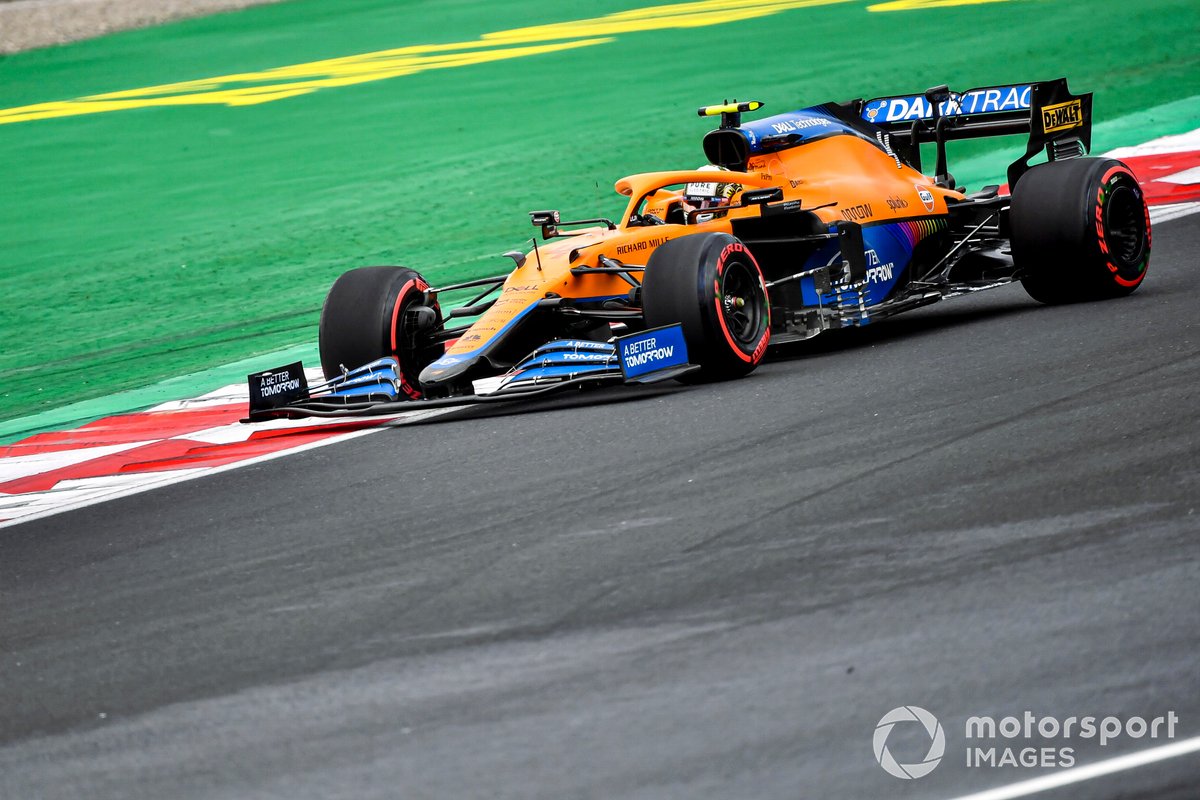
Brown says F1 team has been boosted by having IndyCar squad alongside it
Photo by: Jerry Andre / Motorsport Images
“Arrow Electronics, who are our title sponsor in IndyCar, have joined our F1 team, we’ve had BAT who are a principal partner in F1 join our IndyCar team, along with Tezos, Darktrace, etc. So, while IndyCar is a profitable business, it’s great for our brand, it’s also helped bring more partners into F1.
“It’s the same concept with Extreme E – sustainability, we were the first team to be carbon neutral in 2011. The majority of the other teams now are scrambling to make that same claim. McLaren has been true to sustainability for a decade now and Extreme E is a great way for McLaren Racing to highlight our sustainability credentials, and the same thing with gender and diversity, which again is a very important topic for our partners.
“And then the same concept with Esports – we were the first F1 team to move into Esports in a meaningful way. And that’s for the younger generation, grassroots motor racing if you like, and diversity – because you’ve got men and women from all over the world who want to have a steering wheel in their hands. It gives us that younger audience which F1 is driving towards but isn’t where it needs to be yet.”
Brown says McLaren Racing is on course to turn a profit within the next few years, provided revenues grow and Formula 1’s budget cap continues its glide path from the present $145m per year to $135m in 2023. And it needs to turn a profit, since the McLaren Group has in effect been forced to sell off the family silver in order to keep afloat in recent seasons. Having already leveraged its heritage car collection to buy Dennis out of his 25% share in 2017, McLaren had to look elsewhere when a cashflow crisis struck during the early months of the pandemic in 2020; the previously profitable Automotive arm, which had shored up revenues previously, was unable to carry on doing so as sales dried up.
McLaren secured a £150m loan from the National Bank of Bahrain (an obvious destination since Bahrain’s sovereign wealth fund owns 62.6% of the company) and planned to make 1200 staff redundant, although only 800 eventually departed. It also put the McLaren Technology Centre on the market for $200m, eventually selling to the investment firm GNL for £170m. In December 2020 it sold a minority stake in McLaren Racing to the US sports investment vehicle MSP Sports Capital.

The McLaren Technology Centre has been sold as part of refinancing efforts
Photo by: GP Racing
The financial engineering has continued apace this year. In July, McLaren announced a fresh round of refinancing, worth £550m, £400m of which was new capital from Saudi Arabia’s Public Investment Fund and investment company Ares Management, with a further £150m from existing shareholders via preference shares and equity warrants. This enabled McLaren to pay off the Bank of Bahrain loan. Most recently, it has sold off its McLaren Applied division, which has supplied F1’s standard ECU since 2008. Once seen as the group’s main engine of growth, McLaren Applied has been sold to its existing management – backed by the private equity firm Greybull Capital, a distressed-asset specialist that has also pounced on the remnants of Monarch Airlines and Carillion.
This leaves Automotive and Racing as McLaren’s revenue generators. When asked by GP Racing whether this was a strategic decision or necessary financial engineering, Brown reiterates cars and racing are McLaren’s future.
“Paul Walsh, our chairman, felt that our core business is we’re an automotive and racing company,” says Brown. “It wasn’t about financial needs, it was more about strategically where the McLaren Group want to be long term, and they want to be in the automotive and racing business.
"Nothing can distract our F1 team. As I experienced in Indianapolis in 2019, if you don’t give the same dedication to Extreme E, IndyCar or even Esports, you’ll fail. This is about building up different teams sharing some technical resources, technologies, things that are back at the factory" Zak Brown
“I’m projected in a couple of years’ time to turn a profit. And I suspect other F1 teams already will, which is really how a business and a sporting franchise should run. And I think that’s why you’re seeing investors now coming in and acquiring teams. You’re going to see F1 franchises become much more valuable and more in line with what you see with NFL and NBA teams. You know, putting aside Ferrari because that’s kind of combined with the road car company, you have to ask why F1 teams are trading for less than a billion dollars – in some instances significantly less – in a sport that is globally bigger, and has more revenues than other sports.”
McLaren Racing currently occupies Brown’s “significantly less” bracket – the deal with MSP Sports Capital valued the company at £560m. The F1 team continues to flourish under the leadership of Andreas Seidl, hired in 2019, while McLaren is in the process of expanding its stake in the Schmidt-Peterson IndyCar squad it joined as a partner in 2020, a process Brown likens to “renting before buying”.

Formula E entry remains under evaluation by McLaren
Photo by: Simon Galloway / Motorsport Images
There remains the possibility of further expansion into Formula E, in which McLaren has an option to join the grid in season nine, and sportscar racing via the forthcoming LMDh class, which will be eligible to race in the World Endurance Championship and the US-based IMSA series. Currently these are merely being “evaluated”, and there are those in the world of motorsport who believe the putative Formula E entry was merely a ploy orchestrated by series bosses at a time when FE desperately needed to put out some good news, Mercedes having joined BMW and Audi in heading for the exit.
“We watch closely,” says Brown, “we know historically manufacturers come and go from motorsport. So Mercedes leaving is not a positive, but Jaguar staying is a positive. And we also hear about other manufacturers that are probably going to come in.
“That will drive our decision-making and, of course, we’re paying attention to trends when we review motorsport activities. It has to fit our brand. It has to be financially viable. It needs to support our F1 mission and it can’t be operationally distracting. That’s kind of the lens we look through. IndyCar, Extreme E and Esports, they all ticked all those boxes, and Formula E and WEC continue to be under review against those criteria. We’ll make the decision by the end of the year.”
McLaren Automotive – like the majority of car manufacturers – is feeling its way towards an electrified future, so there is potential fit. Andretti Autosport, which runs BMW’s entry, has partnered with McLaren before, when Fernando Alonso contested the Indy 500 in a McLaren-badged Andretti car in 2017.
That programme was far more successful than when McLaren tried to go it alone two years later, and the lessons drawn from that – avoiding those ‘operational distractions’ – have informed McLaren’s recent expansions into parallel formulae. If it does enter Formula E and WEC it will do so through partners which it might later colonise if the projects are deemed a success. There will be no going back to the days of Bruce McLaren, Denny Hulme, Tyler Alexander and others criss-crossing the globe, running in F1 races one weekend and Can-Am the next.
“Nothing can distract our F1 team,” says Brown. “As I experienced in Indianapolis in 2019, if you don’t give the same dedication to Extreme E, IndyCar or even Esports, you’ll fail. This is about building up different teams sharing some technical resources, technologies, things that are back at the factory. But I won’t have one person working on F1 one weekend, and then they’re going and working on IndyCar. That clearly didn’t work in 2019.”

Brown says lessons have been learned from disastrous Indy 500 attempt in 2019
Photo by: Motorsport Images
McLaren’s attempt to run a full IndyCar campaign with Alonso in 2019 came off the rails disastrously as engine politics (Honda was understandably not keen to work with Alonso again) forced it to split from Andretti, then slim down to a single-car entry for Indianapolis only – for which it failed to qualify. The litany of blunders was comical, stretching from the car being painted the wrong colour to Brown having to borrow a steering wheel from Cosworth because the in-house design wasn’t finished.
“I’d hired Andreas Seidl [as F1 team principal], but he didn’t start until Barcelona,” says Brown. “I had Gil [de Ferran] in F1 [as sporting director], but his first race in IndyCar was the 500. I should have waited – I did that wrong and paid the price. So lots of learning from that. Now everyone from McLaren on the IndyCar team is dedicated to IndyCar. They’re past F1 personnel but they don’t have dual roles because you can’t be in two places at one time.
"When I joined McLaren, I felt we were best served being in multiple forms of motorsport, like we have been historically. That was always my vision when I came in, but it’s all about timing and making sure we’re in a good place" Zak Brown
“2019 was probably one year too early in my learning there. I couldn’t give IndyCar the time and attention it deserved and that’s the result we got because of it. That’s on me.”
So McLaren is likely to carry on exploring other avenues of motor racing – but gradually, cautiously and rigorously.
“When I joined McLaren, I felt we were best served being in multiple forms of motorsport, like we have been historically,” says Brown. “That was always my vision when I came in, but it’s all about timing and making sure we’re in a good place. I joined McLaren at the height of our bottom, as it were, and that was not the right time. F1 remains the centre of gravity for us.”

How Ratzenberger beat the odds to realise his cruelly short-lived F1 dream

F1 uncovered: A weekend behind the scenes with a chief mechanic

When McLaren was pipped by Red Bull in a modern F1 classic

The big opportunity Sainz’s Williams switch affords to F1’s latest centurion

Inside the science of F1 fuel

How F1’s plan for rotating races could look in practice

The early decisions that set Sauber’s rookie for success

How F1 media coverage has evolved in line with its subject

F1 Spanish GP live commentary and updates - Antonelli leads close three-way fight

MotoGP San Marino GP: Marquez takes championship lead with Misano win

Verstappen: Victory at Spanish GP to be "tough" with lack of overtaking opportunities

Live: MotoGP San Marino Grand Prix as it happens
Subscribe and access Autosport.com with your ad-blocker.
From Formula 1 to MotoGP we report straight from the paddock because we love our sport, just like you. In order to keep delivering our expert journalism, our website uses advertising. Still, we want to give you the opportunity to enjoy an ad-free and tracker-free website and to continue using your adblocker.


Top Comments