


Why Kubica's amazing F1 comeback went wrong
For Robert Kubica it's been uphill all the way in his long-awaited return to Formula 1 after a debilitating physical injury. But things are getting better and, even though it won't be at Williams, he's keen to stay in F1, he tells STUART CODLING
Robert Kubica's Formula 1 comeback has been hotly anticipated for years - ever since his appalling rally accident on the eve of the 2011 season, in fact.
But it's fair to say that his long-delayed return to the cockpit this season has not provided the joyous and gilded procession to glory the F1 community desired.
Kubica remains a popular and respected figure at the top of motorsport. The 2019 season, though, has been a proverbial uphill struggle as this talented, grand prix-winning driver toils at the tail of the field in a car that stands little chance of troubling the top 10 during its service life.
On just one occasion has the unloved Williams FW42 secured a point - in Kubica's hands - and even that result hinged on a technical exclusion.
There's another elephant in the room: the performance of Kubica's young team-mate, the Mercedes protege George Russell, who has consistently shown the elder driver the way this season. The reasons for this remain unclear. Some say the lingering effects of Kubica's injury - he now drives, by his own admission, 70% left-handed - means he struggles on circuits with a predominance of slow and medium-speed corners.
Others, particularly the Polish media, say the drivers have been given unequal equipment, which a noisy segment of online fandom puts down to a conspiracy by a British team to favour a British driver. Given the unlikelihood of any F1 team actively seeking to nobble one of its drivers - especially a team whose survival may depend on prize money arising from points scored - the conspiracy angle lacks credibility.
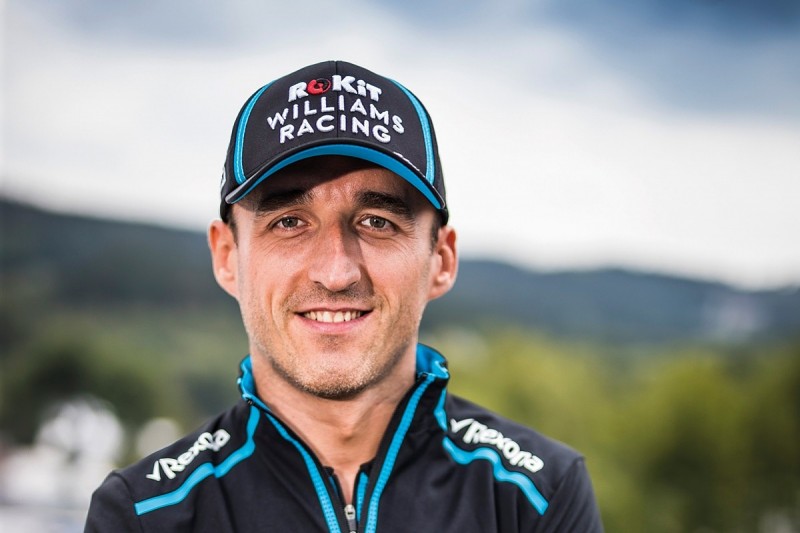
The Robert Kubica F1 Racing finds atop the Williams motorhome at Spa is relaxed, cheerful and confident - certainly not showing any signs of being beaten down by a season that's been characterised by fruitless toil in uncompetitive machinery.
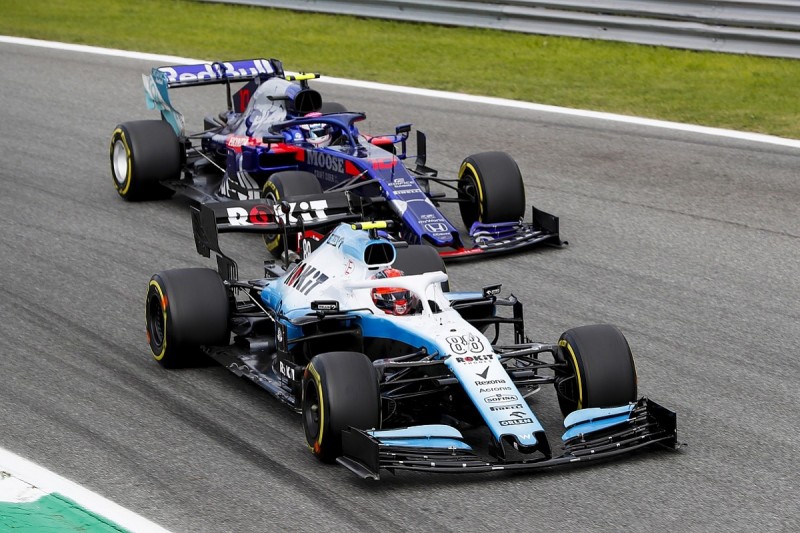
"It was a difficult start," he says. "I would say the first part of the season... there were positives, but they were concealed by most of the difficulties we were having, and quite a lot of inconsistency in delivering performance, let's say.
"But from a personal point of view there have been quite a few positive things. If you think of where I was coming from, how many doubts there were over my physical aspects, one of the positives is that finally I've proved my limitations aren't limiting me."
This latter sentence might sound inherently contradictory, but when Kubica talks about his "limitation" he means the restricted strength and movement in his right arm, which was partially severed in that rally accident.
He's had to adapt to driving in a very different way; study the onboard footage and you'll see the majority of the steering input comes from his left arm.
It's this which has led many observers to conclude the problem is caused by Kubica not being able to get the tyres into the right temperature 'window' for them to generate grip at circuits with tighter corners that require lots of relatively aggressive steering movements. But both Kubica and the Williams team see it differently.
"I remember a lot of people were talking and having doubts, which was correct about Monaco," says Kubica, "but I think Monaco was one of my best weekends. And Australia was a highlight for me - although it was a difficult start to the season, from an emotional point of view it was a big weekend.
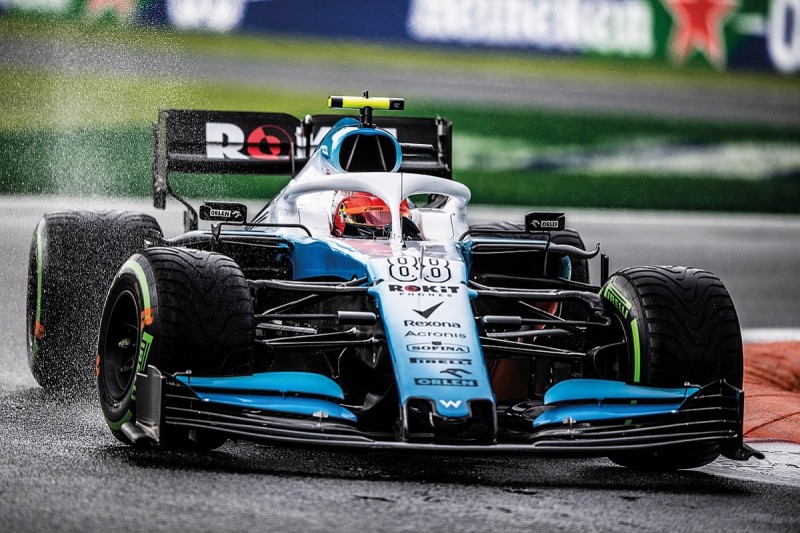
"Hockenheim was my first time in nine years driving an F1 car in the wet, which wasn't easy - it was tough to keep the car on the track. This year has been about single moments, personal goals and achievements rather than results, unfortunately, but we're far off where we were hoping to be."
"Robert's done a good job this year," says Williams deputy team principal Claire Williams. "It hasn't been easy for him - the car isn't what he would like it to be or what any of us would like it to be, so it hasn't necessarily been a good platform for him to demonstrate how strong he can be.
"That gap [between Russell and Kubica] is quite tricky to evaluate properly because sometimes it can be one second, other times it's minimal, and it's a lot to do with the car and how it's behaving.
"Sometimes we'll know exactly what it's doing and why, then a lap later it's doing something else. So, I would never sit here and say, 'I want to see that gap closed, Robert,' because often it's nothing to do with Robert's driving. Robert has no limitations in the cockpit. Not once have we ever heard any comments from him that it's too difficult at a particular track or corner."
While the FW42 has been shamingly uncompetitive - for a team with several world championships under its belt - it's gradually improving, albeit from a low base. It will never become a frontrunner, certainly not now, during a phase of the season where resources are by necessity being directed towards next year's car.
What Williams is doing - and has been since the first few races of the season - is taking each grand prix weekend as an opportunity to learn and 'debug' the car.
The goal is not only to exploit what potential the FW42 has, but also cure the organisational flaws that led to it being finished late and being so disappointingly truculent.
Like McLaren, Williams has recognised it has gone down the rabbit hole and must try to retrace its steps rather than blindly heading deeper into the Stygian murk. As a consequence, it isn't throwing developments at the FW42 but is devoting a substantial portion of Friday practice running to aero-rake testing, so as to establish better correlation between simulation tools and the car's on-track performance.

But that also meant upgrades arrived later than hoped to a vehicle that started its life behind schedule.
The FW42 was late to pre-season testing, missing crucial mileage, then the FIA declared several parts illegal and vital resource had to be redirected at those simply to enable the car to race. Technical director Paddy Lowe also left pre-season.
"We started exploring the aero pre-season as much as we could, but then we had other issues - I don't want to go into the detail but it did slow down the understanding of the car," says Kubica.
"A lot of resource went on solving problems rather than exploring the car. Let's say our starting programme was quite a lot delayed.
"So then once you're in the season, from a team perspective you try to evaluate different directions [of development] and try to understand as much as you can. I'd say I'm now making similar comments [feedback] to George, but of course an F1 car is so complex that even when something sounds simple it might require a lot of work, additional testing and digging into the problem, to make it obvious for the engineers and designers.
"Definitely aerodynamics are a big part of the performance of an F1 car, but not everything. As a driver it's difficult to judge how much time and money and effort it costs to improve different areas, so this is a team decision on where to focus.
"What we're trying to do is help the team with the comments and also the approach - in the end, you know, when we're so far behind it's important to understand where we can improve and how to do it.
"Where we can improve, there's no doubt. How we're going to do it and how much time it will require? This is more complicated and for sure it requires a lot of time."

Williams introduced several major updates mid-season, over the British and German GPs, and the result was a meaningful performance uptick.
At Silverstone, the fastest Williams was closer to the pole time than either car had been all season to that point, and in Hungary Russell missed out on Q2 by half a tenth of a second.
There were other factors in play that Saturday which flattered that performance - Daniel Ricciardo and Sergio Perez tripping each other up, for instance - but it remains significant.
Crucially, Kubica was 1.3s off his team-mate and F1 Racing has never seen him so glum as he was in his post-qualifying press briefing.
At this point in the season it looked as though Kubica had made a step forward only to take at least one back again. At the beginning of the year he'd been certain his car was somehow different from the other, consistently inconsistent.
By now, though, his feedback to the team during race weekends was broadly in line with his team-mate's. And yet - that gap again.
As Kubica said in Hungary, "There's no rollbar or ride-height change that can give you one second. It's a question of putting things together."
This brings us back to the tyre theory, that Russell is finding something Kubica isn't. The current generation of Pirelli tyres is incredibly sensitive, demanding careful preparation over the course of a slow out-lap, so they're perfectly in the temperature window at the beginning of the push lap.
Russell seems to be able to arrive at that start point with grip and the confidence to push straight away, while Kubica's car is slithering as if on an ice rink. Even a driver of Kubica's greatness can't conjure a quick lap from a car with no grip.
"What I'm missing this year, with the chaotic first part of the season, is the consistency which enables you to start building up what you're looking for," he says.
"You build knowledge and from there you build performance. This is one of the things that penalised me, but that's how it is - you go into the racing trying to do your best.
"Of course, sometimes you have situations where you lack performance, and three days earlier you were reasonably happy with the car but now that feeling is gone. Sometimes it's changing from day to day.
"When you're trying to go through a process of developing and improving the car, this brings additional confusion, which is not good. This is one of the things you don't see from outside but unfortunately it's had a big influence on my consistency and the way of driving as well.
"We did have some differences in the behaviour of the cars, as a consequence of the issues we had at the beginning of the season. We [Kubica and Russell] had quite different routes and the cars were behaving in different ways, so we were also giving different feedback.
"But now the feedback is more similar. As I said, we didn't have a good consistency in the car, you feel from one lap to the other that things are changing, and when you can't explain why it makes it difficult to understand. This has been the most influencing factor in this season, I would say."
Ultimately, then, Kubica's troubled 2019 isn't a consequence of dastardly chicanery at Grove. Neither is it a case of a driver with faded powers showing himself up. It is a confluence of factors.
When Kubica last raced in F1 the cars weighed 620kg; now they're 120kg heavier, the equivalent of having a pair of teenagers - or an adult carrying a fair bit of timber - riding in the car as well.
That adds up to a very different set of dynamic characteristics, on top of the abstruse and often baffling behaviour of the tyres. What Kubica needed was some consistency elsewhere in the package. Instead, the FW42 provided yet another moving target.
Kubica says all this has required a "big reset I had to do in order to forget the past and discover the new".
He believes he's getting there. Just not with Williams - some weeks after our conversation, on the eve of the Singapore Grand Prix, he announced that his destination for 2020 lies elsewhere.
"F1 has been my big goal," he says, "and my big challenge in the past few years - a huge challenge after what happened. I thought I had very few chances and nobody was believing in it. Honestly I was also giving myself a very small chance.
"But at the beginning of this season I said to myself, 'The big challenge is starting now,' because if the things are running good I would like to stay in F1. It's the top motorsport category and for sure it would be nice to stay.
"For sure the comeback wasn't as smooth as I hoped. Nobody will take away what I achieved in coming back - and maybe I'll be happier with that in the future than I am now, because now I'm focused on the present."

How Ratzenberger beat the odds to realise his cruelly short-lived F1 dream

F1 uncovered: A weekend behind the scenes with a chief mechanic

When McLaren was pipped by Red Bull in a modern F1 classic

The big opportunity Sainz’s Williams switch affords to F1’s latest centurion

Inside the science of F1 fuel

How F1’s plan for rotating races could look in practice

The early decisions that set Sauber’s rookie for success

How F1 media coverage has evolved in line with its subject

Top five roles on Motorsport Jobs this week

M-Sport’s 2027 WRC Fiesta Kit car breaks cover

Why Bathurst 1000 has lost its international flavour

A fond farewell to a few BTCC favourites
Subscribe and access Autosport.com with your ad-blocker.
From Formula 1 to MotoGP we report straight from the paddock because we love our sport, just like you. In order to keep delivering our expert journalism, our website uses advertising. Still, we want to give you the opportunity to enjoy an ad-free and tracker-free website and to continue using your adblocker.


Top Comments