


Why it will “take years” for Cadillac to reach the level F1 rivals are operating at
Team principal Graeme Lowdon has drawn parallels with Ferrari’s Jean Todt era and McLaren under Andrea Stella

There’s no doubt Cadillac has proved many of its naysayers wrong simply by getting two cars on track at the beginning of the 2026 Formula 1 season. Though it began recruiting in the summer of 2024, before it got the go-ahead to join the grid this year, 18 months doesn’t afford much runway to find facilities and staff, then design and build a car.
The last start-up team was Haas a decade ago, and it had the advantage of a ruleset which permitted it to outsource the majority of design and construction work to Dallara, while buying in many other components from Ferrari. That is no longer permitted.
But backing from a major car manufacturer comes freighted with expectations. Alpine has had a vigorous appetite for team principals since Renault acquired the team a decade ago, while Audi ejected one set of management before it even applied its logo to the car.
Porsche backed out of an engine-development deal with Red Bull because it wanted equity the energy drink manufacturer wasn’t willing to release. Further back in time, BMW and Honda bought teams but didn’t have the corporate stamina to stick the course through the lean years. Toyota seemed to think it would start winning grands prix almost straight away and then spent the rest of its time in F1 wondering why it wasn’t.
At the turn of the millennium, Ford bought a team which had won races – Stewart Grand Prix – and contrived to spend a lot of money while making it a much less successful organisation. That farrago above all was an object lesson in not letting the corporate suits get involved in motor racing, because they generally don’t understand how it works.
The Cadillac F1 team differs from all of those except Toyota in that it is a start-up operation, and its immediate corporate master is TWG Global, a business conglomerate run by Dan Towriss, who made his money in finance but has proved to be an astute custodian of the racing brands he owns. A lot of the senior technical leadership are formerly of ‘Team Enstone’ but, although there is a huge accumulation of individual experience, this is still new as a group.

Jarno Trulli, Toyota TF109
Photo by: Steven Tee / Motorsport Images
Team principal Graeme Lowdon describes the second quarter of this year as a kind of stress test of that organisation, now that the actual racing has begun.
“We like to say every day is a school day,” he told select media including Autosport. “If it's a day where we haven't learned something, it's a day we've wasted. And so we're just trying to find every area that we can improve and constantly, constantly improve.
“And at the minute it's big chunks because there's just so much to do and there's so much that's new as well. So we're somewhere off that area where you're just refining things, where I think a lot of the other teams are probably more in that mode.”
Asked to put a timeline on when Cadillac might reach that point, Lowdon drew an interesting comparison.
“I think it takes years actually,” he said. “You guys have seen this game for a long time. The common thing in all of the successful teams is stability.
“You could argue, what was it that made John Todt so successful at Ferrari? It was probably the five or six years of, I don't know what you would call it, but it wasn't winning. But it was stability and it was building and building and building.
“Same at McLaren. You pick your team, you run with it and it takes time because it's so complicated.
“I've got a master's degree in mechanical engineering and some of the reports I read ahead of a grand prix really stretch my understanding of aerodynamics and fluid dynamics and heat transfer and God knows what else. It's super, super complex. And then on top of all of that is the operational systems and everything, not just pitstops and stuff, but also strategy.”

Graeme Lowdon, Team Principal of Cadillac F1 Team
Photo by: Alastair Staley / LAT Images via Getty Images
Attributing these other successes to stability may seem like an oversimplification. But indubitably one common denominator between Ferrari under Jean Todt and McLaren under Andrea Stella is that both of them have been given the freedom to reshape the team structure and culture by a senior figure who has bought into that vision – and who will defend it when interrogated by those further up the food chain.
In Todt’s case it was Luca di Montezemolo, who headhunted him from Peugeot in late 1993 when the French automotive giant abruptly cancelled its plans to enter F1 as a constructor. With Stella the executive shield is Zak Brown, who promoted him into his current position.
Todt inherited an insanely dysfunctional business and there would be three more seasons of scratching around for results before Michael Schumacher challenged Jacques Villeneuve for the drivers’ championship until the last round of the season in 1997. Then another two before Ferrari won its first constructors’ championship since 1983.
So, Ferrari being Ferrari, Todt spent his first three years under permanent threat of being fired – according to the Italian media. Among the more peculiar elements of the structure he inherited was that the car was being designed in the UK, and the blueprints faxed over to Maranello page by page for construction and assembly.
This is because Ferrari, on Niki Lauda’s advice, had brought legendary designer John Barnard back on board in the hope of fast-tracking the team back to competitiveness. But it was so desperate to retain Barnard’s services that it had granted all his demands, including his requirement to stay in the UK and establish a design office there.
Famously, Barnard liked to drive home for lunch.
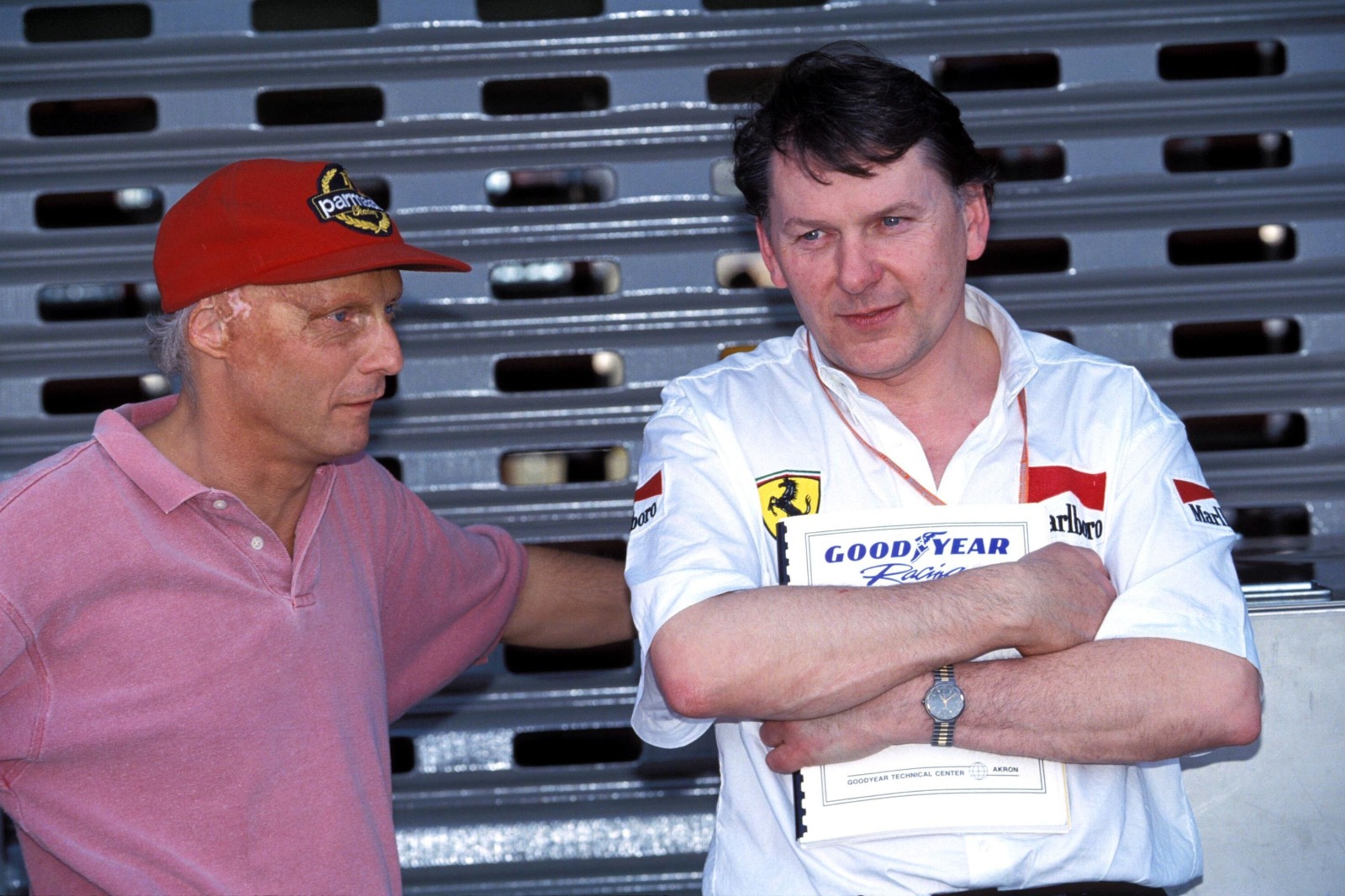
Niki Lauda and John Barnard at the 1994 Brazilian GP
Photo by: Ercole Colombo
The Barnard Ferraris of the mid-1990s did deliver a performance uplift but the shortcomings of designing the car at one site and building it several hundred miles away were obvious. On the early version of the 1994 412T1, for instance, a miscommunication between Barnard’s team and the engine department about the requirements for the cooling architecture led to the car struggling until a B-spec was introduced mid-season.
Todt’s solution, having poached Schumacher to drive in 1996, was to recruit the design leaders who had masterminded the cars Michael had driven to his first two world championships. Under technical director Ross Brawn, design and manufacture was brought back under one roof but this, naturally, took more time – as did the cultural changes Brawn pushed through.
Brawn transformed a working culture riven by silos, Machiavellian blame machinations, and an addiction to quick fixes. This proved controversial but he was, in effect, double firewalled – by Todt and, by extension, Montezemolo.
Bringing in an outsider was politically difficult. It’s said that Todt came home one day to find his house had been broken into and a pair of scissors left on his bed.
Naturally much of this negative sentiment fell away as the new culture delivered five consecutive drivers’ championships and six constructors’ titles. Many of the lessons from this era were imprinted upon a young Stella, then a performance engineer at the Scuderia.
At McLaren, Stella – with Brown’s blessing – restructured the engineering organisation away from the traditional hierarchy of one technical director overseeing everything. Now there are three strands, each with its own director: aerodynamics, performance, and design and engineering.

Lando Norris, McLaren, Andrea Stella, McLaren, Zak Brown, McLaren
Photo by: Steven Tee / LAT Images via Getty Images
Most significantly, Stella did this while eschewing the traditional merry-go-round of hirings and firings. There has been some recruiting, such as Rob Marshall from Red Bull, but for the most part it has been a case of using the same pool of people in a way which better enables them to fulfil their potential.
Like Brawn, Stella is an advocate of responsibility rather than blame, and of finding performance through incremental gains.
“When we succeed today,” he told Autosport recently, “I want everyone at the factory to feel, 'This is something I own. This is something I earned. This is something I helped create.'
“That sense of shared contribution is incredibly powerful. Helping people recognise the value of their own work, and see how it connects to what happens on track, is one of the things that makes this team so special to me.”
So stability over time, as Lowdon said, is one contributor to building a successful organisation.
But so too is culture, which is why some teams never get there.


Italy’s next F1 world champion?

Why Norris doesn’t buy Russell’s driving style theory

How Antonelli is proving unbeatable, even when he's beaten

F1 Spanish GP live commentary and updates - Lap by lap of how Antonelli won

What the drivers think of the "crazy" Madrid F1 circuit

Why new Madrid F1 circuit will be a "challenging" test of cars and engines

What Jacques Villeneueve really learned from Gilles: “I can do this, you can’t”

Why Monza remains F1's eternal test of team bonds

WRC rally winning co-driver Harryman passes away

Hadjar set to make Red Bull return at Azerbaijan GP after injury recovery

Mir to miss Japanese and Indonesian grands prix for Honda

F1 approves shorter races for 2027 to fit revised power unit plan
Subscribe and access Autosport.com with your ad-blocker.
From Formula 1 to MotoGP we report straight from the paddock because we love our sport, just like you. In order to keep delivering our expert journalism, our website uses advertising. Still, we want to give you the opportunity to enjoy an ad-free and tracker-free website and to continue using your adblocker.


Top Comments