


When F1's 'flawed' attempt to chase overtakes and closer racing got radical
OPINION: The 2026 F1 aero regulations have not been overtly designed to produce 'more overtaking' or 'better racing', but to service next year's powertrain rules. That's a change in itself, given F1's past explorations of radical solutions to the on-track problem...

Formula 1's 2026 regulations have received mixed predictions from those involved in the championship, with most of the uncertainty hinging on the complexity of the powertrain rules.
As such, the aero regs have scarcely courted quite the same column inches in recent months - including the introduction of active aerodynamics, removal of the Venturi tunnels, and a smaller diffuser. In many ways, the car leans towards the formula last seen in 2021, albeit with differences in the aerodynamic furniture allowed. The cars will also be slightly shorter and narrower versus the current generation.
How this will affect the racing spectacle remains to be seen. The 2022 regulations were produced through a series of simulations designed to mitigate the loss of downforce following another car; although some of the outright figures were watered down with aero development, this was somewhat predicted. After all, it was hardly up to the teams' designers to consider overtaking metrics in their performance criteria.
The 2026 aerodynamic framework has also changed since the initial reveal last year, as teams lobbied for tweaks to some of the aero parts to recoup lost downforce. That, allied to everyone's wings opening on the straights, might move the dial backwards in terms of what to expect - on the face of it, the reintroduction of more conventional wings might increase the 'dirty air' effect in corners, and minimise the slipstream on the straights. Maybe the manual override system will cover for that.
If it is indeed the case that F1's pursuit of 'better racing' goes backwards, then it's a distinct change in approach versus the years (nay, decades) of attempting to manifest the fans' vision of more wheel-to-wheel racing. (Aside from the 2017-18 regs, of course, where the sole aim was to make the cars faster, thanks to larger wings and wider wheels).
The 2022 regs were aimed squarely at that, as was the 2009-2016 generation of skinny rear wings and wide front wings. And there were more ideas before that. Attempts to improve F1's spectacle have persisted throughout its history, and will continue to do so as long as the championship exists. Every current generation of F1 has been the worst generation, if we take an aggregate of all comments, and the generations of F1 that were considered 'bad' were upgraded to 'good', largely because they weren't the present. That's how it usually works, I think.
And even when 2017's "directionally incorrect" rules, per then-Williams tech chief Paddy Lowe came in to make the cars more visually striking, the fact that it hurt the overtaking statistics seen in races prompted a rethink for the 2019 season. Thus, the front wing furniture was slashed and F1 raised the rear wing heights again.

2017's bigger, wider cars took seconds out of lap-times, but hurt F1's wheel-to-wheel racing
Photo by: Charles Coates / Motorsport Images
F1 had played with rules to 'spice up the show' through the 1990s and 2000s, through playing with tyre widths and grooves, diffuser sizes, front wing heights, and restricting rear wing elements. This was all done on the basis of less aerodynamic downforce equals more overtaking, although another large part of that is parity between cars. If two cars aren't even in the same postcode, it's all quite a futile exercise. Either way, these rules were all minor dimensional changes to fit an existing framework. Even 2022's wide-ranging rules changes retained the notion of what an F1 car looked like, albeit this time with front wings borrowed from an Airbus A350.
The form factor of an F1 car has been, at its core, more or less unchanged since the Lotus 72 made its competitive debut 55 years ago. Front wing, rear wing, four wheels, radiators in the sidepods, engine in the back. The aerodynamics might be more advanced, and dimensions might be elephantine by comparison, but the DNA is the same. It's not dissimilar to the human form either: also generally the same as 55 years ago too, but larger on average and with more microplastics.
Back in 2005, however, the FIA plotted a change that would very much change the face of common F1 car design convention. Earmarked for the 2007 or 2008 seasons, depending on advancements, this was planning to be introduced to course-correct the '05 rules changes that had not produced any of the desired effects beyond knocking Ferrari off its perch.
"By introducing the [centreline downwash-generating] wing we can give motorsport fans exactly what they have asked for, wheel-to-wheel racing with much more overtaking"
Max Mosley, 2005
Raising the front wings even further, revising diffuser dimensions and banning tyre changes had quelled Michael Schumacher's dominance but, individually, made following other cars exceptionally difficult thanks to the loss of downforce in the wake of other cars. The novelty of a title battle between Fernando Alonso and Kimi Raikkonen did much of the heavy lifting; although the Suzuka race was admittedly good, qualifying had been a complete lottery in Japan.
Concerned by the perceived lack of race-closeness between cars, the FIA wanted to do something very different. The governing body commissioned a study with AMD to calculate why 2005's racing product had been less than stellar, and had determined what many other studies had decreed: that chasing cars lose too much downforce due to turbulence, and thus lose too much time in the corners.
Ever since rear wings and diffusers were introduced in F1, it has been difficult to define a wake profile that negates that. Diffusers and rear wings flick air upwards - that's how they work. Expanding the low-pressure zone at the rear of the car also increases suction at the rear, enhancing that effect further. It is not the job of aerodynamicists in F1 to do that in a way where the flow sheds away from the car in a 'laminar' fashion, because that's contrary to how wings work effectively.

2005's technical changes ended Ferrari's reign, but passing proved tough
Photo by: Steve Etherington / Motorsport Images
It's also difficult - or even impossible - for aerodynamicists to make a car as effective in turbulence as it is in laminar, clean-flow conditions. Turbulence models exist, but they cannot predict the motion of every air particle accurately - and, of course, every car never produces the same wake; this is a dynamic, living phenomenon. The proposal was that, by mitigating that kick-up of airflow from the diffuser and rear wing, the chasing car could attain more downforce when following another car.
This was not dissimilar to the goals of the 2022 project, although these rules attempted to achieve this in quite a different fashion by limiting the amount of turbulent air shed.
20 years ago, computational fluid dynamics (CFD) was not as advanced as it is now, but it could still demonstrate a scenario where an aero package could shed airflow that was directed downwards, and thus the following car collected a bit more front-end downforce. The FIA produced a design that could make that happen - which it branded as the 'centreline downwash-generating wing'.
In truth, it was two wings - given the lack of high-quality images available of it, we've produced a quick-and-dirty Photoshop of the 2005 Ferrari [below] with the planned CDG wing formulation. The rules wanted to free up the 'centreline' of the car to shovel airflow downwards, and move the downforce-generating wings further outboard, positioned behind the rear wheels.
"This new research is important for the future of Formula 1," said then-FIA president Max Mosley. "By introducing the CDG wing we can give motorsport fans exactly what they have asked for, wheel-to-wheel racing with much more overtaking. It is our hope that the teams will collaborate with us in the optimisation of this radical new idea so that the aerodynamic benefits can be introduced into Formula 1 in 2007 rather than having to wait until 2008."
The FIA was keen to press it into service, although it was not without its detractors. Although it seemed to have some degree of benefit when chasing a car through the corners, the lack of expected slipstream would make it a lot more difficult to follow on the straights. This is the dichotomy of reducing the effect of 'dirty air' - it's a pain to follow other cars through corners, but the bigger slipstream offers opportunities to pass on the straights.
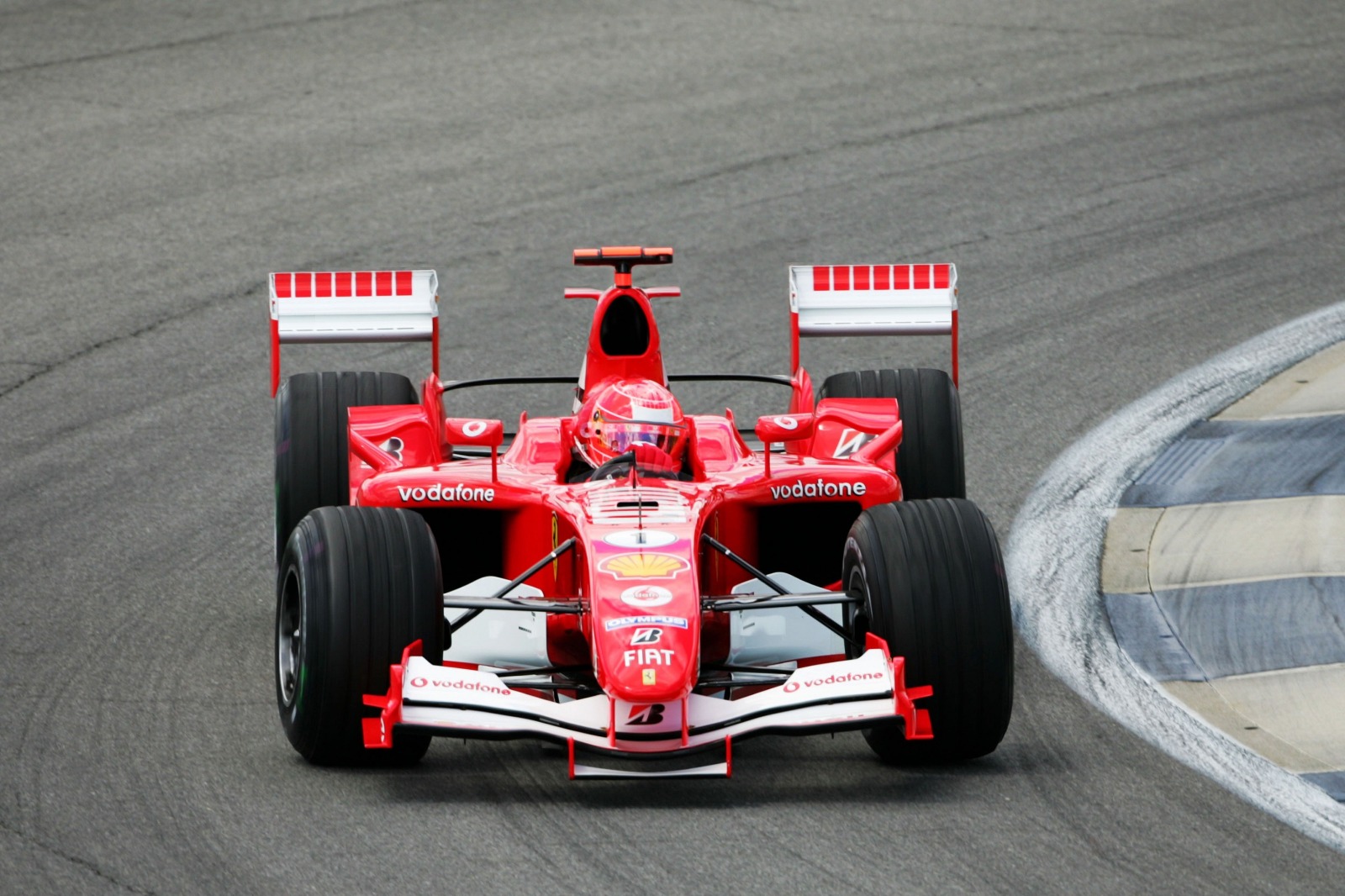
How would the 2005 CDG wing have looked? This writer fired up Photoshop to offer some kind of visual assistance...
Photo by: Autosport
At the time, Autosport reported that an unnamed technical leader stated that "it can only work if you are directly behind another car. [...] What happens when you move out to pass? You hit the wake from the rear wheel and side wings and probably crash. It's a PR exercise with minimal substance".
When presented with the solution, Formula 1's Technical Working Group declined to give the FIA its blessing to implement the wing in 2007, although the FIA wanted to press on with a potential 2008 implementation. The issue appeared to be in the FIA's almost-exclusive use of CFD rather than wind tunnel data; Patrick Head stated that "if CFD was at a level that it could support car design exclusively, then the teams would not have wind tunnels". Mosley had commissioned former business partner Nick Wirth, later known for his CFD-only approach with his Virgin F1 designs five years later, to produce the CFD simulations.
Although some in the paddock praised the idea of the CDG wing, many of the technical chiefs of the time felt the design was flawed. As such, the 'Overtaking Working Group' was formed to find an alternative and head off the 2008 introduction - Pat Symonds, Rory Byrne, and Paddy Lowe led the charge, and developed what eventually became the 2009 regulations.
One hopes that the 2026 regulations don't flop but, if they do, expect some weird studies to crop up as people commission engineers with a CFD package to throw together a few concepts to improve the racing product. We've been here before, and nothing is ever truly new in F1.
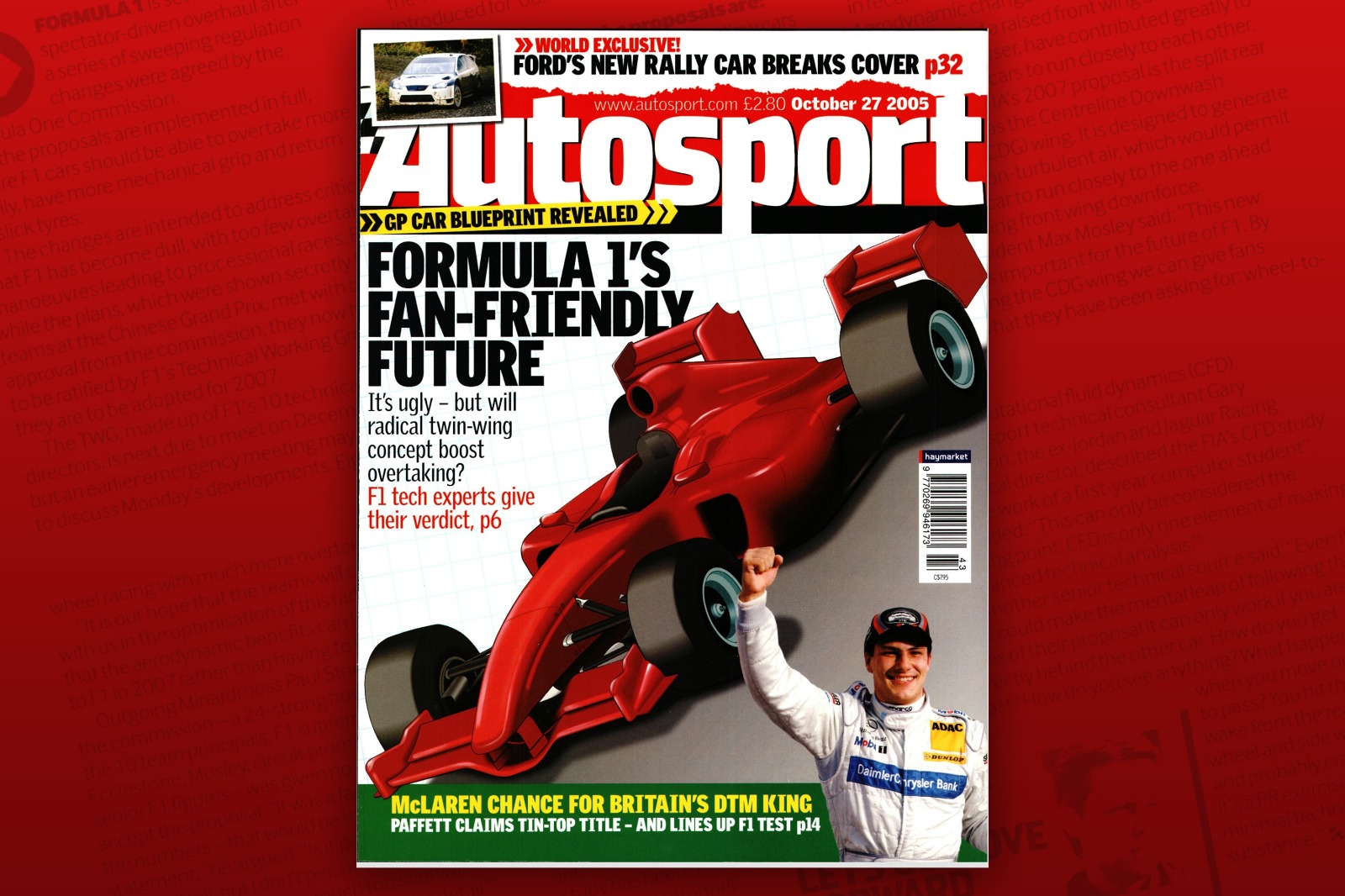
Autosport's cover from its 27 October 2005 issue of the magazine, detailing the CDG concept
Photo by: Autosport


FIA expects F1 races in Qatar and Abu Dhabi to run as planned

Why Piastri has struggled to show his best with this year's McLaren MCL40

Lights, Camara, action: How Haas picked F1's latest rookie for 2027

Horner's inside story of how Red Bull built its own F1 engine

Why Mercedes' latest 2026 F1 update is no downgrade

Singapore Grand Prix Driver Ratings 2026

What we learned from the 2026 F1 Singapore GP sprint race and qualifying

The political minefield set out by F1’s recent cost-cap grievances

How Antonelli levelled up his character to be F1 2026's world champion-elect

FIA set to close F1 cost cap loophole with new rules

Norris promises to make "better decisions" following fresh talks over Singapore GP clash

FIA expects F1 races in Qatar and Abu Dhabi to run as planned
Subscribe and access Autosport.com with your ad-blocker.
From Formula 1 to MotoGP we report straight from the paddock because we love our sport, just like you. In order to keep delivering our expert journalism, our website uses advertising. Still, we want to give you the opportunity to enjoy an ad-free and tracker-free website and to continue using your adblocker.


Top Comments