


What were Antonelli’s chances of starting on the front row in Austria without his yellow-flag blunder?
Kimi Antonelli felt the qualifying lap he mistakenly aborted in Q3 at the Red Bull Ring was good enough for at least second on the grid. We investigate the data…

Over the course of a frenzied few seconds around the clock hitting zero in Q3 for the 2026 Austrian Grand Prix, four different drivers held provisional pole position: Kimi Antonelli, Lewis Hamilton, Charles Leclerc, and George Russell.
Russell’s pole was ‘provisional’ because it had an asterisk over it, courtesy of Max Verstappen running wide into the gravel trap at Turn 9 and smiting the barrier seconds after the chequered flag was unfurled. As we’ve explained elsewhere, marshals are compelled to show waved yellow flags as soon as an incident occurs – which they did – but the order to show double waved yellows, indicating a higher order of danger, must come from race control.

This command was not issued until both Mercedes had passed the scene, within 15 seconds of Verstappen going off. Russell lifted off at the scene (96 metres earlier than on his earlier push lap) but, courtesy of a mighty first two sectors, his lap was good for pole anyway. The stewards pored over the data, decided he had slowed down to their satisfaction, and allowed the lap to stand.
Antonelli, though, had mistaken the single waved yellows for doubles, and aborted his lap. Later he expressed his frustration, for although he knew his lap was at least a tenth off Russell’s, he believed it would have been good enough for the front row.
As it stood, he would start fourth, by dint of the 1m06.414s he had set earlier to claim provisional pole before being bumped down by Hamilton, Leclerc and Russell.
“I was one tenth behind him [Russell], so it would have been front row, but still not enough for pole,” Antonelli said.
The comparison with Russell is pretty accurate since the other Mercedes clocked a 16.424s and 29.620s in the first two sectors of his pole lap, where Antonelli did 16.477s and 29.666s. Antonelli’s 19.998s through the final sector, set on his first push lap, still stood as the fastest time through there – and he would have had to beat that to secure pole ahead of Russell, who clocked a 20.069s through there even with a lift.
So, let’s look at how the beginning of Antonelli’s aborted lap stacks up with the one that put Leclerc next to Russell on the front row.

Could Kimi Antonelli have challenged Charles Leclerc?
Photo by: Eric Le Galliot
Tiny margins in sector one
Much had been made of Ferrari having an engine upgrade already in the tank, ready for the revelation of the FIA’s Additional Development and Upgrade Opportunities (ADUO) rankings. But ahead of the weekend, Leclerc had played down the significance of the upgrade – a revised steel-alloy casting material, which enables the internal combustion engine to run at a higher operating temperature.
“We don't expect magic bullets unfortunately,” he said. “There has been a massive amount of work in the background to make sure the upgraded engine was ready for now. We kind of expected to be on the ADUO looking at the trace we had.
“So, we obviously made sure that we were ready for that first race to put it straight on the car. It's not a revolution, but it's a step in the right direction and that really shows the mentality of the team of trying to put everything together and really pushing the limits of the development to make sure that we don't leave anything behind.”
Throughout FP1 and FP2 the Ferraris had struggled for grip on both axles. Though short and deceptively simple in layout, the Red Bull Ring poses irritatingly counter-intuitive questions of drivers and engineers, particularly in high temperatures.
“We don't expect magic bullets. There has been a massive amount of work to make sure the upgraded engine was ready," Charles Leclerc
Though it has fewer high-speed corners than Barcelona, for instance, the three key traction events on the lap – Turns 1, 3 and 5 – put the rear tyres under a lot of stress. But there’s also a lot of combined turning and braking to be done, such as Turns 4, 6 and 9, along with dynamic elevation changes.
That threatens temperature saturation on the front axle, so the default method of protecting the rears by dialling in some understeer becomes problematic. Ferrari certainly found something from Friday into Saturday because it was almost a match for Mercedes come qualifying.
In sector one alone it was 16.485s (Leclerc) playing 16.477s (Antonelli), a question of milliseconds overall but achieved via subtly different techniques. Both braked at exactly the same point for the uphill approach to Turn 1 but Antonelli (the blue trace in our graph below) got off the throttle earlier.

A slightly later but more aggressive turn-in phase enabled Leclerc (red trace) to carry more speed through the initial entry, but that scrubbed away with a small slide – so Antonelli was faster as the apex approached, albeit marginally. But Leclerc was able to get a neater exit, barely troubling the kerb whereas Antonelli went all the way onto the rumble strip before straightening out.
That cost him in terms of exit speed but, despite being later off the brakes and on the throttle, the Merc’s greater punch brought him to a higher top speed as they approached the kink at Turn 2 and beyond.
Ebb and flow in sector two
Just milliseconds separated the two cars in the middle sector, 29.632s for Leclerc versus 29.666s for Antonelli, but the Mercedes once again had to claw back lost time. On this occasion, it was Turn 3 where again Antonelli lifted off earlier.
But here the championship leader braked later, in a separate movement, while Leclerc overlapped brake and throttle more aggressively, persuading the rear axle to help him get the car to turn. And it was a beautifully fluid movement, judging the apex perfectly and taking just the briefest edge of exit kerb whereas, again, Antonelli got his left wheels further onto the rumble strip and leaked time.
Antonelli was super-brave and committed, running the Mercedes right out over the kerb and flirting with the gravel trap
The speed traces overlap on the run towards Turn 4, then turn decisively in Antonelli’s favour, suggesting more electrical punch since the Mercedes was able to sustain a higher top speed whereas the Ferrari tailed off, despite Leclerc remaining on the throttle for longer as he approached Turn 4.
But there it was Leclerc’s turn to overcook it slightly, edging slightly wide through the sweep of Turn 4 as he got on the throttle earlier and more aggressively, taking him out to the track boundary and within inches of the gravel trap. Being more patient on the throttle enabled Antonelli to get a neater entry trajectory to Turn 5, but again the Ferrari had a slight edge on cornering speed through the apex of Turn 6.
Leclerc might have been able to eke out more of an advantage through there but Antonelli was super-brave and committed, running the Mercedes right out over the kerb at the exit and flirting with the gravel trap on the right as he set it up for the rapid left-right of Turns 7 and 8. Here the track is still on a downward gradient with a slightly challenging camber, the trajectories of those who get the thread-the-needle balance of Turn 7 wrong writ large in ugly black spirals on the driver’s right.
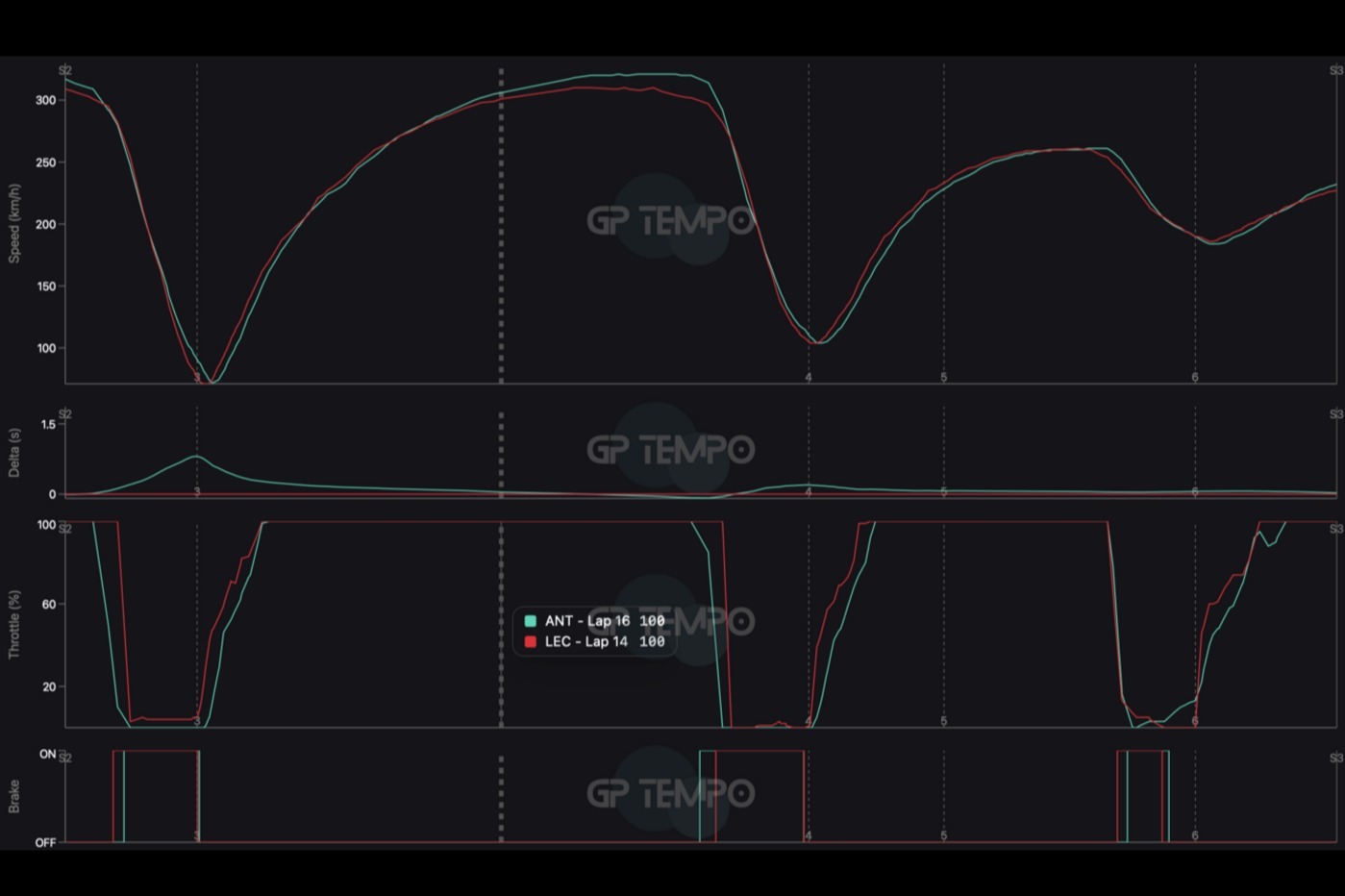
So, by the end of sector two they were separated by mere hundredths of a second. Leclerc then went on to clock a 20.232s through the third sector, adding up to a lap that was good for provisional pole at the time.
Verstappen then crashed, and when Antonelli reached this point he mistook the single waved yellows for doubles and backed right off. What would have happened had he continued with a lift, like Russell?
Antonelli’s previous push lap had been 19.998s through there. A judicious lift, like Russell’s – who went through through sector three in 20.069s on his pole lap – would have satisfied the stewards that he had slowed down sufficiently.
And it would still likely have been good for P2 by a tenth or so from Leclerc.
Lower gear delivered the first blow in sector three
Obviously, we can’t compare Antonelli’s final sector on his last flier with Leclerc’s, because Kimi abandoned ship at Turn 9 and cruised for the remainder of the lap after his yellow-flag confusion. But we can hypothesise based on comparing Leclerc’s final push lap with the third sector on Antonelli’s first.
Here we are looking at 20.232s for Leclerc versus 19.998s for Antonelli. They were separated by mere milliseconds in the opening two sectors of the lap on the final fliers, but here Mercedes seemed to have an advantage.
Viewing the onboard footage of the two drivers, they carried a similar line through the corner, but the difference is in the details. In our graphic the delta indicator placing Antonelli around three tenths down at the beginning of the sector is slightly misleading, given this one is comparing Kimi’s first push lap (where he was slower through the first two sectors) with Leclerc’s end-of-session flier.
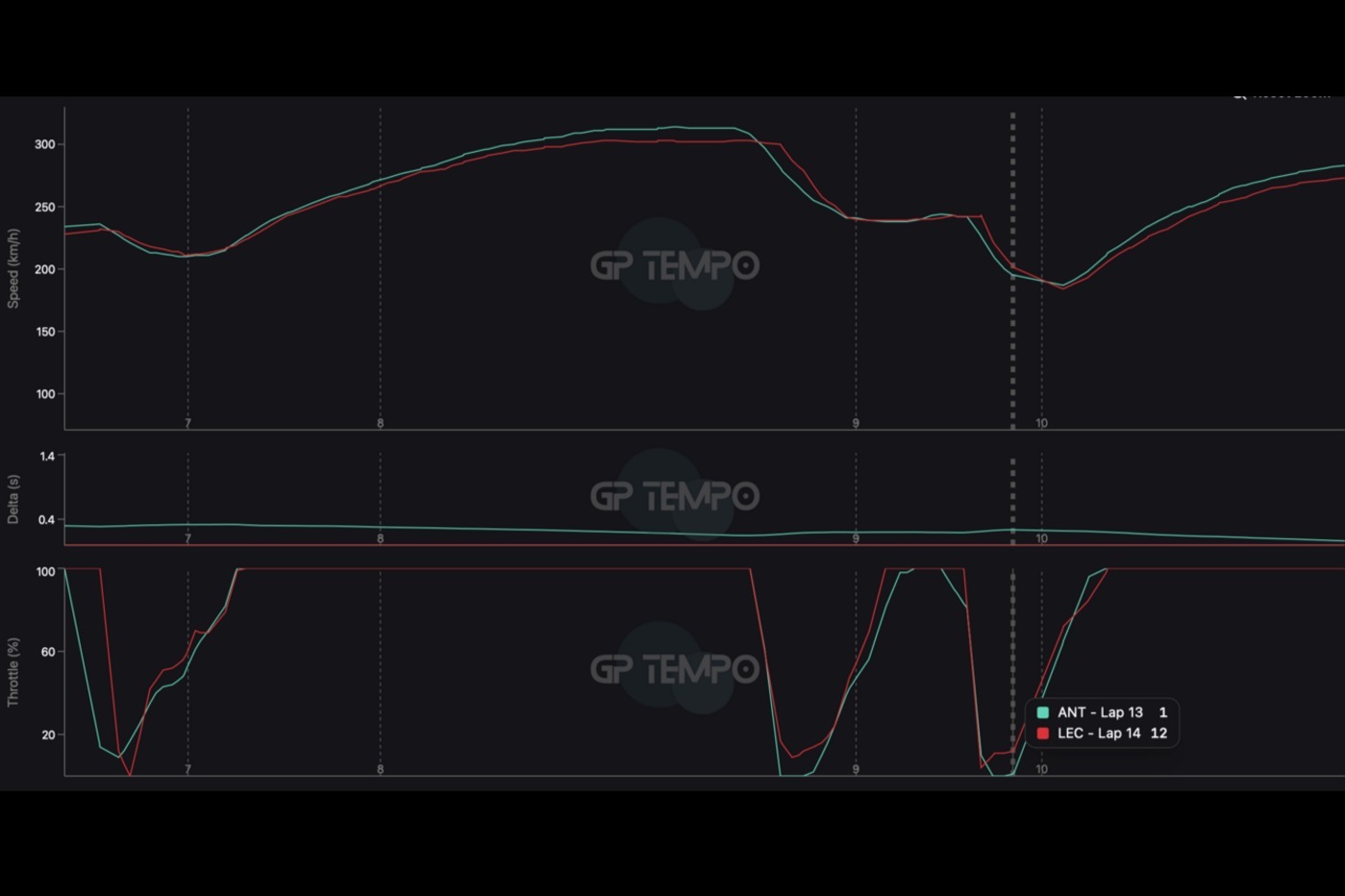
But what we can see is a speed disparity in the order of 10km/h on the approach to Turn 9 – the majority of that differential, in Antonelli’s favour, growing after Leclerc hooked top gear while Antonelli remained in seventh from Turn 8 all the way until just before he hit the brakes for Turn 9. Here, where the approach is over a blind crest, commitment and precision are king, but with these two drivers those factors are seldom in doubt.
For this corner, it was Antonelli who braked earlier and blended that action with bleeding off the throttle to get the rear end to encourage his car to turn. Leclerc took a more conventional late-braking approach which meant the speed trace crossed over briefly in the Ferrari’s favour – but not enough to recoup the fractions of a second lost.
Was the speed differential on the approach a consequence of the Mercedes hybrid system flexing its muscles, or of Antonelli getting a hint of a tow as he came up on Hamilton’s Ferrari while the Briton was on the slow-down lap from his flier? More likely the former, since Lewis promptly dived out of the way.
Leclerc was more aggressive at the Turn 9 exit, picking up the throttle more decisively even as he rode to the edge of the kerbs (and the tolerance of the stewards for track limits), enabling him to match Antonelli’s speed through the short downhill chute to Turn 10, where he again picked up a fraction as Antonelli applied the brakes fractionally earlier. Classic Charles, flirting with the edge of disaster: carry too much speed in here, and get the trajectory over the apex kerb wrong, and the car almost inevitably sails over the exit kerb and beyond the white line denoting track limits.
But, though Leclerc braked later, he also braked longer – and here again, Antonelli was in a lower gear, fourth rather than fifth, though the Ferrari driver briefly downshifted at the end of his braking phase.
As Antonelli got straightened up after leaving the exit kerb it was then a familiar story of Mercedes punch establishing a more potent speed curve – a handful of kilometres per hour but sustained enough to be worth in the order of a tenth of a second on the lunge to the tape alone.


How Antonelli is proving unbeatable, even when he's beaten

F1 Spanish GP live commentary and updates - Lap by lap of how Antonelli won

What the drivers think of the "crazy" Madrid F1 circuit

Why new Madrid F1 circuit will be a "challenging" test of cars and engines

What Jacques Villeneueve really learned from Gilles: “I can do this, you can’t”

Why Monza remains F1's eternal test of team bonds

Hamilton says Ferrari has left it "too late" to back him in F1 title fight

How Gasly and Alpine beat Mercedes, Ferrari, McLaren and Red Bull to Italian GP pole

How Antonelli is proving unbeatable, even when he's beaten

F1 drivers push for Madring changes after "very poor" Spanish GP: "I almost fell asleep"

WRC Chile: Solberg seals victory as Toyota wraps up manufacturers’ crown

Marquez: MotoGP rivals gave me a “present” - and it tastes “sweet”
Subscribe and access Autosport.com with your ad-blocker.
From Formula 1 to MotoGP we report straight from the paddock because we love our sport, just like you. In order to keep delivering our expert journalism, our website uses advertising. Still, we want to give you the opportunity to enjoy an ad-free and tracker-free website and to continue using your adblocker.


Top Comments