


The last person you should ask about F1 TV graphics is George Lucas
F1 CEO Stefano Domenicali's rationale for dropping battery and speed read-outs from broadcast doesn't stand up to any rational scrutiny

In the dim and distant past, a popular brand of feline comestibles was advertised with the slogan "Eight out of 10 owners said their cats preferred it". So much wrong with such a short sentence. Owners? Staff, surely. And the weasel phrasing – preferred it to what? A bowl of rusty nails? And what of the sample size for this supposed survey? Has anyone ever knocked on your door or intercepted you in the street to seek the lowdown on Tiddles' meal preferences?
Advertising regulations are tighter these days (in the UK at least), so it's possible to chortle and do mental arithmetic at the same time when – for instance – cosmetic companies claim massive approval ratings for their latest anti-wrinkle cream, but have to divulge in the on-screen small print that they only asked 117 people.
All that and more passed through this writer's mind during a roundtable interview with F1 CEO Stefano Domenicali last week, when a colleague asked a perfectly reasonable question about the disappearance from the broadcast of the speed and battery state-of-charge graphics. Given F1's desire for continued expansion in the US, where there is a well-documented demand for data in sports broadcasting, isn't it counter-productive to actively remove data that's crucial for understanding how the racing works?
"The truth is exactly the other way around, because no one is interested in how you drive your car," said Domenicali.
Wait, what? If you are indeed not interested in how the cars are driven, feel free to express this sentiment via the handy comments section below.
Now, the comments section of a motor racing website is inherently servicing a niche and self-selecting minority. But since we're playing the game of small sample sizes, why not?
"People are interested if you're overtaking or not. That's the vast majority of the people," continued Domenicali. "I agree with you that certain people are focused on this thing that is very important. It's like when you were opening the DRS, people were not interested in what was the point to pass.

How much battery power did Verstappen use while passing Hamilton in Hungary? In the absence of graphics, interested fans would have to guess
Photo by: Andy Hone/ LAT Images via Getty Images
"I had an incredible and interesting discussion with [Star Wars writer/director] George Lucas on Saturday. He was in Hungary and gave me an incredible view on how the new fans are watching Formula 1, and he gave us an incredible clearance [perspective] to see how we can really simplify things, because the new fans are not understanding what is behind the scenes. They are fascinated by the fact that there is a lot of action.
"So I think, on that, there is definitely the need for the ones that are so focused on that to have the right information. But for the vast majority of the people, trust me, they just want to see what is happening on the track.
"Not interested in the angle of throttle or the brake pressure in how you can overtake. If you think, for example, an incredible overtaking of Max and Lewis at Turn 1 in Hungary, this is a piece of art, if I may say, that these people just want to see. And just connected to the quality of the drivers.
"At the end of the day, this is a scheme that the driver can have on how you can maximise the performance of your car, no matter if it's braking, accelerating, power that is done by the electrification. That's what I think is happening. Of course, for a niche of our fans, this data is relevant and of course it is available."
This is a classic example of sampling bias, where an argument is put forward about the preferences of an entire population based on a sample which excludes a portion of that population
Throughout this year, when Autosport has reported on negative sentiment towards the new regulations, F1 has responded with statistics claiming that actually the fans really do like the new format. But since these are drawn from surveys of subscribers to the F1 Unlocked service, the respondents are as inherently niche and self-selecting as, say, those who are minded to comment at the bottom of articles on a motor racing website.
This is a classic example of sampling bias, where an argument is put forward about the preferences of an entire population based on a sample which excludes a portion of that population. In this case, it is as wrong to assert that "no one is interested in how you drive your car" as it is to say that everyone hates the new regulations.
Clearly there is a proportion of the fanbase expressing the sentiments Domenicali is emphasising. But this does not negate the reservations of those who see differently – and nor is it possible to say, based on the statistical evidence available, which is the majority view.
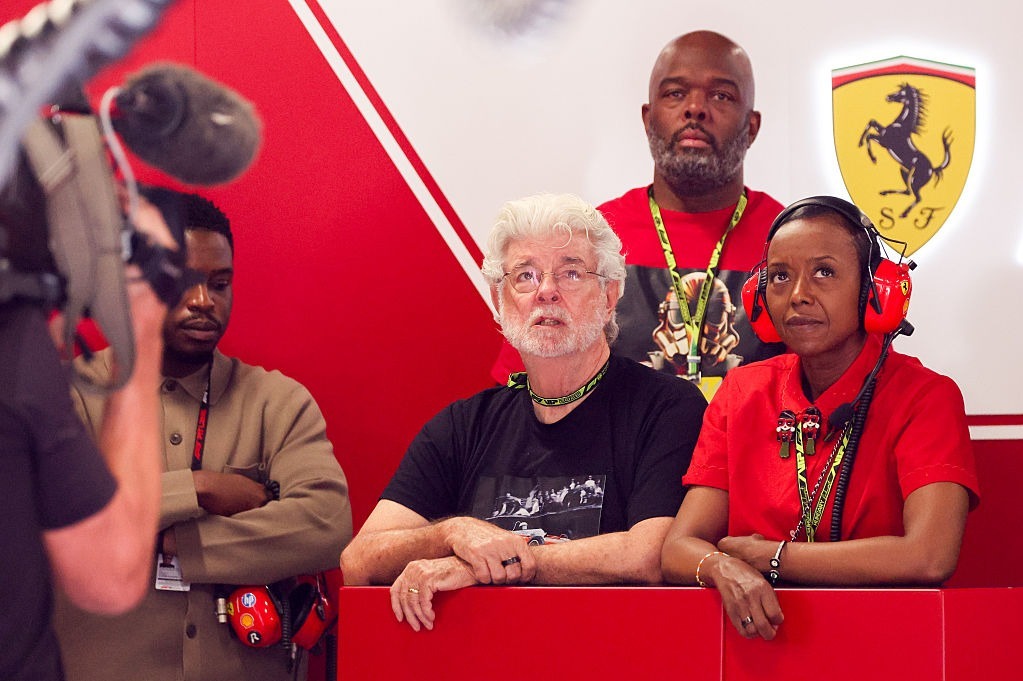
Lucas and his wife, Mellody Hobson, were guests of Ferrari at the recent Hungarian GP
Photo by: Getty Images
Equally clearly, citing George Lucas to justify F1's visual storytelling choices in sports broadcasting (choices made months ago, I might add) is an example of a common logical fallacy, the appeal to authority. In this fallacy the claim is based on the opinion of some expert figure – usually famous – rather than facts or data. It is a popular form of mic drop on social media to share a meme with a picture of some long-deceased public figure along with a supposed quote from them which supports the argument.
And in any case, what qualifies Lucas to preside over whether we see a battery icon or not? I certainly wouldn't be taking storytelling tips from someone who re-edited Star Wars to make Greedo shoot first. And this is before we get into the business of the prequels, of which the best that can be said is that they became progressively less awful as they went on.
In the cinematic world Lucas inhabited, it was popular (until the streaming era at least) to create "making of" featurettes with behind-the-scenes footage to be shown separately. There were those who very much enjoyed this insight into the movie-making process – but, equally, there was a segment of the population which didn't want to see how the magic was created, feeling it would spoil their enjoyment of the film. Easily resolved – if you fall into the latter camp, don't watch the "making of".
Now, in F1 terms, were the speed and state-of-charge graphics diminishing the spectacle for those who are only interested in whether "you're overtaking or not"? I can't imagine they were.
So why remove them, when they were so useful to those who actually wanted to understand the mechanics of driving a 2026 F1 car through traffic, and overtaking? Especially when, over the past few years, F1 has actually been ramping up its data offering as a product placement for Amazon Web Services?
If someone were to knock on my front door enquiring of my cats' comestible preferences, I would probably tell them to mind their own business. Meanwhile, one of said cats would have vanished under the sofa while the other retreated to a safe spot on the stairs, fixing the surveyor with a look which expressed that she had seen deep into their soul and was highly disappointed with what she had observed.
And that, by and large, is the tenor of the response you receive from the commercial rights holder when you ask a perfectly reasonable question about the otherwise inexplicable disappearance of some vitally important data graphics.


Should F1 bring back its data graphics?
Photo by: Guido De Bortoli / LAT Images via Getty Images


Why Norris doesn’t buy Russell’s driving style theory

How Antonelli is proving unbeatable, even when he's beaten

F1 Spanish GP live commentary and updates - Lap by lap of how Antonelli won

What the drivers think of the "crazy" Madrid F1 circuit

Why new Madrid F1 circuit will be a "challenging" test of cars and engines

What Jacques Villeneueve really learned from Gilles: “I can do this, you can’t”

Why Monza remains F1's eternal test of team bonds

Hamilton says Ferrari has left it "too late" to back him in F1 title fight

What's behind the talks between the FIA president and Alonso over ADUO?

Evans favourite to become WRC champion as Rally Saudi Arabia is cancelled

Alonso is right to sound the alarm about F1 - but history seems to be repeating itself

Ogura set to make MotoGP return in Austria
Subscribe and access Autosport.com with your ad-blocker.
From Formula 1 to MotoGP we report straight from the paddock because we love our sport, just like you. In order to keep delivering our expert journalism, our website uses advertising. Still, we want to give you the opportunity to enjoy an ad-free and tracker-free website and to continue using your adblocker.


Top Comments