


The Ferrari Schumacher took to new heights
This record-breaking Schumi steed is set to go under the hammer at Sotheby's. Words: Damien Smith. Studio pictures: Pawel Litwinski
The Schumacher-Ferrari years: too monotonous to recall with any nostalgic glow or a glorious era of unprecedented car-and-driver Formula 1 dominance that was a privilege to witness? It really does depend on who you talk to.
But even those who remember those years between 2000 and 2004 only with a shudder must surely give credit where due. Shock-and-awe Michael Schumacher in his Prancing Horse pomp set the benchmark to which Fernando Alonso, Sebastian Vettel, Lewis Hamilton, Red Bull and Mercedes have all since aspired. Schumi, in perfect partnership with Ross Brawn, Rory Byrne and Jean Todt, changed everything.
It didn't happen overnight. Four increasingly desperate seasons of near-misses and controversy preceded the run of five consecutive drivers' titles. We all wondered what might happen when they hit their stride, before our hopes/fears (delete as applicable) were confirmed with the car shown here.
A year earlier, Schumacher had prised the monkey's fingers from his shoulders with that first Ferrari drivers' title. Now, in 2001, he and his red stallion were truly let off the leash.

The F2001 wouldn't be the most dominant Ferrari he'd race, but its significance to Schumi cannot be overstated. This car represented the first time Ferrari had handed him a clear-air performance advantage and, Michael being Michael, he wasn't about to waste it.
Over the course of 2001 he'd break Alain Prost's win record of 51, set new points records both for a season and a career, and clinch his fourth world title by August. This was how F1 would be for the foreseeable future.
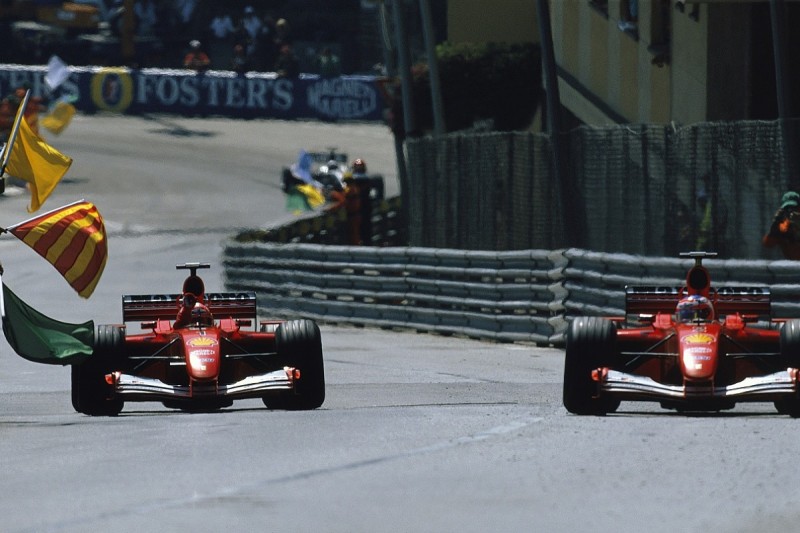
Chassis F2001 211, in which Schumacher claimed the last of his five Monaco victories and secured his second Ferrari title with victory in Hungary, boasts some provenance. No wonder the buzz is building around its impending auction in November, courtesy of Sotheby's in New York.
Even without its coat of Marlboro-influenced high-vis version of Ferrari red, it would still be instantly recognisable as a member of F1's most successful racing car family. A tweak designed to grab back downforce made this the first car to use a Ferrari signature 'droop-snoot' nose thanks to demand for higher mounted front-wing assemblies, while its modest barge boards, swept 'coke-bottle' rear and periscope exhausts extended a likeness born with the F300 in 1998.
Designer Rory Byrne and his engineers had nailed this generation of F1 car, and they knew it. Refining excellence rather than 'eureka' moments of innovation was the objective, so it was no surprise when, by mid-season, it became clear they had clawed back all the downforce the new regs had sought to take away.

They'd even defeated the FIA's desire to keep driver aids such as traction and launch control at bay, using clever (and legal) electronic engine maps that mimicked the behaviour of such systems.
By the Spanish GP of 2001, the governing body had raised the white flag: to the dismay of purists, traction and launch control were officially back (although, in effect, they'd never left), a decision that only added smoke to the flames of conspiracy about Ferrari's off-track influence.
Schumacher won in Australia and Malaysia, but Adrian Newey's McLaren MP4-16 hit back with victory for David Coulthard in Brazil, while Williams' Juan Pablo Montoya inspired hope that Schumacher had a new nemesis to shake Ferrari's apparent world order.
Montoya's pass on Michael into Turn 1 at Interlagos sparked delirium, then next time out at Imola, the 'other' Schumacher, Ralf, took a breakthrough win in the Williams FW23. With Michelin back in harness to create a tyre war with Bridgestone, perhaps this wasn't a foregone conclusion after all.
New-found Ferrari consistency, at least for Schumacher, would prove the lie to those hopes. When David Coulthard's launch control spoilt his pole and team-mate Mika Hakkinen's Merc engine let go in Monaco, Michael took chassis 211 to victory. Thereafter, the hoped-for title battle lost its bounce. Coulthard gave his best, but Hakkinen was a shadow of the man who'd defeated Schumi and Ferrari so stylishly through '98 and '99.

Ralf Schumacher won three times for Williams, while Montoya defeated Ferrari on their home turf. It didn't matter. Schumacher and Ferrari were champions again, Michael 58 points clear of runner-up Coulthard, with nine wins from 17 races. As for Rubens Barrichello in the second Ferrari, he was learning the reality of a team centred around a lead driver.
For Schumacher, only Ayrton Senna's pole record of 65 and Juan Manuel Fangio's world title mark of five remained untopped. From here, he'd take the F2001 to one final win at the Australian season-opener of 2002, before Byrne's new car handed him another level of dominance. A record 11 wins and finishing first or second in every race bar one let him equal Fangio's title tally by July.
At least 2003 would be closer: eight drivers won races and Schumacher's sixth title wasn't clinched until the final round. But the era closed the following season when Schumacher won 11 of the first 12 races. That seventh title capped everything that had come before.
In the context of his 2013 skiing accident, remembering Michael at his awe-inspiring best, in close-to-perfection F1 cars such as this, is entirely correct. The man and the era that came to define him were far from unblemished but, as the years skip by, the resonance of the F2001 211 and her sisters will deepen. It was our privilege to be there.

Ferrari F2001 specification
Chassis Moulded carbon-fibre and honeycomb composite
Front and rear suspension Pushrod activated torsion springs
Wheelbase 4,460mm
Engine Ferrari Tipo 050 V10
Engine capacity 3000cc
Power 800-900hp @ 18,500rpm
Gearbox Seven-speed semi-automatic sequential
Tyres Bridgestone
Weight 600kg
Notable drivers Michael Schumacher, Rubens Barrichello
Race record
Starts 20
Wins 10
Poles 13
Fastest laps 3
Other podiums 14
Retirements 8
Points 193

How Ratzenberger beat the odds to realise his cruelly short-lived F1 dream

F1 uncovered: A weekend behind the scenes with a chief mechanic

When McLaren was pipped by Red Bull in a modern F1 classic

The big opportunity Sainz’s Williams switch affords to F1’s latest centurion

Inside the science of F1 fuel

How F1’s plan for rotating races could look in practice

The early decisions that set Sauber’s rookie for success

How F1 media coverage has evolved in line with its subject

Mercedes has a Russell-sized problem and it is sharing responsibility

Phillips wins inaugural GB4 Winter Series in dramatic circumstances at Snetterton

Rally US host city announced ahead of WRC return

The role Friday practice played in Hamilton failing to achieve a podium at the US GP
Subscribe and access Autosport.com with your ad-blocker.
From Formula 1 to MotoGP we report straight from the paddock because we love our sport, just like you. In order to keep delivering our expert journalism, our website uses advertising. Still, we want to give you the opportunity to enjoy an ad-free and tracker-free website and to continue using your adblocker.


Top Comments