


The feisty defiance that characterised an F1 grafter-turned winner
Sir Frank Williams – who died recently, aged 79 – overcame threadbare beginnings to become a grand prix great. MAURICE HAMILTON knew Frank for over four decades, even lap-charting Keke Rosberg’s 1982 Formula 1 title-winning race for the Williams team, and pays his personal tribute to a giant of modern F1
Frank Williams and I grew up together. Not in the sense of boyhood friends, but as wannabe members of the Formula 1 establishment; Frank as a respected entrant, me as a journalist. During the time I was a salesman in the early 1970s, Frank was also using fast talk to inveigle money from whoever might help him go racing with a variety of cars that retired more often than they finished. But I’d seen a rare exception at first hand when a keen fan in 1975.
My weekends were spent going to motor races, with grands prix high on the agenda if they were within reach. The Nurburgring was always a favourite, particularly since it was easy to blag your way into the paddock once the race had finished. In 1975, I witnessed universal delight as the F1 world descended on the Williams truck to congratulate Frank and Jacques Laffite for finishing second in a car which, given the nature of the Nordschleife, had defied all logic by holding together for 14 punishing laps.
The fact that Laffite was a minute and a half behind the winner didn’t matter; a Williams driver was on the podium for the first time since the heady days of Piers Courage in a privately entered Brabham in 1969.
Frank seemed stunned as he stood quietly to one side and accepted the heartfelt congratulations with a broad smile but very few words. The obvious affection was because everyone knew what Frank had been through following the devastating loss of his dear friend Piers at Zandvoort in 1970. There was also the thought that the six points would be enough to guarantee all-important FOCA travel subsidies which would be worth £150,000 in 1976. Plus, he had won £5,000 in a single afternoon.
The truth was, however, that the prize money would scarcely touch the sides of a financial drain lined by creditors. When Frank got back to London Heathrow after that race, he had to borrow enough money to get his Porsche 911 out of the car park. Despite the hardships, Frank believed that driving a smart car presented the right impression; a Williams rationale with which Bernie Ecclestone had become familiar. Bernie owned Brabham and he also had an interest in a company that rebuilt the Ford-Cosworth DFV engines run by Frank.
“Frank would come in for a chat,” said Ecclestone. “He would say, ‘Bernie, can you lend me £5,000?'. And I would say, ‘Sure, Frank. No problem,’ and give him a cheque for £5,000. Whatever the day was – two weeks, three weeks – whenever it was time for Frank to repay, he would be there with a cheque for £5,000. He would put it on the table and say, ‘Thanks a lot; it’s really helped me. Could you do me a favour?’ Sure, what is it Frank? ‘Could you lend me £7,000?’
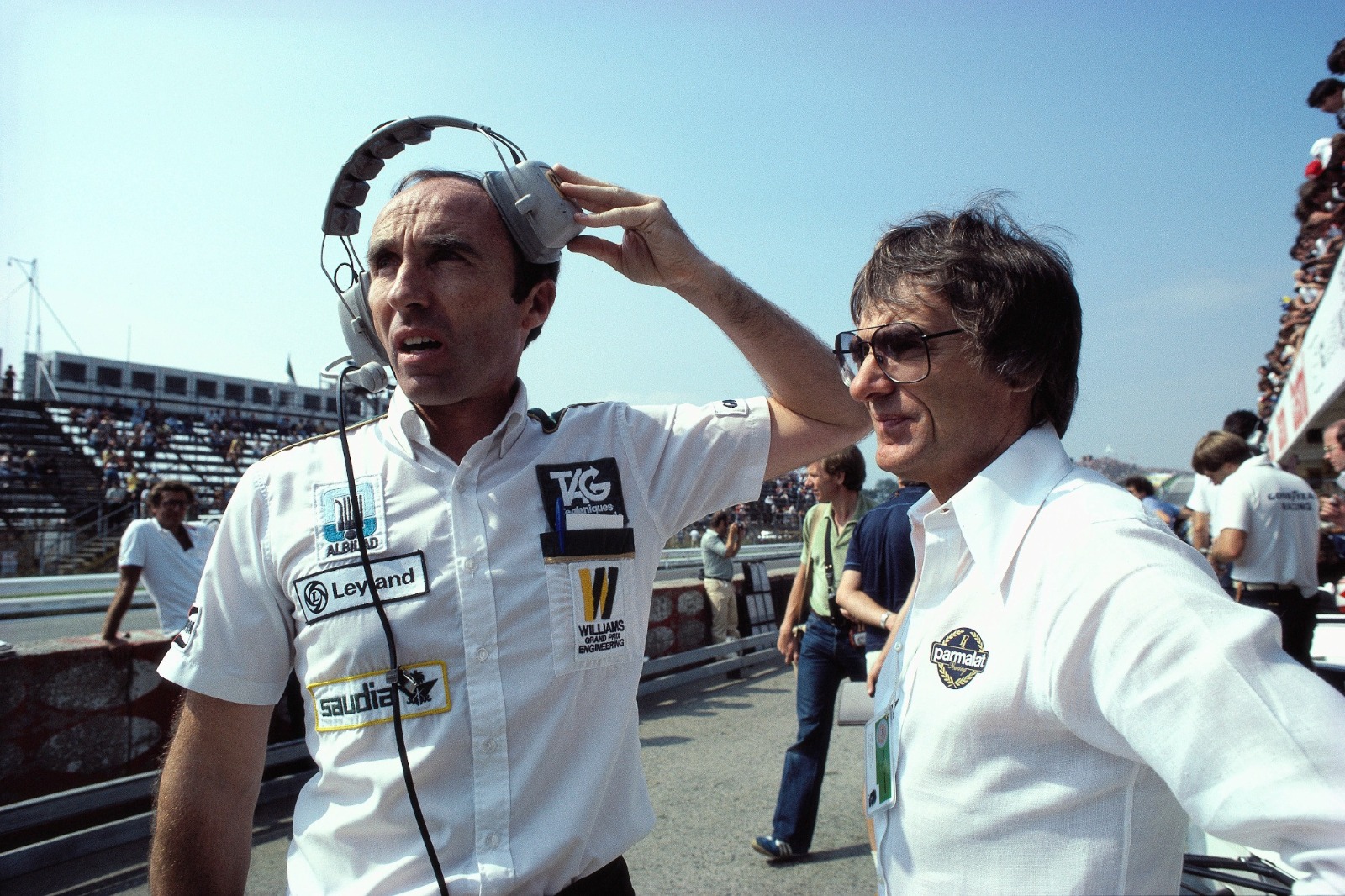
Williams often struggled for money in the early days, but rivals including then Brabham boss Ecclestone were willing to help him out
Photo by: Motorsport Images
“So, he would get a cheque for £7,000. And this went on for a long time. He would take the cheque and immediately go to [London’s] Fulham Road and buy himself some cashmere socks or a cashmere sweater or an expensive shirt. That was Frank.”
The off-the-shelf Ford-Cosworth DFVs powered 92% of the grid in 1975. The original concept for the V8 had been funded several years before by the Ford Motor Company, under the guidance of Walter Hayes. As head of public relations (and later as vice-chairman of Ford of Europe), Hayes could see the value of a strong motorsport connection as he kept a fatherly eye on anyone associated with Ford.
“I used to lend Ford Anglia vans to Frank from time to time – and he would sell them,” said Hayes. “That’s how he raised money to survive. It was the sport’s currency at the time. ‘We need money to go motor racing,’ he would say, ‘and so we get it any way we can.’ If you had brought in someone from outside and they had seen what was happening, they would have said, ‘You can’t let him do that with your property. It’s illegal.’ For people like Frank, we didn’t see it that way.”
This was not so much about getting down to the nitty-gritty of how the race was won but more a simple but very emotional celebration. This was a timely achievement by the quietest but feistiest of fighters
I gathered the foregoing quotes from Ecclestone and Hayes three decades after taking the plunge and quitting my sales job in 1977. Co-incidentally, that was the year Frank finally started to come good. I found myself learning the ropes as an F1 reporter while closely following the birth and dynamic growth of Williams Grand Prix Engineering. I don’t recall formally meeting Frank, but I clearly remember being invited to a former carpet warehouse in Didcot on a sunny morning in December 1977.
Insight: How Williams restarted his F1 team from scratch after Wolf split
Billed as the launch of Williams’ latest grand prix challenger, this was treated with some scepticism, based on Frank’s threadbare ventures during the previous seven years. But from the moment the 20 or so reporters stepped inside his new headquarters, they were aware of a tangible difference; a buzz of energy and purpose within a small but immaculate workshop.
At its heart sat the FW06; the first of many cars to come from the drawing board of Frank’s new associate, Patrick Head. Completing this hungry triumvirate and resplendent in fresh, white driving overalls, Alan Jones shared the welcome to what was clearly a major moment for his new boss.
Dressed in a Doug Hayward two-piece suit with a broad striped tie, Frank – noticeably more hyper than normal – was stirred into demonic action by the beat of a helicopter’s rotor overhead. Throwing open the back doors of the workshop, he watched a helicopter land on a nearby football pitch. On board was a party of four from the airline, Saudia, including its director-general, Sheikh Kamil Sindi.
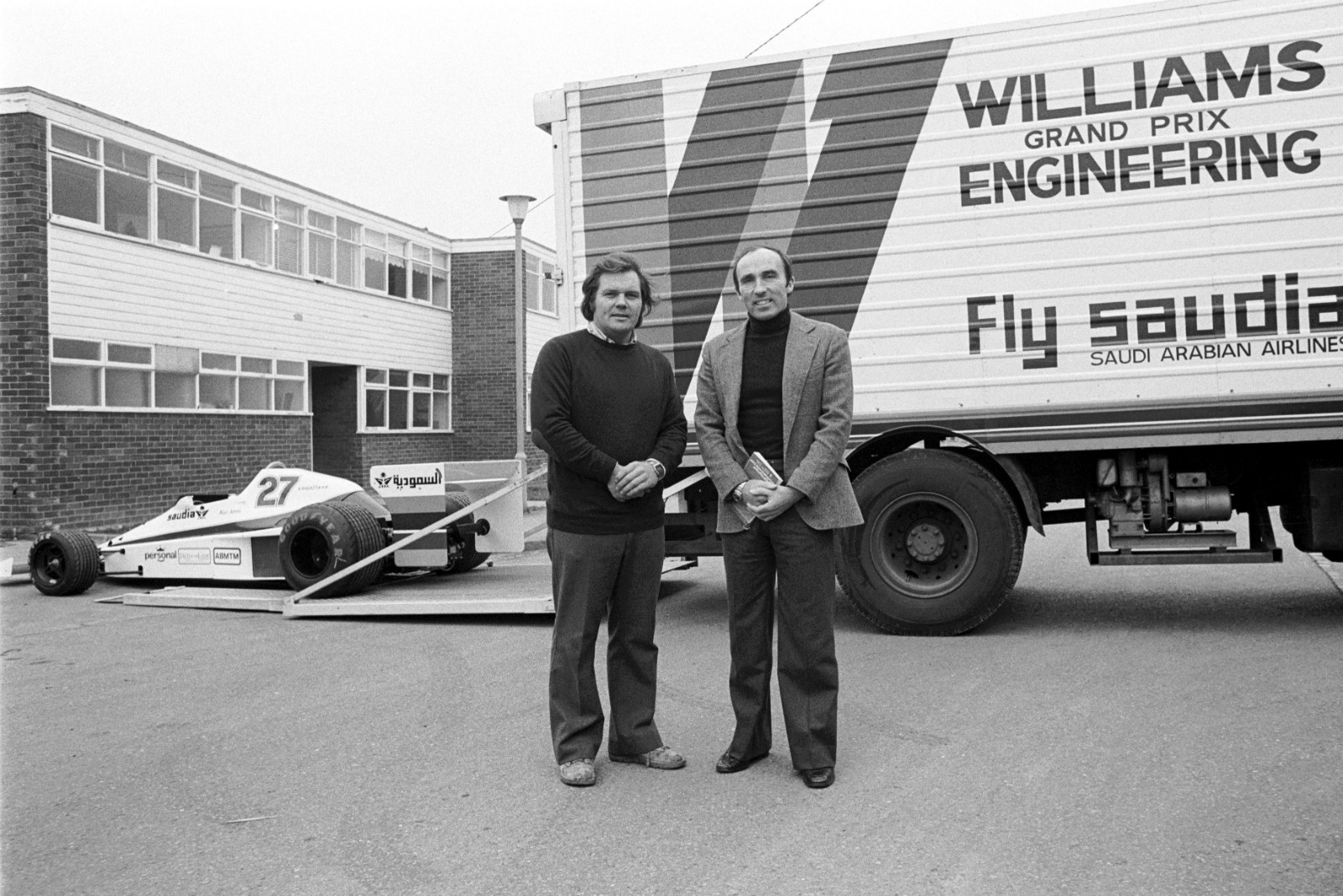
Williams became a player in 1978 with the FW06, before becoming a winner the following year with the FW07 at Silverstone
Photo by: Motorsport Images
As Frank buttoned his jacket and prepared to walk towards the temporary landing pad and receive such significant sponsors, he seemed to realise that his media guests could recite enough horror stories to have the Saudis feel the urgent need to catch the next plane home. Turning briefly towards the assembled company, he winked and said, “Don’t let me down lads,” and then flashed that winning smile. Had references been asked for on the spot, Frank would have been embarrassed by the depth of genuine affection and warmth on that chilly morning.
If the FW06, a car that was as soundly engineered as it was straightforward, did enough to make Williams a serious and consistent runner in 1978, the FW07 would eventually sweep the team to the next level halfway through the following year. Frank’s first win could not have come at a better place than Silverstone. The entire place, it seemed, wanted to share his joy.
Insight: The genesis of an F1 great
There was no official winner’s press conference then, but someone had the bright idea of having Frank come to a marquee at the back of the paddock. He looked as stunned as anyone might when post-race procedures in the past had often amounted to scouring the paddock for a £50 loan to buy enough diesel to get the team truck home. This time, there were tears in his eyes as he quietly and repeatedly murmured ‘thank you, thank you so much’ to the many well-wishers keen to shake his hand. Someone gave him a whisky, and another lit a cigar. He gamely tackled both despite being teetotal and a non-smoker. This was not so much about getting down to the nitty-gritty of how the race was won but more a simple but very emotional celebration. This was a timely achievement by the quietest but feistiest of fighters.
And one of the calmest, too. Frank had shown not a flicker of emotion during the race when Jones had lost an easy lead due to a water leak, leaving Clay Regazzoni in charge in the other Williams. At no stage did Frank reveal concern that Regazzoni might succumb to the same failure. He had remained focused on the lap chart kept on his knees as he sat by the pit wall. In the absence of computers, lap charting was the only way to maintain the full picture as the race evolved, Frank using this information to formulate instructions for the pit signals shown to his drivers. This was Frank’s principal race day role. With one exception.
At the end of a bizarre year that would feature no fewer than 11 different winners, the 1982 championship boiled down to a three-way fight in Las Vegas, with Keke Rosberg in the running for Williams. Longines provided very small black and white timing screens for the teams, but there was nothing for journalists. The only way to follow the race was to stand trackside with a lap chart.
I received a message to visit Frank in the Winnebago motorhome allotted to his team. With so much at stake, Frank wanted to hold a roving brief at the pit wall and, rather than rely totally on the sometimes-unpredictable timing screen, he asked if I would keep the team’s lap chart. On the one hand, I welcomed the opportunity since the Williams pit was normally out of bounds to the media; I would be right in heart of the championship story. On the other hand, I was terrified of screwing up on such an important occasion.
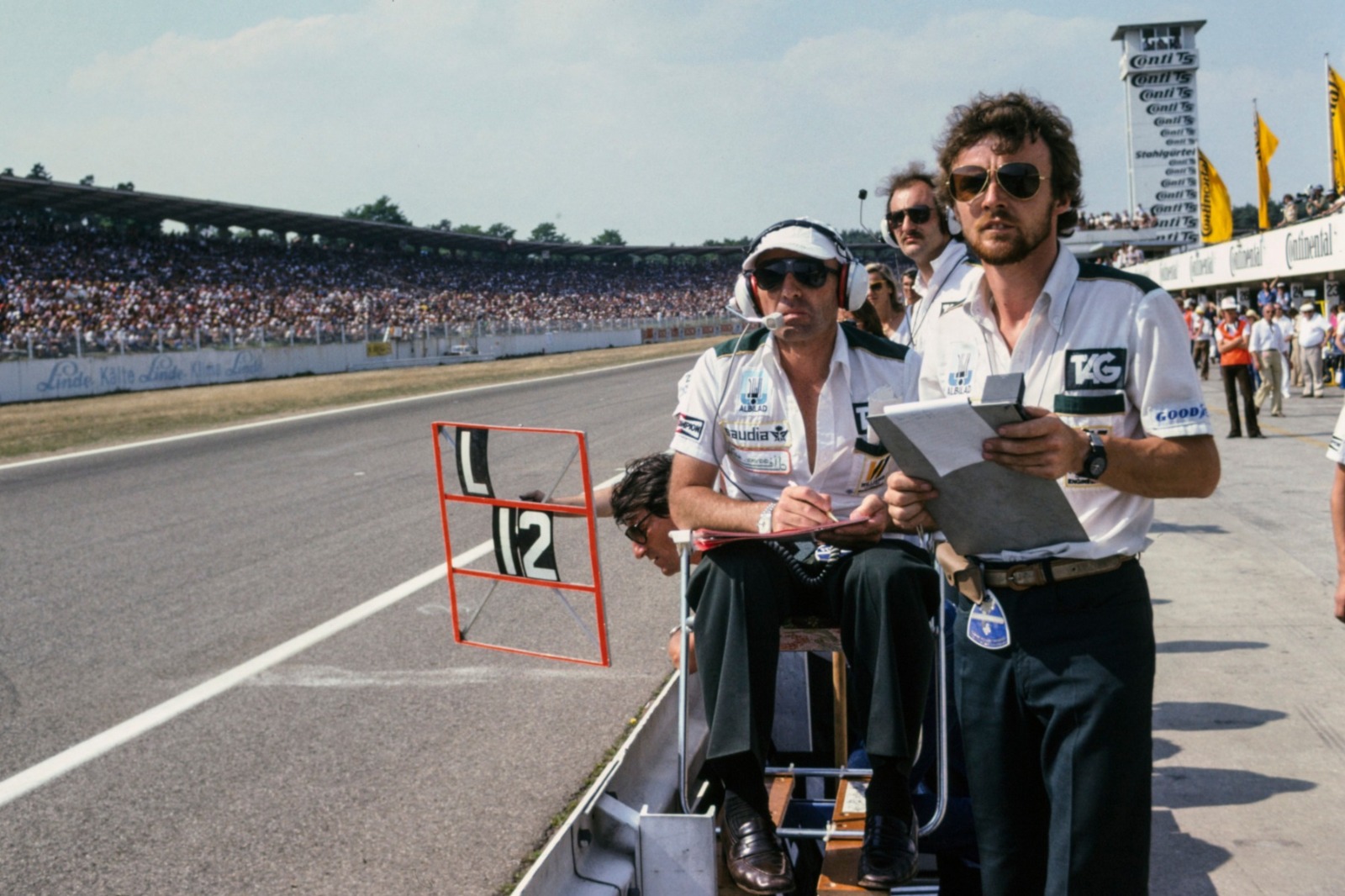
Attention to detail was important for Williams, who lapcharted races himself - only divulging the duty to Hamilton for Las Vegas 1982
Photo by: Motorsport Images
On race morning, as I was passing his motorhome, Frank called me inside. “Will you be all right?” he asked with what I thought was more anxiety than I really needed to feel. When I replied in the affirmative and showed him my prepared lap chart, he handed me a sheet of A4 paper.
“I find this useful,” he said. “You’ll need it for scribbling down the numbers when they come by in tight formation at the end of the first lap. Then you can transfer them neatly to your lap chart before they come round for a second time.”
Keeping the piece of paper I had already assigned for that task in my back pocket, I said thanks and reassured Frank everything would be OK. He nodded and ticked ‘Maurice – lap chart’ off a long list. Such attention to fine detail would undoubtedly help Rosberg win the championship.
Archive: The "cheapest" world champion opens up
The precise regime that governed every aspect of Frank’s life would be cruelly broken – along with his spine between the fourth and fifth verterbrae – during the accident when his hire car left the road in the south of France on 8 March 1986. I was lucky enough to be one of the first to interview him the following January, not long after he had begun trying to form a regular work pattern at the team’s new headquarters in Didcot’s Basil Hill Road. I didn’t know what to expect. I found Frank utterly defiant, despite such a crippling handicap.
"The frustration is almost unbearable. It is without a doubt the biggest setback to come to terms with" Frank Williams
“You see me now, fiddling around, shifting about, still very uncomfortable,” he said, matter-of-factly. “I don’t have anything working below my armpits. The problem is that all I can move is my shoulders, neck and arms – so they are grossly overworked. They ache like fuck all the time.”
Taking such typical candour as a cue, I moved the conversation into an area which I knew was likely to affect him most. Frank had a reputation for not wasting a single second of his day. It had been a standing joke among team members that he had worked out it took something like 19 minutes from the moment he got out of bed, to shower, shave, dress and be waiting in the hotel lobby with his briefcase, ready for a day at the race track. The irony now was that the straightforward business of getting up and mobile in the morning – something which, ironically, most people detest – was a daily routine Frank would have loved to have achieved with his former dexterity.
“The frustration is almost unbearable,” he said. “It is without a doubt the biggest setback to come to terms with. I don’t want to go into sordid details but everything – being lifted out of bed, put in the bath, being shaved, dressed, put in my chair, taken from the chair and strapped into the lift which runs down the stairs, put back in the chair, even putting my tie on – everything seems to take forever. Going to bed isn’t so bad. You’re more placid then, a bit tired and ready to sleep. That operation only takes about 30 minutes…”
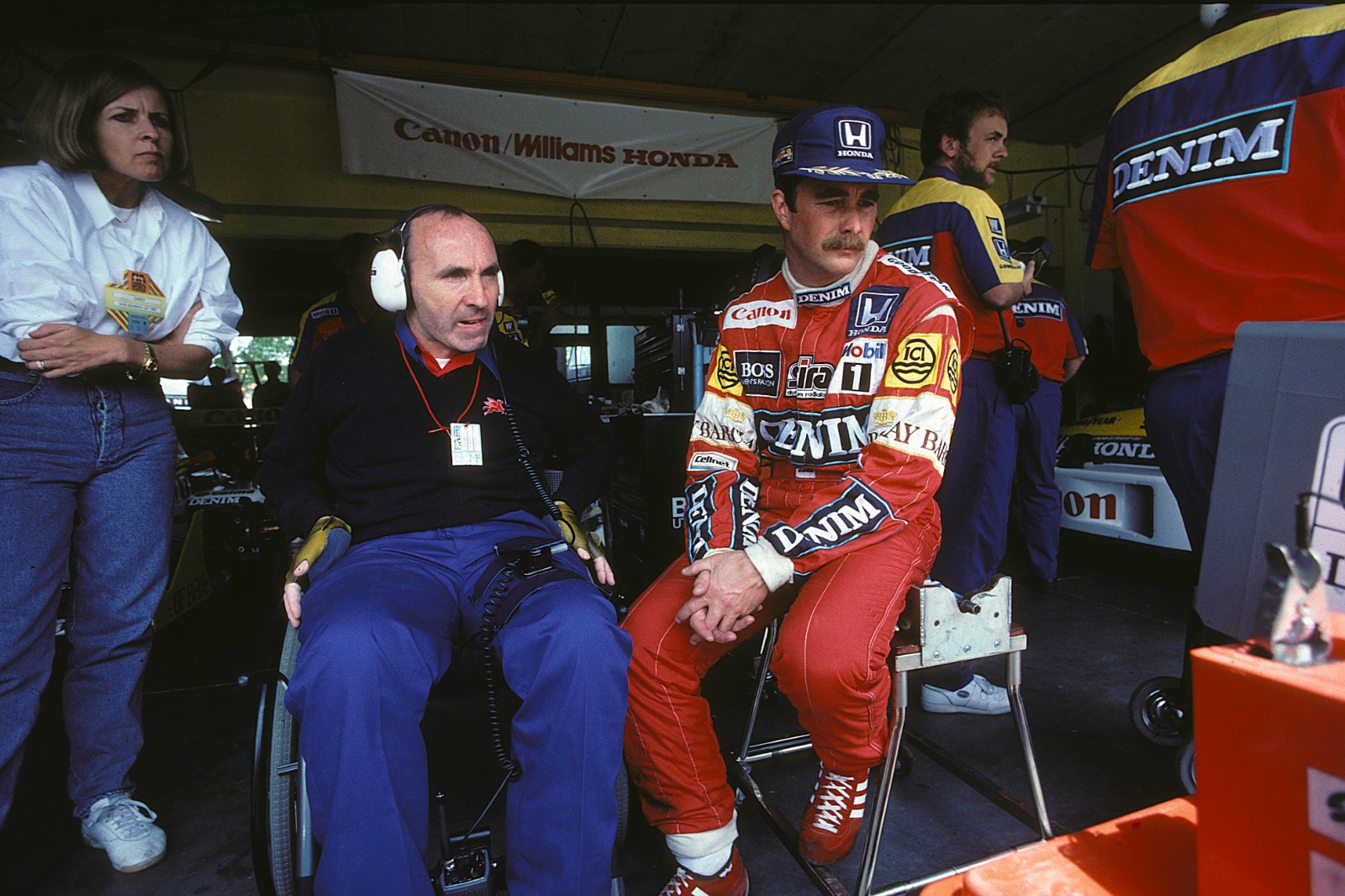
Williams continued to run the team from his wheelchair, despite daily frustrations
Photo by: Motorsport Images
Frank made no excuses for the cause of his life-changing injuries on a rural stretch of road between Paul Ricard and Nice airport.
“I’m very lucky to be here, to have this company full of wonderful people to run, to be able to afford the necessary care. A lot of people in my position don’t have that. I shall have a normal life expectancy, less a few years. I was going to live until 80 anyway, so I shall live to 70 – 75, unless I’m careless.
“What I’m saying is that maybe I’ll be dead in five years, but I don’t believe that. And even if that turns out to be the case, I’ll have no regrets. I met a 16-year-old boy recently with much worse injuries than I have; absolutely terrible. I may have all this aggro now, but I’ve had a good life and mean to continue it for as long as I can. So, let’s get on with it.
“Anyway, enough of that. D’you know what spec engine Prost was running when he did that quick time at Estoril yesterday?”
Obituary: Frank Williams
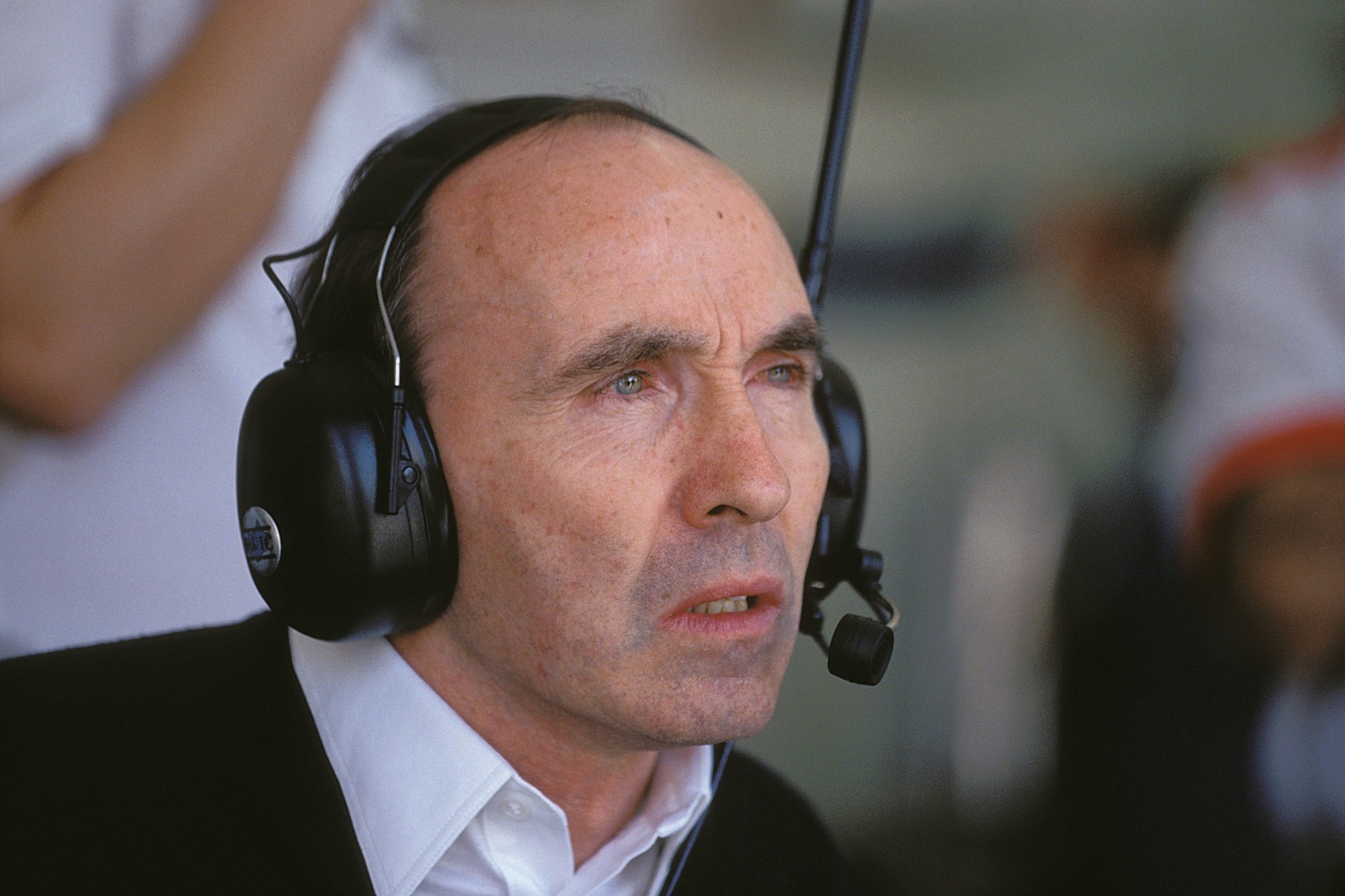
Williams passed away aged 79 last month, drawing tributes from around the world
Photo by: Motorsport Images

How Ratzenberger beat the odds to realise his cruelly short-lived F1 dream

F1 uncovered: A weekend behind the scenes with a chief mechanic

When McLaren was pipped by Red Bull in a modern F1 classic

The big opportunity Sainz’s Williams switch affords to F1’s latest centurion

Inside the science of F1 fuel

How F1’s plan for rotating races could look in practice

The early decisions that set Sauber’s rookie for success

How F1 media coverage has evolved in line with its subject

F1 United States GP live commentary and updates - Antonelli keeps lead

Pryce pips McRae in final stage showdown to win British Rally Championship

Dakar Rally moves 2027 event out of Saudi Arabia; new location to be announced

How both Verstappen and Antonelli were “surprised” in United States GP qualifying
Subscribe and access Autosport.com with your ad-blocker.
From Formula 1 to MotoGP we report straight from the paddock because we love our sport, just like you. In order to keep delivering our expert journalism, our website uses advertising. Still, we want to give you the opportunity to enjoy an ad-free and tracker-free website and to continue using your adblocker.


Top Comments