






The code of conduct debate prompted by the Alonso/Raikkonen marginal call
Fernando Alonso and Kimi Raikkonen's clash in Austin has thrust the debate about rights and wrongs of wheel-to-wheel combat firmly into the public spotlight, prompting complaints about the Formula 1 rules process. But what can the FIA do to prevent the issue resurfacing?

Fernando Alonso has been fun to watch this year: not only for his exploits on track but also for the manner in which he has probed, pushed, exploited and exposed inconsistencies in the Formula 1 rules process.
Never a driver to simply sit back and accept things he thinks are wrong, his memorable deliberate running across the Turn 2 run off at Sochi proved how much of a campaigner he was for his own beliefs.
But, having addressed the issue of drivers gaining at first corners by not respecting track limits, Alonso’s clash with Kimi Raikkonen in Austin last weekend has now thrust the debate about rights and wrongs of wheel-to-wheel combat firmly into the public spotlight.
Alonso was aggrieved that Raikkonen got past him in their fight for points by going around the outside of him at Turn 1 and using the kerbs on the exit. For Alonso, that Raikkonen overtook him off track was a clear breach of the rules that were laid down by the FIA over the weekend.
With some sausage kerbs at that location having been removed on race morning, revised notes from F1 race director Michael Masi were explicit.
Turn 1 was added to the list of corners where: “a driver will be judged to have left the track if no part of the car remains in contact with the track.”
It further added that: “The driver must only rejoin the track when it is safe to do so and without gaining a lasting advantage.”

Fernando Alonso, Alpine A521
Photo by: Andy Hone / Motorsport Images
However, a subsequent clause that proved important in this case was: “The above requirements will not automatically apply to any driver who is judged to have been forced off the track, each such case will be judged individually.”
It was that subjective element which came into play at this moment, as the stewards deemed that Raikkonen had only run wide there because he had been forced wide.
The call was, according to Masi ‘marginal’, but it still came down on the side of Raikkonen in that he had nowhere to go.
As Masi explained later: “The forcing off scenario and the overtake scenario we will discuss at the next drivers’ meeting as it is far from a black and white scenario in that situation.”
It was that subjective element which came into play at this moment, as the stewards deemed that Raikkonen had only run wide there because he had been forced wide
Alonso, of course, did not buy the argument that he had forced Raikkonen wide. He was eager to point out afterwards that the very nature of racing means the car on the inside will always force a rival wide if the other driver does not choose to concede position.
“In a way, you always force a guy to go off track when you brake on the inside: you commit to an overtaking,” he said. “And they [the driver on the outside] need to decide if they back off, or keep the full throttle off the track outside the circuit.
“It is what [Carlos] Sainz did. [Antonio] Giovinazzi did, I did. And we have to give back the position for sure, because you are running full throttle off track. But Kimi didn't. So that's why I felt that it was not consistent.”
The biggest issue here is that for a championship that is so meticulous with everything, when it comes to judging incidents between drivers over who has the right to a piece of track and who needs to back off, there is no hard and fast document detailing it.

Fernando Alonso, Alpine A521, Mick Schumacher, Haas VF-21, and Lance Stroll, Aston Martin AMR21
Photo by: Steven Tee / Motorsport Images
The only proper reference in the rules about overtaking and defending is tucked away in Chapter 4 of Appendix L International Sporting Code relating to a code of driving conduct on circuits.
It states: “Overtaking, according to the circumstances, may be carried out on either the right or the left. A driver may not leave the track without justifiable reason. More than one change of direction to defend a position is not permitted.
“Any driver moving back towards the racing line, having earlier defended his position offline, should leave at least one car width between his own car and the edge of the track on the approach to the corner.
“However, manoeuvres liable to hinder other drivers, such as deliberate crowding of a car beyond the edge of the track or any other abnormal change of direction, are strictly prohibited. Any driver who appears guilty of any of the above offences will be reported to the Stewards.”
It’s a start but it certainly does not deal with the type of incidents we have seen repeatedly these days, of the dispute being over who has the right to a corner.
And could it even be argued that if the FIA felt that Raikkonen was in the right because he had been forced off track, then surely Alonso was in the wrong for ‘deliberate crowding of a car’? Imagine punishing him for that...
What is completely missing is a crystal clear definition of when a driver overtaking a rival on corner entry has earned the right to be left an entire car’s width on the exit.
But for Alonso, when asked about having a more detailed code of conduct after the Austin race, he reckoned that the rules were clear enough already.

Fernando Alonso, Alpine and Kimi Raikkonen, Alfa Romeo Racing in the drivers press conference
Photo by: FIA Pool
"No, I don't think that we need anything," he said. "The rule is very clear. We just need to put in place the rules. I think when you go in football, and you take the ball inside the area with a hand, it is a penalty. So there is no clarification of the rule [needed].
"You just need to take the decision and say that this is a penalty. Because if not, everyone will be inside the area with the ball in his hand.
"We don't need any modification. We just need to implement the rules when it [an offence] happens."
While he has a point, the biggest difficulty is that it still seems to be a subjective call on whether or not an attacking driver has earned the right to a corner.
Alonso is correct that a driver on the outside has the choice to keep his foot in and run off track in his attempt to battle it out, or back off and concede the place.
While he has a point, the biggest difficulty is that it still seems to be a subjective call on whether or not an attacking driver has earned the right to a corner
But he is racing for that position just as much as the driver on the inside, and there comes a moment where the car on the inside has to lose the right to take the whole track and needs to give some ground on the exit.
It is exactly the same issue that has surfaced over the many incidents between Lewis Hamilton and Max Verstappen this year, as they have agreed to disagree over their clashes at Silverstone and Monza.
After Monza in particular, where the debate hinged on who had the right to which part of the chicane, the gist was that Verstappen was to blame because he had not been during any point of the battle: “any further forward than just behind the front wheel of Car 44.”
So if Verstappen’s front wheel had been fully alongside Hamilton’s, would that have been enough to win the corner? Or would it need to be fully ahead? There is nothing in the rules that explain that.
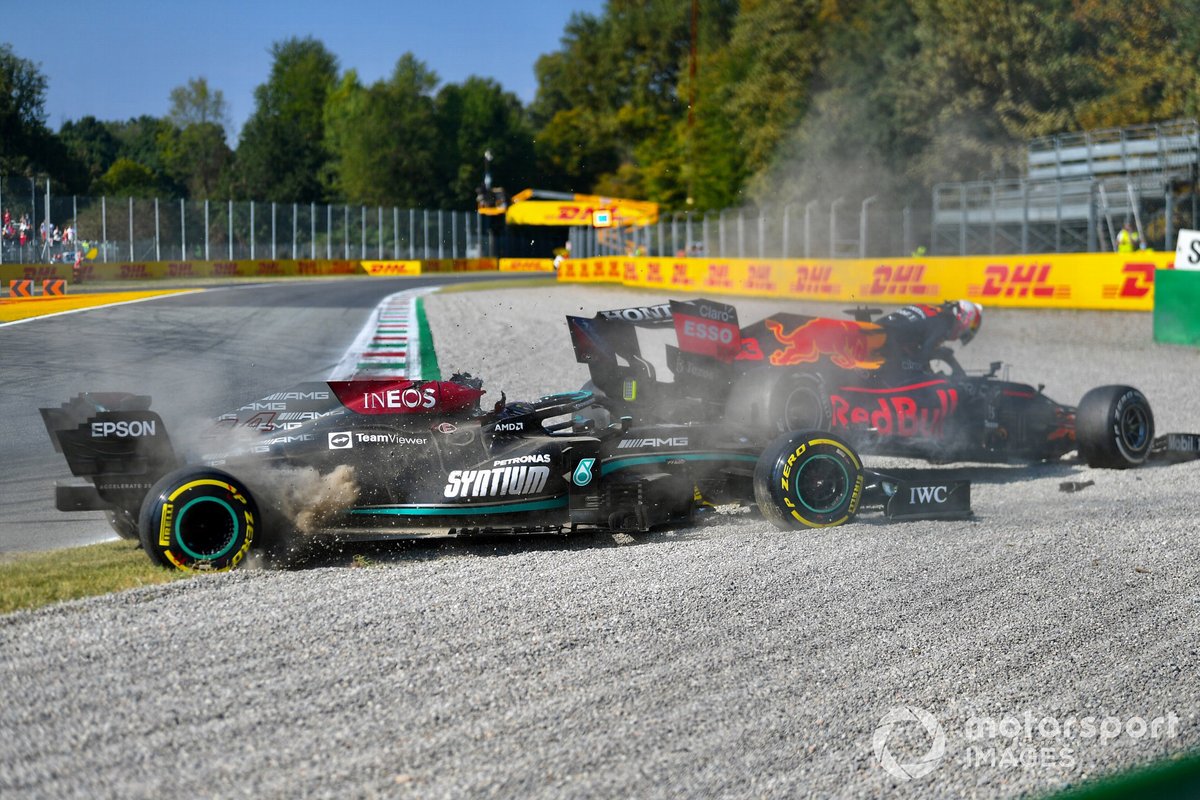
Lewis Hamilton, Mercedes W12 and Max Verstappen, Red Bull Racing RB16B collide
Photo by: Jerry Andre / Motorsport Images
F1 drivers and fans would almost certainly be helped if there was an official document explaining just how far forward a driver needs to be when attempting an overtaking move before he is owed some track in a battle.
The closest we have come to that was the document that Mercedes boss Toto Wolff sent to Masi after the Verstappen/Hamilton crash at the British GP.
The guidance, which it later emerged was sent to Mercedes by former F1 race director Charlie Whiting back in 2015, was offered as guidance on what the FIA stewards’ approach is to ruling on who has the right to corners.
The document asked for the driver on the outside: “Have I got fully alongside?”
If the answer was yes then it says: “You have a right to the corner – the other driver must leave you room.”
In Raikkonen’s case, video footage of the incident shows that Raikkonen got quite a way up the outside of Alonso – with his front wheels nearly completely alongside the Alpine’s at one point.
So the incident would come down to the definition of what ‘fully alongside’ means. Do the wheels have to be completely alongside to the nearest centimetre, or is failing to do that by a little bit enough for it not to count?
The crux of the issue is just how fully alongside is fully alongside?
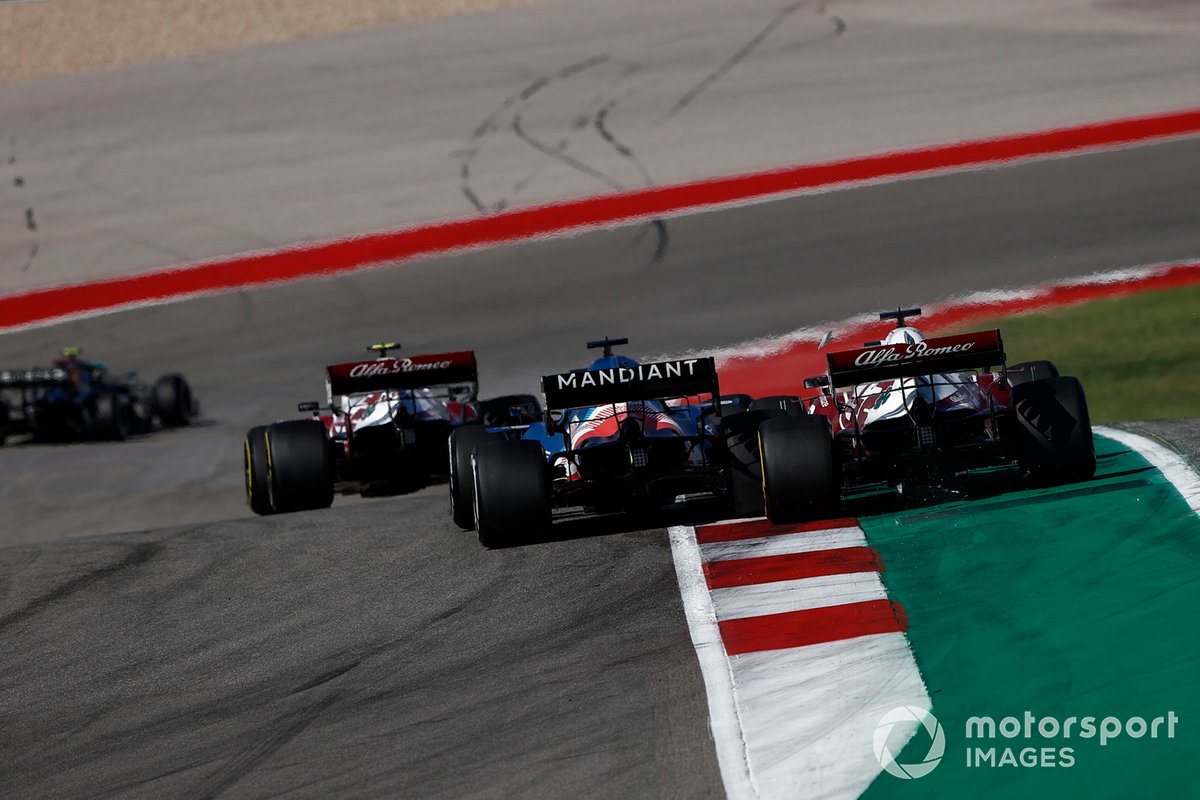
Antonio Giovinazzi, Alfa Romeo Racing C41, Fernando Alonso, Alpine A521, and Kimi Raikkonen, Alfa Romeo Racing C41
Photo by: Andy Hone / Motorsport Images
Raikkonen himself felt he had every right to the corner and that Alonso should have given him room.
“I mean I braked there and we touched and I had to go off,” he said. “If I'd just kept the line that I was going we'd have had a much bigger touch and crash. I'm sure he had a big space on the inside. What the stewards say, it doesn't matter.”
Alonso told several media outlets immediately after the race that the situation – and the lack of consistency between what happened with Raikkonen and other incidents in the race when drivers had to give up position – was bad for fans.
“They saw a show that they didn’t deserve,” he said.
There surely has to be a point at which the car making the attack on the inside or the outside has earned that right. So why isn’t there a rule defining it?
That Masi does plan talks with the drivers in Mexico next week to discuss the rights and wrongs of the Raikkonen incident will be welcome in at least (hopefully) providing some clarity to the drivers in better understanding what is and is not allowed.
But in a series that has such detailed access to onboard cameras, GPS traces, and trackside cameras, at all moments, it would surely be a positive for everyone if there were hard and fast driving etiquette rules about who has the right to a corner in fights.
There surely has to be a point at which the car making the attack on the inside or the outside has earned that right. So why isn’t there a rule defining it?
A clearer definition of that line would make it easier to understand, the decision making process of the stewards’ more understandable and remove some of the controversies that come when drivers think they have been wronged.
Even Alonso might agree with that.

Antonio Giovinazzi, Alfa Romeo Racing C41, Fernando Alonso, Alpine A521, and Kimi Raikkonen, Alfa Romeo Racing C41
Photo by: Andy Hone / Motorsport Images


Brundle awarded OBE in King’s New Year’s honours

The new rules dilemma that will define the 2025 F1 season

Verstappen issues Red Bull title warning in push for RB21 progress

Mercedes opens up on the factors that hurt Hamilton with the W15

How McLaren faced up to the misinformation, noise and distractions of being an F1 title challenger

Why Bottas is not letting the “worst-case scenario” end his F1 career

Jon Noble: An unfair perception or a genuine concern? Lifting the lid on Red Bull’s Tsunoda scepticism

Binotto on Audi's F1 reality check after finding team "frozen" with no plans

Top five roles on Motorsport Jobs this week

Champions crowned at incident-filled Donington Park 750 Motor Club meeting

Why Toyota’s 2026 WEC triumphs have put it into the all-time greatest endurance racing team debate

Cobra is King while battle for second rages in Silverstone Pall Mall Cup contest
Subscribe and access Autosport.com with your ad-blocker.
From Formula 1 to MotoGP we report straight from the paddock because we love our sport, just like you. In order to keep delivering our expert journalism, our website uses advertising. Still, we want to give you the opportunity to enjoy an ad-free and tracker-free website and to continue using your adblocker.


Top Comments