


The Cadillac calculus F1 has made that weighs up $450m today vs billions tomorrow
Cadillac’s arrival in Formula 1 has overcome many barriers, chiefly a $450m dilution fee split between the existing 10 teams. On paper it is a cut-price deal that will leave teams short-changed, but it hinges on a greater return on investment for the entire grid over the coming years
Autosport Business
Covering industry news and insight into the business of motorsport
Formula 1 teams agreed to accept $450million to welcome Cadillac onto the grid in 2026 - the highest entry fee in the championship's history. On paper, it looks like a windfall, but in practice, it is a down payment on permanent dilution.
Split 10 ways, the fee delivers $45m to each existing team as compensation for what comes next: an 11th entrant permanently dividing F1's prize money. With an annual prize pool of roughly $1.27billion, the mathematics are straightforward. Within a few seasons, the one-off payment is eclipsed by lost revenue, after which the dilution continues indefinitely.
Either F1's sharpest commercial minds have miscalculated, or they are betting on something the headline numbers fail to capture: that an American manufacturer joining the grid grows the overall value of the championship faster than it erodes individual shares of the annual prize pots and commercial income. Mercedes team principal Toto Wolff has been explicit: “The compensation fee, which is currently set at $450m, is too low. It does not make up for the direct loss in income.” On pure arithmetic, he is right.
The controversy cuts deeper than accounting. Should F1 remain an open competition where merit decides success, or a closed financial franchise? At $450m, grid access has become financial gatekeeping – a barrier with little connection to competitive merit.
F1 teams are now valued in the billions and owners who bought in for tens of millions have seen extraordinary appreciation. Against that backdrop, a reduction in already enormous profit margins seems reasonable for a fuller grid, given only 20 cars can feel sparse, while more teams mean more stories, more innovation, and a healthier overall championship.
This sentiment clashes with how businesses typically think, but it reflects a core belief many fans still hold: that F1 should reward ambition and ingenuity, not just financial muscle.
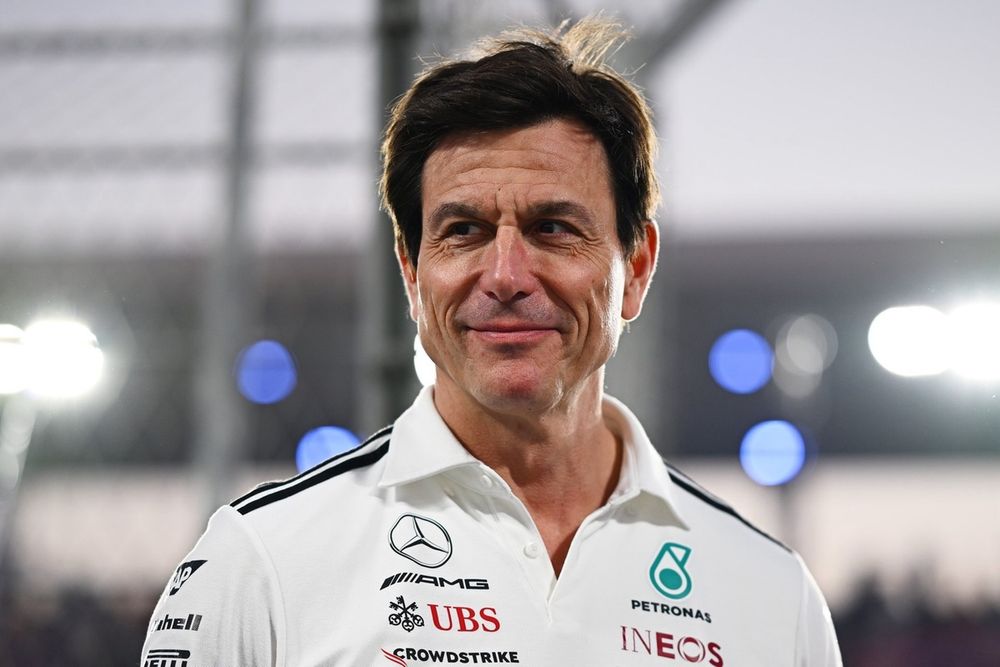
Wolff has highlighted the financial risk the F1 teams have taken with accepting Cadillac's entry
Photo by: Guido De Bortoli / LAT Images via Getty Images
Historically, that belief was not misplaced. Ferrari paid nothing to join in 1950. Red Bull acquired Jaguar Racing for a symbolic dollar in 2004. Brawn GP emerged from Honda's ashes to win both titles in 2009. The story of F1's most significant innovations coming from teams operating without establishment resources is one retold numerous times in different ways.
A closed shop makes such disruption far less likely. When entry requires nearly half a billion dollars before a car is designed, the series inevitably prioritises financial backing over creative engineering risk. Indeed, the teams' counter-argument is neither trivial nor cynical. They invested when F1's commercial future was uncertain, absorbing years of losses before valuations exploded. From that perspective, dilution without meaningful compensation feels like a penalty for success.
This is also why the bar for new F1 teams has been set so high in recent years, as not every new entrant can add value, while underfunded teams circulating at the back do little to enhance the spectacle.
The tension lies in F1's identity crisis; whether it remains a meritocratic constructors' championship or evolves into a franchised entertainment property
This is why Cadillac matters. F1 and its teams are not simply admitting an 11th entry; they are admitting General Motors – a factor so critical it kept the project alive when it appeared dead in the water amid the fallout with Andretti. The hope is that an American manufacturer with global scale, marketing reach, and deep pockets will do what smaller operations cannot – materially expand F1's footprint in the United States.
US viewership has grown by more than 130% since 2018, with average race audiences reaching approximately 1.3m in 2025. Formula 1 now claims a domestic fanbase of over 50m, while three US races generate close to $2bn in combined economic impact.
The strategic bet is that Cadillac will accelerate this trajectory. If its presence – through sponsorship, brand visibility, and manufacturer credibility – helps unlock the next tier of American media rights and sponsor diversification, the championship's total commercial value could grow enough for all teams to benefit despite diluted shares. Even a modest increase in American media rights or sponsorship revenue would quickly outweigh the losses associated with an extra team. That is the bet.

Haas arrived on the grid 10 years ago, but its impact hasn't been the driver of F1's rise of interest in the US
Photo by: Haas F1 Team
Yet the evidence against is stubbornly relevant. Haas has been on the grid since 2016, and while it provided an American flag, much of F1's US growth has come from Netflix's Drive to Survive and Liberty Media's aggressive promotion strategy. Cadillac may amplify that momentum, or it may simply arrive as a passenger on a trend already in motion.
Other sports offer precedent. Seattle's NHL franchise paid $650m to join a league with far less global reach than Formula 1. The tension lies in F1's identity crisis; whether it remains a meritocratic constructors' championship or evolves into a franchised entertainment property.
The real verdict will not come in 2026, but later in the decade. If Cadillac's presence helps secure significantly richer US broadcasting deals, unlocks new sponsor categories, and sustains rising team valuations, then the dilution becomes a tolerable cost of growth. If not, the teams will have traded long-term income for a one-off payment that covered only a few years of losses.
Wolff is mathematically correct that $450m does not compensate for permanent dilution. Yet Mercedes still signed the deal, as did every team. In doing so, each team acknowledged that F1's future value may depend less on protecting existing shares than on growing the pie itself. By the end of the decade, it will be clear whether Cadillac was the catalyst or the most expensive experiment F1 has ever run.

Cadillac's impact, and the wider success it brings, won't be known for a number of years
Photo by: Sergio Perez

Ferrari not yet switching focus to 2027 F1 car

The verdict on the WRC Rally Chile tyre solution

Top five roles on Motorsport Jobs this week

Quartararo explains why Yamaha relationship has strained ahead of Honda move
Subscribe and access Autosport.com with your ad-blocker.
From Formula 1 to MotoGP we report straight from the paddock because we love our sport, just like you. In order to keep delivering our expert journalism, our website uses advertising. Still, we want to give you the opportunity to enjoy an ad-free and tracker-free website and to continue using your adblocker.


Top Comments