


The anatomy of the last Williams F1 world title winner
It’s 25 years since a Williams F1 car last won a world championship. STUART CODLING examines the FW19
Almost 25 years have now passed since Williams last fielded a Formula 1 car worthy of winning a world championship. The sight of this team plying its trade at the tail of the field has become so commonplace that it’s almost strange to think of a time when the launch of a new Williams was a baton-passing exercise from one great car to another. As Jacques Villeneuve and Heinz-Harald Frentzen unveiled the FW19 early in 1997, anything other than dominance of the season to come would have been faintly disappointing.
The roots of Williams’ last championship-winning car ran deep. The team had got its design mojo back in 1995 after a 1994 season rocked by troubles with the car – by his own admission, design guru Adrian Newey fumbled the transition from active to passive suspension – and by the tragic death of Ayrton Senna. With FW16’s aerodynamic instability problem solved, the Williams FW17, 18 and 19 followed an evolutionary path to greatness – albeit one overshadowed by the ongoing legal ramifications of Senna’s death.
Newey, though, had long since cleared his desk when the FW19 first turned a wheel. In the final months of the car’s gestation he was theoretically serving his ‘gardening leave’ before joining McLaren. If that phrase conjures up images of bucolic solace, think again: while he did manage to move house, closer to the McLaren factory, and sketch out a few ideas on his drawing board at home, Newey spent the majority of that time preparing his defence against the manslaughter charges brought by Italian prosecutors against him, Patrick Head and Frank Williams in relation to Senna’s accident. The trial, in the summer of 1997, would involve no less an eminence than former Ferrari chief engineer Mauro Forghieri appearing as the prosecution’s star expert.

The Williams FW19 was the last car to have direct involvement from Adrian Newey despite his earlier departure to due the concept carryover
Photo by: James Mann
Neither could the early stages of the FW19’s development be described as ‘settled’. Newey had fought for a new contract giving him, among other privileges, a say in driver choice, only to return from an off-season holiday to find Frank and Patrick had signed Jacques Villeneuve in his absence. Later he would learn second-hand of Damon Hill’s firing in favour of Frentzen, and it was this which tipped him in favour of the contractually fraught move to McLaren, prompting rancour with the Williams principals.
Fortunately a brief period of relative stability in the rules meant the FW19 could be a nuanced evolution of what had gone before. To accommodate Hill’s taller frame and large feet, from 1995 on Williams cockpits reclined the driver further with the legs and feet resting higher, the better to raise the entire nose for aerodynamic gain. Switching from coil-over shocks at the front to torsion bars and raising the steering column freed up more room for the feet, and Villeneuve was among the first drivers to take advantage of this to adopt left-foot braking when he replaced McLaren-bound David Coulthard for 1996. Lowering the driver’s head height was theoretically beneficial to the car’s overall centre of gravity, as well as offering cleaner airflow to the rear wing – important given the higher cockpit sides mandated for safety reasons from 1996 onwards.
"You could do a lap and get out of the car and think, ‘Wow, that was amazing. That was special.’ You knew you had done a lap that nobody could get close to" Jacques Villeneuve
Pushing the driver into an even more reclined position was also an attempt to address an issue which had bedevilled aerodynamicists up and down the grid: turbulence caused by the driver’s crash helmet disrupting the airflow into the engine, starving the inlet trumpets closest to the front. Fitting fairings to the helmets had little effect; Ferrari’s drivers even tried canting their heads over while on the straight, an arrangement which was as sub-optimal as it sounds. During the 1996 season Newey would experiment with reshaping the driver’s headrest to arch forward at the top, interacting with a fairing on the back of the helmet to behave as a single aerodynamic form. This worked, but only up to a point – at Hockenheim, where kerb-hopping was among the prerequisites for a quick lap time, repeated impacts caused the headrest to crack. A portion of the material then lifted on the straights, obstructing the airbox, and Hill was lucky to regain the lead and the victory when Gerhard Berger’s engine blew.
For the FW19 Newey redrew the area around the airbox, inspired by a eureka moment he’d experienced while on holiday: looking out of the window during a flight from Barbados, he’d noted the shape of the engine air intake below the propeller and realised this was the solution to the headrest-induced turbulence. The new shape raised the air intake away from the headrest and featured a cut-out between the two elements.

The FW19 was powered by Renault's RS9 V10 engine - its strong swansong before leaving F1
Photo by: James Mann
Elsewhere the majority of the changes were structural, since cars now had to pass a rear-end crash test identical in terms of force to that undergone by the nose. There was an all-new engine and gearbox to accommodate, too. In June 1996 Renault had announced it would be leaving F1 at the end of the following season. Its reasons for doing so have always been somewhat mysterious. Had it achieved all it had set out to achieve? Was it facing diminishing returns, in marketing terms, since victory was always expected of it? Or had Renault’s recent privatisation signalled the end for high-spending motorsport programmes?
Whatever Renault’s corporate reasons for ending this period of its involvement with F1, its engineers – led by Bernard Dudot – were determined to leave on a victorious note. The new RS9 V10 was smaller and 11kg lighter than its predecessor, with a slightly wider vee angle (71 degrees rather than 67) which lowered the car’s centre of gravity. It could be mounted 27mm lower, enabling Williams to design a lower and more compact transverse gearbox. Tested well in advance in an interim FW18B chassis, the new engine would prove reliable throughout the 1997 season.
It would have to be, for Williams and Villeneuve contrived to make very heavy weather of securing the world titles. That the FW19 was sizzlingly quick over a single lap was in no doubt. At the season-opening Australian GP, Villeneuve was the only driver to go under the 1m30s mark during qualifying and only six other drivers posted a lap within three seconds of his time. While a red flag late in the session rendered this something of an outlier event, Villeneuve started from pole position at 10 of the season’s 17 races.
“You could do a lap and get out of the car and think, ‘Wow, that was amazing. That was special,’” said Villeneuve of the FW19. “You knew you had done a lap that nobody could get close to. It was a car you had to respond to. It was like driving on ice but with a lot of grip. You were always on a knife edge but the edge with that car was so fine and if you could live on that edge it was great. But as the tyres got old in the race and you got a little bit ‘out of the window’ it was difficult to drive – and very difficult to drive in the wet.”
Among the possible reasons for this was Newey’s early adoption of the high-rake aerodynamic philosophy he would take to even greater extremes in later years at Red Bull. He began jacking up the rear rideheight in the windtunnel with the 1995 FW17, and pushed it further with that car’s successor. The simulation tools were relatively primitive and there were concerns to overcome about centre of gravity and tyre degradation, which might account for why the car was at its quickest on fresh rubber and became tricky thereafter.

The FW19 won eight races and took 11 pole positions in the 1997 F1 season
Photo by: James Mann
Villeneuve might have been on a different plane in qualifying for the season opener, but when the lights went out on race day he bogged down at the start and was sandwiched at the first corner between Eddie Irvine’s Ferrari and Johnny Herbert’s Sauber. That was the end of Villeneuve’s race and, while he won in Brazil, Argentina, Spain and Britain, there were failures to finish in San Marino (gearbox), Monaco (crash damage) and Canada, where he shunted embarrassingly on lap two into the barrier which in future years would be nicknamed ‘the Wall Of Champions’. Neither had team-mate Heinz-Harald Frentzen donned the ermine cloak of glory; one pole position, a single race win and two other points finishes were all he took from an underwhelming first half of the season.
As a result, when Villeneuve took a fortuitous victory in race nine of 17, the British GP, Ferrari’s Michael Schumacher led him by 47 points to 43 in the drivers’ standings, and Ferrari held a three-point lead over Williams in the constructors’ championship. So much for this being an interim year for the Scuderia, as a new technical team led by Ross Brawn took over from the departing John Barnard; it was Ferrari’s most successful season since 1990. Schumacher ought to have won at Silverstone, since Villeneuve had been delayed by a sticky wheelnut at his first pitstop, but a mechanical failure pitched Schuey into retirement. Up until that point he’d won as many races as Villeneuve in the surprisingly competitive F310B.
Apart from brief resurgences with BMW power in the early 2000s, and Mercedes in the first seasons of the hybrid era, there has been little of merit to speak of as this once-great team drifted into F1’s hinterlands
There was a further setback in Germany as Villeneuve complained about a lack of straightline speed in his car – not good at the ‘old’ Hockenheim – and during qualifying switched to the spare FW19, set up for Frentzen. From ninth on the grid Jacques spun off trying to pass Jarno Trulli, while Schumacher finished second to Gerhard Berger’s Benetton. Jacques clawed back ground with victory in Hungary but toiled to fifth in the wet at Spa, where Schumacher won by nearly half a minute. Victories in Austria and ‘Luxembourg’ (the Nürburgring adopting another flag for the weekend) brought Villeneuve back into the points lead before a controversial disqualification in Japan, for failing to slow for yellow flags during practice, dropped him a point behind Schumacher and set up a fascinating denouement at Jerez. There, Villeneuve qualified on pole but slipped behind Schumacher and Frentzen at the start, requiring the team to order HHF to let Jacques past. Schumacher led until lap 48 of the 69, at which point Villeneuve caught him and dived up the inside line at Turn 6, also known as Dry Sac. Rather too obviously Schumacher turned in on him, but the impact merely scarred the sidepod of the Williams while the Ferrari bounced into the gravel trap. Villeneuve’s pace tailed off, enabled both McLarens to pass him, but third was enough to win the championship.
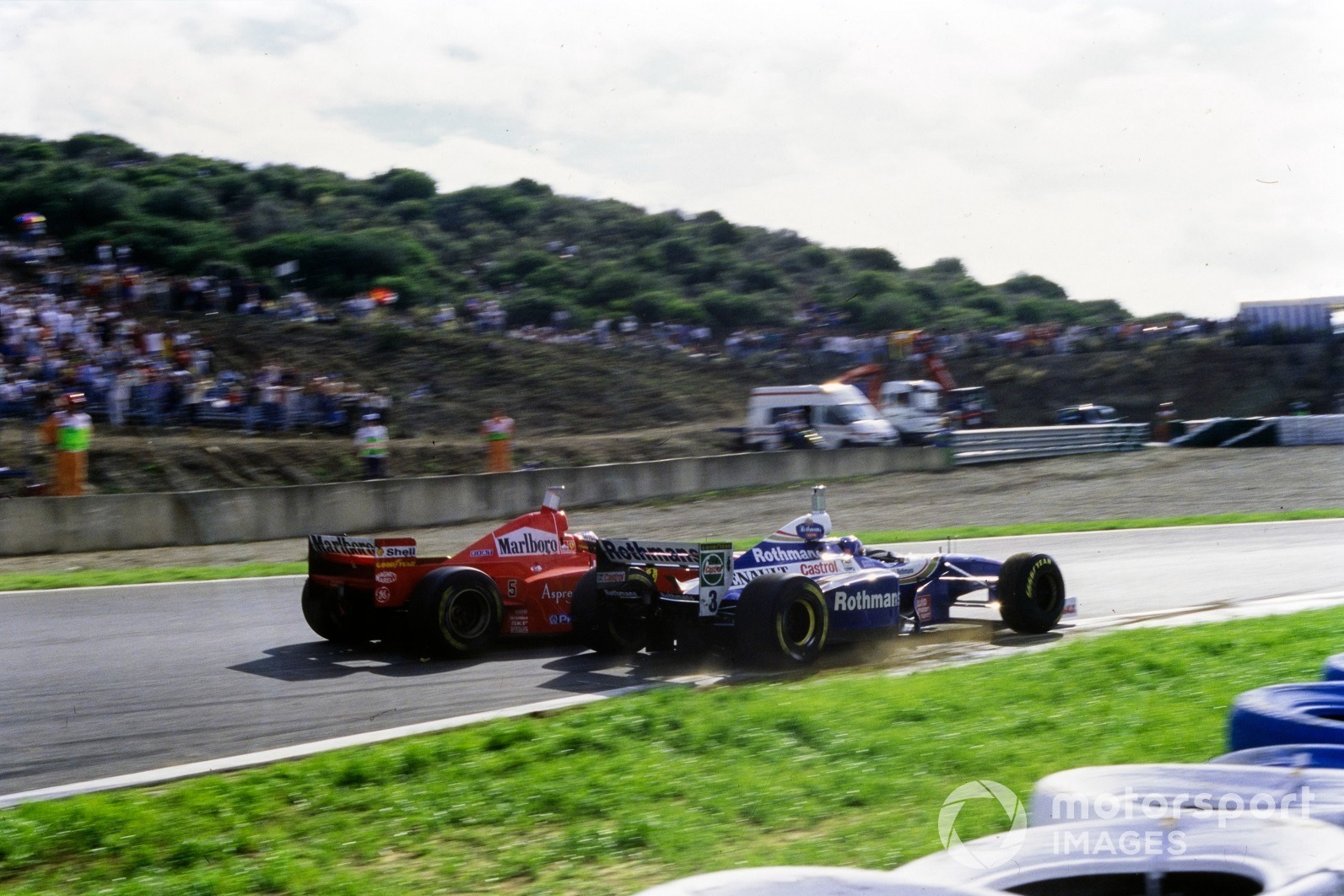
The controversial collision between Schumacher and Villeneuve that overshadowed the 1997 F1 title fight
Post-race accusations of collusion between McLaren and Williams were as nothing compared with the furore which embroiled Schumacher and Ferrari. While the stewards initially dismissed the collision as a racing incident, a subsequent disciplinary hearing resulted in Michael’s exclusion from the championship results. The three-point margin by which Jacques won the title vanished into the memory hole; history records Frentzen as the runner-up, by 39 points.
After this, his second season in F1, Villeneuve would achieve just four more podium finishes as his top-flight career slumped into a long tail of mediocrity. Much the same could be said of Williams: apart from brief resurgences with BMW power in the early 2000s, and Mercedes in the first seasons of the hybrid era, there has been little of merit to speak of as this once-great team drifted into F1’s hinterlands.
Race record
Starts: 34
Wins: 8
Poles: 11
Fastest laps: 9
Podiums: 7
Constructors’ championship points: 123
Specification
Chassis Carbonfibre monocoque
Suspension Double wishbones with torsion bars (front), double wishbones with pushrod-actuated coil springs/dampers (rear)
Engine 71-degree naturally aspirated Renault RS9 V10
Engine capacity 2997cc
Power 760bhp @ 16,000 rpm
Gearbox Six-speed semi-automatic
Brakes Carbone Industrie discs front and rear
Tyres Goodyear
Weight 600kg (including driver)
Notable drivers Jacques Villeneuve, Heinz-Harald Frentzen
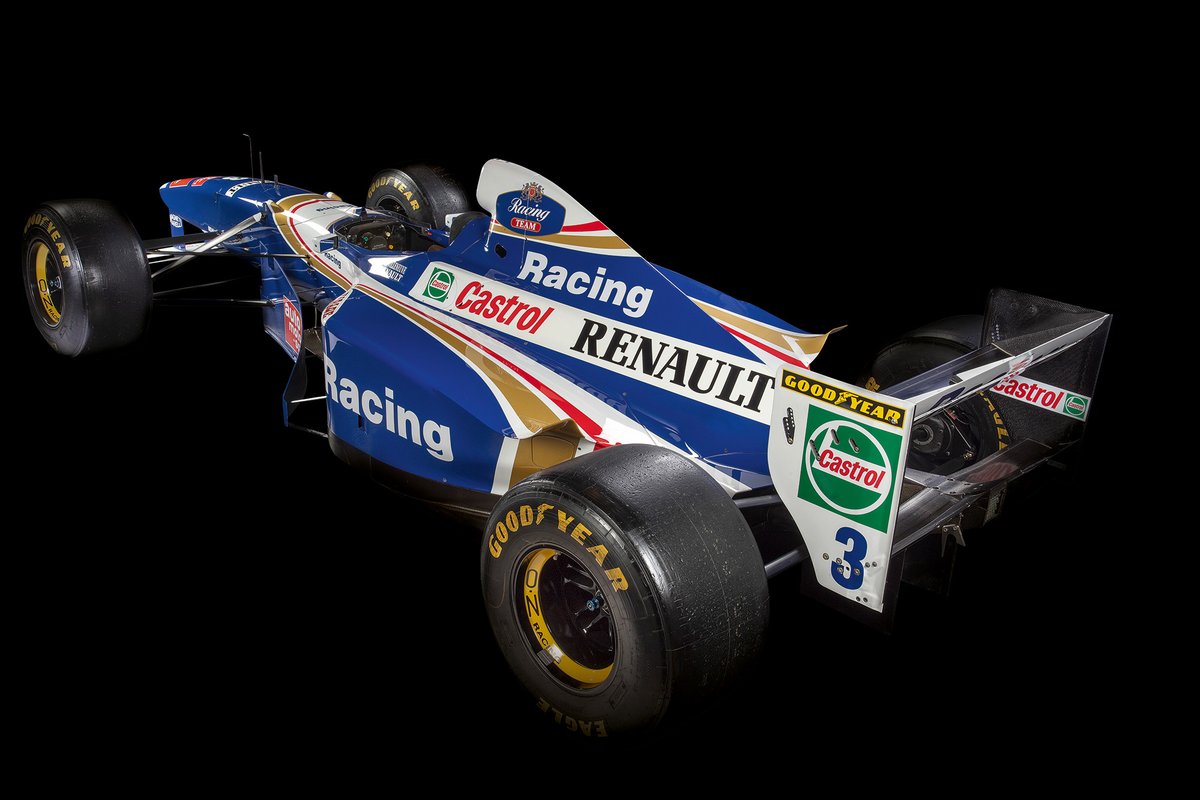
The Williams FW19 remains the team's most recent F1 world title winner
Photo by: James Mann

How Ratzenberger beat the odds to realise his cruelly short-lived F1 dream

F1 uncovered: A weekend behind the scenes with a chief mechanic

When McLaren was pipped by Red Bull in a modern F1 classic

The big opportunity Sainz’s Williams switch affords to F1’s latest centurion

Inside the science of F1 fuel

How F1’s plan for rotating races could look in practice

The early decisions that set Sauber’s rookie for success

How F1 media coverage has evolved in line with its subject

Acosta's long road to his maiden MotoGP win

MotoGP Austrian GP: Acosta finally claims maiden win

Great debate: Which circuit should host the F1 2026 finale if the calendar has to change?

Live: MotoGP Austrian Grand Prix updates as it happens
Subscribe and access Autosport.com with your ad-blocker.
From Formula 1 to MotoGP we report straight from the paddock because we love our sport, just like you. In order to keep delivering our expert journalism, our website uses advertising. Still, we want to give you the opportunity to enjoy an ad-free and tracker-free website and to continue using your adblocker.


Top Comments