


Technical analysis: The implications of a FRIC ban in F1
Following the British Grand Prix, Formula 1 teams received an FIA technical directive that aims to ban hydraulically interconnected suspension, better known as FRIC

While not coming completely out of the blue, as the FIA had plans in place to ban the system as part of the cost-cutting measures, the urgency in the technical directive did come as a surprise.
F1 teams need to unanimously agree to run the system until the end of the year, or it will be banned for the next race in Germany in just under two weeks' time. This presents the F1 pack with a huge technical hurdle to overcome - potentially within a very short timescale.

FRIC has been around F1 for a long time - its earliest incarnations predate the active suspension era and its latest generation has been on the cars since 2008.
Now every team has a system of some description, although several teams are still in their first year or two of experience of the set-up.
Those teams that adopted the system early, such as Lotus, Mercedes, Ferrari and Marussia, have the car's design fully adapted to the slightly different mechanics of the FRIC.
In most cases teams have replaced the third heave element on each end of the car with a hydraulic element. The chambers in the telescopic device compress hydraulic fluid that passes along the car, through valves and accumulators to a matching device at the other end of the car.
Removing the system and replacing it with an unconnected set-up is not quite as simple as it sounds. The car's ride height, mechanical and aero set-up will all need to change.
The teams with suspension fully optimised around the FRIC design do not necessarily have the mounting points for a full complement of side, heave and roll elements that an unconnected system requires. There may not be the space or sufficient hard points inside the car to create these at short notice.
As a result the extremely low ride heights at the front of the car, which FRIC allows teams to run, will have to be compromised. A raised front ride height is required to keep the splitter and plank off the track and avoid them suffering excessive wear.
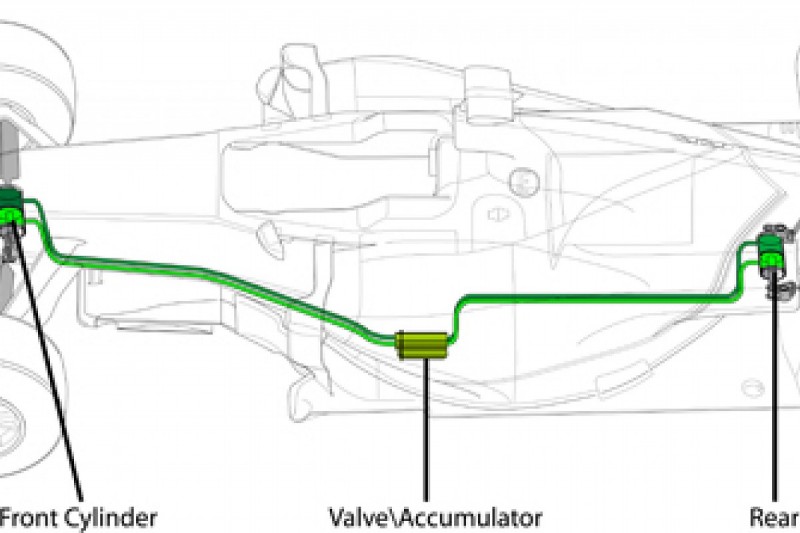
With these higher ride-heights the cars' front wing and underbody will need to be changed. Different specifications of wing and floor are designed for specific ride height ranges, and as the car will have to run higher, the bodywork will need optimising to cope with this. Otherwise the car will lose downforce and suffer balance changes at different speeds.
It could be argued that a rushed FRIC ban will be unsafe, but it is probably more fair to say that the change will compromise cars' handling and teams' ability to predict it. But there should not be the dramatic effect seen when active suspension was banned for 1994.
In any rule change there will be winners and losers, and the teams mentioned above with more time and car design invested in FRIC will suffer the most. Those on the initial learning curve will be able to step back earlier and will most likely have the car equipped to run without FRIC anyway.
As a ban under the cost cutting measures was already mooted, some teams had already commenced a test programme to research their car's performance without FRIC. This could help them if a unanimous decision cannot be reached and the ban is applied with immediate effect.
As always with F1 it is the teams with resources and budget that will adapt to the change quickest regardless of their FRIC status.
It is unlikely to knock Mercedes' dominance of the sport this year, nor have a huge effect on the running order behind it.
Share Or Save This Story

The perfect Formula 1 car from 2016

F1's new development war has already begun

F1 teams still pushing with an eye on 2017

LIVE: F1 Hungarian GP updates - Who can grab pole? Qualifying under way

DTM Oschersleben: Preining wins, Thiim loses points lead to Engel

Formula E Tokyo E-Prix: Ticktum pulls off last-lap overtake on Dennis for victory

F1 Hungarian GP: Norris beats Hamilton to top final practice
Subscribe and access Autosport.com with your ad-blocker.
From Formula 1 to MotoGP we report straight from the paddock because we love our sport, just like you. In order to keep delivering our expert journalism, our website uses advertising. Still, we want to give you the opportunity to enjoy an ad-free and tracker-free website and to continue using your adblocker.


Top Comments