


Tech Notes: Why sidepods are the new secret to speed
While many have been looking at F1's ugly new noses, Craig Scarborough has been looking further back to find how sidepod designs are fast becoming the key to gaining an advantage in 2012
As each car was launched, most people noted the difference in the nose shape, but as the cars start to test the most important changes are the sidepods.
For 2012, the rules have changed regarding the exhausts position. These rules were brought in to the prevent teams using the engine to blow a stream of fast moving exhaust gas over the diffuser. Now exhausts must be higher and point upwards.
However, this year some teams are using the sidepods and the air flowing downwards over them to redirect the exhaust plume, creating a downwash-sidepod. This is a legal way to work around the rules and recreate some of the exhaust-blown diffuser effect.
Exhaust-blown diffusers help a car's aerodynamics in several ways. Firstly, the fast moving exhaust flow speeds up flow through the diffuser creating more downforce, and the exhaust plume is also used to help the seal the sides of the diffuser like a skirt.
This latter exhaust function helped teams run the cars at a more aggressive nose-down tail-up raked attitude. Having the car at a steep rake angle places the front wing lower to the ground and effectively makes the diffuser at the back of the car taller, as it's higher from the ground.
These combined effects were used to great effect by Red Bull, but other teams were cottoning on to this through 2012. Now this effect is gone, with exhausts required to point 10 to 30 degrees upwards and be positioned much higher and further back.
Teams have sought to keep the exhaust floor pointed at this crucial region between the rear tyre and the diffuser. However the new exhaust rules preclude any exhaust position that would directly aim the plume to this region.
This is where the downwash sidepod design comes into the equation. Although the exhaust plume is at great speed and exits with a lot of energy, it can still be affected by the general flow over the car. As speed increases the cross flow passing over the exhaust pipe, will bend the exhaust plume into a curve.
Teams have realised that this can be used along with other aerodynamic effects to make the exhaust plume move from an upwards direction to downwards, towards the sides of the diffuser. The trick in achieving this is to create a strong downwash of airflow over the sidepod. Several teams have gone this route: McLaren, Sauber and latterly Red Bull with the new aero package released over the weekend at the final Barcelona test. Other teams like Ferrari and Mercedes use a similar effect for different reasons.
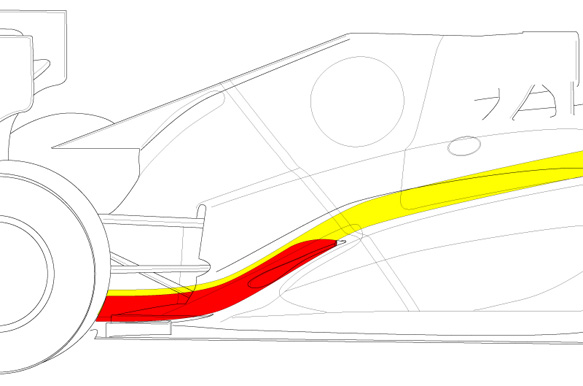 At speed the downwash (yellow) over the Sauber sidepods deflected the exhaust (red) towards the floor (Click picture to enlarge)
|
Downwash sidepods work by the high pressure created above the chassis and sidepod fronts being directed by the sloping top surface of the sidepod towards the exhaust outlet. Directing this flow over the exhaust creates the bending effect of the exhaust plume. Then detail work with small vanes and brake duct vanes help to keep the plume pointed at the edge of the diffuser and the tyre itself.
In some cases the change in exhaust direction is aided by a coanda effect, this is the effect whereby the airflow blowing over a curved surface tends to follow the surface rather than continuing straight on. Having a section of sidepod behind the exhaust exit will make the exhaust plume want to follow this surface.
While this solution appears to be the most powerful way to exploit the exhaust regulations, used in isolation it does have one drawback, which is to obstruct the flow passing low down along the sidepod undercut. F1 sidepods now all have deep undercuts below their inlets; this undercut flow passes around the sidepods Coke-bottle shape and passes over the centre of the diffuser.
Most teams this year have exposed the centre of the diffuser and the starter motor hole to gain a better flow under the centre of the diffuser. This undercut flow has to cross the downwashed exhaust flow and hence cannot reach the centre of the diffuser. So some of the teams with downwash sidepods provide a path beneath the exhaust flow, to allow the undercut flow to cross.
Sauber
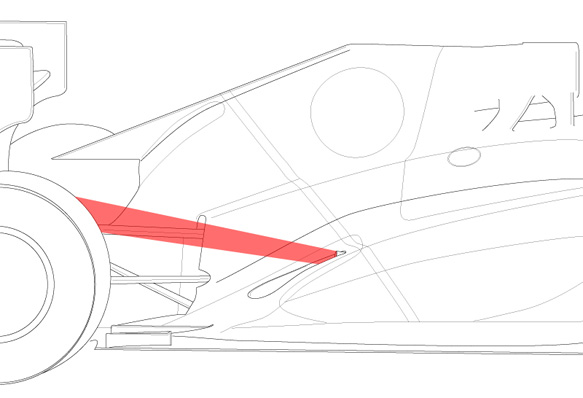 At a stand still the path of the exhaust plume (red) is upwards at ten-degrees (Click on picture to enlarge)
|
Perhaps the simplest form of a downwashed sidepod is the Sauber. The exhausts are positioned on the top surface of the sidepod and the sidepods slopes steeply down over the exits.
By having the exhaust outlets recessed into the surface of the sidepod, the plume blow attaches to the curved sidepod shape and with the cross flow over the sidepod the plume is directed directly between the tyre and diffuser.
In this case the downwashed cross-floor and the coanda effect are clearly evident. However the sidepod design does not allow for the flow around the sidepod undercut to pass over the exhaust plume.
Red Bull
Comparing Red Bull's latest sidepod and exhaust set up to the Sauber, it's clear the effect being gained is the same. Red Bull's sidepods again feature a top exit exhaust position and a length of sidepod surface behind the outlets forms a ramp for the plume to attach to. However, Red Bull has cleverly placed an undercut beneath this ramped section, which allows the around-the-sidepods undercut to reach the centre of the diffuser.
This downwash sidepod\exhaust was probably always envisaged for the RB8, as several areas of the car were optimised for its use even before the new sidepods were fitted. The car's lower wishbone has unusually narrow spaced legs, which is structurally less efficient, but for the new exhaust set up it usefully clears more space for the exhaust flow to pass through. Also, the 'V' shaped centre of the diffuser, an area known as the boat-tail, has been exposed this year. In previous years this has been faired-in under the gearbox.
Overall, and perhaps unsurprisingly, the Red Bull iteration of the downwash sidepod is perhaps the most complete and logical downwash solution. However it's not a quantum step above McLaren's solution.
McLaren
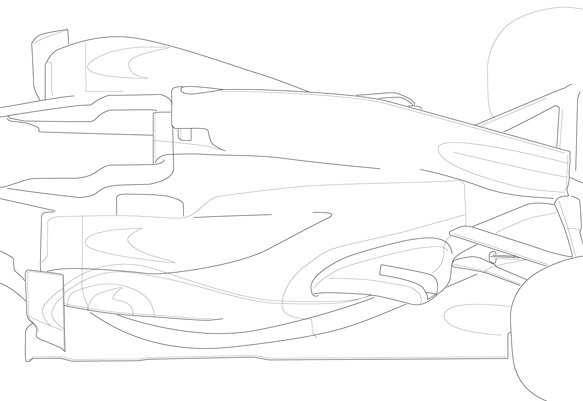 Mclaren's exhaust fairing features a recessed exhaust and opening to allow the downwash to redirect the exhaust (Click on picture to enlarge)
|
McLaren's launch exhausts were temporary parts; as soon as the car started running the first exhaust iteration became evident. The early testing exhaust still uses the bulged fairings seen on the launch car, but the exhaust outlet was now positioned deep within the bulge and a large opening was made over the top surface of the fairing.
Just as with the other two cars described already, the sidepod shape is optimised to direct the downwash into this slot. This starts the process of deflecting the exhaust plume, but rather than create a continuous surface for the plume to attach to, the fairing provides a short ramp for the exhaust to follow then the exhaust passes openly towards the floor. Having the bulged fairing provides a clear path for the undercut airflow to pass below the exhaust plume.
Being the first team with a downwash design, early flow-viz tests showed the fluorescent paint to be scorched and blown away in the area of floor ahead of the diffuser. Other evidence of the blown effect near the rear tyres is the presence of marbles of rubber thrown from the inner shoulder of the tyre onto the floor ahead. All teams running similar exhaust solutions have conducted lot of tests with temperature sensors to ensure the flow isn't overheating the tyres.
In the last day of testing, McLaren produced a revised exhaust fairing and sidepod design. Similar in concept to the early testing version, the new version used a steeper sidepod shape and the fairing was realigned to point rearwards rather than slightly outwards on the earlier version.
Ferrari
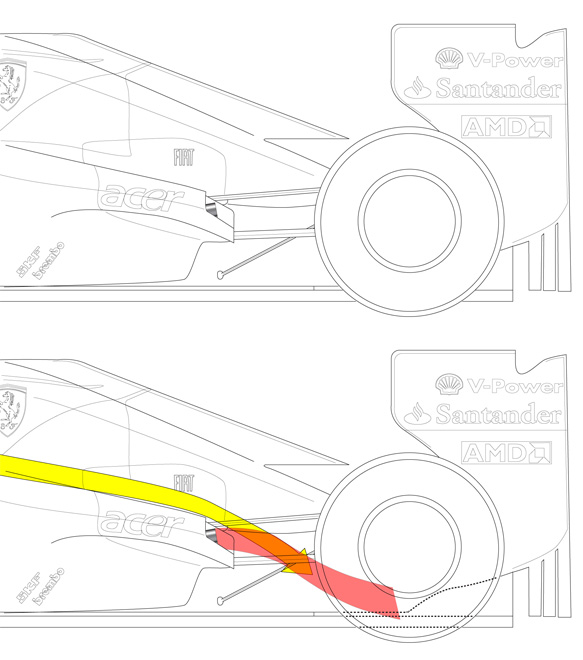 Top: Ferrari's exhaust sits inside a downswept fairing. Bottom: At speed the exhaust (red) is deflected by the downwash around the fairing (yellow) and redirected towards the floor. (Click on picture to enlarge)
|
Ferrari's exhaust solution is perhaps more a work-in-progress than the other teams. At its launch and in early testing the exhausts were placed quite far outboard inside the chimney fairings.
These were soon revised with the outlet positions eventually ending up further inboard and slightly lower than the launch specification.
However, the evidence of the solution using the sidepods downwash is still evident, the downswept chimney fairings around the exhaust create the downwash, but the final path of the exhaust plume is less clear.
This set up doesn't appear to be as effective as rivals' solutions. A sidepod revision is clearly required for the Ferrari, if only to re-optimise the exhaust chimneys around the new position of the exhaust outlets, although rumours now abound of a more substantial change to the sidepod layout.
Mercedes
Unlike the teams above, Mercedes appear to be using the exhaust in a different way, albeit still using downwash to redirect the airflow. Mercedes has heavily rounded sidepods and the exhaust position is quite far inboard. Clearly there's no path for the exhaust to reach the gap between the tyre and diffuser.
Instead, the plume appears to curl under the sidepod towards the boat-tail section of diffuser. Increasingly during testing, the Coke-bottle section of sidepod is produced in plain heat-protective carbon, rather than painted. This suggests the exhaust is playing over this area. Perhaps the reason for this exhaust solution is to feed the small channel formed above the diffuser.
Confusingly termed a new double-diffuser solution by other media, to be legal this channel is separated from the diffuser below, creating a duct exiting between the diffuser and the tail lamp. As the exhaust flow curls under the sidepod it blows into the channel and helps the flow coming up from the boat tail section. Admittedly a clever solution, this does not appear to offer the benefits of blowing the outer floor area.
Conclusion
As the season progresses teams will constantly play with the sidepod and exhaust shape. Many midfield teams have opted for a non-sensitive exhaust position, with plans to exploit the exhaust gasses once the effect is better understood. The downwash sidepod and exhaust is clearly a key performance differentiator between the teams this year.

The perfect Formula 1 car from 2016

F1's new development war has already begun

F1 teams still pushing with an eye on 2017

A glimpse at McLaren's 2017 work at Austin?

Engine oddities and aero tweaks at Suzuka

The unexpected technical upgrades at Sepang

Mercedes' suspension under the spotlight again

F1 teams' low downforce secrets

Mercedes has a Russell-sized problem and it is sharing responsibility

Phillips wins inaugural GB4 Winter Series in dramatic circumstances at Snetterton

Rally US host city announced ahead of WRC return

The role Friday practice played in Hamilton failing to achieve a podium at the US GP
Subscribe and access Autosport.com with your ad-blocker.
From Formula 1 to MotoGP we report straight from the paddock because we love our sport, just like you. In order to keep delivering our expert journalism, our website uses advertising. Still, we want to give you the opportunity to enjoy an ad-free and tracker-free website and to continue using your adblocker.


Top Comments