


How Formula 1 teams have learned to live with the cost cap
Just as engineers respond and adapt with each change in technical regulations, financial brains do a similar job working to the finest margins within strictly controlled constraints – and they’ve got fresh updates to look forward to next season

After a small delay to the expected communique from the FIA, Formula 1’s 2024 cost cap results are in. And, once more, nobody has surpassed the limit, set at a base of $135million (plus extra for inflation and calendar size), meaning that there have been no major breaches for the past three years.
Aston Martin’s procedural breach was just that – its auditor was unable to provide their final signature on its submission prior to the deadline; the FIA accepted this as force majeure, and Aston Martin has accepted any further ramifications.
Four years in, teams have become accustomed to dealing with the cost cap. Ultimately, it’s just another ruleset; just as engineers expend their time on developing an all-encompassing understanding of the FIA’s technical regulations, finance teams tackle the cost cap rules with a similar degree of fastidiousness. It’s the accounting world championship, and falling barely on the wrong side of the cap can levy very real consequences on a team as a whole.
There were rumours that another team had transgressed the cost cap regulations, as the later timing of the FIA’s cost cap recap (late October, rather than early September) had apparently hinted at a breach somewhere else along the grid. But this was proven to be false; all 10 teams involved in 2024 had complied, and that was the end of that.
Red Bull was hit with a $7m fine (helpfully, not one of the outlets covered by the cap) and a 10% reduction in aerodynamic testing
Red Bull, of course, had to come to terms with that when its finances in the first year of the cap strayed beyond the-then $145million cost cap (£118million) by £1.8m. The team was hit with a $7m fine (helpfully, not one of the outlets covered by the cap) and a 10% reduction in aerodynamic testing.
Since Red Bull was already on the lowest allocation, having been in the lead of the 2022 championship at that point, the 70% modifier applied to the base aero testing limits was thus reduced to 63%.
“It gives an advantage to our competitors, which is why they were pushing so hard for a draconian penalty,” former team boss Christian Horner rued at the time. “I’m sure if you burned our wind tunnel down, it wouldn’t be enough.”
The FIA revealed that Red Bull had incorrectly adjusted or excluded costs of around £5.6m, leading to the overspend. This included catering costs, allocating costs of spare parts to the team’s heritage department, and other minor indiscretions involving employee-based overheads.

While then-Red Bull boss Horner reckoned his team had been disadvantaged by its penalty, it still swept the board in 2023
Photo by: Mark Sutton / Motorsport Images
For all of Horner’s complaints, it didn’t hurt the team much in 2023; Red Bull and Max Verstappen tore through the titles, akin to lions through a herd of grazing impalas. There’s an argument to make that it did, however, assist with a slight downturn in form over 2024 as the final months of the cost cap penalty would have impinged upon the RB20’s development. Yet, engineers are very good at cutting their cloth accordingly; creativity and ingenuity can often thrive amid tightening restrictions.
Penalties for procedural breaches are usually financial. Williams copped a $25,000 fine for submitting its 2021 accounts late, although Aston Martin will not take a fine due to the nature of its breach. In 2023, Honda and Renault also took an accepted breach agreement (ABA) after indiscretions in their filings, and were fined $600,000 and $400,000 respectively.
Those in charge of the oversize calculators will have to get their heads around the myriad revisions for next year’s amended cost cap. While the limit rises to $215m next year, it includes more costs that had been previously allowed an exemption. Marketing, heritage and human resources costs will remain outside of the cap, as will the fees of drivers and the three highest-paid personnel.
Furthermore, Sauber (or Audi, from next year) will receive an offset in line with the higher living costs in Switzerland for its staff based at Hinwil – although this was an unpopular addition among the other teams.
It would be surprising to see a team fall foul of the current rules, given the effort expended on ensuring that every part of a team complies with them
While a new series of cost cap rules might open the doors once more to a first overspend breach since Red Bull’s 2021 miscalculation, we won’t truly know until 2027; next year’s accounting update will correspond with this season’s spending. It would be surprising to see a team fall foul of the current rules, given the effort and time expended on ensuring that every part of a team complies with the rules.
The FIA seems to be pretty hot on creative accounting, as demonstrated by Red Bull’s earlier attempt to append some of its assets to a cap-exempt department. Even employee bonus costs are regulated to ensure teams don’t cut wages and convert them into exemption territory.
Thankfully, F1 is spared the nonsense of transfer-fee amortisation, such as the Premier League’s profit and sustainability rules. The threat of losing performance should be enough in a discipline governed by the stopwatch.
This article is one of many in the monthly Autosport magazine. For more premium content, take a look at the December 2025 issue and subscribe today.

Driver fees, plus the cost of a team’s three highest-paid personnel, remain outside the cap
Photo by: Sam Bagnall / Sutton Images via Getty Images


Lights, Camara, action: How Haas picked F1's latest rookie for 2027

Horner's inside story of how Red Bull built its own F1 engine

Why Mercedes' latest 2026 F1 update is no downgrade

Singapore Grand Prix Driver Ratings 2026

What we learned from the 2026 F1 Singapore GP sprint race and qualifying

The political minefield set out by F1’s recent cost-cap grievances
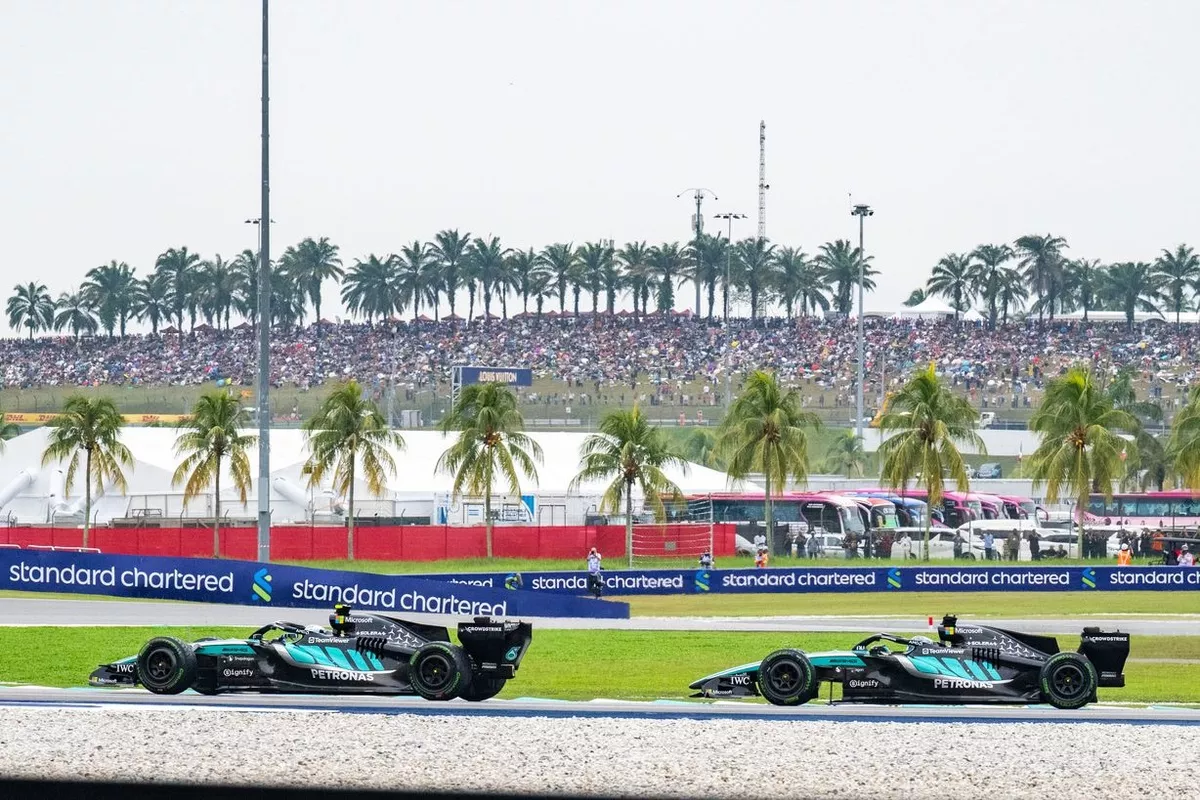
What caused Mercedes' pace deficit at Sepang despite upgraded W17?

Three kings: F1's generational stars shone at Sepang

How Toyota destroyed the competition to seal the WEC crowns

McLaren retains Fornaroli as F1 reserve and hands him WEC programme for 2027

How Andrew Jordan realised his teenage rallycross dream

Inside the competition building F1’s future engineering talent
Subscribe and access Autosport.com with your ad-blocker.
From Formula 1 to MotoGP we report straight from the paddock because we love our sport, just like you. In order to keep delivering our expert journalism, our website uses advertising. Still, we want to give you the opportunity to enjoy an ad-free and tracker-free website and to continue using your adblocker.


Top Comments