


How Red Bull hopes to succeed where McLaren failed
Red Bull has ended its acrimonious association with Renault to form a new engine partnership with Honda. JAMES ROBERTS visits its factory, where team boss Christian Horner explains how this new alliance will avoid falling into the same trap that ruined McLaren-Honda's hybrid Formula 1 dream
As he looks out of his office window, for just a moment, Christian Horner could be forgiven for thinking he was in Salzburg.
It's the lunch break and he notices a few members of Red Bull staff on a patch of snowy grass, first rolling the head and then the belly of a makeshift snowman. An Austrian flag flutters above them. It's a reminder of the wealthy investment supporting this title-winning F1 team.
But this snowy vista is not from an Alpine retreat, merely a wintry weekday in Milton Keynes.
"Ah, but we do have our own ski slope," jokes the Red Bull team principal. He has reasons to be cheerful, despite the fact it's been five seasons since he last guided Red Bull to championship glory.
Another building in Milton Keynes, closer than the dry-slope 'SnoZone' to the Red Bull Racing factory, is of much more significance: Honda Racing's European R&D facility. The geographical proximity is already a metaphor for the closeness of the new working relationship in this latest British-Japanese joint F1 venture, compared with what went before.

The high-profile failure of McLaren-Honda has been well-documented, with both sides admitting errors, but this new relationship is filled with optimism. After Toro Rosso ran Honda engines last year, Red Bull decided to take the plunge too.
For obvious reasons, neither Mercedes or Ferrari were keen for Red Bull to get hold of their powerunits, and with Renault deciding to invest in a works team once more, Red Bull's only option outside of its previous customer deal with Renault was forming an accord with the maligned Japanese manufacturer.
Although all 12 Renault victories in the V6 hybrid era have been scored by Red Bull, the partnership fell into acrimony on a similar parallel to McLaren's relationship with Honda, which ultimately led to the termination of the collaboration.
"It was a no-brainer for Red Bull with the aspirations we have for the future - which are also shared by Honda," explains Horner. "With Renault having their own team now, and their own plans, we were rapidly becoming an inconvenience and a thorn in their side. The route we have chosen to take suits all parties."
With the complexities of the hybrid engine formula, Honda struggled initially with reliability, committing some fundamental mistakes and proving slow to react to the required scale of development. McLaren was particularly vocal of its disappointment in Honda, while also failing to acknowledge its own weaknesses. The most vocal critic was Fernando Alonso, who humiliated Honda on home soil at Suzuka, describing its powerunit as a "GP2 engine". Red Bull starts its new alliance looking to avoid the same mistakes.
"Clearly, it didn't work for either side of the relationship," says Horner of the failed McLaren-Honda programme. "There were probably lessons that could be learnt from both sides. Honda have been very open and our approach has been to understand their culture, their approach, and not force them into solutions they are uncomfortable with."
While he won't be drawn on specifics, Horner is quietly confident that both reliability and performance have improved.
On the other side of Milton Keynes, Honda's technical director Toyoharu Tanabe still feels there is a "bit of a gap" to the frontrunners.
"Nobody stands still in Formula 1," adds Horner. "And we are hopeful and optimistic that progress has been made on all fronts. But what we don't know is what is happening in Maranello or Brixworth in comparison. Certainly, after the early, painful growing years for Honda, they do seem to have hit a vein of development, which is being fruitful for them."
For Honda, this year will be a significant shift in terms of data-gathering as it will have double the amount of resource to analyse thanks to supplying two teams for the first time in the hybrid era.
Following the departure of Toro Rosso's former technical director James Key (who is McLaren bound), the Italian team will enjoy a much closer working relationship with Red Bull than in recent years, utilising Red Bull Technologies and employing a technical partnership that is similar to the one Haas enjoys with Ferrari.
"There is a closer synergy with Toro Rosso this year," confirms Horner. "They will take our gearbox solution, rear suspension and other elements on the non-listed supply list - which excludes aerodynamics.
" From a Honda perspective, having the same drivetrain gives them a degree of commonality in mapping between the four cars. Hopefully that will be four consistent data sets coming back, which gives them added knowledge and track time."

Graduating from Toro Rosso to the Red Bull A-team is Frenchman Pierre Gasly, who brings his knowledge of racing the Honda powerunit last year.
This youthful partnership with Max Verstappen leads Horner to joke he used to be younger than his drivers, now he is four years older than their combined age of 41...
"I've known Pierre through the junior programme a long time," he says of his newest charge. "Although he has been elevated 12 months before we'd ideally like, he had a great debut season with Toro Rosso and alongside Max they'll be a strong pairing.
"Max has a good degree of experience, while Pierre is on a different point on his learning curve trajectory. So Max, as the experienced driver, will be leading development and shoulders a lot of responsibility now.
"Max is a driver very much at the top of his game and up there with the very best. Last year he outqualified Daniel Ricciardo 15-5, which is significant, as Daniel is certainly no slouch. He's hugely competitive, has a tenacious determination to succeed and is fiercely driven.
"I bumped into David Beckham before Christmas and he said to me how impressed he was how Max stood up to the backmarker [Esteban Ocon] that took him off in Brazil and how he had 'fire in his belly' - that passion ignites a following and support."
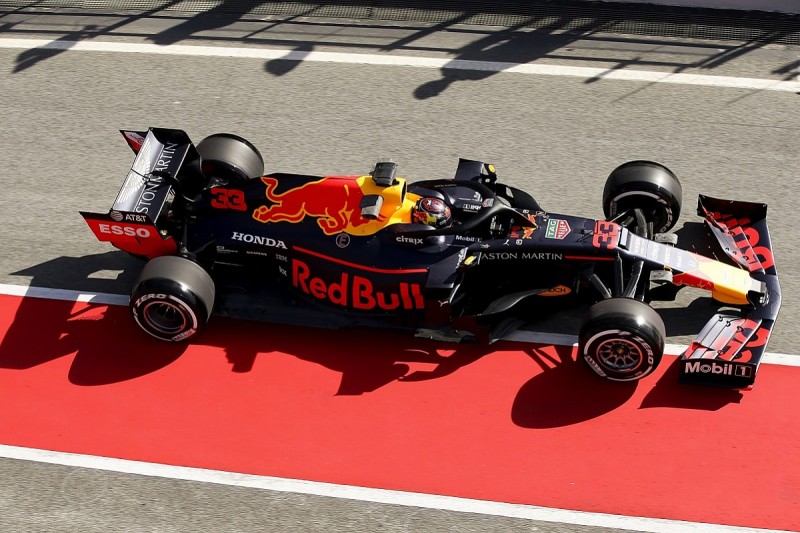
However, that tenacity and fight will need to be tempered heading into this new era with Honda.
As the youthful, independent-spirited Red Bull team forges a relationship with a culturally reserved Japanese manufacturer, team leader Verstappen's competitive angst will need to be moderated.
Honda will not take kindly to a repeat of the public humiliation it suffered at Alonso's hands. Verstappen was vocal amid retirements caused by Renault last year, but Horner has no expectation that there will be a repeat of Max's expletive-fuelled tirades.
"There is a much different approach," Horner says.
"The deal with Honda is no longer a customer and supplier relationship. This is a combined project, where the engine partner is integrated into the development and aspirations of the team, rather than an off-the-shelf service.
"It's a totally different relationship and from the beginning. Max very much buys into that and, obviously, he's not being goaded as well from the supplier. I think it will be a different scenario, it's a much different relationship."

Before arriving at Horner's office, we meet on the other side of the growing Red Bull campus on Bradbourne Road.
A new building opened at the end of last year - dubbed 'MK7' after the postal code the team is based in - which houses every Red Bull car from 2005, the year it took over the factory and F1 entry from Jaguar.
As he walks across the car park towards his office (after proudly showing off the new Aston Martin Valkyrie workforce), Horner passes each member of his team with a "good morning" or "how are you?"
It's a reminder of his personable and relaxed management style.
"In the Stewart Grand Prix days, this was originally Jackie's office," says Horner. "But it was slightly different back then, with a tartan carpet, chaise-lounges and even a couple of Labradors.
"We have many people in the business, in facilities, on the test team, that were Paul Stewart Racing die-hards and have 25 years of service with us now."
On the factory floor, you sense a growing energy for this new season. For the first time in Red Bull's history it has essentially a 'works' engine deal and that has had a significant impact on the design of the RB15 and on the morale of the workforce.

"Walk around the factory and the one thing you feel stands out is optimism," says Horner.
"We used to go into a season knowing our engine was 50-60hp down on the best and that was tough on the whole group. We've punched above our weight before, but now we might be on the dawn of something changing.
"Adrian Newey's motivation has sky-rocketed since the Honda involvement because, from a technical point of view, instead of there being a very clear firewall between what the chassis is and the engine, it's far more integrated. This collaborative way of working is what Mercedes and Ferrari obviously enjoy and it's as close to an in-house engine as we can get."
Despite the good vibes, Horner notes a touch of caution. It is only the first year of a long-term partnership and there will inevitably be teething troubles - combined with the arrival of a new set of regulations. He points out that Mercedes has won 75% of races since the start of the hybrid era...
"This team is capable of great things and we have a desire and hunger to have success again in the future," Horner adds. "From Mr Mateschitz in Austria, to the engineers in Milton Keynes, there is a great energy and enthusiasm for F1. We have a strong driver line-up and we hope to be challenging more often than we were in 2018."
Red Bull with a works engine deal is arguably the strongest it can hope to be. Back in September 2014, a prominent McLaren employee - now no longer of this parish - said the following about the team's new deal with Honda: "You cannot be world champions if you are a customer: it's impossible. The path with a manufacturer to be a works team is absolutely the way to go."
So it's time for Red Bull to try to succeed where McLaren failed.

How Ratzenberger beat the odds to realise his cruelly short-lived F1 dream

F1 uncovered: A weekend behind the scenes with a chief mechanic

When McLaren was pipped by Red Bull in a modern F1 classic

The big opportunity Sainz’s Williams switch affords to F1’s latest centurion

Inside the science of F1 fuel

How F1’s plan for rotating races could look in practice

The early decisions that set Sauber’s rookie for success

How F1 media coverage has evolved in line with its subject

No denying it now – the one reason why F1’s ‘horrible’ start in Malaysia could be a good thing

Inside Alonso's decision to contest the 2027 Dakar Rally with Aston Martin

The greatest F1 campaigns with no wins

MotoGP to introduce sprint qualifying amid 2027 format changes
Subscribe and access Autosport.com with your ad-blocker.
From Formula 1 to MotoGP we report straight from the paddock because we love our sport, just like you. In order to keep delivering our expert journalism, our website uses advertising. Still, we want to give you the opportunity to enjoy an ad-free and tracker-free website and to continue using your adblocker.


Top Comments