


How much will Red Bull's aero testing penalty really hurt?
A $7m fine and a 10% cut in aerodynamic testing time was Red Bull's punishment for violating 2021's cost cap rules: a punishment too harsh for the team's liking, and not harsh enough for its rivals. Here's a look at how it really affects Red Bull

The dust seems to have finally settled in the wake of the tempestuous storm over 2021’s cost cap accounting. Red Bull has been forced to swallow the pill of a $7 million fine and a 10% reduction in aerodynamic testing time, and the other teams have had to accept that the punishment ends there. It’s not a surprise that Red Bull wanted a lighter sentence and that the other teams wanted more – that's only natural in Formula 1’s Piranha Club.
That’s not to say that the endless grandstanding and melodrama from all sides has not been tiresome, but if Red Bull was to roll over and accept the penalty in good grace it would belie its initial stance that felt its accounting had been in order. Part of the eventual £1.8m overspend related to Red Bull’s catering budget, so there’s at least a chance that the team will have something to take the bitter taste away from the whole farrago.
Regardless, the reasons behind cost cap transgressions have already been dissected to the point where little remains on the coroner’s table. Red Bull principal Christian Horner has labelled the punishment “draconian”; others reckoned it was too lenient, and Mercedes’ Toto Wolff resisted the urge to trade jabs with a frequent sparring partner and reckons it was “too much” for Red Bull, “not enough” for others. Of course, they’d all have different opinions if the shoe was on the other foot...
PLUS: The one thing that can't be sacrificed amid Red Bull’s F1 overspend controversy
The true picture of the draconian-ness of Red Bull’s penance won't become apparent yet, as the punishment affects the team’s windtunnel and simulation time over the next 12 months. The $7m fine ironically levied for surpassing the cost cap will have little to no effect on the team as it doesn’t affect its cap-affected budget for next season. It comes outside of that allowance and will not have to be accounted for, and by rights it should be that the FIA uses it for good. Either way, it’s an irrelevance. But will the 10% reduction in aerodynamic testing mete out any kind of punishment?
Already, that reduction in aero testing time has split opinion. “I've heard people reporting today that's an insignificant amount," Horner began during his solo press conference in Mexico. "I can tell you now, that is an enormous amount. That represents anywhere between a quarter and half a second's worth of lap time. That comes in from now, that has a direct effect on next year's car, and will be in place for a 12-month period.
"By winning the constructors' championship, we become victims of our own success, in addition to that 10%, having 5% incremental disadvantage or handicap compared to the second and third place. That 10% put into reality will have impact on our ability to perform on-track next year."
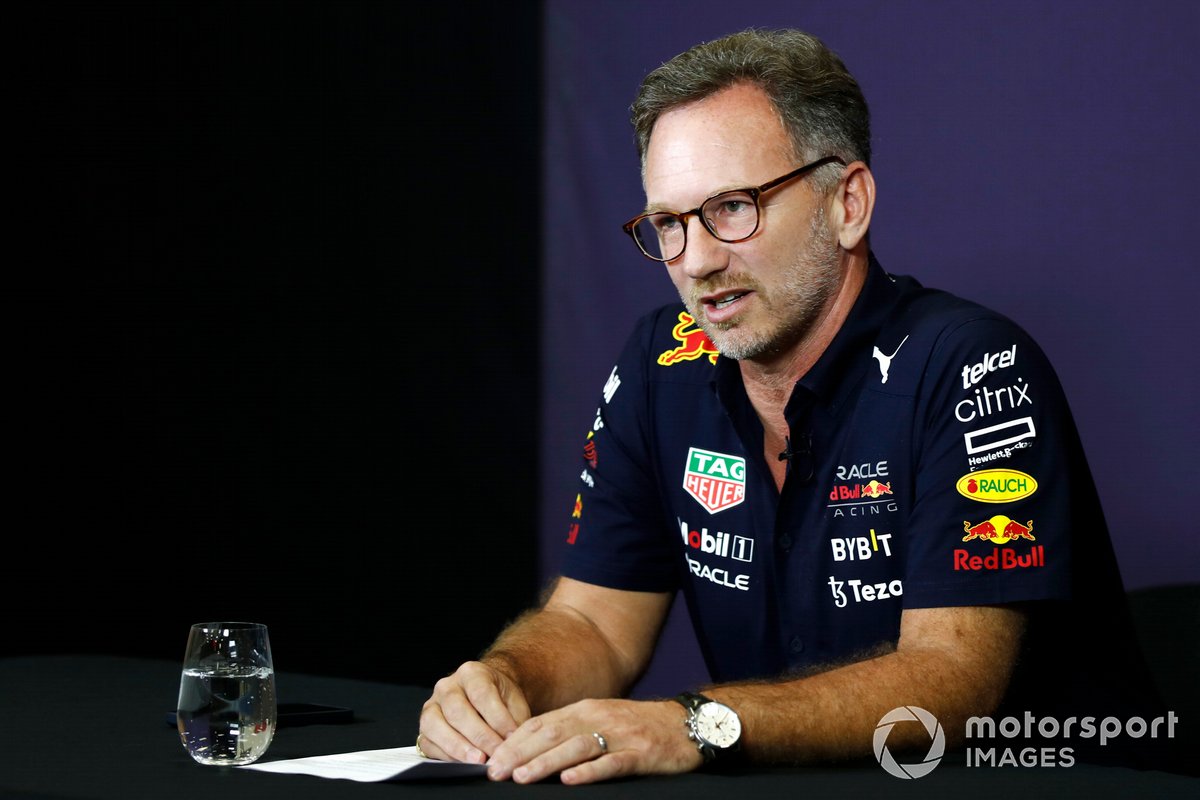
In Mexico Horner laid out Red Bull's grievances and explanations behind its cost cap breach and subsequent penalty
Photo by: Carl Bingham / Motorsport Images
It’s true that Red Bull will take a hit on an already-depleted allowance of windtunnel and simulation time, as it operates on the lowest allotted time in the FIA’s sliding scale. Let’s break that down first, just so everyone’s on the same page with what the aero testing regulations affect, before delving into the veracity of Horner’s comments and if he doth protest too much.
In that aero testing sliding scale, new for 2022, the FIA has determined a base level of testing to work from. This is assigned to the team that finishes seventh in the championship; teams below that get more testing time and resources - and teams above that get less – in 5% increments. For example, Williams is set to finish 10th in the constructors’ standings, and thus will get 115% of the base level allocation.
Red Bull, prior to its punishment, would have received 70% of that time. The 10% reduction is then applied as a compound reduction to the new total, so Red Bull now gets 63% of the base total.
"I would have thought a tenth, maybe two-tenths at the upper end, is realistically what that will cost you" Andrew Shovlin
The next point of order is that there are six aerodynamic testing periods in a year, spanning two months each. For each testing period, there are allocations of windtunnel time and runs that a team can use and, in CFD, a given number of discrete items that can be tested. Below are Red Bull’s allotted values per aerodynamic testing period against the base value, the values it would have received pre-penalty, and what Ferrari will receive.
|
|
BASE (100%) |
Red Bull (63%) |
1st in WCC (70%) |
Ferrari (75%) |
|
Windtunnel Runs (#) |
320 |
201.6 |
224 |
240 |
|
Wind On Time (hours) |
80 |
50.4 |
56 |
60 |
|
WT occupancy (hours) |
400 |
252 |
280 |
300 |
|
Geometries (#) |
2000 |
1260 |
1400 |
1500 |
|
CFD Solving (MAuh) |
6 |
3.78 |
4.2 |
4.5 |
Windtunnel runs are self-explanatory, and wind on time refers to the amount of time a team can run with a wind speed higher than 15m/s. The FIA defines windtunnel occupancy as "the first shift of occupancy will be deemed to commence the first time the windtunnel air speed is above 5m/s on a given calendar day, and will end at a time, declared by the Competitor, when the windtunnel air speed falls below 5m/s."
The geometries refer to those used in CFD; any new or altered geometries tested consumes that relative allowance. As for the CFD solving, measured in the nebulous “Mega Allocation unit hours”, this refers to a formula relating time spent on simulations multiplied by processing power and cores used. A less powerful system will take more time to solve a simulation, and thus it balances it out to ensure teams with more powerful hardware don’t have a baked-in advantage.

Max Verstappen, Red Bull Racing RB18, kicks up some sparks
Photo by: Andy Hone / Motorsport Images
Over a two-month period, Red Bull loses about 22 runs in the windtunnel owing to its penalty, around 5.5 hours of wind on time and 28 hours of occupancy time. Relative to Ferrari, this corresponds to about 9.5 hours of testing at higher wind speeds, 48 hours less time overall in the windtunnel, and about 38 runs. Per week, Red Bull loses about three runs relative to the normal 70% multiplier, 42 minutes of wind on time and 3.5 hours of occupancy time. It’s also a drop of 17.5 new geometries that can be tested throughout that week.
Does that correspond to Horner’s claims that Red Bull’s lesser testing time “represents anywhere between a quarter and half a second's worth of lap time”? Mercedes’ Andrew Shovlin doesn’t quite agree and suggested that Horner’s metric would suggest “a team at the back of the grid would have a three-second advantage to the one at the front, and that isn’t the case.”
“It depends how well you make decisions through the year,” he added. “I would have thought a tenth, maybe two-tenths at the upper end, is realistically what that will cost you.”
One current F1 aerodynamicist’s view of the situation was that it was “a slap on the wrist” for Red Bull, even when taking the aero testing penalty into account. But it’s probably worth asking an independent adjudicator for their view, because each employee currently working in F1 has some degree of vested interest.
Ex-F1 aerodynamicist Jean-Claude Migeot is well aware of the challenges of finding performance in a windtunnel, and so the situation was put to him. If Red Bull is already operating at the lowest end of the aerodynamic testing scale, and then gets a further reduction, will that cost the team as much as Horner suggests?
“What I want to say is the teams, all of them before this new rule this year, they had invested considerably in the process of making more information with less time in the windtunnel,” Migeot suggests. “It's a complicated process, but I think they have been trained on that for more than 10 years now.
“Now, the question is whether a further reduction, how much that would impact them and it's very much depending on the team position, if you have to recover or if you are leading. I think Red Bull is the moment has less trouble to fight back than some other ones which, which probably made this. You know, this rule of penalising the first team is, is the same thinking: the one behind need more effort, the one in front, you had your advantage and let other recover. It's not very sporting, but it's the way they are running this business.

Jean-Claude Migeot worked with Alain Prost at Ferrari
Photo by: Ercole Colombo
“Whatever the amount of testing you have, you have to distribute it in the optimum way between the key areas and the other things you would like also to do. I think about the position that I had as a supplier, if we had a programme for 4000 hours a year or for 300 hours a year, you still have to deliver a car, so you choose the most important things to do and you explore less development streets. I think for next year, the developments are quite clear for most of them, but for Red Bull, it's even more clear. So I don't think it's a real penalty, honestly. They're the best team to cope with it, if I can say it this way.”
So what’s the penalty really worth if the overspend is by £1.8m? If one takes Red Bull at its word and the bulk of it was purely down to overdoing the catering, then the team simply has to shell out on 514,000 fewer Tesco meal deals (or 461,500 sans Clubcard in today’s economy) and the slight time loss predicted draws a line in the sand in case other teams fancy risking the upper limit. But if that limit was helped by initially going over on development, then how much does the time loss cost via a knock-on effect?
Ultimately, the rules transgression could not go unpunished – and even the most fervent of Red Bull fans cannot argue that, particularly if their reaction to another team doing the same would not elicit the same response. As much as many would like the FIA to make an example of Red Bull, just as it had with McLaren during the 2007 Spygate scandal, it’s hard to sanction such an overwhelming penalty given Red Bull complied fully with the FIA’s investigation.
If Red Bull is stripped of its wings and spends the next few years hobbling around in the lower midfield then it’ll have been too heavy-handed, but one suspects it will be a minor inconvenience at best
The effect on the 2023 Red Bull, assuming the majority of the development work is already done, won't be anything like it would be on the 2024 car, although the windtunnel and CFD restrictions might hurt in-season development slightly simply due to the timing of the 12-month penalty span.
Perhaps the circa £8m ultimate spend – including overspend and penalty – along with the reduced testing time was worth it in the short term; this is equally something that the FIA must monitor to determine whether the punishment did indeed fit the crime.
If Red Bull is stripped of its wings and spends the next few years hobbling around in the lower midfield then it’ll have been too heavy-handed, but one suspects it will be a minor inconvenience at best. The aero team will have to cut its cloth accordingly, and no doubt it will. But the 0.25s to 0.5s loss of time for the sake of a couple of windtunnel runs a week seems like hyperbole at best; one suspects that the FIA might have to review cost cap penalties again in the future, if it turns out transgressions could be worth more than their sentence...

Red Bull's windtunnel won't see so much F1-related action over the next 12 months
Photo by: McLaren


FIA expects F1 races in Qatar and Abu Dhabi to run as planned

Why Piastri has struggled to show his best with this year's McLaren MCL40

Lights, Camara, action: How Haas picked F1's latest rookie for 2027

Horner's inside story of how Red Bull built its own F1 engine

Why Mercedes' latest 2026 F1 update is no downgrade

Singapore Grand Prix Driver Ratings 2026

What we learned from the 2026 F1 Singapore GP sprint race and qualifying

The political minefield set out by F1’s recent cost-cap grievances

McLaren held fresh talks after Singapore GP clash as Norris promises to "make better decisions"

FIA expects F1 races in Qatar and Abu Dhabi to run as planned

Top five roles on Motorsport Jobs this week

Champions crowned at incident-filled Donington Park 750 Motor Club meeting
Subscribe and access Autosport.com with your ad-blocker.
From Formula 1 to MotoGP we report straight from the paddock because we love our sport, just like you. In order to keep delivering our expert journalism, our website uses advertising. Still, we want to give you the opportunity to enjoy an ad-free and tracker-free website and to continue using your adblocker.


Top Comments