


How Mercedes overcame Ferrari to become Verstappen’s 2022 Dutch GP win challengers
Just 0.021 seconds had split Max Verstappen and Charles Leclerc in qualifying for the Dutch Grand Prix on Saturday. But come the race, the Monegasque's Ferrari was always playing catchup, while a strategic gamble from Mercedes meant Lewis Hamilton came closest to denying Verstappen's marauding Red Bull a fourth win on the trot

It was very tense and required driving perfection, but Max Verstappen’s triumph in the 2021 Dutch Grand Prix was strategically straightforward. His repeat victory in the 2022 race at Zandvoort was very much not.
The home hero left with an extended points lead over Ferrari’s Charles Leclerc, but it was actually the resurgent Mercedes squad that put Red Bull most at risk of a shock defeat. That all followed Verstappen’s team needing to put in serious overnight set-up work back at its factory to recover from his lost FP1 running on Friday.
Red Bull’s efforts – and Leclerc losing the rear of his Ferrari when it mattered most in Q3 going through the long Turn 10 hairpin for the final time – meant Verstappen again headed the Zandvoort grid.
He lined up on pole alongside Leclerc, both running the soft tyres most teams had concentrated on understanding during FP2. This was disrupted by the Formula 1 organisation losing its data link to its Biggin Hill base and the teams therefore being unable to immediately piece together their rivals’ long-run lap times. But they were later able to re-engineer the pace picture with eventually released timing data, and that work plus the qualifying result pointed towards another Red Bull versus Ferrari victory fight.
Indeed, Verstappen and Leclerc angled their machines towards each other’s projection path for leaving the line, with the Ferrari making the slightly better launch when the lights went out. But Verstappen acted decisively, chopping across to the inside on the run to Tarzan and sealing the lead for the opening phase.
Behind, Mercedes’ Lewis Hamilton and George Russell were having rather more dramatic starts – the two W13s shod with medium tyres for the first stint. Hamilton dived inside Carlos Sainz’s third place for the first corner but moved with such speed he glanced the Ferrari’s right-hand sidepod and was fortunate to stay pointing forwards. Behind, Russell was squeezed behind McLaren’s Lando Norris at the second corner.

Verstappen controlled the start to lead Leclerc and Sainz in the opening phase of the race
Photo by: Red Bull Content Pool
Verstappen escaped to a 0.7-second lead by the end of lap one of 72 and then continued to gap Leclerc. He had a 1.5s advantage at the end of lap three, but then Leclerc began to home back in – getting to 1.1s adrift three tours later as they alone ran comfortably in the 1m16s bracket. But, here, Verstappen responded in devastating fashion – pulling away by 0.6s in one lap. Leclerc wouldn’t get so close ever again last Sunday.
As the fight at the front settled down, Sainz fell back to 6.3s from his team-mate over the first 12 laps, with Russell also soon quickly back past Norris and chasing Sergio Perez in the second Red Bull.
Hamilton pressured Sainz, but was unable to find a way by in that period – something that Mercedes would recall much later on. But at just 0.6s ahead on lap 13, Ferrari called Sainz in the next time around – team boss Mattia Binotto claiming it had seen “the pitcrew of Mercedes in the pitlane” possibly considering an undercut attempt (highly unlikely given Hamilton’s harder tyres).
But it did so when Sainz was “in the last corner and it was too late for the mechanics to be ready”, according to Binotto. This resulted in a calamitous 12.7s stop, with Sainz’s new left-rear medium initially missing and Perez then running over a stray Ferrari wheelgun as he exited the Red Bull pits just from behind.
"Our plan all along was to try and make a one-stop strategy work if Red Bull and Ferrari went for the two-stop as expected. As that would have given us the best chance of fighting for the win" Andrew Shovlin
Sainz’s lack of early race pace meant Verstappen and Leclerc were gone up front, but the two Mercedes cars were now in free air with the Spaniard and Perez removed.
“Our plan all along was to try and make a one-stop strategy work if Red Bull and Ferrari went for the two-stop as expected,” Mercedes’ director of trackside engineering Andrew Shovlin would later explain. “As that would have given us the best chance of fighting for the win.”
That potential was still to become clear, because first Verstappen had to finish off escaping Leclerc. But in the two laps following Sainz’s stop, Verstappen gained another 1.5s to run 4.4s clear in the lead. Leclerc then pitted on lap 17.
“Our pace on the soft was really good at the beginning,” Leclerc said afterwards. “We had used tyres [for the first stint], Max was on new, so I think the difference was more or less what we expected. But then, on the new medium, we were slower than expected…”

Leclerc couldn't stay with Verstappen after swapping onto the medium tyres
Photo by: Ferrari
The two leaders were running that compound after pitting to exchange their softs for mediums on laps 17 and 18 respectively – having managed their pace on full tanks while using the softest compound. They would have to do so again for the second stint, with thermal degradation the only challenge coming on the Pirellis all race – no graining or blisters spotted. And Verstappen did it much better.
Having actually edged to a 4.9s lead despite his stop being 0.9s slower, thanks to his in-lap being 0.7s more rapid, Verstappen then dropped Leclerc even more. By the end of lap 28 the difference was 6.9s and the Dutchman was facing a new threat – and had just overtaken his ‘new’ rival’s team-mate: Russell.
Having assumed the race lead, Hamilton had continued to show strong pace in the 1m16s in clean air. Verstappen, meanwhile, was homing back towards the net lead, easily getting by Russell with a simple DRS-assisted blast to Tarzan’s outside.
But it was clear he couldn’t take the mediums to the finish. Mercedes, however, was going to attempt to do just that, with the hard rubber being lined up for both cars.
Hamilton made his pitstop on lap 29, with Russell following suit two laps later. The gap from Verstappen to Hamilton was 20s when the older Briton rejoined and he was now behind Perez too – thanks to the undercut power of the Mexican’s two-stop strategy.
But here Hamilton started flying. And it was down to a single factor – the hard was the best rubber to have. Mercedes’ decision to use it for a one-stopper was “rolling the dice”, per Russell, after no team had explored using the white-walled rubber in the FP2 long-run practice.
This gamble paid off handsomely because when the Zandvoort track rubbered up considerably across the weekend and during the race – something Russell had predicted early on in Sunday’s proceedings – the hard tyre had “degradation close to zero”, according to Pirelli motorsport boss Mario Isola.
“The hard had the possibility to push without any management because it was very consistent,” he explained, adding that the ultimate pace gap between the hard and medium was just half a second and not the pre-event expectation of 1.2-1.3s. “But on the medium and the soft clearly they had to manage.”

Hamilton used his pace advantage on hards to surpass Perez, after a tight scrap
Photo by: Mark Sutton / Motorsport Images
Hamilton’s pace was now so strong he needed just five laps to eradicate basically all of a 5.3s gap to Perez – at the same time closing his post-pitstop difference to Verstappen to 17.1s. With no degradation and the Mercedes drivers therefore “pushing absolutely flat out”, per Russell, Red Bull needed its rear gunner to delay Hamilton for as long as he could. Very 2021.
On lap 36, Russell having been going so quickly in fifth on his hards he set a then fastest lap, Hamilton attacked Perez. He got an excellent run to force his way alongside into Tarzan, where the Red Bull locked up heavily.
Perez recovered his momentum and the slide wide even aided his defence against Hamilton on the right-hander hairpin’s exit as he could run the Mercedes out to the edge of the track and force his rival to back out or risk falling off. This was something Perez himself would later get wrong in a battle with Sainz.
"I never really wanted to go to a hard tyre. But when I heard the lap times, I was like ‘that's quite quick’. And I was trying to push up a bit, but they were still a few tenths faster" Max Verstappen
Hamilton then had a second look at passing into the short Turn 11 90-degree right at the end of the back straight and the entry to the track’s stadium-like sequence. Perez was more easily able to rebuff that move, but he was defenceless the next time into the first corner and Hamilton was by – although not out of time-loss danger.
Sebastian Vettel had emerged from the pits in his lapped Aston Martin and, despite blue flags being shown to the German driver, he took from the pit exit to the run down from the Scheivlak Turn 7 plunge to make way.
In the meantime, Perez dived to the low line around Hugenholtz but Hamilton held on before Vettel finally obliged and pulled over. This and Perez’s defence won Verstappen back all the 2.9s Hamilton had previously gained.
Next up for Hamilton’s hard tyre charge was Leclerc and his 10.6s advantage – with Russell quickly and more easily overcoming Perez in the lead Mercedes’ wake. Over the next seven laps, Hamilton eroded that to 4.5s, by which time Ferrari had decided it had seen enough of Mercedes’ pace to know the hard was performing better than expected – Fernando Alonso and Norris were also going along very nicely on the same compound in the pack behind – and so called its charge in for a second time.

Hamilton's pace on the hard tyre with a planned one-stop made Red Bull wary before VSC interruptions played into Verstappen's hands
Photo by: Steve Etherington / Motorsport Images
Now, Red Bull knew the challenge it faced.
“As soon as they swapped to the hard, I was quite interested to see their pace,” Verstappen said of Mercedes. “Because I never really wanted to go to a hard tyre. But when I heard the lap times, I was like ‘that's quite quick’. And I was trying to push up a bit, but they were still a few tenths faster. Very surprising that they made that tyre work around here.”
“The two-stop going into the race was the faster race,” Red Bull team boss Christian Horner also explained. “We had the new set of tyres with Max that we felt best strategically to use to make sure we got the best start and using that first stint.
“The pace of the Mercedes seemed pretty strong on the hard tyre, but they had a huge stint to do on it. At that point in time, we were going to go probably back to the soft tyre [at Verstappen’s planned second stop]. We knew we’d probably concede track position, but we’d have the pace with the offset.”
Verstappen would indeed get a second stop, but not for the rubber he wanted – nor in circumstances he and Red Bull could have predicted, despite the conspiracy theories that later tiresomely flooded F1-focused social media.
On lap 44, with Verstappen’s lead over Hamilton soon to be down to 14.7s, Yuki Tsunoda pulled his AlphaTauri over at the exit of the Turn 4 rapid right above Hugenholtz – fearing one of the hards that had just been fitted to his car was not on properly.
When his team assured him everything was fine, Tsunoda got going again – albeit after loosening his seatbelts in anticipation of climbing out, and so he required a return to the pits to have the belts, that were never unlocked, retightened, as per a resulting stewards’ decision to reprimand Tsunoda.
But when Tsunoda headed back out of the pits, he felt again “like only one wheel was having wheelspin” as he was “drifting” and “counter-steering on the straight”. He was ordered to pull over by AlphaTauri – this time further around Turn 4 and on the opposite side of the track. The stewards’ investigation into his seatbelt infraction later confirming the cause was down to a suspected “problem with the differential”.

Tsunoda's issues allowed Verstappen to shed his medium tyres and retain the lead until the Bottas safety car
Photo by: Red Bull Content Pool
At the time of writing, AlphaTauri is conducting its own investigation into what went wrong, having subsequently told team-mate Pierre Gasly to perform a complex steering wheel default adjustment to avoid having the same issue.
Tsunoda parking up for the second time led to the FIA activating the virtual safety car, which took the pressure right off Verstappen and Red Bull – despite Horner’s assertion that the VSC “couldn’t have really come at a worse moment”.
This feeling was just down to Red Bull having to fit the hards Verstappen ideally wanted to avoid as he said he was “just a bit more competitive on the softer compounds” compared to any rivals.
But the 10s gain of stopping under a VSC was too lucrative – so much that Mercedes also brought Hamilton and Russell in to switch back to new mediums in a neat double-stack. After the VSC ended on lap 50, Verstappen led Hamilton by 12.6s.
Red Bull was convinced Mercedes would “leave George out strategically as a rear gunner for Lewis”, per Horner. But it, and others, including Hamilton, were stunned when it did not
Over the next five laps, the crescendo that had been building having been rather punctured, that gap came down to 10.8s as Hamilton nevertheless relentlessly charged. Then another wave of drama occurred.
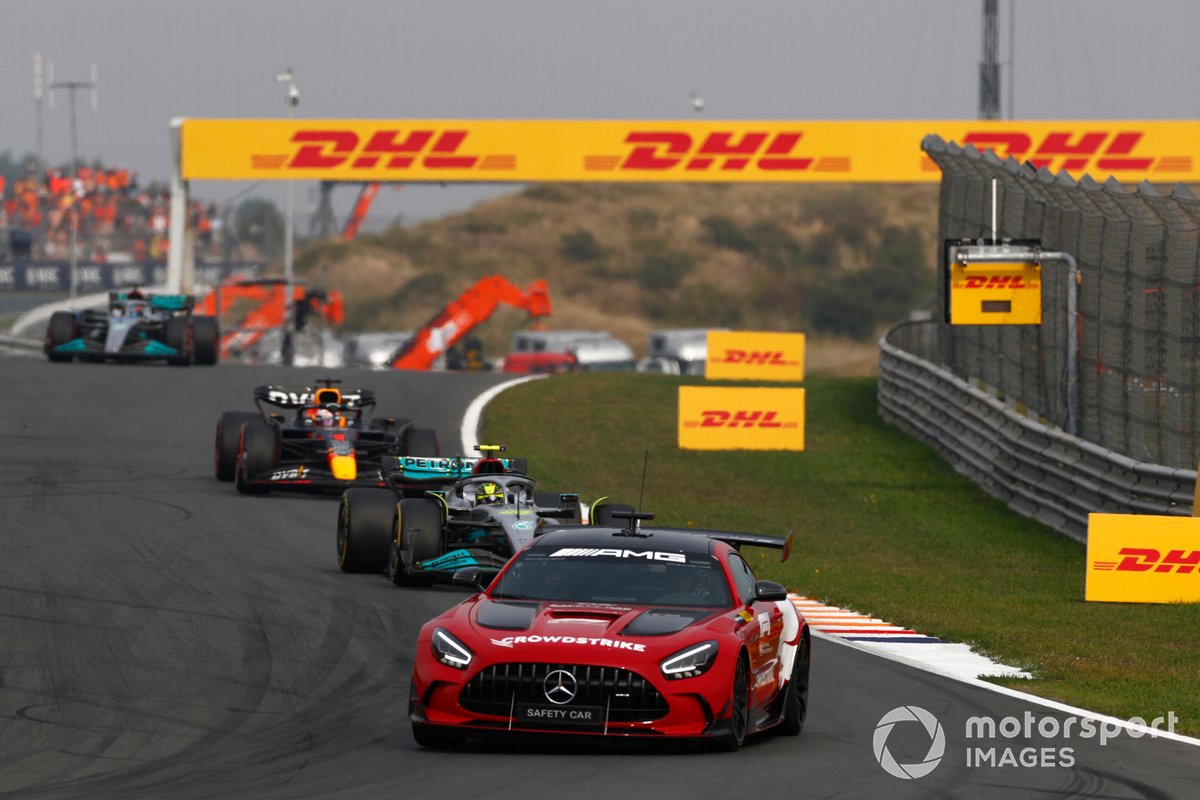
On lap 55, the lapped Valtteri Bottas had lost power aboard his Alfa Romeo and pulled over on the approach to Tarzan – dropping him out of 13th. This then required a full safety car activation so the on-fire car could be shifted, leading to a series of race-defining calls.
First, Red Bull pitted Verstappen from the lead. Mercedes left its cars out – Hamilton cycling into first and Russell beating the long-time leader to second at the second safety car line at the pit exit. But Red Bull had a plan.
“We saw the pace of the Mercedes on the medium versus ourselves on a hard and we felt that with the warm-up [being slower on the harder tyre], we’d just have Max exposed,” Horner explained, knowing that had Verstappen stayed out Mercedes would’ve done the opposite and that in going back to the softs his driver was back on his preferred compound. “So, better to go attack than trying to hang on at the front.”
Russell swapped to softs under the safety car, leaving Hamilton without a rear-gunner for the restart - a move that would secure the younger Briton second
Photo by: Alastair Staley / Motorsport Images
Red Bull was also convinced Mercedes would “leave George out strategically as a rear gunner for Lewis”, per Horner. But it, and others, including Hamilton, were stunned when it did not.
Russell, “losing the tyre [temperature]” had decisively called his team to “put the soft on” the second time by the pits under the safety, which it agreed to very late – in fact just as he reached the pitlane entry line, the whole pack following the safety car through the pits to allow the marshals room and time to get Bottas’s car removed.
“When I pulled past my pitbox I saw the soft tyres were out and I saw it was happening for George and in that moment my heart was sinking,” said Hamilton, as things got very Abu Dhabi 2021-like very quickly.
Mercedes was in a quandary whatever it did here. Horner was “quite surprised” it removed Russell as a potential blocker, but the younger Briton was aware he was losing critical temperatures in an already aged set of mediums, with fresh softs “ready immediately” for the upcoming restart – according to Isola.
Hamilton and Mercedes did not converse on doing what Russell eventually did, but team boss Toto Wolff acknowledged that “on a par with the same tyre, we couldn’t have overtaken the Red Bull with the straightline speed” differences between the draggy Mercedes and slippery, efficient Red Bull. In the race’s speed trap classification, Verstappen hit 203.1mph to Hamilton’s 195.9mph…
Wolff also added: “With Sainz, who had less pace, we weren't really able to pass him at the beginning. So that was the call. Every single day of my life, I'd rather risk everything for winning the race, rather than cementing in second and third.”
So, with lapped cars having been allowed to overtake, Hamilton lined up for the laps 60-61 restart knowing he faced having to hold back Verstappen on fresh softs against his eight-laps-older mediums. He insisted being “late to get to race mode [engine setting]” was no hinderance, but the restart battle just wasn’t a contest.
Verstappen was so fast down the straight he nearly erred in passing Hamilton before the finish line, but in fact judged it to perfection by 0.016s and then barrelled back to first by the Tarzan entry. Home fans delighted; he roared off – gapping Hamilton by 1.7s in a single lap back at racing speed.

Verstappen rapidly reclaimed the lead at the restart and was never headed thereafter
Photo by: Mark Sutton / Motorsport Images
Russell then passed the fuming Hamilton at the start of lap 64. The DRS move “could’ve been a bit nasty”, per the Mercedes works newbie, as “a bit of confusion” meant he “came out [right] just as he [Hamilton] defended”. But a check-up off the gas avoided disaster for Russell and he powered past his team-mate.
Two laps later, Leclerc, who was initially convinced the two Mercedes cars did make contact, likewise did the same. He’d hassled Russell at the restart. There, the recovering Sainz also repassed Perez (the only other driver to face the restart on mediums having been given them at his safety car stop) and set off after their late battle, during which Perez showed he’d not learned from Hamilton’s sensible concession exiting Tarzan much earlier on.
Topping the podium was Verstappen, with the fastest lap set on the second lap post-safety car to boot. His championship lead is now 109 and a second title coronation all but inevitable
Leclerc then followed Russell up to Hamilton and rescued a podium that looked lost to Ferrari due to its unfortunate pre-VSC stop timing.
Topping the podium was Verstappen, with the fastest lap set on the second lap post-safety car to boot. His championship lead is now 109 and a second title coronation all but inevitable.
“It's always special to win your home grand prix,” he concluded. “It was already last year. This year, I had to work for it even more.”

Verstappen laps up the applause from the orange army after securing a 10th win of 2022
Photo by: Alastair Staley / Motorsport Images


Why Britain’s role in Formula 1 endured a troubled start

Why Bottas believes his F1 reserve driver role is the fastest route back to a race seat

Why Norris is now ready for his final exam

The key advantage for Bottas vs Perez in the 2026 F1 return race

Why Ferrari's management is under pressure after its bad start to F1 2025, not Hamilton or Leclerc

Why Red Bull can’t solve its second F1 car problem with a simple paint job

Hirakawa replaces Doohan at Alpine for Japanese GP FP1 outing

How Alonso and Bortoleto can be F1 rivals in a unique driver management deal

Morrow edges Grant as older Formula Fords entertain in Festival support contests

Is MotoGP’s title fight over after the Australian GP swing?

The one aspect of the 2026 US GP that should be a blueprint for F1 2027

Red Bull explains why Verstappen and Hadjar's 'silly' problems won't all be fixed in 2026
Subscribe and access Autosport.com with your ad-blocker.
From Formula 1 to MotoGP we report straight from the paddock because we love our sport, just like you. In order to keep delivering our expert journalism, our website uses advertising. Still, we want to give you the opportunity to enjoy an ad-free and tracker-free website and to continue using your adblocker.


Top Comments