


How Aston Martin has been "aggressive" with its 2023 F1 car design
The buzzword from Aston Martin’s AMR23 Formula 1 car launch was aggression, as it aims to create a design to suit its drivers and new mentality. By taking development paths forged by others while also exploring new ones, can the car match the team’s ambition?

In the creation of its 2022 Formula 1 car, Aston Martin opted to produce a car that could be theoretically developed along multiple different paths. If an early prevailing wind suggested that a certain direction was particularly bountiful, the Silverstone squad could follow that road and develop around it.
As it happened, Red Bull cemented itself as an early favourite and Aston’s design team had the kit to match it. It earned the team “Green Red Bull” taunts in the process, but it nonetheless reacted to the best design path and helped haul the team out of the rut it began the season in.
It’s an idea that has a certain merit, but it was always going to be a compromise; F1 teams rarely flesh out their designs to the idiom “jack of all trades; master of none”. While the AMR22 proved to be a competent midfield runner by the end of the season, particularly in the hands of the retiring Sebastian Vettel, it hardly pulled up any trees either.
The pressure on the team is bigger in 2023. Fernando Alonso replaces Vettel and will expect nothing but the best from the Aston Martin team, while the team’s new factory – due for a move-in date in May – will offer another degree of scrutiny as the team has invested heavily into its infrastructure. And, with a clear and defined direction taking shape with the technical regulations, Aston cannot afford to be cautious.
“The design team was adamant that it wanted to tackle these regulations without compromise,” explained technical director Dan Fallows. “We want to move up the grid and start challenging the teams at the front – and you can’t do that by sitting back and being conservative.
“AMR23 is a significant development of the car we refined in the latter half of 2022 – and we have improved it in every critical area. It optimises the solutions we felt would offer us the most performance, and it embodies the joint vision we have embraced and have built together over the recent months.”
In the feature detailing McLaren’s Monday launch, some of the key themes of 2023’s cars were explored – and these carry over into the AMR23 as well as pioneered by Red Bull and AlphaTauri last year. In that, we’ve got downwashing sidepods placing airflow on top of the diffuser, and the tunnel-shaped cooling outlets on the engine cover – together creating a channel for the airflow to move into.
PLUS: Why McLaren's 2023 may be a building year, despite new F1 car's Red Bull hints
The cooling gills have been stacked on top of that, rather than in the further forward position they occupied on last year’s car. But there’s a key difference between the cars: the sidepods feature Ferrari-style channels that further feed airflow to the rear of the car. It’s not dissimilar to how Alpine merged the two ideas last year, but Aston’s taken the depth to a different level.
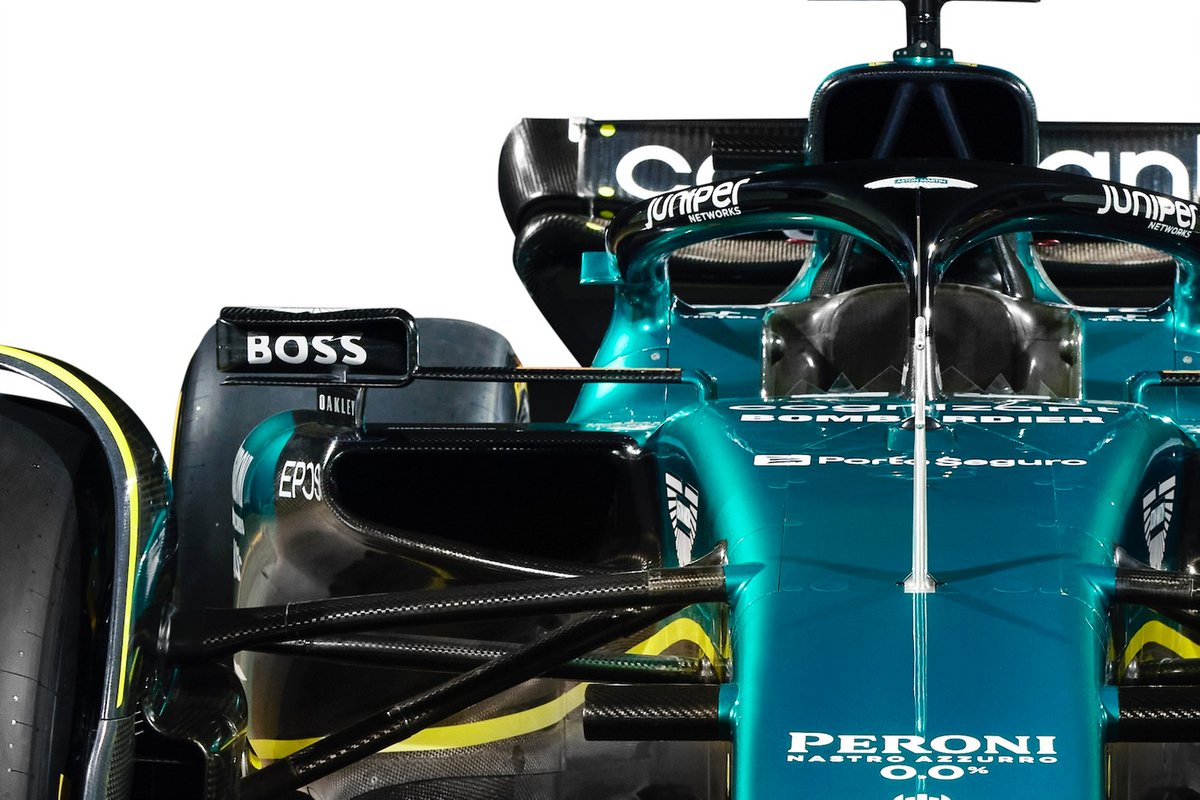
Aston Martin's AMR23 follows a design trend led by Red Bull and used by AlphaTauri and McLaren
Photo by: Aston Martin Racing
The inlet to the sidepods also discards the angled leading edge that the AMR22 featured, and it seems that opting for a higher inlet with a pronounced underbite (a la Red Bull) has become the popular way forward. This feeds into an undercut to expose more of the floor’s upper surface and reduce the path of travel for the air moving around the sidepod.
One area that the team was made to revise focused on the rear wing, as its clever interpretation of the rules to create a more conventional endplate was outlawed. As this design had removed the issue of airflow spilling over the sides and thus created a more effective span width, the designers have had to reacquaint themselves with the problem and have opted for a spoon-shaped mainplane on its launch model. The rear wing will change from race to race, but it’s interesting to see how the team has addressed the knock-on effect of its own ingenious solutions getting banned.
The nose is visually different; last year’s car featured a flat nosecone that blended into the second wing element, but the team has opted for a larger and longer nose that extends down into the mainplane. This nose, similar to that of AlphaTauri and Haas last year, has been sculpted into the leading edge of the wing, and also features modular panels to afford customisability.
Aston Martin proved last season that it could make a car that develops well – this year, it needs the AMR23 to be a fast car that enjoys a similar development trajectory
Fallows explained that this was another area where the team felt it had to be aggressive, and also explained the effect of the rules changes on the design, from the trim to the floor edges to the larger mirrors introduced for 2023.
“I think the things that really stand out from last year are the front end, the front wing particularly, right through to the side pods. These are the very aggressive features that we've been working on, and these are all evolutions, if you like, of the rules as they were,” Fallows explained.
“The new rules that have come in for this year [15mm cuts to floor edges and fences], they're not particularly big and I think visually that a lot of the cars will be quite similar, but there are some fairly significant features - for example, the mirrors are much larger than they were last year.
“That's been introduced to make visibility obviously a lot better for the drivers. As an aerodynamicist I could say I'm not very happy about that , but you know, I suppose they need to be able to see occasionally!”
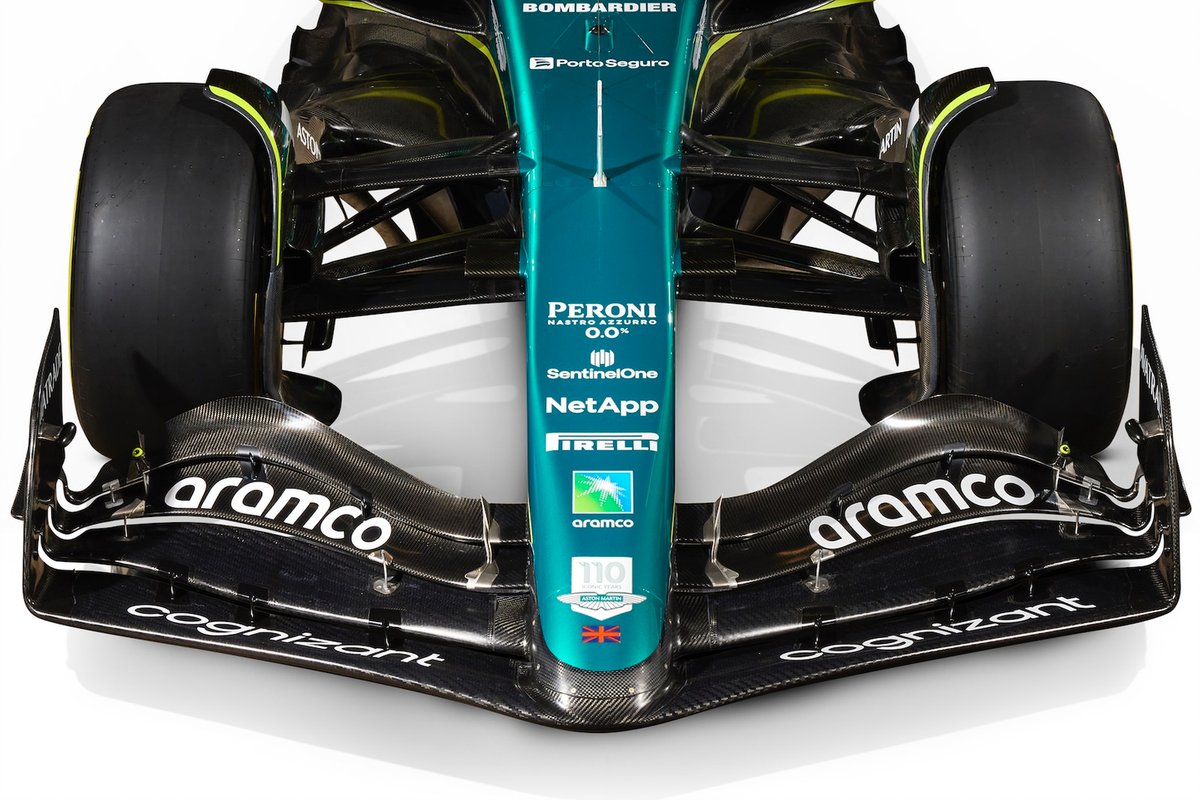
Aston Martin has gone for a more aggressive design with the AMR23 compared to its predecessor
Photo by: Aston Martin Racing
Although only in launch spec, the majority of the front wings seen so far are ‘inboard loaded’, meaning that the wings are at their largest in the centre. While it’s fair to say that Aston’s wing is lower in the centre compared to the 2022 car, no longer featuring the raised nose tip, there still seems to be a focus on loading the centre of each wing flap more. The outboard remains unloaded to promote outwashing, and the wing endplates have a small cut-out at the rear to elevate this.
Explaining the effect of the AMR22’s development on the new car, Fallows felt that the new car was an “aggressive” evolution of the previous model, and that the team wanted to keep its strengths on board.
“We went into this year trying to be bold and aggressive, to try to take on the lessons from last year. We did make quite a bit of progress through AMR22. We wanted to make sure that this is a sensible evolution of that, but it also gives us a really good platform to develop on,” he enthused.
“But, at the same time, we wanted to make sure that it was aggressive: to give a big challenge to all of the engineering team to make sure that they really push themselves. And I think you can see that in the design of the car.”
With Alonso cracking the whip from within, the engineers will continue to feel that challenge throughout the season. While every bit as motivated as he was in his championship-winning seasons, the Spaniard’s career in F1 is certainly closer to its climax than its beginning, and he wouldn’t dare countenance the idea that his final win was already achieved nearly 10 years ago. That, and team owner Lawrence Stroll is going to want to start seeing returns on his heavy investment as he pulled the team out of the mire.
Aston Martin proved last season that it could make a car that develops well – this year, it needs the AMR23 to be a fast car that enjoys a similar development trajectory. If it manages that, Alonso can be trusted to put the car beyond its capabilities, while Lance Stroll has to reduce the massive variance in his results and find levels of consistency nearer his previous peaks.
The new facilities won’t bear any fruit until it comes to the development of the 2024 car, but Aston Martin needs to break out of a couple of stagnant years on-track and continue to press on with its planned ascent. Off-track, the team has been building up its strength – on track, it needs to show those signs of aggression. Thankfully, it's now got the driver to do it...

Can the AMR23 deliver on what is demanded from the drivers and the team bosses?
Photo by: Aston Martin Racing


FIA expects F1 races in Qatar and Abu Dhabi to run as planned

Why Piastri has struggled to show his best with this year's McLaren MCL40

Lights, Camara, action: How Haas picked F1's latest rookie for 2027

Horner's inside story of how Red Bull built its own F1 engine

Why Mercedes' latest 2026 F1 update is no downgrade

Singapore Grand Prix Driver Ratings 2026

What we learned from the 2026 F1 Singapore GP sprint race and qualifying

The political minefield set out by F1’s recent cost-cap grievances

FIA set to close F1 cost cap loophole with new rules

Norris promises to make "better decisions" following fresh talks over Singapore GP clash

FIA expects F1 races in Qatar and Abu Dhabi to run as planned

Top five roles on Motorsport Jobs this week
Subscribe and access Autosport.com with your ad-blocker.
From Formula 1 to MotoGP we report straight from the paddock because we love our sport, just like you. In order to keep delivering our expert journalism, our website uses advertising. Still, we want to give you the opportunity to enjoy an ad-free and tracker-free website and to continue using your adblocker.


Top Comments