


Five F1 2026 tech clues from Red Bull's surprising RB22 renders
Red Bull and Racing Bulls launched their F1 2026 liveries in Detroit on a standard show car - but the subsequent renders offered much more detail on bespoke models. While we don't expect either to be representative of the finished cars, they demonstrate where next year's development opportunities are

Autosport Explains
Our experts decode the most important stories in motorsport.
Keen anticipation has brought us to this point; now, 2026's Formula 1 launch season has begun. Red Bull and Racing Bulls were the first teams to break out of the gate, presenting their new(ish)-for-2026 liveries as part of a launch event with Ford in Detroit.
For the event itself, this was ostensibly true; Red Bull and Racing Bulls put their new schemes onto a 2026 show car, produced by Memento Exclusives, and demonstrated their revised liveries to the audience. Red Bull turned the clocks back and reintroduced a metallic blue scheme for the first time since 2015, while Racing Bulls made a few minor tweaks to the white livery it introduced last year. After the marketing spiel, driver chat, and glitzy reveals - surely, that was it?
Not so. Both teams followed up on their livery launches with some additional renders using a different model - and, somewhat unexpectedly, these genuinely offer some value in revealing some of the many development opportunities presented by the 2026 aerodynamic regulations. While Audi's clipped-up Barcelona shakedown presented some broad brush strokes, the two breeds of Bull have elucidated some of the finer details.
The usual caveats remain: these sets of renders are likely to be early-specification models, and less developed than the real cars we see on track in Barcelona and Bahrain. However, there are some clear trends and takeaways that will likely repeat across many of the other 2026 designs as they emerge.
1. Different front wing approaches
Firstly, it's lovely to see a lack of front-wing clutter. Restricting teams to just a three-element wing naturally evokes comparisons to the designs seen pre-2009; a world before outwash (the wings pushing airflow outwards around the front tyre) became king. The regulations' positioning of the front wing endplates naturally railroads teams into channelling the bulk of the airflow closer to the centre-line of the car - inwash rather than outwash.
While both Red Bull and Racing Bulls have produced sweeping mainplanes, Red Bull's wing has a more pronounced spoon-shaped central element; it's using the central part of the wing for more downforce and to wash upwards to the underside of the nose. In doing so, it can use the section of the wing either side to set up the flow for the floor - the front wing not only produces downforce, but also develops a flow field that needs to link up seamlessly with the rest of the car.
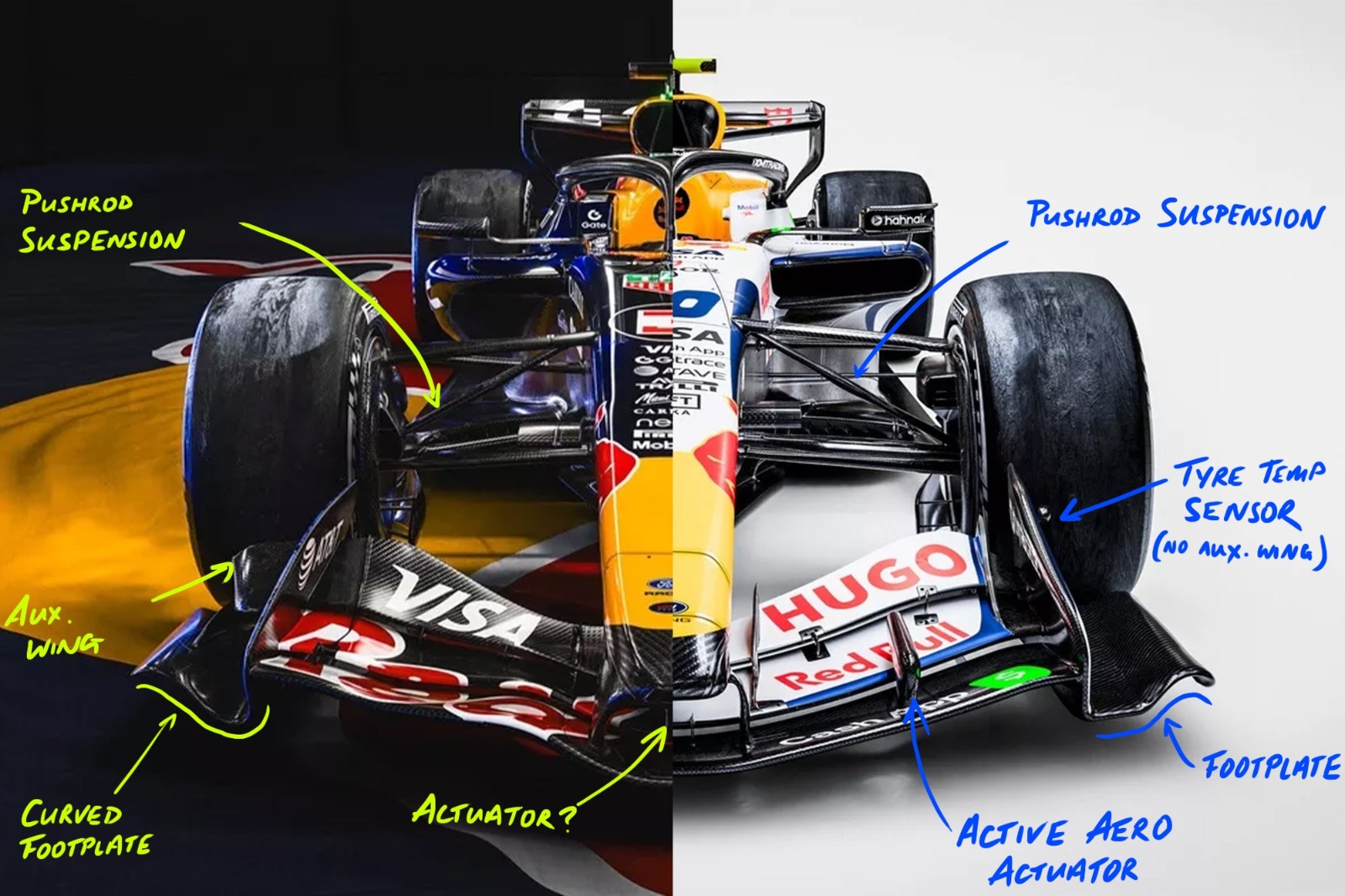
This rendition of the RB22 also employs a footplate with more curvature, with a small inwashing flow conditioner placed topside, and an auxiliary wing flap ahead of the tyre. Between the wing mounts, I believe the active aero housing sits underneath the nose and operates the front wing flaps here.
Racing Bulls' wing appears to be more uniform across the span of the wing, and uses a squarer footplate to resolve in a tighter 'tunnel' at the tips - which will roll up a vortex to control the wake around the wheel. The auxiliary winglet does not appear, instead replaced by a tyre temperature sensor.
Rather than the presumed-central location of the front wing active aero device, there appears to be two separate actuator housings either side of the wing. Presumably, this won't hurt the front-end flow too much; the nose is also squarer, versus the Red Bull's smoother blend into the wing mounts.
2. Push-rod suspension rules again
Many years ago, an engineer with vast experience in F1 told this writer that suspension geometries were, structurally, pretty settled - development was all about the aerodynamic form. However, the 2022-25 regulations introduced myriad experiments with suspension layout to control ride heights and reduce centre of gravity, and this resulted in low-line upper wishbone legs and the use of pull-rod suspension around the grid.
Red Bull and Racing Bulls use a common suspension package, but it's interesting that both teams - who also used pull-rod front suspension last year - have reverted to a push-rod. There's likely a few reasons for doing so - mostly aerodynamics, but with the ease of making ad-hoc tweaks in the pitlane. The new geometry around the front end likely makes the pull-rod a little less viable, from a packaging standpoint.
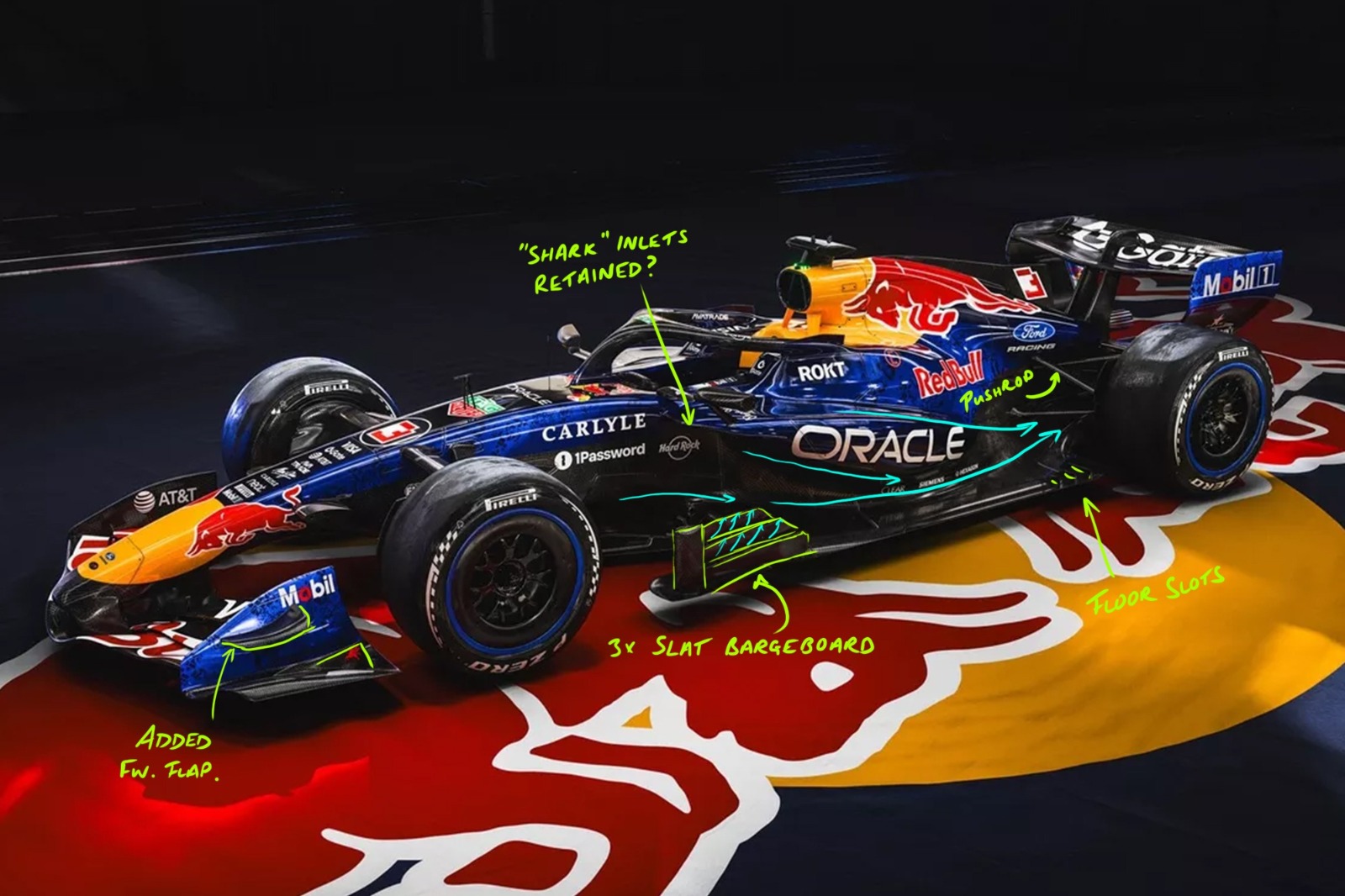
Although the suspension is more 'conventional', the rear leg of the upper wishbone is nonetheless mounted to the chassis relatively low down, so either perhaps some degree of ride control remains in vogue - or it's, again, largely aerodynamic to help bring airflow away from the sidepod inlet.
Push-rod suspension remains in place around the rear, however; although most teams had gravitated to a pull-rod rear between 2009-2021, it might be another aerodynamic consideration to keep the airflow around the Coke bottle section clean and to open up the diffuser space.
3. Bargeboards open to pre-2022 exploitation?
When it was announced that F1's 2026 cars would reinstate some variation on bargeboards, there was a small rippling of discord; look at any pre-2022 bargeboard package, and one can imagine why the 'dirty air' problem had become so widespread. Although captivating in an abstract, artistic sense, their sole purpose was to gather every molecule of air shed by the tyres and turn it outwards - sending the driver behind a considerable pocket of turbulence to drive into.
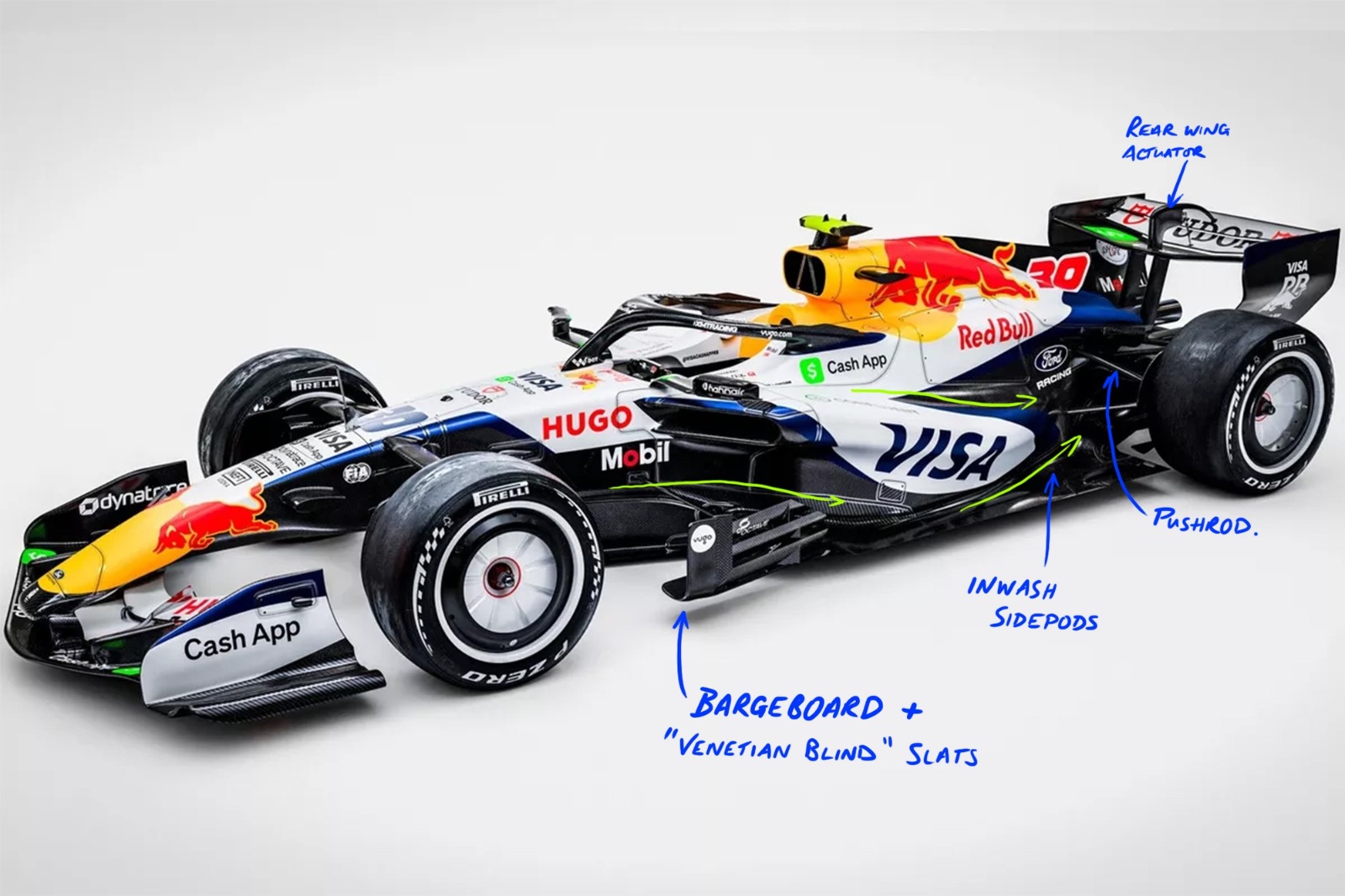
Although the scope of the new bargeboards is different, and has been inclined to follow the FIA's diktat of retaining inwash, both Red Bull and Racing Bulls have demonstrated how the two-panel system can be open to interpretation. The lead bargeboard panel for both is just a single upright piece, although Racing Bulls has demonstrated how this can be sculpted into the corresponding floor mount. Secondly, the two teams have opted for the Venetian blind solution - which gives the bargeboard a little more opportunity to 'comb' any upward wake turbulence into something a little bit neater. Racing Bulls' design also has a stay mounted to the side of the chassis.
As long as the bargeboard slats remain as a single contiguous design, then it's perfectly legal to follow that route. Yet, it rather suggests that this will be another key vein of development as teams find ways of making that region of the car more effective at managing the turbulent air pouring off the tyre. Let's just hope it doesn't become a contributor to further wake problems...
4. Coke bottle gets its fizz back
Although a few teams attempted to apply inwashing sidepod designs to their 2022 cars, aiming to reduce the frictional losses of airflow as they got to the back of the car, it became apparent that the downwash sidepod slopes pioneered by Red Bull became the most powerful way to get the rear of the floor working. By keeping a steady supply of airflow across the entirety of the upper floor surface, the pressure differential between the top and bottom surfaces could be massaged slightly more - allowing the underbody to produce more downforce.
But, since the cars are narrower, and there's no long Venturi tunnels to consider, teams can start shortening the airflow paths once again. While there's still an element of letting airflow wash downwards over the sidepods, their trailing edge now folds more neatly into the rear end bodywork. And, while airflow is still needed over the diffuser's top surface, the car's geometry allows you to downwash and inwash at the same time.
This gives the rear-end 'Coke bottle' - so named, because of the curvature's equivalence to a receptacle containing Red Bull's rival soft drink - a bit more authority. It's all a finely choreographed dance; the floor needs feeding, the air needs to be kept away from the rear tyres, and teams can start managing that transition a bit sooner.
5. Rear wings seem to be tightly controlled... for now
Of what we've seen so far, the rear wing looks to be the most settled part of design. You've got the tapered endplates, the double under-wing mounts, and the reversion to a three-element wing which is operated by the active aero kit. Red Bull and Racing Bulls have shown their wings to have a pretty even distribution in size between the top two elements, but one might imagine this would change depending on the circuit. That said, the switch between two different wing modes might not place as much emphasis on making such modular changes; in other words, there might be less difference between the Monaco and Monza specs.
The challenge will lie in making a wing that works across both states well, which will force engineers into a world of iteration and compromise. Plus, the removal of the beam wing gives teams fewer ways to trim out the rear end downforce - an aspect that McLaren in particular liked to tinker with.
While these are likely not the finished products, the digital renditions of the RB22 and VCARB 03 at least offer us food for thought - and where the teams are likely to find their development paths. From a purely aesthetic standpoint, I'm liking what I'm seeing so far.

Red Bull rolled back the years with its metallic blue hue
Photo by: Red Bull Content Pool


Lights, Camara, action: How Haas picked F1's latest rookie for 2027

Horner's inside story of how Red Bull built its own F1 engine

Why Mercedes' latest 2026 F1 update is no downgrade

Singapore Grand Prix Driver Ratings 2026

What we learned from the 2026 F1 Singapore GP sprint race and qualifying

The political minefield set out by F1’s recent cost-cap grievances

What caused Mercedes' pace deficit at Sepang despite upgraded W17?

Three kings: F1's generational stars shone at Sepang

How Toyota destroyed the competition to seal the WEC crowns

McLaren retains Fornaroli as F1 reserve and hands him WEC programme for 2027

How Andrew Jordan realised his teenage rallycross dream

Inside the competition building F1’s future engineering talent
Subscribe and access Autosport.com with your ad-blocker.
From Formula 1 to MotoGP we report straight from the paddock because we love our sport, just like you. In order to keep delivering our expert journalism, our website uses advertising. Still, we want to give you the opportunity to enjoy an ad-free and tracker-free website and to continue using your adblocker.


Top Comments