


Why F1’s approach to pole winners with grid penalties undermines drivers
OPINION: Valtteri Bottas is credited with pole position for the 2021 Turkish Grand Prix, despite being beaten in qualifying. This is another example of Formula 1 and the FIA scoring an own goal by forgetting what makes motorsport magic, with the Istanbul race winner also a victim of this in the championship’s recent history

Motivation is a powerful tool for athletes.
Some think back to past slights or wrongs they have endured (even tiny ones most people would brush off) to drive them on to success. Others are determined to reward faith shown by supporters or family. Some target specific milestones.
Sometimes what motivates a sportsperson is out in the open. Other times its hidden – after all, it’s easy for targets to become distracting. Focus too much on a specific goal and you just might miss it. But don’t give it enough attention and it might slip away. There’s a tough balance to strike.
There’s a curious anomaly in Formula 1, which threads through the motivation for drivers at each grand prix. In qualifying, every driver wants to start as high up the grid as possible. The Q1-Q2-Q3 session isn’t as meaningful as the points-awarding race, nor as glamorous as a ‘grand prix’, but the desire to do well there is clear. It aids the main objective.
There’s even an incentive at the end – the fastest driver gets credited with securing ‘pole position’. Except sometimes, through no fault of their own, they don’t. And this is faintly ridiculous.
Let’s get something out of the way first. Yes, ‘pole position’ is the first spot on the grid and is worded as such in the rules and there are plenty of killjoys with anonymous social media profiles ready to point that out. But it’s much more than that and that is what makes motorsport magical. If people didn’t care about what could be argued as the mundane then F1 (and all sport) is in serious trouble. Passion matters in this context.
F1 is so complex it can be difficult to equate its many aspects. Succeeding in a Haas is rather different to succeeding in a Mercedes or Red Bull. That’s why George Russell’s qualifying achievements for Williams are rightly lauded – that’s the best time for that combo to shine, when the race will throw up more hurdles the teams with better cars can traverse more easily.

George Russell, Williams FW43B
Photo by: Andy Hone / Motorsport Images
Securing pole with a blistering lap should be celebrated and is. So, why then does F1 get itself into a farcical situation where drivers with grid penalties lose a statistic that can mean so much to them personally or even materially (sponsorship or contract rewards)?
Yes, the rules have been developed to the point that exceeding the allocation of certain car parts or bad driving needs to be punished with grid drops to try and ensure legality. But that surely shouldn’t impact the tangible, real reward of a driver being able to point to a certain pole stat and say ‘I did that, me – I was the best in that session’.
This situation is back in the spotlight because at last weekend’s Turkish Grand Prix, Valtteri Bottas got his 18th F1 pole – equal with Mario Andretti, Rene Arnoux and Kimi Raikkonen. Except he didn’t top qualifying. Lewis Hamilton did – only he was always set to drop 10 places for the race after taking a fourth internal combustion engine of 2021 ahead of practice. And those drivers involved, plus Max Verstappen, rightly mocked this turn of events.
If it can have a much-mocked pole position trophy physically awarded each weekend, which was given to Hamilton and not Bottas in Turkey (the world champion signing it for his team-mate), an asterisk in the record books isn’t exactly complex
When asked how it felt to have the Istanbul pole taken away, Hamilton replied: “Well, I still… I get recorded the pole, right? No? Ah, dammit.” Then the following amusing exchange took place.
Bottas: Do I get the pole?
Hamilton: So, he gets the pole.
Verstappen: I just don’t get that!
Bottas: So, you need to give the [promotional Pirelli trophy] tyre to me.
Hamilton: You can have the tyre. I don’t know where they go.
Verstappen: Lewis has a few spare.
Bottas: I don’t think it’s fair though.
Hamilton: No, it’s alright.
Bottas: Even though it was my best pole.
When Autosport followed up on this, asking if F1 and the FIA should look at finding a way to ensure great ‘missing’ qualifying performances are recorded in the history books, Hamilton said “I don’t think the penalty should affect that”, but was also dismissive “I don’t really care, to be honest”.

Lewis Hamilton waves from parc ferme after securing 'pole'
Photo by: Jerry Andre / Motorsport Images
Hamilton often makes similar comments about other milestones, such as win totals, which one can assume is his honed motivational approach – to deliberately play them down to makes sure he reaches them. We can be fairly sure Hamilton cares considerably, or he wouldn’t still be breaking records.
Bottas was typically calmly measured on the topic, while Verstappen was as forthright as ever, saying: “The guy who does the fastest lap should deserve pole position.” And he’s right.
The need to ensure the sporting rules are enforced must stay, of course, but even with the grid drops surely F1, which is so utterly fond of innovation – in every area, including self-aggrandisement – can come up with a way fixing this wrong?
If it can have a much-mocked pole position trophy physically awarded each weekend, which was given to Hamilton and not Bottas in Turkey (the world champion signing it for his team-mate), an asterisk in the record books isn’t exactly complex. Nor is calling the winner of a sprint race exactly that, and not giving them the pole stat when the Q3 victor gets ignored if they don’t win said sprint race.
That debate is already being had, and Bottas has been particularly hard done by here given he topped 2021 Monza qualifying and won F1’s second sprint race but still got no pole stat thanks to his engine-change grid drop for the grand prix. Similarly infuriatingly, Hamilton’s immense display in Silverstone ‘Friday’ qualifying earlier this year is also shamefully missing from the record books.
On four other occasions F1 drivers have gone to the limit to secure pole and it is forgotten.
Kimi Raikkonen lost pole at the 2005 Italian GP with a 10-place grid drop for an engine change – the first example of engine-change rules impacting a driver that topped qualifying. Fernando Alonso was docked five places for his actions blocking Hamilton in the McLaren pits at Budapest 2007. Michael Schumacher famously never lined up on the 2012 Monaco pole he’d secured as he had to serve a five-place grid penalty for clattering Bruno Senna in Spain the race before. And Verstappen lost the Mexico 2019 pole for failing to slow for a yellow flag, which was shown because of Bottas’s Q3 crash.
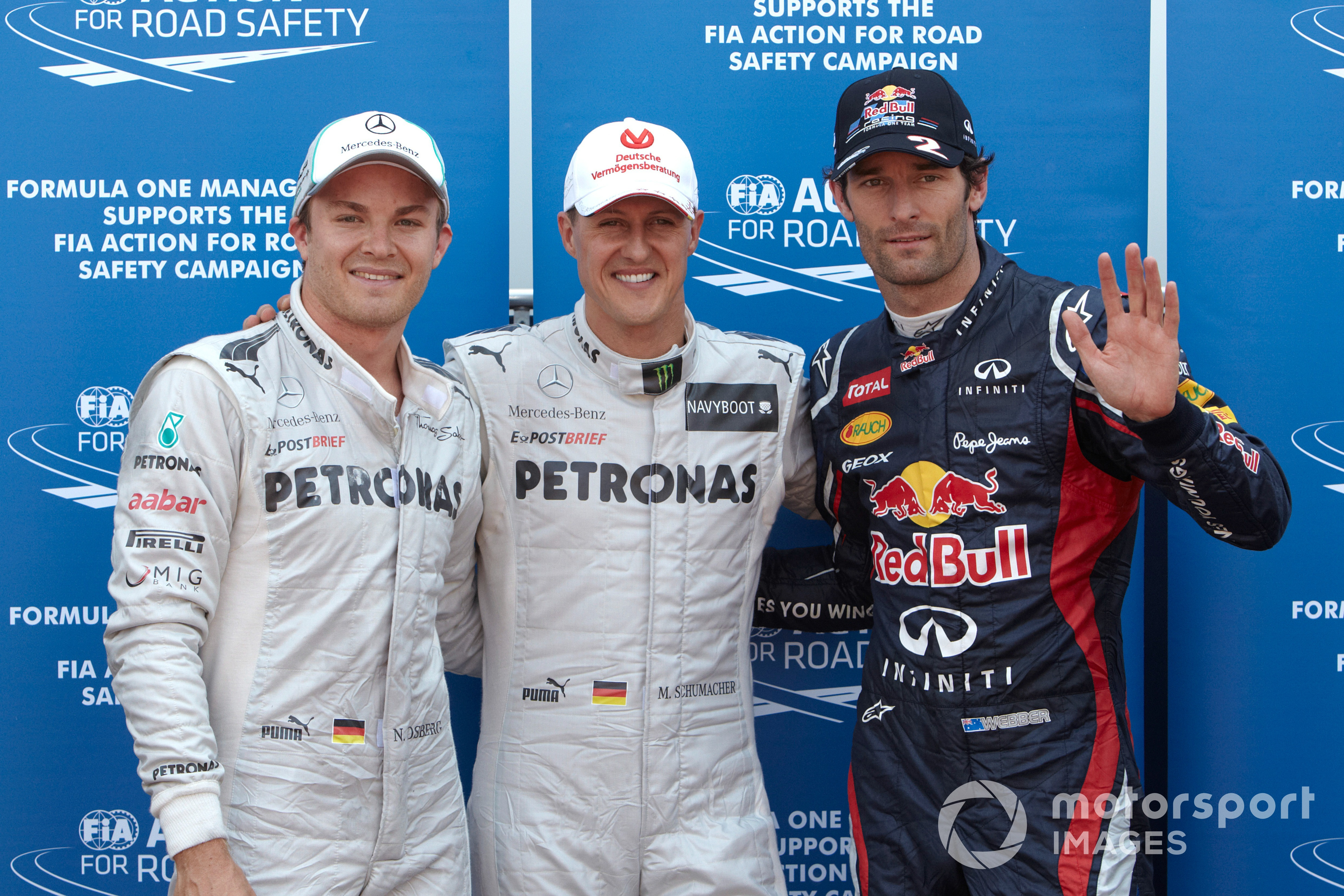
Michael Schumacher takes top spot in qualifying for the 2012 Monaco GP before serving a five-place grid penalty
Photo by: Steve Etherington / LAT Images
Now, the Alonso and Verstappen lost poles are anomalies within anomalies because they didn’t abide by the sporting rules and so were punished accordingly. But it is a travesty that Schumacher and Hamilton didn’t get the poles for Monaco 2012 and Turkey 2021. In the former’s case, it would have been one more, final, pole in a glittering career taken in well-executed circumstances at a legendarily tough track. That means something.
This whole argument might be trivial to some, but motorsport is multi-faceted and brilliant for it. To forget great performances in the face of cold regulation when a driver is not at fault is a wrong that just should be righted.

Lewis Hamilton, Mercedes W12
Photo by: Zak Mauger / Motorsport Images


Why Britain’s role in Formula 1 endured a troubled start

Why Bottas believes his F1 reserve driver role is the fastest route back to a race seat

Why Norris is now ready for his final exam

The key advantage for Bottas vs Perez in the 2026 F1 return race

Why Ferrari's management is under pressure after its bad start to F1 2025, not Hamilton or Leclerc

Why Red Bull can’t solve its second F1 car problem with a simple paint job

Hirakawa replaces Doohan at Alpine for Japanese GP FP1 outing

How Alonso and Bortoleto can be F1 rivals in a unique driver management deal

Portugal to be absent from WRC 2027 despite date agreement

Whether Baku was Red Bull's last realistic opportunity of winning in F1 2026

Why there’s no perfect solution to the WEC safety car conundrum

Keen and Bryant snatch last-gasp Spa Six Hours win
Subscribe and access Autosport.com with your ad-blocker.
From Formula 1 to MotoGP we report straight from the paddock because we love our sport, just like you. In order to keep delivering our expert journalism, our website uses advertising. Still, we want to give you the opportunity to enjoy an ad-free and tracker-free website and to continue using your adblocker.


Top Comments