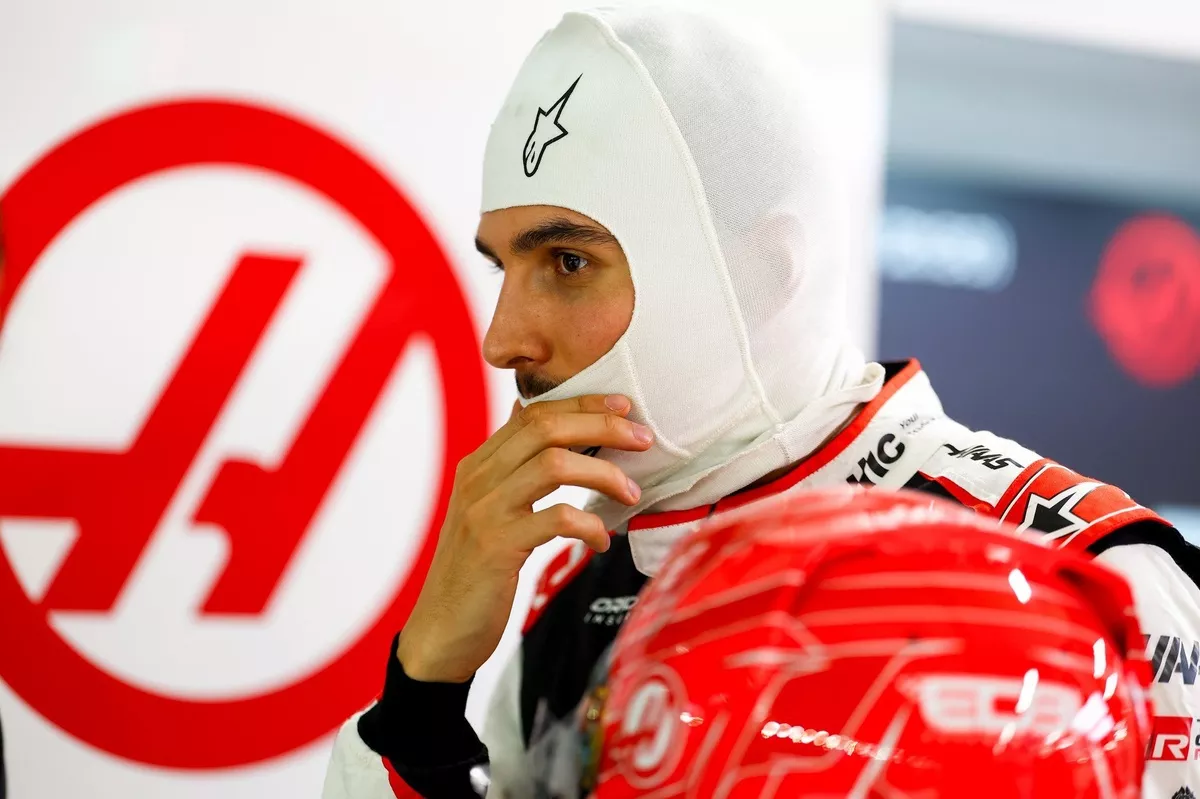


Does Toyota's tie-up with Haas indicate it's edging back towards F1?
Having fallen short in its previous endeavours as a full works team, the Japanese manufacturer now appears to be dipping a toe a little deeper with this alliance

It was almost quarter of a century ago when Toyota embarked upon its first dalliance with Formula 1. And, for all the capital spent in the prelude to its 2002 debut – a never-raced V12 engine, mothballed when F1 switched exclusively to V10s, and a full year spent shadowing the F1 calendar with an overweight test mule – the Japanese manufacturer never found a foothold in the championship.
Commercial bluster, underpinned by the billions spent, did not echo reality and its potential was obscured by excess internal bureaucracy and persistent tinkering with its managerial structure. Toyota’s F1 tenure lasted just eight seasons, before retreating to its roots of sportscars and rallying.
It didn’t seem possible that a return to F1 would ever sit upon Toyota’s horizon; once bitten, twice shy, and all the rest. It wanted to do F1 its way, but this proved immiscible. Like other automotive companies of the time, Toyota and Ford were perhaps the worst offenders in bogging down development in their labyrinthine hierarchical structures.
Attitudes have changed and Toyota’s racing operations work very differently today under the Toyota Gazoo Racing umbrella. When the marque announced its technical tie-up with Haas’s F1 team in late 2024, it gave Toyota an F1 ‘in’ for the first time in 15 years – although it was keen to draw the line at the ‘technical’ part.
Toyota wanted an environment in which it could train engineers for its motorsport involvements elsewhere, and Haas wanted to set up a testing of previous cars (TPC) programme of its own. Thus, Haas and Toyota’s work on the TPC project appeared to be an extracurricular sense of symbiosis.
That being said, Toyota’s involvement does seem to be increasing, albeit steadily. Having presumably learned expensive lessons during its original F1 stay, where its massive outlay effectively amounted to lighting billions of yen on fire, Toyota does appear to be exercising prudence as it expands its involvement.
This has culminated in Toyota’s title sponsorship deal with Haas now taking effect, replacing money transfer company MoneyGram for 2026. In a conveniently muted fashion, the American squad will race as TGR Haas F1 Team this season; certainly, it’s less unwieldy than ‘Toyota Gazoo Racing Haas F1 Team’ but neatly economical with the use of the Toyota brand name.

Toyota's first dip into F1 produced moderate success before it withdrew amid the global financial crisis
Photo by: Getty Images
That’s also handy, in the sense that Haas relies on another manufacturer for much of its infrastructure: Ferrari. Ever since Haas joined the F1 grid a decade ago, Ferrari has been a key component of the team’s growth. It has supplied powertrains and other transferable components, designers, drivers, wind tunnel access, and use of the simulator at Maranello.
This has suited Haas just fine, allowing it to set up and scale up a full F1 team while shortcutting some of the investments required, but largely at the cost of remaining tethered to the Ferrari ecosystem. It’s a perfectly cromulent situation to sit within but, if the team ever wished to seek out its own independence, it becomes a difficult task to extricate itself.
In aligning with Toyota, Haas does have the opportunity to strike out on its own – should it wish to, of course. Toyota is involved in the development of Haas’s new – and long-awaited – simulator, an asset it can use to its own advantage in training drivers and engineers.
If the FIA produces something to Toyota’s taste, then it has a ready-made alliance with Haas with which to move forward as a works partnership
The TPC days will continue, following Sho Tsuboi’s outing in the 2023-spec Haas last season, and the addition of the simulator will be useful to benchmark the racers occupying Toyota’s ‘Driver Challenge’ programme. That includes two-time World Rally champion Kalle Rovanpera, who makes his switch to single-seaters for this year.
Of course, Toyota will not be developing a powertrain for F1’s 2026 regulations. However, the expected brevity of the ruleset before F1 transitions to something presumably less complex gives Toyota an opportunity to keep its hand in. If the FIA produces something to Toyota’s taste, then it has a ready-made alliance with Haas with which to move forward as a works partnership.
It’s almost as though entering F1 quietly through the back door, rather than battering down the front and loudly stumbling through the entrance in a flurry of disappointment like last time, is a good idea. Will the car in front finally be a Toyota?

This article is one of many in the monthly Autosport magazine. For more premium content, take a look at the February 2026 issue and subscribe today.

Haas and Toyota’s TPC outings will continue – here Tsuboi sets off at Fuji last August


Horner's inside story of how Red Bull built its own F1 engine

Why Mercedes' latest 2026 F1 update is no downgrade

Singapore Grand Prix Driver Ratings 2026

What we learned from the 2026 F1 Singapore GP sprint race and qualifying

The political minefield set out by F1’s recent cost-cap grievances

What caused Mercedes' pace deficit at Sepang despite upgraded W17?

Three kings: F1's generational stars shone at Sepang

Bahrain Grand Prix in Malaysia Driver Ratings 2026

Camara over Ocon - did Haas make the correct call for F1 2027?

Camara to make F1 debut as Ocon's replacement at Haas in 2027

Mekies under the microscope: How different is his leadership at Red Bull from Horner?

Rwanda turns to F1 as it moves forward from a chequered past
Subscribe and access Autosport.com with your ad-blocker.
From Formula 1 to MotoGP we report straight from the paddock because we love our sport, just like you. In order to keep delivering our expert journalism, our website uses advertising. Still, we want to give you the opportunity to enjoy an ad-free and tracker-free website and to continue using your adblocker.


Top Comments