


Can F1's Madrid street race avoid the fate of Valencia’s white elephant?
OPINION: Madrid's long-proposed vision to host a Formula 1 race in the coming years has finally come to fruition, after penning a 10-year deal to stage the Spanish Grand Prix from 2026. While the event has been talked up as being nothing but positive for city and country, F1 has a stark reminder in Spain of what could potentially go wrong if it's not careful

A street race around a vibrant Spanish city to boost F1’s image and bottom line. Optimism about a boom of spectator interest off the back of a Fernando Alonso hype train. Headline talk of there being a mammoth economic boost to the local area. And all the above without a single penny coming from the taxpayer. Everyone is a winner, aren’t they?
Formula 1’s announcement of a new home for the Spanish Grand Prix from 2026 was all glitz and glamour on Tuesday, as Madrid officials rolled out the red carpet and the musicians to announce that it had grabbed the race off Barcelona. All the soundbites coming out of the IFEMA venue near Madrid’s international airport, around which the F1 race will be held, were of a bright new era for F1 that will capture fan and commercial interest over its 10-year contract.
But you do not have to go far back in the history books, or even go on too long an express train ride out of Madrid down to the coast, to realise that Spain and F1 have been here before – with the ultimately doomed Valencia Grand Prix project. Back in 2007, then F1 supremo Bernie Ecclestone announced that Spain would have a second race as he had reached a deal with the Valencia regional government for a street circuit around its new America’s Cup port.
Having been negotiated with regional premier Francisco Camps, the original seven-year deal was going to bring huge tourism to the area, and lead to a massive economic boost. Plus, the financial injection that the event brought would help fund ambitious property redevelopment near to the circuit. Best of all, though, was that this would all come without the need for taxpayer money.
As Camps was quoted as saying to Spanish media at the time: "It is good for Valencians, for the Valencian Community and for Spain; and it will not cost the public coffers a single euro."
Ambitions and reality do not always meet, though, and the Valencia race ultimately fell far short of its grand vision. It was mired in political shenanigans from the off, as Ecclestone initially went public and said the contract would not be honoured if Camps did not win forthcoming elections. Opposition parties piled in with the criticism, as they suggested the whole deal was aimed at influencing voters.
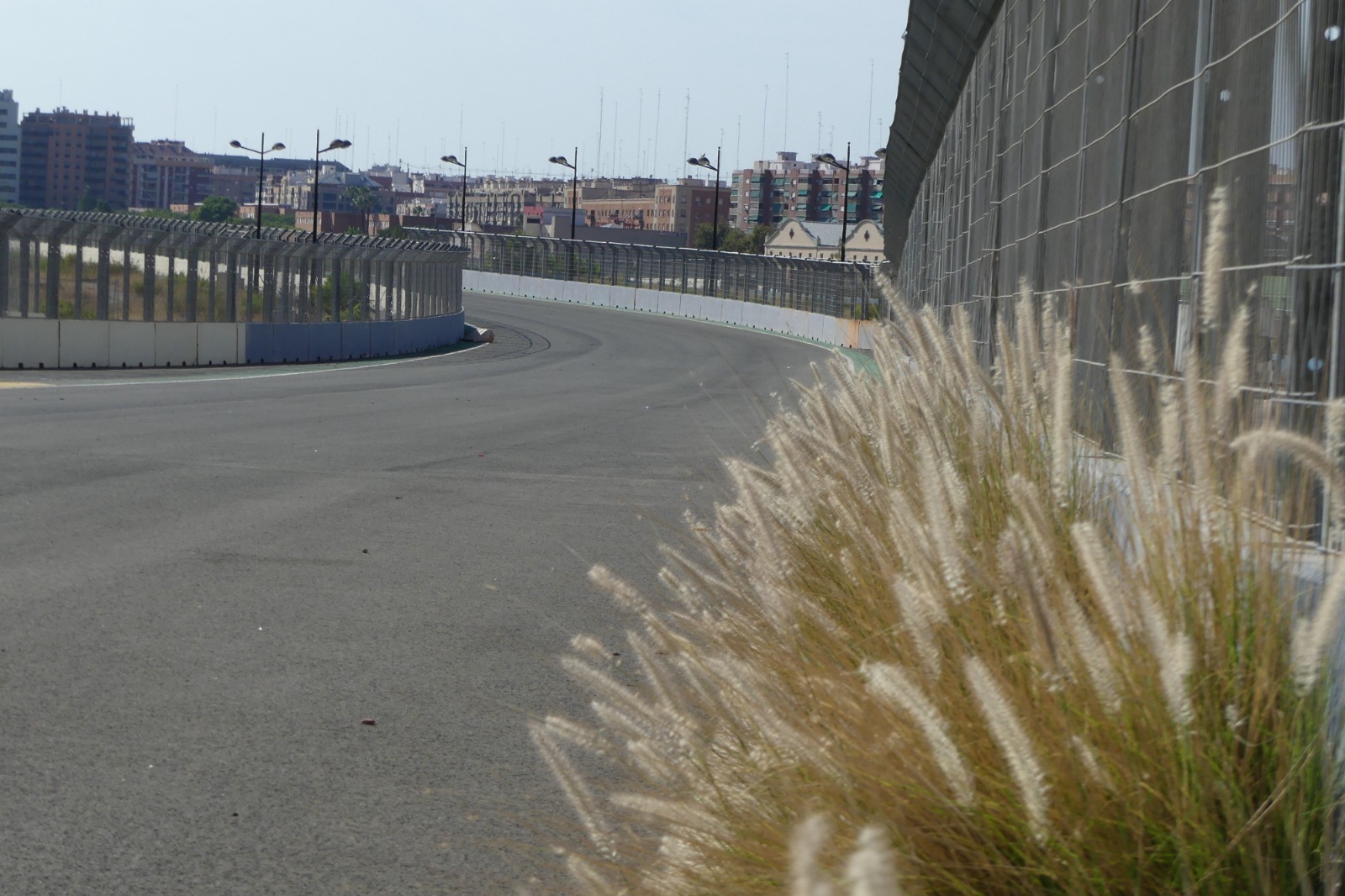
Photo by: Jonathan Noble
The old Valencia F1 track - that was meant to not cost the tax payer anything - lies as a crumbling reminder of how things can go wrong
The race itself, despite that barnstormer in 2012 when Fernando Alonso charged from 11th on the grid to grab a sensational victory in what would be its final event, did not grab the fan interest hoped for.
PLUS: When Alonso triumphed through chaos to relieve a nation
The regional benefits ended up to not outweigh the costs of holding the race. Local politicians, who saw the government ending up having to foot much of the bill, estimated having to bankroll more than €200m by the time the contract was terminated before the 2013 event.
The dreams of a huge redevelopment in the area were derailed by Spain’s real estate crash at the time, while Camps resigned in 2011 amid a corruption investigation that would ultimately lead to a not guilty verdict. Visitors to the Valencia port now can still see evidence of the track, but it is in ruins. Some of it is locked behind fences, and much of the derelict venue is overgrown and full of litter. Its only modern sporting use is that some of the catch fencing has been turned into five-a-side football pitches.
"It’s a nice problem to have, to have multiple cities – some in the same country – wanting to host a grand prix. It shows the value of our proposition. But we need to keep focused on the reason for our success and make sure we aren’t complacent" Stefano Domenicali
While the Valencia GP story ended in wasteland, the optimism surrounding its launch shares a lot of similarities to Madrid right now – and should at least act as a reality check on thinking that it will be a guaranteed success. Madrid has been clear that, as Valencia originally intended, the project will not be funded by the regional nor country’s government. Instead it says the cash is going to come from private investors.
The costs of the race – probably around a $30-40m hosting fee plus up to $60m per year for staging the event – do seem at face value to be a bargain considering the predicted benefit of a $490m injection to the economy, with the creation of an estimated 10,000 jobs.
But the question is whether the investors that Madrid is chasing will come up trumps in seeing value in their proposition, because there is no guarantee that any extra income the race delivers goes back into their pockets. And then the real question is if there is a shortfall down the road, will the governments be leaned upon to plug any gags – and could there be political consequences if it is seen that taxpayer money is once again bailing out a sporting extravaganza?

Photo by: Formula 1
The Madrid F1 track will be situated at the IFEMA conference centre
What Madrid does have going for it though is that being so close to a major city and busy international airport, there should be plenty of footfall for the event. Madrid’s 3.2 million population is four times bigger than Valencia, whose race was also held at a time when many locals got out of the city because of the summer heat. But interest in F1 in Spain, like many countries around the world, is so dependent on the success of the home nation’s drivers.
F1 made a point of playing up the massive growth of interest in Spain right now – with its TV audience increasing 85% in 2023 compared to the previous year. Social media interest on F1’s official channels also showed a 45% spike. As F1 CEO Stefano Domenicali said: “Spain was a market that just a couple of years ago, was not in the centre of our eyes. Now it is very important. We signed a new deal with Spanish broadcaster DAZN until at least the end of 2026.
“It’s a nice problem to have, to have multiple cities – some in the same country – wanting to host a grand prix. It shows the value of our proposition. But we need to keep focused on the reason for our success and make sure we aren’t complacent.”
Those words are important because that spike in interest was almost certainly entirely driven by Alonso’s return to the front of the grid, and seeing Carlos Sainz enjoying a better time with the Ferrari. Fast forward to 2026 and the Spanish hype may be a lot less. Alonso is not guaranteed to be around on the F1 grid (but never say never with him), and it is far too early to predict exactly where or how good Sainz will be looking.


If Spanish interest in F1 has ebbed, then that will give Madrid a much tougher task to sell the race in a congested calendar. And if the spectator numbers don’t add up, then that has consequences on the overall economics of the event – and its regional impact – that can trigger a Valencia-style spiral.
But it’s fair to say that F1 is in much more robust health right now than it was in the Ecclestone era when Valencia was trying to establish itself. And key to it is that F1’s promoter Liberty Media is not just interested in getting the cash from each race to bolster the bank account, and that is the limit of its involvement.
As it has shown with new era races like Zandvoort and Las Vegas, it takes an interest in building and nurturing them. And that’s something that may prove to be the biggest help of all in giving Madrid the chance of a strong future and steering it away from being a Valencia repeat.

Photo by: Sutton Images
Madrid has everything going for it to be a success and avoiding the same fate as Valencia


Brundle awarded OBE in King’s New Year’s honours

The new rules dilemma that will define the 2025 F1 season

Verstappen issues Red Bull title warning in push for RB21 progress

Mercedes opens up on the factors that hurt Hamilton with the W15

How McLaren faced up to the misinformation, noise and distractions of being an F1 title challenger

Why Bottas is not letting the “worst-case scenario” end his F1 career

Jon Noble: An unfair perception or a genuine concern? Lifting the lid on Red Bull’s Tsunoda scepticism

Binotto on Audi's F1 reality check after finding team "frozen" with no plans

Bruising F1 2026 will not be the end for George Russell - Toto Wolff

Haas confident of getting 2027 F1 budget closer to cap with new partner talks

Top 10 Can-Am drivers

F1 reveals 2027 calendar as Monaco joins expanded sprint schedule
Subscribe and access Autosport.com with your ad-blocker.
From Formula 1 to MotoGP we report straight from the paddock because we love our sport, just like you. In order to keep delivering our expert journalism, our website uses advertising. Still, we want to give you the opportunity to enjoy an ad-free and tracker-free website and to continue using your adblocker.


Top Comments