


Boardroom wrangling to points on debut: Audi's long journey towards its bright start in Australia
Making its F1 debut in Australia, Audi impressed first time out as Gabriel Bortoleto scored its first points. It's been a long, and sometimes fraught, road for the German marque - and there's still more to come

The protracted prelude to Audi's long-awaited assault on Formula 1 had painted the newly minted manufacturer as something of an enigma. Contextualised by a delayed buyout long after the sale had been agreed, a C-suite power struggle that ended with the ejection of both Andreas Seidl and Oliver Hoffmann from the boardroom, followed by the arrival of an all-new management structure headed up by Mattia Binotto, it was hard to gauge where the team could realistically hope to challenge in 2026.
Add to that uncertainty over Audi's first-ever F1 powertrain project, albeit to a ruleset that had tickled the German brand's fancy in the first place, and it felt as though 2026 might be little more than a low-key building year with few opportunities for points.
Pre-season testing had suggested that the team was capable of more than this, and perhaps might serve as a link between the midfield and those at the back - effectively, fulfilling a role that Sauber had been used to playing throughout its time in F1. Yet, Melbourne demonstrated otherwise.
It was equally surprising and heartening that Audi had immediately proved its competitiveness in the Australia season opener, given the context detailed above and the rumours that Audi's AFR 26 power unit was lacking the power of its rivals. Instead, the team threw its weight around the upper reaches of the midfield with apparent ease, and Gabriel Bortoleto's run to ninth was a hugely encouraging start to the year. Had Nico Hulkenberg's car not lost its telemetry link before the start, consigning the German to the sidelines for the season opener, the team might have even scored more.
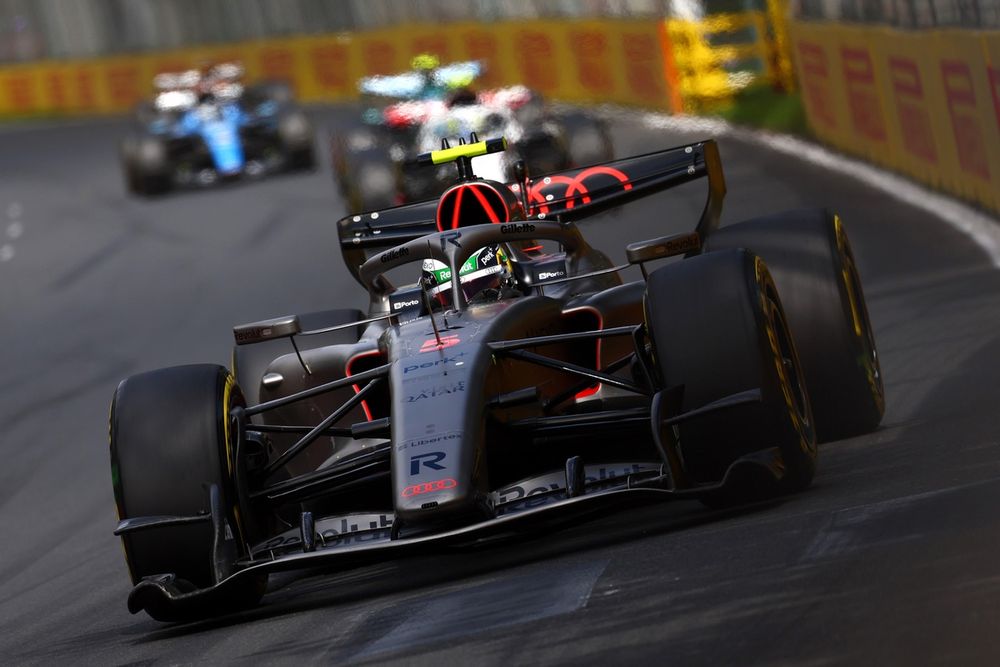
Bortoleto gave Audi something to smile about in its first F1 race
Photo by: Joe Portlock / Getty Images
Audi had agreed to make Sauber its works team all the way back in 2022, and had plotted a phased buyout over the next three years - it would take 25% control in 2023, another 25% in 2024, and a final 25% in 2025. But this perhaps demonstrated naivety; since Finn Rausing - majority shareholder through his Islero Investments company - would not own a majority stake in the team, it made little sense for the Swedish billionaire to put any more money into the team. Yet, Audi was not inclined to invest either until it owned the majority stake - and this left Sauber in the crossfire, treading water.
Without a resolution, and with track performance dwindling as investment in the team's infrastructure was not forthcoming, Audi decided to purchase the team outright - although later sold a 30% stake to the Qatar Investment Authority. Once Seidl and Hoffmann were gone, new Audi CEO Gernot Doellner - originally an F1 sceptic, as the move into the championship had been mapped out by his predecessor Markus Duesmann - merged their responsibilities and put Mattia Binotto in charge.
Understandably, Audi was not initially enthused by the idea of giving the team resources while it still remained Sauber - why invest in a team not even bearing its name? Yet, Binotto reasoned the contrary: if the team could receive investment now, improve its facilities and restart the largely inert development processes, it would have up-to-date tools honed through its development over 2025. This goes some way to explaining why Sauber made such great leaps over 2025, following a 2024 season in which the car was barely touched.
Adding Wheatley, complete with his experience from the Red Bull pitwall, was a colossal boon. Although too modest to say it himself, the Briton made an early impact at Sauber
The addition of Jonathan Wheatley as team principal added another missing element. When Fred Vasseur left to join Ferrari in 2023, Sauber's race operations had been headed up by Alessandro Alunni Bravi as "team representative", and head of trackside engineering Xevi Pujolar - there was no formal team principal until Wheatley arrived. In that period, the team was infamous for its desperately slow pit stops owing to teething problems with new equipment, and very nearly went through 2024 without scoring a point - until Zhou Guanyu got the team belatedly off the mark with eighth in Qatar.
Adding Wheatley, complete with his experience from the Red Bull pitwall, was a colossal boon. Although too modest to say it himself, the Briton made an early impact at Sauber: the aimless pit stops were now transformed into slick services that had begun to match those of the top teams. With the addition sporting director Inaki Rueda, a former colleague of Binotto at Ferrari, and performance director Stefano Sordo, Pujolar quietly left the team last year. Alunni Bravi moved to McLaren to head up its driver development programme.
That's part one of the puzzle: Audi's eventual investment under Binotto's direction ensured that the race operations had been overhauled and the technical structure, led by James Key, had also received investment. It hadn't had the backing to make its best-laid plans a reality until that point, but now had the means to put its plans into motion for 2026.

Audi revealed its F1 plans as early as 2022 - but its journey into the championship was hardly a smooth one
Photo by: Mark Sutton / Motorsport Images
Binotto and Wheatley set the team an ambitious task: get a car designed, built and running within the first couple of weeks of January before the shakedown. While that suggests that the team might have been compromised, as it could theoretically lose valuable days of gestation time before the final design was frozen, it implemented that task in stages: build a shakedown-spec car, and then spend longer refining the aerodynamics with a target of getting the additional parts to Bahrain. It met both targets, and the R26 logged its first laps in Barcelona on 9 January.
There was just the small matter of a powertrain to build. Audi had set up its F1 powertrain project in its Neuberg base in 2022 under the watch of Adam Baker, with Stefan Dreyer leading the design. Dreyer's background wasn't in F1, having been with Audi since 1999 and was a key part of its powertrain developments across DTM, Le Mans Prototype, and Formula E. Supported by a cast of engineers who had also worked across Audi's various motorsport programmes, spliced with new hires with F1 experience, the team's first F1 project was in the works.
Baker left in 2025, with his responsibilities split between Binotto and new chief operating officer Christian Foyer as the team sought to move onto the next step of integrating the Hinwil and Neuberg teams. It's been a continual evolution. Early infighting between Seidl - leading the Sauber side of the operation - and Hoffmann - leading the Audi side - was dealt with quickly and severely, quelling the ruckus with the addition of top-level F1 experience.
On joining the team, Binotto sought unity. His experience at Ferrari, known for having chassis and powertrain departments under one roof, was not practical for his new employer given the limitations of the Hinwil HQ. Thus, he sought the next best thing: dedicated conference rooms to keep the two facilities intertwined.
Winds of change swept through Audi's F1 project as it evolved. Although it wanted to stick by its own people, F1 experience carries significant weight. It's a tale as old as time: put the right people in the right places, and give them the power they need to shine.

Audi was the first F1 team to get its 2026 running on-track, two weeks before the official Barcelona shakedown
Photo by: Audi
What made Audi so impressive in Melbourne? From a chassis standpoint, the explanation is deceptively simple: on the face of it, Audi took a very good grand prix team in Sauber that had struggled for funding and momentum, put some money behind it, and let the team produce a car with more up-to-date infrastructure and tools. With Binotto overseeing the technical operations, it had someone who had vast experience with Ferrari in linking together simultaneous chassis and powertrain projects, and the addition of Wheatley turned a down-on-its-luck race team into a well-drilled, well-oiled machine.
But, as detailed above, it's not been quite that easy.
The R26 that emerged from Hinwil, complete with its unique sidepod package, appears to be a strong car. When accounting for average cornering speeds across the Australian Grand Prix, Bortoleto was clear of the rest of the midfield - and even a match for the Red Bull RB22 through the apex. Versus the other midfield cars, particularly the Haas and the Racing Bulls, the Audi was capable of running more consistently at a marginally higher pace.
"If someone told me we were going to score points in our first ever race and be in Q3, man, I wouldn't know if they were drunk or what" Gabriel Bortoleto
Had Bortoleto been able to take part in Q3 (and enjoyed a stronger start), it's not unreasonable to say that he might have had the better of Oliver Bearman and the impressive Arvid Lindblad. By the time Bortoleto caught Lindblad late on, it was at a phase of the race where overtaking had become more tricky owing to the convergence in deployment; thus, he couldn't quite make the Audi's marginally better through-corner pace work out.
There was a clear difference in the Lindblad-Bortoleto battle: Bortoleto had the stronger corner speed, but Lindblad had the legs on him during the straights. The deployment prowess of the Red Bull-Ford powertrain had been highlighted by Mercedes over testing, perhaps as a dead cat to detract from the ongoing compression ratio saga, but it had its roots in truth. The electrical components in Red Bull's debut turn as a powertrain manufacturer are efficient, and this grants the electric motor a little bit more capacity to harvest versus some of the other PU brands.
Audi isn't there yet, and it's a little bit down on power versus the likes of Mercedes, Ferrari, and Red Bull. Catch-up mechanisms through the "additional development and upgrade opportunities" (ADUO) system exist to bring parity between the marques on the grid, with reviews after each quarter of the season. This is something Audi should be able to make use of should the FIA find that the AFR 26 is missing a little bit of performance versus the more established entities.

Binotto and Wheatley have been major players in Audi's F1 preparation
Photo by: Andy Hone/ LAT Images via Getty Images
Hence the disparity. It should be much less of a burden for Audi when it comes to the less power-dependent circuits like Monaco, Hungary, and Singapore, although it may well have been able to wrangle some extra horsepower by the latter events.
Still, Bortoleto's result and the combined efforts of the two drivers across the Australia weekend indicate that Audi has potential. But many manufacturers have been here before, and were then derailed by boardroom indecision and a dogmatic approach to team ownership - you need only look at Jaguar and Toyota in the early 2000s for a masterclass in how to waste latent potential. For Audi's sake, its management must ensure that Binotto and Wheatley are given the support to call the shots, and resist the temptation to meddle. Thankfully, Audi's approach appears to remain sensible.
"If someone told me we were going to score points in our first ever race and be in Q3, man, I wouldn't know if they were drunk or what," Bortoleto reckoned in the aftermath of the Albert Park opener. "It was a bit tough at the beginning for us. A lot of problems, a lot of things happening. But the team has managed to put an incredible piece of art and deliver a great result.
"It's great to be fighting for points. We know how it was last year, even if the field was much tighter last year. Sometimes you did some great racing or laps and you were outside of the points by far. And now to be having a great race and be in the points, it's something great. Obviously, it's not enjoyable to be led by other teams still, but that's the current situation we are in. We're going to be fighting and working to reduce this gap and one day be fighting with them."
Start as you mean to go on, as they say - and Audi has started rather well indeed. Other manufacturers have not fared nearly as well...

The sky's the limit for Audi's F1 dreams
Photo by: Joe Portlock / Getty Images


Leclerc and Hamilton's differing theories behind Ferrari's Austin qualifying disappointment

What we learned from Friday practice at the 2026 United States GP

The reasons behind Ferrari's US GP upgrades

Mission control: Inside the FIA and F1's remote operations centre

FIA expects F1 races in Qatar and Abu Dhabi to run as planned

Why Piastri has struggled to show his best with this year's McLaren MCL40

Lights, Camara, action: How Haas picked F1's latest rookie for 2027

Horner's inside story of how Red Bull built its own F1 engine

MotoGP announces new start time for Australian GP after weather delays

Antonelli pole shows Mercedes is 'finally seeing the results' of car upgrades

Leclerc and Hamilton's differing theories behind Ferrari's Austin qualifying disappointment

Norris frustrated after United States GP qualifying: "I did a very bad job"
Subscribe and access Autosport.com with your ad-blocker.
From Formula 1 to MotoGP we report straight from the paddock because we love our sport, just like you. In order to keep delivering our expert journalism, our website uses advertising. Still, we want to give you the opportunity to enjoy an ad-free and tracker-free website and to continue using your adblocker.


Top Comments