


Are these the 50 quickest drivers in F1 history?
Who are the quickest drivers in Formula 1 history? LUKE SMITH asked a jury of experienced and international panel of experts and F1 insiders. Some of them have worked closely with F1’s fastest-ever drivers – so who better to vote on our all-time top 50? We’re talking all-out speed here rather than size of trophy cabinet, so the results may surprise you…
Each member of our jury was asked to select their 20 quickest (note, not ‘greatest’…) drivers from any point in the history of the F1 world championship, from 1950-2022. Their number one pick was awarded 20 points, number two got 19 points, and so on until 20th on their list received one point. While their exact selections remain anonymous, the collective results form a top 50 ranking.
The driver career statistics and fastest-lap ratio are based on actual number of race starts; pole ratio is taken from all qualifying sessions attempted; and qualifying performance against team-mates is based on times alone, regardless of whether they started the race. Events where drivers had no team-mate were discounted.
The jury
Frederic Vasseur, Gunther Steiner, Andrew Shovlin, Ricardo Musconi, Jody Egginton, Jack Aitken, Bernadette Collins, Karun Chandhok, Maurice Hamilton, David Tremayne, Will Buxton, Jennie Gow, Roberto Chinchero, Jonathan Noble, Ronald Vording, Christian Nimmervoll, James Allen, Kevin Turner, Matt Bishop, Andrew Benson, Tom Clarkson, Anthony Peacock.
50. Jenson Button (Great Britain)

Button took his first pole with BAR at Imola in 2004, where he led Schumacher's all-conquering F2004 early on
Photo by: Lorenzo Bellanca
GP starts: 306 (2000-2017)
Outqualified team-mate: 43% (133:176)
Fastest lap ratio: 3% (8)
Pole position ratio: 3% (8)
While not known for his qualifying prowess, Button was able to turn things on when the stars aligned. His 2009 title showed what he was capable of, but arguably even better was his stint at McLaren. Second behind the dominant Sebastian Vettel in 2011 was impressive, and he was untouchable at Spa in 2012. He was closer to Lewis Hamilton than many got, proving his critics wrong and increasing his standing among the quickest of the early 2010s.
49. Damon Hill (Great Britain)

Victory in the French GP was one of eight Hill managed on his way to the 1996 world title for Williams
Photo by: Motorsport Images
GP starts: 115 (1992-99)
Outqualified team-mate: 49% (59:61)
Fastest lap ratio: 17% (19)
Pole position ratio: 17% (20)
The under-rated (though not by our jury) Hill might have come to F1 relatively late in life, but he took full advantage of his opportunity with Williams. When everything was hooked up, he was hard to beat, being one of the few to say he took the fight to Michael Schumacher. Redemption for their Adelaide run-in came in 1996, while later hurrahs for Arrows (Hungary) and Jordan (Spa) showed his lasting quality.
48. Tom Pryce (Great Britain)

Pryce took pole for the 1975 British GP with Shadow, but the Welshman's death at Kyalami in 1977 meant his full potential was never realised
Photo by: David Phipps
GP starts: 42 (1974-77)
Outqualified team-mate: 56% (23:18)
Fastest lap ratio: 0% (0)
Pole position ratio: 2% (1)
Pryce spent his all-too-brief career with Shadow, a privateer lacking the might to properly compete at the front. It didn’t stop Pryce from starring, particularly in the wet, and taking a shock pole at Silverstone in 1975. Most tipped him as a future world champion: his dominant win at the Race of Champions in 1975 at Brands Hatch, against a field including Ronnie Peterson, Jacky Ickx and Jody Scheckter, was a sign of what could have been.
47. Francois Cevert (France)

Cevert was expected to take over from Stewart as Tyrrell's team leader until his fatal crash at Watkins Glen in 1973
Photo by: David Phipps
GP starts: 46 (1970-73)
Outqualified team-mate: 18% (9:41)
Fastest lap ratio: 4% (2)
Pole position ratio: 0% (0)
The heir-apparent to Stewart at Tyrrell, Cevert might not have quite matched the pace of his team-mate and great friend for much of their time racing together. But by his final season in 1973, he was a podium regular and shaping up to be a title contender, racing with precision and, importantly, speed. His tragic accident at Watkins Glen meant we never truly got to see just how good he could have been.
46. Jacky Ickx (Belgium)

Better known for his Le Mans successes, Ickx won eight times in F1 - including in the wet at Zandvoort with Ferrari in 1971
Photo by: Motorsport Images
GP starts: 114 (1967-79)
Outqualified team-mate: 40% (42:63)
Fastest lap ratio: 11% (13)
Pole position ratio: 11% (13)
There was a moment where Ickx looked set to take the 1970s by storm. Reliability cost him a proper shot at the title in 1970, a crown he said he was glad not to deny the late Jochen Rindt, before his heyday coincided with the Stewart/Tyrrell juggernaut being so hard to beat. Naturally quick and arguably F1’s first true rain-master, Ickx had much unfulfilled potential (thanks to poor career-move timing) which was thankfully realised at Le Mans.
45. Lando Norris (Great Britain)

Norris looked set to break his victory duck at Sochi in 2021 until a late rain shower hit
Photo by: Charles Coates / Motorsport Images
GP starts: 82 (2019-present)
Outqualified team-mate: 67% (55:27)
Fastest lap ratio: 6% (5)
Pole position ratio: 1% (1)
The reserved, understated vibe of Norris’s early years in F1 has given way to him becoming one of the brightest, steeliest talents on the grid right now. An even match for Carlos Sainz in their two years together before destroying Daniel Ricciardo, bagging himself a long-term McLaren deal. A shock pole in Sochi so nearly brought a first win, but it’s surely a matter of time. He’ll be higher on this list one day.
44. Masten Gregory (United States)

Gregory, pictured on his way to third aboard a Maserati 250F at the 1957 Monaco GP, was America's first truly great F1 racer
Photo by: Motorsport Images
GP starts: 38 (1957-1963, 1965)
Outqualified team-mate: 63% (30:18)
Fastest lap ratio: 0% (0)
Pole position ratio: 0% (0)
The ‘Kansas City Flash’ was so quick he was an idol for a young Jim Clark. Yet he often found himself in the wrong place at the wrong time, never landing the Ferrari seat which had prompted him to up sticks to Italy. Injuries blighted Gregory’s chances with top teams, but he held his own alongside Jack Brabham and Bruce McLaren at Cooper. He’d go on to enjoy greater success in sportscar racing, but was America’s first truly great grand prix driver.
43. Pedro Rodriguez (Mexico)

Rodriguez scored BRM's only win of 1970 at Spa
Photo by: Rainer W. Schlegelmilch / Motorsport Images
GP starts: 54 (1963-71)
Outqualified team-mate: 62% (32:20)
Fastest lap ratio: 2% (1)
Pole position ratio: 0% (0)
Never truly given the opportunity to shine in F1, Rodriguez showed how quick he was in his sportscar escapades with Ferrari and Porsche. But he was still one of the fastest F1 drivers of his era, matching Jochen Rindt in their time together at Cooper and winning only his ninth GP, at Kyalami. A wet-weather ace with no fear going for overtakes, Rodriguez had so much more to give before his death in 1971.
42. Rene Arnoux (France)

Arnoux scored 18 poles in his F1 career, but only twice converted that to victory - one of them came at Canada in 1983
Photo by: Ercole Colombo/Motorsport Images
GP starts: 149 (1978-89)
Outqualified team-mate: 50% (78:78)
Fastest lap ratio: 8% (12)
Pole position ratio: 12% (18)
Arnoux mounted a challenge to the likes of Gilles Villeneuve, Alain Prost and Nelson Piquet through his career; his speed yielded more poles than anyone from 1981-83. But this didn’t convert often enough into big results on Sunday, making seven wins a disappointing return. Infighting led to exits from Renault and Ferrari, leaving him to spend the final years of his career making up the numbers with Ligier – a far cry from his undeniably quick peak.
41. Robert Kubica (Poland)

Kubica somehow hustled the Renault R30 to second on the grid at Monaco in 2010 and wrestled it to third in the race
Photo by: Charles Coates / Motorsport Images
GP starts: 99 (2006-2010, 2019, 2021)
Outqualified team-mate: 47% (46:53)
Fastest lap ratio: 1% (1)
Pole position ratio: 1% (1)
A man whose full potential we sadly never got to see, due to injuries in a near-fatal accident ahead of the 2011 season. Kubica soared with BMW Sauber, spawning ‘Pole on pole’ headlines in Bahrain 2008 and sustaining an unlikely title bid until BMW shifted focus to its 2009 car. A future with Ferrari beckoned before his accident. The man who came closest to challenging Ferrari and McLaren at the height of their mid-noughties battle.
40. Daniel Ricciardo (Australia)

Red Bull was rarely quickest during Ricciardo's stint at the team, but he twice took pole at Monaco and after bad luck in 2016 converted it in 2018
Photo by: Zak Mauger / Motorsport Images
GP starts: 232
Outqualified team-mate: 54% (124:107)
Fastest lap ratio: 7% (16)
Pole position ratio: 1% (3)
The McLaren years may have dampened his reputation but, at his peak, Ricciardo was among the fastest on the grid, capable of pulling some magic laps out of the hat. His Monaco poles stand out and, while his wins may have been opportunistic – Red Bull was rarely, if ever, the fastest in his time there – all required him to seize the moment and not miss a beat: Baku, China and Monza were brutally fast days.
39. Dan Gurney (USA)

Gurney was the only driver the great Jim Clark feared
Photo by: Motorsport Images
GP starts: 86 (1959-70)
Outqualified team-mate: 67% (50:25)
Fastest lap ratio: 7% (6)
Pole position ratio: 3% (3)
The only driver Jim Clark truly feared on track. Gurney’s speed was evident from the very start of his career but he hopped from Ferrari to BRM to Porsche to Brabham, never staying in one place long enough to sustain the title challenge his speed deserved. He remained a force through the 1960s, scored Porsche’s only works F1 win in 1962, and is second only to Mario Andretti for American F1 victories.
38. Nico Rosberg (Germany)

Rosberg holds the honour of being the only team-mate of Lewis Hamilton's to beat him to the title, doing so in 2016 before his bombshell retirement
Photo by: Glenn Dunbar / Motorsport Images
GP starts: 206 (2006-2016)
Outqualified team-mate: 61% (126:80)
Fastest lap ratio: 10% (20)
Pole position ratio: 15% (30)
Rosberg benefitted from essentially being in a two-car battle through the final four years of his F1 career. But he managed to hold his own going toe-to-toe with Hamilton, one of the greatest of all time, especially over a single lap. Yes, he was the slower of the two, but not by much a lot of the time, and snared a title when the opportunity came his way. Especially good when factors such as rain weren’t a differentiator.
37. Jody Scheckter (South Africa)

That Scheckter's 1979 title success at Ferrari came against no lesser talent than Villeneuve underlines his speed
Photo by: Motorsport Images
GP starts: 111 (1972-80)
Outqualified team-mate: 48% (41:44)
Fastest lap ratio: 5% (5)
Pole position ratio: 3% (3)
Scheckter was labelled a “madman” by Emerson Fittipaldi after their collision at Paul Ricard in 1972, summing up the South African’s crash-strewn nature early in his career. But the speed was always there. He honed it, punching above his weight with Wolf before making it work, to the surprise of many, at Ferrari to win the 1979 title. Beating Villeneuve in the same team speaks volumes about Scheckter’s speed.
36. George Russell (Great Britain)

Russell outshone his Williams cars to earn his seat at Mercedes for 2022, and became a winner in Brazil
Photo by: Sam Bloxham / Motorsport Images
GP starts: 82
Outqualified team-mate: 81% (66:16)
Fastest lap ratio: 6% (5)
Pole position ratio: 1% (1)
Russell’s one-lap escapades in Formula 1 meant it didn’t take long for him to gain the ‘Mr Saturday’ tag from TV pundits. But it goes far beyond the numbers, impressive as they may be. He put the sluggish Williams on the front row in the damp at Spa with a wet-weather lap for the ages, and made his future stardom clear through year one at Mercedes. To be so close to Hamilton already is a very promising sign.
35. Graham Hill (Great Britain)

Five times a Monaco GP winner, Graham Hill (pictured en route to victory in 1969) had charm to go along with his speed
Photo by: Rainer W. Schlegelmilch / Motorsport Images
GP starts: 176 (1958-75)
Outqualified team-mate: 64% (109:62)
Fastest lap ratio: 6% (10)
Pole position ratio: 7% (13)
The first true media darling of Formula 1. Hill’s charm off-track was matched by his determination to succeed on it. He turned BRM around to win his first title and pulled Lotus out of its darkest hour following Jim Clark’s death to take his second crown in 1968. He may not have been on Clark’s level – but few were through the 60s. To excel so frequently in Monaco was proof of Hill’s greatness and sheer pace.
34. Jack Brabham (Australia)

Brabham's feat as the only F1 driver to win the title for his own marque is unlikely ever to be matched
Photo by: Motorsport Images
GP starts: 126 (1955-70)
Outqualified team-mate: 58% (63:45)
Fastest lap ratio: 10% (12)
Pole position ratio: 10% (13)
Brabham’s understated style meant he went under the radar compared with many of his contemporaries, but you don’t win three world titles – especially against the likes of Stirling Moss, Jochen Rindt and John Surtees – without the speed to back it up. Brabham’s technical prowess paved the way for him to drive his own team’s car to a title, a feat unmatched to this day, and he was winning races and taking poles in his final season at the age of 44.
33. Carlos Reutemann (Argentina)

Reutemann embraced his team leader role at Ferrari and won four times - including at Long Beach - to be the best non-Lotus driver in 1978
Photo by: David Phipps
GP starts: 146 (1972-82)
Outqualified team-mate: 61% (91:59)
Fastest lap ratio: 4% (6)
Pole position ratio: 4% (6)
Pole on grand prix debut? Par for the course for ‘Lole’, a driver with a case as one of the greatest never to win a world title, although he came close a few times. Regularly seen as a number two within his teams, he embraced the team-leader role at Ferrari when Niki Lauda quit and duly flourished. He’d come within a point of the crown in 1981, his speed displacing reigning champion Alan Jones as top dog at Williams.
32. Tony Brooks (Great Britain)

Tony Brooks came close to the F1 title in 1959
Photo by: Motorsport Images
GP starts: 39 (1956-61)
Outqualified team-mate: 48% (22:24)
Fastest lap ratio: 8% (3)
Pole position ratio: 8% (3)
A star of the 1950s whose speed impressed Enzo Ferrari, Brooks was referred to by Moss as “the greatest little-known driver of all-time.” How different it might have been had Brooks won the title in 1959, one he narrowly lost because of a promise he kept to himself not to drive substandard or damaged cars after previous crashes, prompting him to pit for checks after a lap-one knock in the season finale. It handed the title to Brabham.
31. Jean Alesi (France)

Alesi only ever won a single grand prix, at Montreal in 1995, despite his immense speed
Photo by: Motorsport Images
GP starts: 201 (1989-2001)
Outqualified team-mate: 61% (124:78)
Fastest lap ratio: 2% (4)
Pole position ratio: 1% (2)
Alesi is a perfect example of the difference between a quick driver and a great driver. He set F1 alight when he arrived on the scene, dicing with Senna for the win in just his ninth race. Yet he never converted his undeniable raw pace into solid results: his sole win came in 1995 at the Circuit Gilles Villeneuve, a driver to whom Alesi was frequently compared, albeit without the success to back it up.
30. Chris Amon (New Zealand)

Amon's Ferrari dream was plagued by reliability woes that meant he somehow never won a world championship grand prix
Photo by: David Phipps
GP starts: 96 (1963-76)
Outqualified team-mate: 68% (45:21)
Fastest lap ratio: 3% (3)
Pole position ratio: 5% (5)
His reputation as the greatest F1 driver never to win a race belies the speed of Chris Amon. The Kiwi raced in an era of stiff competition, and his boyhood dream of racing for Ferrari was dashed by constant reliability issues. He jumped ship to March at just the wrong time, meaning the breakthrough win never arrived. Luck was never on his side, but he commanded the respect of his rivals who regarded him among the very best.
29. Giuseppe Farina (Italy)

Giuseppe Farina became Italy's first F1 hero
Photo by: Motorsport Images
GP starts: 33 (1950-55)
Outqualified team-mate: 55% (34:28)
Fastest lap ratio: 15% (5)
Pole position ratio: 15% (5)
Formula 1’s inaugural champion was Italy’s first hero of the world championship era, claiming his title with Alfa Romeo before becoming a race winner with Ferrari. But his undeniable courage and speed sometimes blurred into a recklessness that would put both Farina and others at risk; Fangio said his one-time team-mate drove in a “crazy way.” One of the quickest through F1’s early years.
28. Juan Pablo Montoya (Colombia)

Montoya gave the all-conquering Schumacher/Ferrari combination something to think about, famously ambushing the German on only his third start at Interlagos in 2001
Photo by: Steven Tee / Motorsport Images
GP starts: 94 (2001-06)
Outqualified team-mate: 45% (43:52)
Fastest lap ratio: 14% (13)
Pole position ratio: 13% (12)
Montoya’s haul of poles and fastest laps is even more impressive given they were during the peak of the Schumacher/Ferrari era; seven of his poles came in 2002. Yet if Montoya’s panache and tenacity – the kind that moved him to dive up Schumi’s inside for the lead at Interlagos in only his third race – was matched by his work ethic, success may have been much greater. But there’s no denying his place in F1’s quickest this century.
27. James Hunt (Great Britain)

Hunt's laid back off-track personality didn't defy his speed on it - as he proved at the Nurburgring in 1976
Photo by: Motorsport Images
GP starts: 92 (1973-79)
Outqualified team-mate: 94% (50:3)
Fastest lap ratio: 9% (8)
Pole position ratio: 15% (14)
Hunt’s depiction in Rush as the antithesis to Niki Lauda’s calculated approach was accurate. With raw speed and instinct in bucketloads, Hunt punched above his weight at Hesketh before his McLaren title win, in a season where he was easily quickest over a single lap. His team-mate stats are skewed by a lack of real competition, but it should not detract from his status as one of the quickest pedallers of the 70s.
26. John Surtees (Great Britain)

Surtees remains the only racer to win world championships on two wheels and four at the highest levels
Photo by: Motorsport Images
GP starts: 111 (1960-72)
Outqualified team-mate: 76% (60:19)
Fastest lap ratio: 10% (11)
Pole position ratio: 7% (8)
His championship success on bikes was no guarantee Surtees could do the same in cars – yet he was arguably even better with twice the wheels at his disposal. A second and pole in his opening three GPs set the tone for the F1 success to follow, including the 1964 title with Ferrari. Falling-outs caused Surtees’ career to meander, ending partnerships with Lotus and Ferrari, the latter something he regretted. But no matter the car, he was rapid.
25. Keke Rosberg (Finland)

Keke Rosberg, easily the fastest of the name
Photo by: Motorsport Images
GP starts: 114 (1978-86)
Outqualified team-mate: 74% (82:29)
Fastest lap ratio: 3% (3)
Pole position ratio: 4% (5)
Rosberg’s knack for the spectacular earned him the reputation as F1’s first ‘flying Finn’, but it wasn’t until Alan Jones’s shock retirement that he got his shot at the big time with Williams. He grabbed it with both hands, winning the title in 1982 as he harnessed the aggressive style that made him so quick while delivering a consistency others couldn’t match. Still had it, even in his final year with McLaren.
24. Mario Andretti (USA)

Mario Andretti won Lotus' final F1 world title in 1978
Photo by: David Phipps
GP starts: 128 (1968-82)
Outqualified team-mate: 60% (70:47)
Fastest lap ratio: 8% (10)
Pole position ratio: 14% (18)
Andretti showed his speed in everything he got his hands on. Fifteen of his 18 poles came across 1977 and 78 with Lotus, the latter year yielding Andretti’s title with the dominant Lotus 79. To have been such an even match for Peterson across the garage spoke to Andretti’s quality, as did his ability to stick his car on pole both on debut at Watkins Glen in 1968 and in his penultimate race at Monza some 14 years later.
23. Nelson Piquet (Brazil)

Nelson Piquet's reputation as one of F1's fastest drivers has been tarnished by abhorrent comments made in 2022
Photo by: Motorsport Images
GP starts: 204 (1978-91)
Outqualified team-mate: 73% (149:55)
Fastest lap ratio: 11% (23)
Pole position ratio: 12% (24)
Piquet and Brabham were a formidable combination in the early 1980s, yielding two titles. He remained a force in qualifying even when the Brabham left much to be desired in 1984 and ’85. This prompted a move to Williams and a third championship, and he was still quick in his final years at Benetton. An acquired taste, whose abhorrent comments in 2022 rightly made him persona non grata in modern F1.
22. Emerson Fittipaldi (Brazil)

Emerson Fittipaldi, McLaren's first F1 world champion
Photo by: Sutton Images
GP starts: 144 (1970-80)
Outqualified team-mate: 65% (61:33)
Fastest lap ratio: 4% (6)
Pole position ratio: 4% (6)
A smooth and clinical style did nothing to detract from Fittipaldi’s scintillating pace, seen from early in his F1 career – he won his fourth race. He proved a potent force in the Lotus 72 and was F1’s youngest champion in 1972, a record that stood until Fernando Alonso’s first title. A similar harmony with the McLaren M23 delivered a second crown two years later. The family team fell flat, but Emmo’s speed was never in doubt.
21. Charles Leclerc (Monaco)

Charles Leclerc's win tally doesn't show the true picture of his speed
Photo by: Simon Galloway / Motorsport Images
GP starts: 103 (2018-present)
Outqualified team-mate: 68% (70:33)
Fastest lap ratio: 7% (7)
Pole position ratio: 17% (18)
Is there a faster qualifier in F1 right now? Leclerc may only have five wins, in part owing to Ferrari’s Sunday struggles, but his raw pace over a single lap cannot be disputed. He ended 2019 and 2022 – Ferrari’s only truly competitive seasons since he arrived – with more poles than anyone, and even snared a couple in 2021 despite the team’s woes. Given the right car, titles and records will inevitably follow for Leclerc.
20. Stefan Bellof (Germany)

Bellof's fatal sportscar accident at Spa in 1985 robbed F1 of one of its most exciting talents
Photo by: Motorsport Images
GP starts: 20 (1984-85)
Outqualified team-mate: 12:10 (55%)
Fastest lap ratio: 0% (0)
Pole position ratio: 0% (0)
Monaco 1984 might be remembered for Senna’s great arrival, yet it was also where Bellof made his mark as a future star, recovering from last on the grid to cross the line third. He’d been in karts just four years earlier. Outqualified Martin Brundle in their year together at Tyrrell, and would surely have harnessed his spectacular style and searing pace to achieve greater things had it not been for his death in a sportscar race at Spa in 1985.
19. Sebastian Vettel (Germany)

Sebastian Vettel was a real force in his Red Bull heyday
Photo by: Charles Coates / Motorsport Images
GP starts: 299 (2007-2022)
Outqualified team-mate: 64% (191:109)
Fastest lap ratio: 13% (38)
Pole position ratio: 19% (57)
Vettel’s later career exploits may have shifted perceptions over his speed, but there is no denying his greatness through the Red Bull heyday. The sight of Vettel in the garage at the end of Q3, knowing his ‘banker’ was good enough for pole, became a familiar sight, as did regular half-minute gaps to the field on Sundays. He would often set the fastest lap against his team’s wishes – just because he could.
18. Alberto Ascari (Italy)

Alberto Ascari was the first to take Ferrari to the F1 title
Photo by: Motorsport Images
GP starts: 32 (1950-55)
Outqualified team-mate: 78% (29:8)
Fastest lap ratio: 38% (12)
Pole position ratio: 44% (14)
To still hold the (now joint) record of nine consecutive wins in F1’s most unreliable and dangerous era points to the quality of Ascari. He stood out with his smooth, calculated – and blisteringly fast – approach. Ascari was Ferrari’s first champion and remains one of its favourite sons. His title years yielded 11 wins, 11 poles and 10 fastest laps across 14 races, a hit rate even Senna, Schumacher or Hamilton couldn’t match.
17. Kimi Raikkonen (Finland)

Raikkonen was deadly when he had the right car underneath him, and launched a strong title challenge in 2003 after netting his first win in Malaysia
Photo by: Motorsport Images
GP starts: 353 (2001-09, 2012-21)
Outqualified team-mate: 48% (168:184)
Fastest lap ratio: 13% (46)
Pole position ratio: 5% (18)
Might have needed the right car to unlock his very best, but boy was Räikkönen rapid when things clicked, perhaps best seen in 2005 even if reliability woes kiboshed his title hopes. The comeback with Lotus proved he’d lost none of his speed, signs of which remained towards the end of his second stint at Ferrari. Try finding a better specialist at Spa, a true sign of all-round rapidity.
16. Ronnie Peterson (Sweden)

Ronnie Peterson's speed earned him cult hero status
Photo by: David Phipps
GP starts: 123 (1970-78)
Outqualified team-mate: 71% (91:38)
Fastest lap ratio: 7% (9)
Pole position ratio: 11% (14)
Another name in the conversation of the greatest drivers never to win a title, Peterson arguably deserved the crown in 1973. Poor reliability meant nine poles translated to just four wins, leaving him third in the standings. He wouldn’t get another real chance at fighting for a title until 1978, where he was seen as the quicker half of the Lotus duo but lacked Andretti’s technical skills. F1’s ‘SuperSwede’ remains a cult hero, 44 years after his death.
15. Niki Lauda (Austria)

Niki Lauda's speed was never dampened even after his horror 1976 crash
Photo by: Motorsport Images
GP starts: 171 (1971-79, 1982-85)
Outqualified team-mate: 55% (98:79)
Fastest lap ratio: 14% (24)
Pole position ratio: 14% (24)
A world apart from most of his rivals through the mid-1970s, Lauda took nine poles in 1974 and 75, the latter spawning his maiden title. Post-accident, he’d lost none of his edge, even if the Brabham move proved ill-fated. His return to glory in 1984 came despite Alain Prost being the quicker of the McLaren drivers, yet Lauda could turn it on when it mattered, proved by his fightback at Estoril to clinch a third crown.
14. Jochen Rindt (Austria)

Rindt remains F1's only posthumous world champion
Photo by: Rainer W. Schlegelmilch / Motorsport Images
GP starts: 60 (1964-70)
Outqualified team-mate: 73% (47:17)
Fastest lap ratio: 5% (3)
Pole position ratio: 17% (10)
A beloved figure of his era, winning acclaim for his bravery behind the wheel through an all-too-short career. Rindt was a star in Formula 2 before finally showing his speed in his fifth F1 season upon joining Brabham. He was even better with Lotus in 1969, and completely untouchable the following year as he won five of the opening eight races. Tragically, he would lose his life at Monza at just 28, posthumously becoming world champion.
13. Nigel Mansell (Great Britain)

Nigel Mansell - Britain's fastest F1 driver?
Photo by: Motorsport Images
GP starts: 187 (1980-92, 1994-95)
Outqualified team-mate: 48% (91:98)
Fastest lap ratio: 16% (30)
Pole position ratio: 17% (32)
Mansell drove with heart and total confidence in his machinery throughout his career. He reached new heights with Williams in his championship year (1992), taking pole for 14 of the 16 races. His finest hour perhaps came at Silverstone when he gapped the field – including team-mate Riccardo Patrese – by almost two seconds in dry qualifying. He fought the likes of Nelson Piquet, Alain Prost and Ayrton Senna with bravado, and even won the adoration of the tifosi.
12. Alain Prost (France)

Prost's methodical approach netted plenty of accolades, although he was sometimes shown up in the qualifying stakes by Senna
Photo by: Sutton Images
GP starts: 199 (1980-91, 1993)
Outqualified team-mate: 67% (135:66)
Fastest lap ratio: 21% (41)
Pole position ratio: 17% (33)
Prost won against many of the names on this list – but he was firmly put in the shade by Ayrton Senna, particularly over a single lap. It changed perceptions of Prost, given their difference in styles, since the Frenchman’s methodical approach hardly screamed ‘quick’. Successful right through his career, his ability never appeared to wane. It allowed for a final blast with Williams in ’93 to win a fourth title. A driver who would be higher if this list ranked the greatest, not the quickest.
11. Fernando Alonso (Spain)
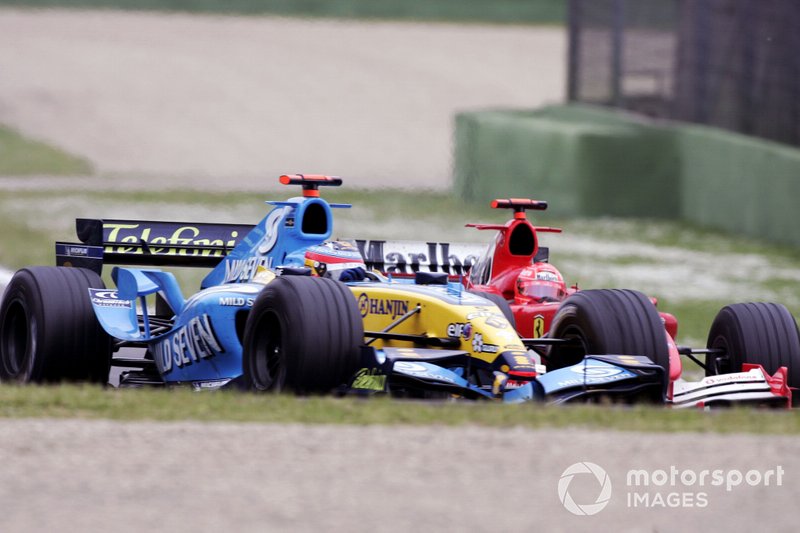
Fernando Alonso's best is perhaps too fast to only have won two world titles - here he holds off Schumacher on his way to victory at Imola in 2005
Photo by: Sutton Images
GP starts: 358 (2001, 2003-2018, 2021-present)
Outqualified team-mate: 72% (258:99)
Fastest lap ratio: 6% (23)
Pole position ratio: 6% (22)
If Ayrton Senna raced on instinct and Michael Schumacher through physical and technical mastery, then Alonso is a blend of the two. He dethroned Schumacher with titles in 2005 and ’06 before the fall-out at McLaren set the tone for a rollercoaster, title-less career since, often spent hauling substandard cars much further up the grid than they belong. Few argue that Alonso’s speed makes him one of the greatest, for all his foibles. Even last year he got the Alpine to the front row in Canada, having lost none of his sharpness. With the right car, a third title isn’t unfathomable.
10. Stirling Moss (Great Britain)

Stirling Moss deserved at least one world title given how fast he was
Photo by: Motorsport Images
GP starts: 66 (1951-61)
Outqualified team-mate: 71% (47:19)
Fastest lap ratio: 29% (19)
Pole position ratio: 24% (16)
No matter what Moss drove, he was quick. From dominating Formula 1 alongside Juan Manuel Fangio in the Mercedes ‘Silver Arrows’ to achieving great things for British manufacturers such as Vanwall, Cooper and Lotus, the fact Moss failed to win a title is one of racing’s great travesties. He was one of the few drivers to truly sustain success through the 1950s, never finishing lower than third in the standings from 1955-61. His Goodwood crash in ’62 ended a career that still had so much more to give, but his stats reflect just how good he was – especially when you consider the team-mates he was up against.
9. Mika Hakkinen (Finland)

Hakkinen is F1's ultimate 'Flying Finn' and delayed Schumacher's Ferrari glory years with his back-to-back titles in 1998 and 1999
Photo by: Rainer W. Schlegelmilch / Motorsport Images
GP starts: 161 starts (1991-2001)
Outqualified team-mate: 70% (116:49)
Fastest lap ratio: 16% (25)
Pole position ratio: 16% (26)
He’s the third Finn on the list, but Mika Hakkinen is the one we all know as the ‘Flying Finn’ for a reason. From outqualifying Ayrton Senna on debut for McLaren at Estoril to being Michael Schumacher’s fiercest competitor, Hakkinen fought against the very best and often came out on top, even if he only won two titles. He outclassed David Coulthard in their time together at McLaren, never losing their qualifying head-to-head. But Mika also had the ability to pull it out of the bag when it mattered in the races, seen no clearer than in his iconic pass on Schumacher at Spa in 2000.
8. Gilles Villeneuve (Canada)

Villeneuve is still rated highly over 40 years after his death at Zolder in 1982
Photo by: Motorsport Images
GP starts: 67 (1977-82)
Outqualified team-mate: 58% (40:29)
Fastest lap ratio: 12% (8)
Pole position ratio: 3% (2)
Villeneuve’s time in Formula 1 might have been tragically brief, yet he made such an impression his name sits among the greats. His approach was never to take it easy and build things up, instead working in the opposite way: go over the limit, then work your way back. It was a high-risk, high-reward approach, one that paid off as he trounced Ferrari team-mates Jody Scheckter and Didier Pironi in qualifying, both renowned for their pace. Find a picture of Villeneuve’s scarlet Ferrari emblazoned with #27, and you have the perfect image of what it meant to be fast in F1.
7. Jackie Stewart (Great Britain)

Jackie Stewart's speed took him to three world titles in F1
Photo by: Motorsport Images
GP starts: 99 (1965-73)
Outqualified team-mate: 80% (82:20)
Fastest lap ratio: 15% (15)
Pole position ratio: 17% (17)
We doubt there’s such a thing as a quick list in shooting, making JYS’s career change one for which we remain thankful. Stewart starred in F3 before getting his chance at the big time in F1, winning at Monza in his first season. It wasn’t until 1969 his first pole arrived but Stewart was never one to wring the neck of his cars. A smoother, more methodical approach paid dividends as he unlocked more and more pace, winning his first title in ’69. Reliability hurt his title defence before a move to Tyrrell set up the successful partnership that would take him to the end of his F1 career.
6. Juan Manuel Fangio (Argentina)

Fangio, F1's first true superstar, had a knack for being in the right cars at the right time to showcase his skill
Photo by: Motorsport Images
GP starts: 51 (1950-58)
Outqualified team-mate: 88% (51:7)
Fastest lap ratio: 45% (23)
Pole position ratio: 57% (29)
Arguably the first driver on the countdown with truly dizzying numbers. But that’s how much of a star Fangio was. Five world titles looked like an unbeatable landmark for decades.
Fangio was never in a race to make up the numbers. In two of his title years, of the races he finished he never crossed the line lower than second, and he had comparatively few incidents or crashes. He didn’t take crazy risks – he was so quick, he didn’t need to. Huge margins of victory were common, yet it was his fightbacks that showed how fearless Fangio was. At the Nurburgring in 1957, he recovered from losing almost a minute in the pits to beat the Ferraris of Mike Hawthorn and Peter Collins.
5. Max Verstappen (Netherlands)

Verstappen has already forged a reputation as one of F1's fastest drivers - and his career has a way to go yet
Photo by: Andy Hone / Motorsport Images
GP starts: 163 (2015-present)
Outqualified team-mate: 74% (120:42)
Fastest lap ratio: 13% (21)
Pole position ratio: 12% (20)
A game changer in F1 whose age forced rule rewrites – minimum age of 18 to get a superlicence – meaning his records may never be beaten. Impressed at 17 with Toro Rosso, justifying his early promotion to Red Bull, then holding off Raikkonen, Ricciardo and Vettel in his first race for his new team to become F1’s youngest winner. It was just the start.
In the shade of Mercedes’ domination, Verstappen ironed out the more erratic elements of his driving. Once he got a car ready to fight for a title in 2021 he took full advantage, defeating Hamilton. Last year was a story not only of his supremacy, but also growing maturity and completeness. Verstappen had it all: raw pace, good tyre management, assured overtaking. A record 15 wins in a season followed, going down as one of the most dominant in F1 history. Verstappen will only get quicker; a frightening prospect for a young man who has already achieved so much.
4. Michael Schumacher (Germany)

Schumacher's legend endures to this day, having rewritten the history books during his stunning career
Photo by: Steve Etherington / Motorsport Images
GP starts: 308 (1991-2006, 2010-12)
Outqualified team-mate: 75% (232:76)
Fastest lap ratio: 25% (77)
Pole position ratio: 22% (68)
It was clear what a special talent Schumacher was from the moment he put his Jordan seventh on the grid at Spa in 1991, as a late stand-in. The speed was always there, but what turned Schumacher into a true great with so many records to his name – some of which still stand – was his dedication to becoming the all-round package.
He redefined approaches to driver fitness, he built teams around him and worked on all the marginal gains that added up to make him, at his prime, unbeatable. The driving standards were questionable at times, yes, and it’s clear that during his comeback Michael wasn’t the force he used to be, pulling some of his numbers down. He might have lacked the natural gifts of those ahead on the list but, no matter the conditions, he excelled. He didn’t just win, but crushed the opposition, so strong was his hatred of losing.
3. Lewis Hamilton (Great Britain)

Lewis Hamilton's records of 103 pole positions - and the same number of wins - will be hard to topple
Photo by: Andy Hone / Motorsport Images
GP starts: 310 (2007-present)
Outqualified team-mate: 65% (202:108)
Fastest lap ratio: 20% (61)
Pole position ratio: 33% (103)
An instant revelation from his debut season in 2007, when he came within a point – or a better-judged strategy in China – of winning the championship as a rookie. Hamilton shook up the establishment and won a title at the second attempt but, as the years went by, the fit with McLaren didn’t quite work.
He gambled, as so many greats do, on jumping ship, and found in Mercedes the team with which he would write a new F1 history. Defeat to Rosberg in 2016 hurt but only fuelled Hamilton to reach new heights as he kept getting better with age. Like Schumacher, he took fitness seriously, going vegan and hailing the benefits. He bulked up when F1’s weight rules were relaxed and flourished, sweeping to four titles in a row to take his tally to seven.
But above all, Hamilton has raced fairly. Never did he put even a toeover the line when in battle, racing hard but fair – something that often couldn’t be said of the drivers he fought. Bar Ayrton Senna, there’s never been a better qualifier. And his race management is a skill often overlooked due to his raw speed. The greatest of his generation? Without question.
2. Jim Clark (Great Britain)

A regular sight in 1965 - Clark's victory at the French GP was his third on the trot. He'd win six on the spin en-route to a second world title
Photo by: Sutton Images
GP starts: 72 (1960-68)
Outqualified team-mate: 84% (63:12)
Fastest lap ratio: 39% (28)
Pole position ratio: 46% (33)
The 1960s was an era blessed with so many great drivers but none of them came close to Clark. His astonishing hit rate, all achieved while racing for a single team, Lotus, tells the story of just how far clear of the rest he was. Like Fangio, he was rarely in a race without a shot at winning it; he only finished a race in second place once, at Hockenheim in 1963 while battling engine issues. His march to the title that year was among the most dominant F1 has seen: he took seven poles and seven wins in the 10 races.
Clark achieved all of this without ever becoming reckless or looking like he was out of control, rarely having accidents or incidents, again like Fangio. Stewart hailed the smoothness with which his fellow Scot raced, noting that he never made an error or missed a beat.
The times when he didn’t win, more often than not, it was due to a reliability problem on his car or, as he faced in 1966, an uncompetitive car as opposed to his own lack of pace. That was never in the equation. A rare talent we should have seen so much more of, but what we did enjoy left an indelible mark.
1. Ayrton Senna (Brazil)

GP Racing's panel voted three-time champion Senna, pictured on his way to victory with an ailing McLaren at Spa in 1991, as the fastest F1 driver ever
Photo by: Rainer W. Schlegelmilch / Motorsport Images
GP starts: 161 (1984-94)
Outqualified team-mate: 89% (141:18)
Fastest lap ratio: 12% (19)
Pole position ratio: 40% (65)
It was never going to be anyone else. Senna embodied what it meant to be a quick Formula 1 driver, so often destroying the competition. Prost might have been the only team-mate to seriously give him a run for his money but, even then, in terms of outright pace, it wasn’t close: Senna outqualified him 14-2 through McLaren’s dominant 1988 campaign.
Even when he was lumbered with a car not capable of fighting for the championship – the early Lotus days, McLaren in 1992 and ’93 – he wrung every last second out of it, taking it far above where it deserved to be. That opening lap at Donington in 1993 was proof of the magic he could muster, his final year with McLaren arguably being his best in F1.
Senna was no angel. Unlike Hamilton, he went over the line with a ruthlessness that drew criticism. Yet he also drove with a kind of freedom, a purity, what he recognised as a spirituality, that unlocked a level of performance no driver in F1 history could match. Monaco qualifying in 1988, when he took pole by 1.4 seconds from Prost and claimed he had gone “beyond my conscious understanding”, was the epitome of that.

At his brilliant best, there could be no stopping Senna
Photo by: Rainer W. Schlegelmilch / Motorsport Images

How Ratzenberger beat the odds to realise his cruelly short-lived F1 dream

F1 uncovered: A weekend behind the scenes with a chief mechanic

When McLaren was pipped by Red Bull in a modern F1 classic

The big opportunity Sainz’s Williams switch affords to F1’s latest centurion

Inside the science of F1 fuel

How F1’s plan for rotating races could look in practice

The early decisions that set Sauber’s rookie for success

How F1 media coverage has evolved in line with its subject

Pryce pips McRae in final stage showdown to win British Rally Championship

Dakar Rally moves 2027 event out of Saudi Arabia; new location to be announced

How both Verstappen and Antonelli were “surprised” in United States GP qualifying

Inside COTA's Turn 1 clubhouse and its plans to build a second track
Subscribe and access Autosport.com with your ad-blocker.
From Formula 1 to MotoGP we report straight from the paddock because we love our sport, just like you. In order to keep delivering our expert journalism, our website uses advertising. Still, we want to give you the opportunity to enjoy an ad-free and tracker-free website and to continue using your adblocker.


Top Comments